



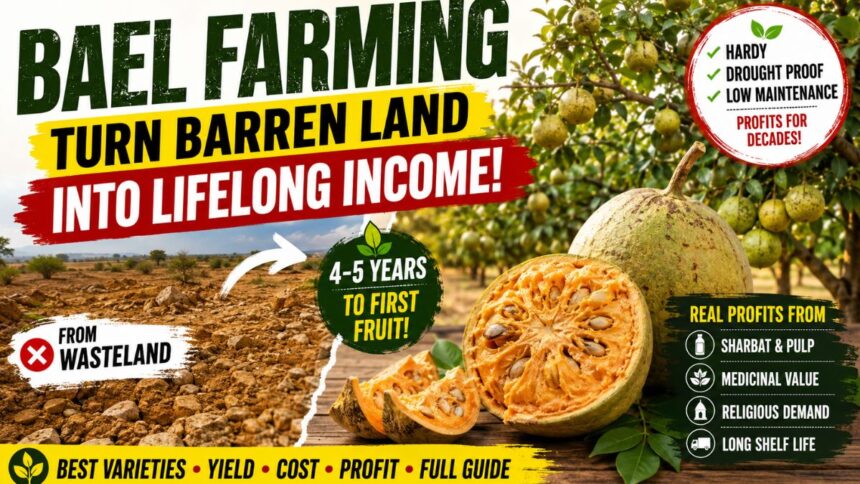
Bael Farming: If you have dry, salty, stony or degraded land that defeats every other fruit crop, bael (wood apple) may be the one tree that turns it into an orchard. This guide is for farmers and agri-entrepreneurs weighing bael honestly: what it really earns, why it’s a patient long-term crop rather than a quick cash one, and how to actually make money from a fruit whose real value isn’t on the fresh-fruit stall at all. No hype — just where bael genuinely fits.
- What makes bael different from every other fruit crop
- Is bael farming profitable?
- The honest positioning: what bael is and isn’t
- Where bael grows — its real superpower
- Choosing a variety — match it to your market
- How to grow bael
- Yield and the money — realistically
- Turning bael into real income
- Government support
- Is bael farming worth it?
- Frequently asked questions
What makes bael different from every other fruit crop
Bael (Aegle marmelos), also called wood apple, stone apple, Bengal quince or shriphal, is one of India’s oldest native fruit trees and is sacred in Hindu tradition, with its bilva leaves used in the worship of Lord Shiva. As a crop, three things set it completely apart from the fruit trees most farmers consider:
- It is astonishingly hardy. Bael tolerates severe drought, extreme heat, and even cold, and it fruits on poor, shallow, stony, saline and alkaline soils where mango, guava or citrus simply fail. It genuinely grows on marginal and near-desert land.
- Its fruit stores and travels well. Thanks to a hard, woody shell, bael doesn’t rot in days like most fruit. It can be transported long distances to processors and held far longer than a perishable crop — the exact opposite of a delicate vegetable.
- Its value is medicinal and religious, not just culinary. Bael is prized in Ayurveda for digestion (it’s traditionally called amrit phal and used for gut ailments), its pulp makes popular summer sharbat, and its leaves and fruit have steady demand for worship.
Understanding these three traits is the key to knowing whether — and how — bael can work for you.
Is bael farming profitable?
Bael farming can be worthwhile as a low-input, long-term crop, especially on dry, saline or marginal land where little else grows. Returns from fresh fruit alone are modest, and grafted trees take four to five years to bear. So the real earnings come from value addition, medicinal and religious demand, and the patience to let a very hardy, low-cost orchard mature.
The honest positioning: what bael is and isn’t
Let’s be straight about this crop, because the honest framing is what saves you from disappointment.
Bael is not a high-value cash crop in the way a premium vegetable or a spice can be. Sold as plain fresh fruit into a local market, bael brings modest, seasonal returns — one long-standing horticulture estimate puts the net return from selling fresh bael fruit at only a few tens of thousands of rupees per hectare a year. If you’re looking for quick or large per-acre profit, bael is the wrong crop.
What bael actually is is a low-cost, low-risk, low-maintenance, long-lived tree that produces steadily for decades on land that would otherwise earn nothing. Its economics work not because the fruit is expensive, but because the inputs are minimal, the risk is low, and the land it uses is often “free” — marginal ground with no better option. Add value through processing, or tap medicinal and religious demand, and modest fruit turns into a respectable income. Frame bael that way and it makes sense; expect a cash bonanza and it won’t.
Where bael grows — its real superpower
This is where bael earns its place. It thrives across an enormous range of conditions:
- Climate: It withstands intense heat and prolonged drought, and mature trees tolerate cold as well; it grows from the plains up to moderate hills. Importantly, bael needs a pronounced dry season to fruit well — it’s built for India’s hot, dry belts, not humid year-round wet zones.
- Soil: Sandy, loamy, clay, shallow, stony, saline and alkaline soils all suit it. It handles problem soils — high-pH, salt-affected, degraded — that rule out almost every other fruit tree, and it copes with both drought and occasional waterlogging better than most.
In practical terms, bael is a serious option for arid and semi-arid regions, salt-affected or degraded land, field bunds, and wasteland reclamation and agroforestry. If your problem is “nothing profitable will grow here,” bael deserves a look.
Choosing a variety — match it to your market
A key decision: are you growing for the fresh-fruit market or for processing? Improved varieties are bred for different purposes, so pick accordingly.
| Variety | Developed by | Best suited for |
|---|---|---|
| NB-5 (Narendra Bael-5) | NDUAT, Ayodhya | Fresh market — precocious, low mucilage and seed |
| NB-9 | NDUAT, Ayodhya | High yield and high sweetness (TSS) |
| Pant Shivani | GBPUAT, Pantnagar | Fresh — large fruit, good storage |
| Pant Urvashi | GBPUAT, Pantnagar | Fresh — heavy bearer, large fruit |
| CISH-B-1 / CISH-B-2 | ICAR-CISH, Lucknow | Processing — purpose-built |
| Goma Yashi | CHES, Godhra | Dwarf, spineless, early, large fruit |
| Thar Divya | ICAR-CIAH, Bikaner | Arid-region cultivation |
Choose fresh-market types like NB-5, Pant Shivani or Pant Urvashi if you’ll sell fruit, and processing types like the CISH varieties if you’re aiming at sharbat, powder or pulp. Confirm the best variety and source quality grafted planting material from ICAR-CISH, ICAR-CIAH or your state horticulture department before buying.
Also Read: Broccoli Farming in India: Profit, Cost, Price & Market Risks
How to grow bael
Propagation and planting
Use grafted or budded plants, not seed. Seedling trees are highly variable and take far longer to fruit; grafted plants come true to type and bear years earlier. Dig planting pits in the pre-monsoon months, enrich them with well-rotted farmyard manure, and plant with the onset of the monsoon so the young trees establish on natural moisture.
Spacing
Bael is planted at wide spacing — commonly around 6 to 7 metres — which fits roughly 70 to 100 trees per acre, though high-density planting with dwarf varieties allows more.
The long wait
Be clear about the timeline: grafted bael typically starts bearing in about four to five years, building to full production by around eight to ten years, after which it can crop for decades. Like any orchard, the early years are investment-only, so intercropping the wide young rows can help offset that period.
Care — genuinely minimal
This is bael’s best practical feature. Once established, it needs very little: light training and canopy management, occasional irrigation (it survives on very little), nutrition based on a soil test, and relatively little pest or disease pressure compared with most fruit trees. Some varieties can show fruit drop or cracking, which good variety choice and management help control. For a fruit orchard, the upkeep is about as low as it gets.
Yield and the money — realistically
A mature bael tree (ten years and older) can carry on the order of a hundred fruits, and a well-managed orchard may yield in the range of roughly 100–150 quintal per hectare — very roughly 40–60 quintal per acre — once the trees are in full bearing, with actual figures varying widely by variety, soil and management.
An illustrative planning frame (estimates only — verify locally):
| Item | Indicative figure (estimate) |
|---|---|
| Time to first bearing (grafted) | ~4–5 years |
| Trees per acre | ~70–100 at ~6–7 m spacing |
| Mature yield | builds to ~100 fruits/tree; ~40–60 quintal/acre |
| Fresh-fruit price | modest and seasonal |
| Ongoing maintenance | very low once established |
| Where the real value sits | processing, medicinal and religious demand |
The takeaway: bael’s return per kilo of fresh fruit is modest, but its return on effort and on otherwise-idle land can be genuinely good — precisely because it costs so little to grow and lasts so long.
Turning bael into real income
Because plain fresh fruit brings only modest, seasonal money, the growers who do well with bael think beyond the fruit stall:
- Value addition is the big lever. Bael pulp makes popular sharbat and squash, and it’s turned into powder, murabba, candy and ready-to-serve drinks. Processing multiplies the value of the same fruit and — helped by that hard, storable shell — smooths out the seasonal glut.
- Medicinal and Ayurvedic demand is real and steady; bael pulp and other plant parts feed the herbal industry, so a link to Ayurvedic or processing buyers can be more reliable than the open fruit market.
- Religious and seasonal niches exist too — bael fruit and bilva leaves have continuous demand around temples and festivals.
- The storability advantage means you can aggregate and send fruit to distant processors without the frantic race against spoilage that perishable crops face — a quiet but real marketing edge.
Line up at least one of these channels, ideally before your orchard comes into full bearing.
Government support
As a hardy horticulture and medicinal crop, bael can draw on several streams:
- MIDH and your state horticulture department support orchard establishment and planting material.
- ICAR-CISH (Lucknow) and ICAR-CIAH (Bikaner) are the key research institutes for improved varieties and quality planting material.
- The National Medicinal Plants Board (for the medicinal angle), NABARD-linked orchard loans with a gestation grace period, and wasteland-development or agroforestry schemes may also apply, given bael’s suitability for degraded land.
Support levels, eligibility and processes change and vary by state, so confirm current assistance through your district horticulture office before relying on it.
Is bael farming worth it?
For the right situation, bael is a genuinely smart, underrated crop. It turns dry, saline, stony or degraded land — ground that earns nothing otherwise — into a low-cost, low-risk orchard that produces for decades with minimal care. Its storable fruit avoids the perishability trap, and its medicinal, religious and processing demand gives you more than one way to earn. If you have problem land, patience, and ideally a value-addition or buyer plan, bael can be a quietly rewarding long-term asset.
But be honest about the downsides before you plant:
- It’s a long-term commitment — around four to five years to first fruit and longer to full bearing.
- Fresh fruit alone brings modest, seasonal returns — this is not a high-value cash crop as raw fruit.
- The fresh market is thin and seasonal, so real income usually needs processing, medicinal buyers or aggregation.
- It suits dry regions with a distinct dry season — not humid, year-round wet zones.
A sensible way in: plant grafted improved varieties matched to your market on land that has no better use, intercrop the early years, keep inputs low, and use the gestation period to build your processing or buyer plan. Approached that way — as a hardy, patient, value-added crop rather than a quick earner — bael rewards the farmers who understand what it actually is.
Frequently asked questions
How many years does bael take to bear fruit?
Grafted bael trees usually begin bearing in about four to five years and reach full production by roughly eight to ten years, after which they crop for decades. Seedling trees take considerably longer and give variable fruit, which is why grafted planting material is strongly preferred.
Can bael grow in saline or dry wasteland?
Yes — this is bael’s biggest strength. It tolerates drought, extreme heat, and poor, stony, saline and alkaline soils that defeat most fruit trees, making it one of the best options for arid regions and degraded or salt-affected land. It does, however, need a distinct dry season to fruit well.
Is bael farming profitable?
It can be, but as a low-input, long-term crop rather than a quick or high-value one. Fresh fruit brings modest seasonal returns; the better profits come from value addition like sharbat and powder, medicinal and religious demand, and the fact that it grows cheaply on land that would otherwise earn nothing.
What is bael fruit used for?
Bael pulp is eaten fresh and, more importantly, processed into sharbat, squash, powder, murabba and candy. It’s widely used in Ayurvedic medicine, especially for digestive health, and the fruit and leaves also have steady religious demand in Hindu worship.
Does bael fruit spoil quickly?
No — and this is a real advantage. Its hard, woody shell lets the fruit store and travel far better than most fruit, so you can send it to distant processors and manage the harvest without the rapid spoilage that perishable crops suffer.
Which bael variety is best?
It depends on your goal. For the fresh market, varieties like NB-5, Pant Shivani and Pant Urvashi are valued for eating quality and fruit size; for processing, the CISH varieties are purpose-built. Match the variety to your target market and confirm the choice with ICAR-CISH or your state horticulture department.