




Pig farming is among the most efficient ways to turn feed into meat and money — pigs breed prolifically, grow fast, and give quick returns on modest investment, which makes them a genuine opportunity for small and landless farmers. This guide is for anyone seriously considering it, and it gives the complete, honest picture: the breeds, the economics, exactly how to start — and the two hard realities that decide whether pig farming will work for you at all: where you can actually sell pork, and how you’ll survive African Swine Fever.
- Why pig farming is so efficient
- Is pig farming profitable?
- Two realities to check before you start
- 1. The market is regional
- 2. African Swine Fever is a serious, ongoing threat
- Also Read: Mango Farming Business: Does Exporting Really Pay ₹100/kg?
- Choosing a breed
- Housing and feed
- Biosecurity and disease — the part you cannot cut corners on
- How to start a pig farm, step by step
- The money — honestly
- Where and how to sell
- Government support
- Is pig farming worth it?
- Frequently asked questions
Why pig farming is so efficient
The appeal of pigs is real and grounded in biology:
- They multiply fast. A sow can farrow roughly twice a year with large litters of eight to twelve or more piglets, so your herd grows quickly.
- They grow fast on efficient feed. Pigs reach market weight in about eight to ten months and are among the most efficient livestock at converting feed into body weight.
- Low entry cost, quick returns. You can start small with modest capital and see money come back within months, not years — a big advantage over cattle.
- They use what others waste. Pigs can utilise kitchen waste, agricultural by-products and greens, which can cut feed costs (with an important disease caveat we’ll come to).
For a small or landless farmer wanting a fast-returning livestock venture, pigs are one of the strongest options on paper. But the paper case isn’t the whole story.
Is pig farming profitable?
Pig farming can be highly profitable because pigs breed prolifically, grow fast, and give quick returns on low investment. But pork is eaten only in certain regions of India, and African Swine Fever can wipe out a whole herd. So having a pork market near you and practising strict biosecurity matter more than anything else to your success.
Two realities to check before you start
Most “pig farming is super profitable” articles skip the two things that actually decide whether you should do it. Check these first.
1. The market is regional
Pork is not eaten everywhere in India. For cultural and religious reasons, a large part of the population doesn’t consume it, so demand is concentrated in specific regions and communities: the Northeast (Nagaland, Mizoram, Assam, Meghalaya, Manipur, Arunachal) has the highest pork consumption, along with Goa, Kerala, parts of Punjab, tribal and Christian belts, and premium urban and processed-pork segments in metros. If you are in or near one of these markets, demand is strong. If you’re not, pig farming becomes very hard, because pork can’t simply be sold anywhere the way chicken or eggs can. Confirm you have a real pork market within reach before anything else.
2. African Swine Fever is a serious, ongoing threat
This is the risk that has devastated real farmers in recent years, and you must go in understanding it. African Swine Fever (ASF), first reported in India in 2020, is a highly contagious viral disease with no vaccine and no cure and near-total mortality in infected pigs. The only response is culling and containment. Outbreaks have recurred across the Northeast — Assam saw major waves through 2021–2023 and a sharp resurgence in 2025 across many districts, with large numbers of pigs culled and farmers left carrying loans on wiped-out herds. The virus is highly resilient, spreads through animal movement, contaminated feed and secretions, and can destroy a herd almost overnight. This doesn’t mean don’t farm pigs — it means biosecurity isn’t optional, it’s the business.
Also Read: Mango Farming Business: Does Exporting Really Pay ₹100/kg?
Choosing a breed
Breed choice depends on whether you’re going commercial or low-input.
| Type | Example breeds | Notes |
|---|---|---|
| Exotic / crossbred | Large White Yorkshire, Landrace, Hampshire, Duroc | Fast-growing, large, higher feed and care needs; standard for commercial farms |
| Indigenous (desi) | Ghungroo, Niang Megha, Zovawk, Agonda Goan | Hardy, disease-resilient, thrive on scavenging and low input; smaller and slower-growing |
| Crossbred (desi × exotic) | Regional crosses | A balance of hardiness and growth |
For commercial, market-oriented farming, exotic and crossbred pigs are usual because of their growth and size; for low-input or backyard systems, hardy indigenous breeds suit better. Source healthy stock from a reputable, disease-free source, and confirm the best breed for your region and system with your veterinary department or ICAR’s pig research centre.
Housing and feed
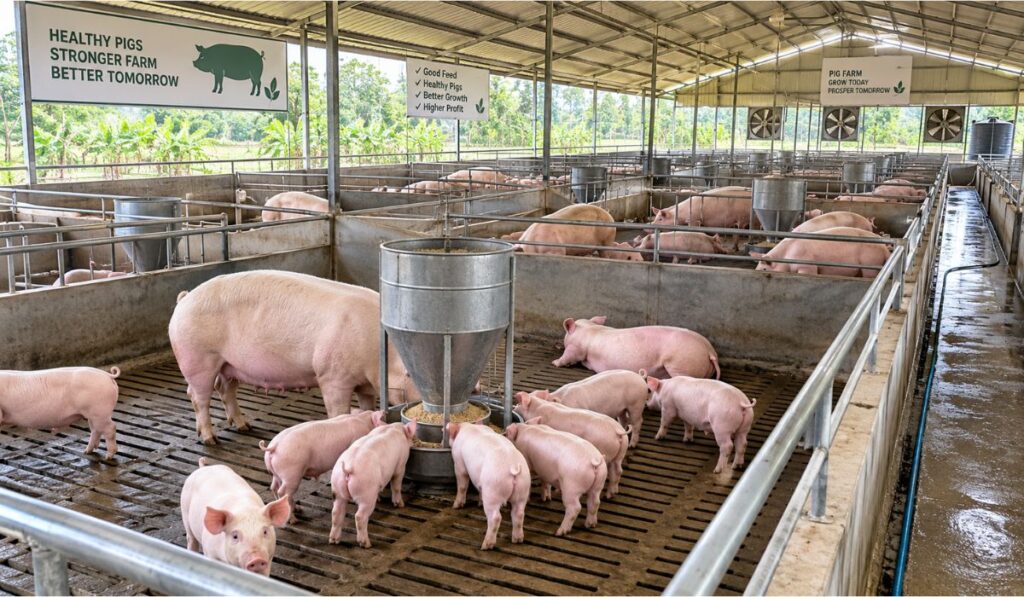
Housing: Build a clean, dry, well-ventilated sty with a solid floor and good drainage, adequate space per pig, and shade against summer heat. Site it away from residential areas — pig farms carry odour and waste, and local acceptance matters. Good housing directly reduces disease and improves growth.
Feed — your biggest cost: Feed typically accounts for the majority (roughly 60–70%) of running costs, so feed efficiency makes or breaks profitability. A balanced ration drives fast, healthy growth, and agricultural by-products and greens can reduce cost. One serious caution: feeding untreated kitchen or hotel waste (swill) is a known route for spreading African Swine Fever, so if you use waste feed, understand and manage that biosecurity risk carefully. Always provide clean drinking water.
Biosecurity and disease — the part you cannot cut corners on
Because ASF has no vaccine and no cure, and because other diseases like classical swine fever (CSF), foot-and-mouth disease (FMD) and brucellosis also threaten pigs, biosecurity is the single most important management skill in this business. The essentials:
- Vaccinate on the recommended schedule against preventable diseases like CSF and FMD (there is no ASF vaccine), and deworm regularly.
- Quarantine every new animal before mixing it with your herd, and isolate any sick pig immediately.
- Restrict outside visitors and vehicles, disinfect the farm, and control movement in and out.
- Be extremely careful with swill/waste feed, a known disease vector.
- Work with your vet or KVK, follow official advisories, and report suspected disease promptly.
Treat biosecurity as the core of the operation, not an afterthought — it is what stands between you and a wiped-out herd.
How to start a pig farm, step by step
1. Confirm your market first. Is there genuine pork demand within reach? If not, stop here — this is the make-or-break feasibility check.
2. Write a business plan and pick your model. Decide between breeding (selling piglets), fattening (raising to market weight), or farrow-to-finish, and between intensive, semi-intensive or scavenging systems, at a scale you can manage.
3. Choose your breed and source healthy stock from a reputable, disease-free supplier.
4. Build proper housing — dry, ventilated, well-drained, adequately spaced, sited away from homes.
5. Set up feed and water. Plan a balanced ration, supplement sensibly with by-products, and manage the swill biosecurity risk.
6. Put biosecurity and a health calendar in place — vaccination, deworming, quarantine, disinfection, vet linkage — before problems arise, not after.
7. Manage breeding to get roughly two litters a year from each sow.
8. Plan waste management. Pig manure has value as fertiliser or biogas feedstock, and larger units must meet pollution norms.
9. Get licensed. Obtain the required pig-farm registration/permissions from your local body and state animal husbandry department, plus FSSAI registration for selling meat, and pollution clearances for larger units [VERIFY: confirm current licensing and FSSAI requirements for your state and scale].
10. Line up your sales channels and keep records, then scale gradually once you’ve proven you can manage feed, health and market.
The money — honestly
On the revenue side, live fatteners have recently sold in the range of roughly ₹130–150 per kilogram, so a market-weight pig of around 100 kg fetches on the order of ₹13,000–15,000 live, with dressed pork retailing higher in strong markets. A small unit of around ten pigs might need roughly ₹1.5–2.5 lakh to set up, with returns coming in months rather than years.
The margins can genuinely be good — but they hinge on three things: feed cost and feed-conversion efficiency, avoiding disease loss, and having a market. The viral “earn ₹5–10 lakh a year, guaranteed” figures assume disease-free herds, cheap feed, good growth and reliable sales all at once. The reality of recent years — entire herds culled by ASF, farmers left repaying loans on dead stock, and subsidy payments delayed — is the cautionary other side of those numbers. Plan conservatively, insure where you can, and never bet money you can’t afford to lose to an outbreak.
Where and how to sell
Your channels include live sale to traders, butchers and slaughterhouses; direct sale to households in pork-eating communities; hotels and restaurants (strong in the Northeast, Goa and urban centres); meat processors; and retail pork shops. Value addition — processed pork like sausages, bacon and ham — is a premium opportunity where you have the market and the compliance for it, and it can lift margins well above selling live animals. As with every livestock business, reliable buyers close to your farm are worth more than a distant premium.
Government support
Pig farming has real institutional backing:
- The National Livestock Mission (NLM), under the Department of Animal Husbandry and Dairying, supports piggery entrepreneurship with capital subsidy for breeding units (commonly cited at up to 50%), delivered with bank credit.
- State animal husbandry departments, NABARD-linked loans, and dedicated Northeast piggery development schemes also support the sector.
Two honest notes: subsidy rates, caps and eligibility change and vary by state, so confirm the current position before relying on them — and be aware that, in practice, subsidy disbursement has sometimes been delayed, leaving farmers to service loans in the meantime. Don’t build a plan that only works if the subsidy arrives exactly on time.
Is pig farming worth it?
For the right farmer in the right place, pig farming is one of the most efficient and fast-returning livestock businesses in India. Pigs multiply and grow quickly, need modest capital, can use low-cost feed, and serve a strong, if regional, pork market — and government schemes support the sector. In a pork-consuming region, run with discipline and tight biosecurity, it can genuinely transform a small farmer’s income.
But be honest about the downsides before you commit:
- The market is regional. Without pork demand within reach, it doesn’t work.
- African Swine Fever is a real, herd-wiping threat with no vaccine or cure — biosecurity is existential.
- Feed is the biggest cost, and thin feed efficiency erodes profit fast.
- The viral profit figures are best-case, ignoring disease loss and subsidy delays.
- Odour, waste and local acceptance need managing.
The smartest way in is to confirm your market first, start small, choose the right breed, build proper housing, and treat biosecurity and animal health as the heart of the business rather than an afterthought. Done that way, in the right region, pig farming rewards disciplined farmers — but it punishes anyone who underestimates disease or the market.
Frequently asked questions
Is pig farming profitable in India?
It can be very profitable because pigs breed prolifically, grow fast and give quick returns on low investment. But profitability depends heavily on having a pork market nearby, keeping feed costs efficient, and avoiding disease loss — especially African Swine Fever, which can destroy a whole herd. It’s rewarding in the right region, risky in the wrong one.
Which pig breed is best for farming in India?
For commercial farming, exotic and crossbred breeds like Large White Yorkshire, Landrace, Hampshire and Duroc are popular for fast growth and size. For low-input or backyard systems, hardy indigenous breeds like Ghungroo suit better. Crossbreds of desi and exotic pigs balance hardiness with growth; confirm the best fit for your region.
Where is there a market for pork in India?
Demand is strongest in the Northeast — Nagaland, Mizoram, Assam, Meghalaya, Manipur and Arunachal — along with Goa, Kerala, parts of Punjab, tribal and Christian communities, and premium and processed-pork segments in metros. Because pork isn’t consumed everywhere, confirming a real market near you is the first thing to check.
What is African Swine Fever and can it be treated?
African Swine Fever is a highly contagious viral disease of pigs with no vaccine and no cure, and it kills almost all infected animals. The only response is culling and strict containment. It has caused major herd losses in India, especially the Northeast, which is why biosecurity — quarantine, restricted movement, disinfection and careful feeding — is essential.
How much does it cost to start a pig farm?
A small unit of around ten pigs may need roughly ₹1.5–2.5 lakh, while larger commercial farms cost much more, offset partly by subsidy. Costs vary widely by breed, scale, housing and location, and feed is the largest ongoing expense, so build a careful, region-specific budget before starting.
Do I need a licence for pig farming?
Yes. You’ll generally need registration or permission from your local body and state animal husbandry department, FSSAI registration to sell meat, and pollution clearances for larger units. Requirements vary by state and scale, so confirm the current rules with your local authorities before setting up.