



If you’re thinking about planting amla (Indian gooseberry) as a long-term orchard, thiamlas guide is for you — the farmer or agri-entrepreneur weighing a crop you’ll live with for decades, not one season. We’ll cover where amla actually grows well, how long before it earns, what the trees cost to establish, and the honest reason so many amla growers struggle: not with the tree, but with the price of raw fruit.
- Why amla is worth considering (and why demand is real)
- Is amla farming profitable?
- The one thing to understand before you plant
- Where amla grows and why it suits tough land
- Choosing varieties and why you need more than one
- Establishing the orchard
- What to expect from yield and when
- Why raw amla often disappoints
- Marketing and a serious word on “buy-back” offers
- Government support for amla orchards
- Is amla farming worth it?
- Frequently asked questions
Why amla is worth considering (and why demand is real)
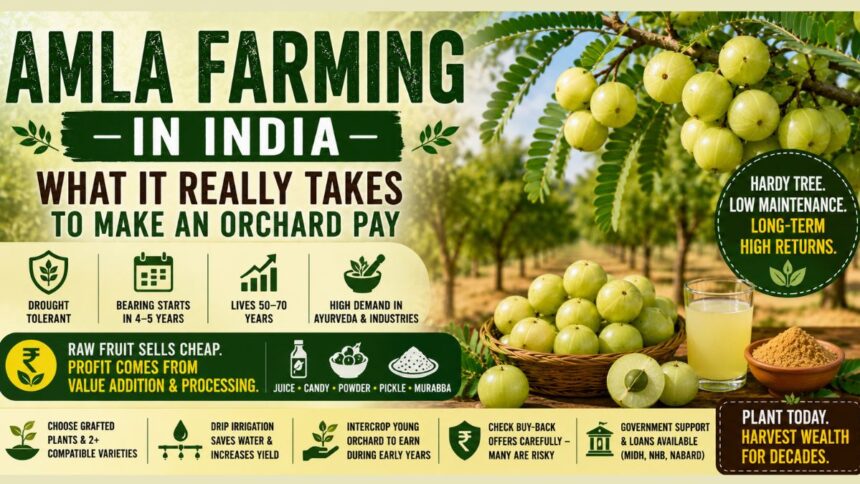
Amla — also called aonla, nelli, or Indian gooseberry (Emblica officinalis / Phyllanthus emblica) — is one of the hardiest fruit crops you can plant. It shrugs off drought, tolerates poor and alkaline soils, handles heat, and, once established, a single tree can keep bearing for 50 to 70 years.
Demand is genuine and broad. Amla is the backbone of Ayurvedic staples like Chyawanprash and Triphala, and it feeds the hair-oil, cosmetics, nutraceutical, and food-processing industries as juice, powder, candy, murabba, and pickle. That’s a wide, growing market — but note the important word: most amla is consumed after processing, not as fresh table fruit. That single fact shapes the entire economics, as we’ll see.
Is amla farming profitable?
Amla farming can be profitable, but it’s a long-term orchard, not a quick crop. Grafted trees take about four to five years to start bearing, and raw fruit often sells cheap in the mandi — so real profit usually comes from value addition or a secured buyer, plus the patience to wait out the establishment years.
The one thing to understand before you plant
Amla is a perennial orchard crop with a long gestation. This is the single most important trade-off, and it’s different from any annual crop.
You will invest money and care for roughly the first four years and earn nothing from the trees in that period. Grafted plants typically begin bearing around the fourth or fifth year, and yields keep climbing for several years after that before stabilising. In return, a well-kept orchard can then produce for decades.
So amla is not a crop you plant to fix this year’s cash flow. It’s a patient-capital decision: you’re locking up land and money now for a payoff that starts years later and then runs long. If that horizon doesn’t suit your finances, stop here — no amount of good farming changes the timeline.
Where amla grows and why it suits tough land
This is where amla shines. It is remarkably adaptable and forgiving:
- Climate: Thrives in dry and semi-arid regions, tolerates high summer temperatures, and handles conditions that stress most fruit trees. It grows across a wide belt from the plains up to moderate altitudes.
- Soil: Adapts to a broad pH range (roughly 6.0–8.0) and even tolerates some alkalinity and salinity — soils where many crops fail. Deep, well-drained loam gives the best production, but the tree survives on far less.
- Water: Drought-hardy once established. It responds well to irrigation but doesn’t demand it the way delicate fruit crops do.
Amla is grown across Uttar Pradesh (Pratapgarh is a well-known amla belt), Rajasthan, Madhya Pradesh, Gujarat, Maharashtra, and parts of southern India. If you have marginal, dry, or alkaline land that won’t support premium horticulture, amla is one of the few orchard crops genuinely built for it.
Also Read: Isabgol Farming Looks Highly Profitable – Until One Week of Rain Changes Everything
Choosing varieties and why you need more than one
Here’s an agronomy point beginners often miss: amla needs cross-pollination for good fruit set, so you should plant at least two compatible varieties together. A single-variety block will disappoint you.
| Variety | Notes |
|---|---|
| Banarasi | Old, popular type; large fruit but irregular bearing |
| Chakaiya | Hardy, heavy and regular bearer, smaller fruit; widely grown |
| Krishna (NA-5) | Improved, good size and quality |
| Kanchan (NA-4) | Improved, prolific bearer, good for processing |
| NA-6, NA-7, NA-10 | Improved selections with good yield and quality |
| Francis (Hathijhool) | Large fruit, but can be prone to fruit issues |
Choose a main heavy-bearing variety plus a compatible pollinator, and buy grafted (budded or softwood-grafted) planting material — never seed. Seedling trees give poor, variable fruit and a much longer wait. Confirm the best variety combination and a certified nursery source with your state horticulture department or ICAR-CISH before buying.
Establishing the orchard
Spacing and planting
Pits are usually dug in the pre-monsoon months (around May–June), left open to sun for a couple of weeks, then filled with topsoil mixed with well-rotted farmyard manure. Grafted saplings are typically planted with the onset of the monsoon so young roots get natural moisture to establish.
At a standard spacing of around 8 metres, you’ll fit roughly 100 trees per acre; closer or hedge-row planting fits more but needs tighter management. Fix your spacing to your soil, water and long-term plan.
The first few years
This is make-or-break. Young amla plants need protection from harsh summer heat and cold, regular watering while establishing, mulching to conserve moisture, and careful training of the framework. Losses in year one usually come from neglect during the first hot season, not from any disease.
Put the empty years to work: intercropping
Because rows sit wide and the canopy is small for years, you can intercrop young amla orchards with short-duration vegetables, pulses, or suitable medicinal crops to earn something while the trees mature. Done sensibly, this offsets part of the gestation-period cost — just don’t compete with the young trees for water and nutrients.
Ongoing care
Drip irrigation is well worth it: it saves water and labour and suits amla’s root zone. Base fertiliser doses on a soil test rather than a fixed formula, feed the trees more as they mature, and keep an eye out for pests and fruit problems, following locally approved measures. Compared with most fruit crops, amla’s routine upkeep is genuinely low.
What to expect from yield and when
Yields build gradually. The numbers below are illustrative ranges to show the shape of the curve, not guarantees — actual yield depends heavily on variety, spacing, soil, water and management.
| Orchard age | Fruit per tree (approx) | What’s happening |
|---|---|---|
| Years 1–3 | Negligible | Establishment — cost, no fruit income |
| Years 4–5 | A few kg, rising | First bearing begins |
| Years 6–8 | Building steadily | Yield ramps up |
| Year 8+ (mature) | Up to around 1 quintal per tree | Full, stable production for decades |
The headline to remember: real, full income arrives late — and then it can continue for a very long time.
Why raw amla often disappoints
Now the part most “amla is super-profitable” articles skip. Fresh, raw amla is a bulky, perishable, low-value product in its unprocessed form, and its mandi price swings a lot. In recent seasons, wholesale rates have ranged widely — often somewhere in the low tens of rupees per kilo, sometimes higher, occasionally much lower in a glut.
If you plant a large orchard, harvest tonnes of fruit, and then try to dump it fresh into the local mandi at peak season, you can find the price barely covers your picking and transport. That is the real risk in amla — not growing it, but selling raw fruit into a thin fresh market.
The money is in one of three places instead:
- Value addition. Amla candy, murabba, juice, dried powder, and supari sell for far more than raw fruit, and processing also solves the perishability problem. This is where serious amla income lives.
- A secured buyer or processor contract arranged before you scale, so your fruit has a home at a known price.
- Aggregation and grading, selling clean, graded fruit to processors rather than mixed lots at the spot mandi.
An illustrative first-year establishment cost, per acre, to plan around (estimates only — they vary widely by region and choices):
| Item | Indicative range (estimate) |
|---|---|
| Grafted saplings (2+ varieties) | ₹8,000–20,000 |
| Pit preparation, FYM, planting | ₹10,000–20,000 |
| Drip irrigation (optional, recommended) | ₹30,000–45,000 |
| First-year labour, weeding, protection | ₹10,000–15,000 |
Treat these as a starting checklist, not a quote. Remember to also budget for the ongoing upkeep across the non-earning years — that carrying cost is the part first-timers forget.
Marketing and a serious word on “buy-back” offers
Some companies sell amla saplings bundled with a buy-back guarantee, promising to purchase your future fruit at an attractive rate. Some are legitimate; many are not. Farmers have been burned by inflated sapling prices, vague or unenforceable agreements, and buyers who vanish or refuse the crop years later.
Be blunt with yourself here: a promise on paper about a price four or five years in the future is only as good as the company behind it. If you consider such an offer, get the agreement examined by a lawyer, check the company’s track record with existing growers, be wary of overpriced planting material, and never treat a buy-back as a substitute for understanding your own real market. When in doubt, plant, then build your own buyer relationships and value-addition plan.
Government support for amla orchards
Amla is a horticulture crop, so orchard establishment can fall under horticulture development support — commonly the Mission for Integrated Development of Horticulture (MIDH) and schemes run through your state horticulture department and the National Horticulture Board (NHB), which may assist with planting material, drip irrigation, and orchard development.
Because amla has a gestation period, orchard/plantation loans through banks and NABARD — which build in a repayment grace period — are also worth exploring to fund the early non-earning years. Support levels, eligibility and processes change and vary by state, so confirm current rates and apply through your district horticulture office.
Is amla farming worth it?
For the right grower, amla is a strong long-term asset. It turns dry, marginal, alkaline land into a productive orchard that can pay for decades with modest upkeep, and it plugs into a large and growing processing-driven market. If you own suitable tough land, can wait out the establishment years, and — crucially — plan for value addition or a real buyer, it’s a genuinely sound choice.
But go in clear-eyed about the downsides:
- Long gestation. Roughly four to five years of cost with no fruit income.
- Raw fruit is low-value and perishable. Selling fresh into a glut can barely cover costs; the profit is in processing or a secured market.
- You must plant multiple varieties for proper pollination and fruit set.
- Capital is locked up for years before returns begin.
- “Buy-back” plantation offers carry real scam risk and need careful scrutiny.
A sensible way in: start with a manageable block, plant certified grafted saplings of two compatible varieties, intercrop the empty years, and use the establishment period to line up your processing plan or buyer — so that when the trees finally bear, you’re selling into value, not dumping into a glut.
Frequently asked questions
How many years does amla take to give fruit? Grafted amla trees usually begin bearing around the fourth or fifth year, with yields building for several years afterwards before stabilising. Seedling trees take even longer and give poorer fruit, which is why grafted planting material is strongly preferred.
Is amla farming profitable per acre?
It can be, but not from raw fruit alone and not quickly. Profitability depends far more on your selling strategy — value addition or a secured buyer — than on yield, because fresh amla often fetches low mandi prices, especially in a glut.
Why do I need to plant more than one amla variety?
Amla depends on cross-pollination for good fruit set, so a single-variety orchard tends to bear poorly. Planting a heavy-bearing main variety alongside a compatible pollinator variety gives far better yields.
Why is raw amla so cheap sometimes?
Fresh amla is bulky, perishable, and mostly bought by processors rather than eaten fresh, so a large harvest hitting the mandi at peak season can crash the price. This is exactly why value addition — candy, juice, powder, murabba — matters so much for amla income.
Does amla suit dry or poor-quality land?
Yes — this is one of its biggest strengths. Amla tolerates drought, heat, and alkaline or marginal soils where many fruit crops fail, making it a strong option for tough land, though deep well-drained soil still gives the best yields.
Can I get a subsidy or loan for an amla orchard?
Possibly. As a horticulture crop, amla may qualify for support through MIDH, the National Horticulture Board, and state horticulture schemes, while NABARD-linked orchard loans can help fund the non-earning years. Confirm current rates and eligibility with your district horticulture office before you count on any figure.