




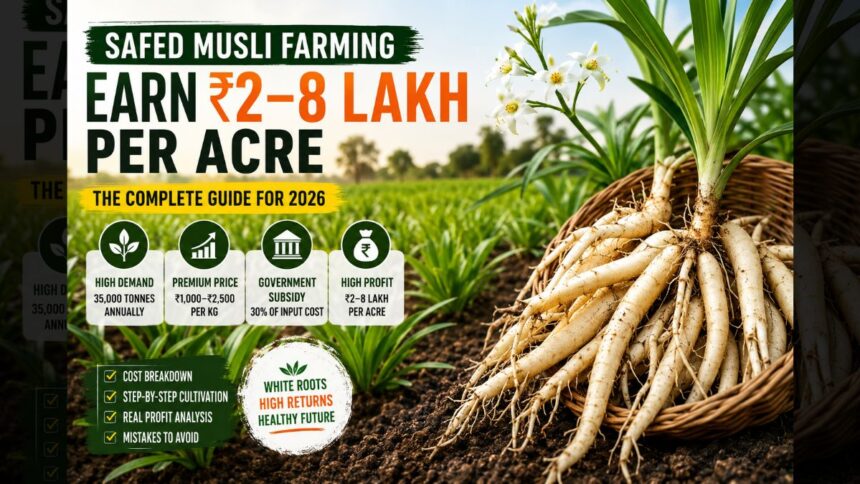
Most Indian farmers earning ₹30,000–₹40,000 per acre from wheat and soybean have no idea that a white-rooted medicinal herb growing in the same soil can fetch them ₹2–₹8 lakh from that exact same piece of land.
- What Is Safed Musli?
- Why Safed Musli Farming Is a Big Opportunity in 2026
- Safed Musli Farming Cost Breakdown Per Acre (2026)
- Safed Musli Farming Profit Per Acre — Realistic Numbers
- Agro Potli Daily Farm Expense Tracker
- Real Success Story: Ram Charan Patidar, Dewas, Madhya Pradesh
- Step-by-Step Safed Musli Cultivation Guide
- Step 1: Choose the Right Climate and Soil
- Step 2: Land Preparation (April–May)
- Step 3: Selecting and Treating Planting Material
- Step 4: Sowing (June–August)
- Step 5: Fertilization and Manuring
- Step 6: Irrigation
- Step 7: Weeding
- Step 8: Harvesting (September–October)
- Step 9: Post-Harvest Processing
- Where to Sell Safed Musli in India
- Government Support and Subsidies for Safed Musli Farmers
- Expert Tips for Maximum Profit from Safed Musli Farming
- Common Mistakes That New Safed Musli Farmers Make
- Safed Musli vs. Traditional Crops: The Income Comparison
- Is Safed Musli Farming Worth It in 2026?
- FAQs About Safed Musli Farming in India
That herb is Safed Musli — and Safed Musli farming is one of the most under-discussed, high-reward agricultural opportunities available to Indian farmers right now.
The demand for Safed Musli is estimated at 35,000 tonnes per annum in India while the present supply is only about 5,000 tonnes per annum. That gap between demand and supply tells you everything. The buyers are waiting. The market exists. What is missing is farmers who grow it correctly.
This guide gives you everything — the real costs, realistic profits, step-by-step cultivation, and the mistakes that kill this crop before it even gets started.
What Is Safed Musli?
Safed Musli (Chlorophytum borivilianum) is a tuber crop belonging to the family Liliaceae. There are about 256 species of Chlorophytum and 17 among them are found in India. Among these, Chlorophytum borivilianum has a good market both indigenously and globally. Quora
The plant looks simple — short, green leaves, white star-shaped flowers. But its real value is underground: thick, white tuberous roots that are harvested, peeled, dried, and sold to Ayurvedic companies, pharmaceutical firms, and herbal product manufacturers.
The roots of Safed Musli are reported to contain 2–15% saponin, which has the medicinal property of enhancing vitality and immunity. It also helps in correcting gynaecological disorders. There are many other therapeutic uses where dried tubers are used as a curative for pre-natal and post-natal illness, arthritis, and as a restorative health tonic. Quora
Safed Musli is among the 20-odd species of native medicinal plants that enjoy extensive therapeutic application and expansive global market.
Why Safed Musli Farming Is a Big Opportunity in 2026
The demand-supply gap is massive: Safed Musli ranks sixth among 28 selected priority medicinal plants, the cultivation and export of which is being actively encouraged by the Government of India through the National Medicinal Plants Board.
The natural source is getting fast depleted, necessitating field cultivation of this medicinally important crop. Forests can no longer supply what the market needs — which is exactly why commercial cultivation is booming. Quora
Premium price year-round: Safed Musli is sold at ₹1,100–₹1,220 per kg. When you list conventional crops in one column and their selling price on the next, no crop like vegetables, wheat, or soybean is sold above ₹100 per kg. Grown on the same land for the same time period, Safed Musli is 10 times more profitable than other horticultural crops.
Government actively supports it: Financial assistance in the form of 30% of input cost — which is ₹2.25 lakh per acre in the case of Safed Musli — is provided as subsidy to farmers under the Contractual Farming Scheme of the National Medicinal Plants Board.
Booming herbal market: The market for medicinal plants in India stood at ₹4.2 billion in 2019 and is expected to grow at a CAGR of 38.5% to ₹14 billion by 2026. Safed Musli sits right at the centre of that growth.
Safed Musli Farming Cost Breakdown Per Acre (2026)
Before you plant anything, understand what you are getting into financially. These are India-specific, realistic figures:
| Expense Item | Estimated Cost (₹) |
|---|---|
| Land preparation (deep ploughing + raised beds) | ₹5,000 – ₹8,000 |
| Tuber / Finger planting material (400–450 kg) | ₹60,000 – ₹90,000 |
| FYM / Organic manure (5–6 trolleys) | ₹8,000 – ₹12,000 |
| Seed treatment (fungicide) | ₹1,500 – ₹2,000 |
| Drip irrigation setup (recommended) | ₹15,000 – ₹20,000 |
| Labour (planting, weeding, harvesting) | ₹15,000 – ₹20,000 |
| Harvesting + Post-harvest processing | ₹8,000 – ₹12,000 |
| Miscellaneous | ₹3,000 – ₹5,000 |
| Total (Year 1) | ₹1,15,000 – ₹1,70,000 |
As per Indian Council of Agricultural Research estimates, the cost of cultivation per hectare is ₹4.50 lakh. Per acre that works out to approximately ₹1.80 lakh — consistent with the breakdown above when drip irrigation is included.
Important: The planting material (tubers) is your biggest cost. Source them from verified, reputable suppliers only. Do not compromise here to save money — poor-quality tubers will ruin the entire crop.
Safed Musli Farming Profit Per Acre — Realistic Numbers
This is what most beginners want to know first. Here are honest, research-backed figures.
Yield per acre: 20 to 25 quintals of dried Safed Musli can be obtained per acre when 2 to 3 finger tubers are planted. From one plant, 10 to 12 tubers develop — a 6 to 10 times increase from the planting material is possible with proper organic care.
Market price in 2026: As per March 2026, high quality dried white roots fetch ₹1,000 to ₹2,500 per kg. Medium or yellow roots fetch ₹300 to ₹900 per kg.
Conservative profit calculation (per acre):
| Scenario | Yield | Rate | Revenue | Cost | Profit |
|---|---|---|---|---|---|
| Conservative | 15 quintal dry | ₹700/kg | ₹1,05,000 | ₹1,50,000 | Loss in Year 1* |
| Moderate | 20 quintal dry | ₹1,000/kg | ₹2,00,000 | ₹1,50,000 | ₹50,000 |
| Good Management | 25 quintal dry | ₹1,200/kg | ₹3,00,000 | ₹1,50,000 | ₹1,50,000 |
| Premium Quality | 25 quintal dry | ₹2,000/kg | ₹5,00,000 | ₹1,50,000 | ₹3,50,000 |
*In year one, lower profits are common due to high planting material costs. From year two onward, saved tubers from your own harvest dramatically cut input costs.
Farmers at Kaliya Musli Farm in Madhya Pradesh earn around ₹2–₹3 lakh per acre through this crop, which has steady market demand and a consistent selling price.
Quick Answer for Featured Snippet: Safed Musli farming profit per acre in India ranges from ₹1.5 lakh to ₹8 lakh depending on yield quality, drying technique, and selling price. High-quality white dried roots fetch ₹1,000–₹2,500/kg while medium-grade roots sell for ₹300–₹900/kg. Year-two profits are significantly higher as farmers reuse their own tubers as planting material.
Agro Potli Daily Farm Expense Tracker
Real Success Story: Ram Charan Patidar, Dewas, Madhya Pradesh
Ram Charan Patidar manages the family-run Kaliya Musli Farm along with his brother Shyam Patidar. The farm spreads across 25 acres and is located in Dehariya Sahu village, Dewas, Madhya Pradesh.
Prior to 2003, the Patidar brothers cultivated routine crops like potato, onion, and wheat. However, after switching to Safed Musli, farm revenues escalated by 10 times. “In 2003 I read an article on Safed Musli and was spellbound to see its selling price. I decided to try one crop on an experimental basis. The results attained were astonishing — I could sell entire produce and earned profits like never before,” says Ram Charan.
In one acre farm, 3.5 quintals of tubers are sown that yield 26 quintals. “On average, from 1 quintal tuber, 8 quintals of Safed Musli is obtained. The biggest market for this crop is Khairabadi, New Delhi. Traders pick the entire produce from the farm gate with immediate payment,” he shares.
What makes this story most valuable for beginners: In 2009, the Patidar brothers started a farmers’ group engaged in Safed Musli cultivation. Today the group has 300 farmer-members. They supply planting material to all of them along with farming guidelines. Post-harvest, if the farmers can sell their produce independently then well and good — else they sell through the group. “We always ensure all the farmers in our group sell their farm produce at the right price and earn good profits,” asserts Ram Charan.
This is a model every new Safed Musli farmer should try to replicate — find an experienced grower in your region, join their network, and learn the market before scaling up.
Step-by-Step Safed Musli Cultivation Guide
Step 1: Choose the Right Climate and Soil
Safed Musli can be grown in hot and subtropical climates. Normally the agro-climatic conditions suitable for potato, onion, and garlic are also suitable for Safed Musli. Well-drained soils with rich mineral content are ideal. Hard and acidic soils are to be avoided. TNAU
Target soil pH: 6.5–8.5. Do a soil test before investing in expensive planting material.
Based on agro-climatic suitability, Safed Musli can be cultivated in Bihar, Odisha, Madhya Pradesh, Uttar Pradesh, Rajasthan, Maharashtra, Andhra Pradesh, Karnataka, Kerala, and Tamil Nadu. Quora
Step 2: Land Preparation (April–May)
The land is prepared during April–May. Before that, soil is subjected to deep ploughing and tilling during March/April. At least 12 trolleys of farm yard manure per hectare are mixed during April/May. Raised beds are prepared keeping the bed distance at 60 cm and height 25–30 cm. The raised beds are well irrigated before sowing the planting material.
Never plant Safed Musli on flat ground in areas prone to waterlogging. Raised beds are non-negotiable.
Step 3: Selecting and Treating Planting Material
The crop is propagated by tubers or fingers. While selecting seeds, care should be taken to get them from well-known sources. Good seeds will have a disc or crown with them. The tuber’s epidermal layer should not be damaged. Approximately 400 to 450 kg of seed is required per acre — about 30,000 to 35,000 fingers.
Musli seeds should be treated with Humicil at 5ml per litre of water and Dithane-M 45 at 5 grams per litre of water before sowing.
Step 4: Sowing (June–August)
The optimum time for sowing Safed Musli is from June to August. Spacing of 10 inches x 12 inches should be maintained. While sowing, make sure the crown is at the top side of the tuber in a slanting position.
The sowing of Safed Musli starts with the first shower of the monsoon. Two to three fingers are approximately attached to a part of crown. The fingers of tuber planting material are treated with fungicides before planting to keep free from fungal contamination.
Step 5: Fertilization and Manuring
The quantity of cow dung should be 20 to 25 tonnes per hectare, or 5 to 6 trolleys of cow-dung manure per acre. Apart from cow dung, green manures like Sesbania, Crotalaria, or Pilli Pesara can be applied. Musli requires bone meal to fulfil phosphorus requirements and necessary micro-nutrients.
Keep chemical fertilizer use minimal. Organic Safed Musli commands a premium price in the market.
Step 6: Irrigation
Musli requires constant moisture in the soil throughout its growth period and even after the fall of leaves. It is mostly grown as a rainy season crop and does not require irrigation during the rainy season.
After the monsoon recedes, irrigate every 10–15 days. Drip irrigation is highly recommended — it maintains consistent moisture without waterlogging.
Step 7: Weeding
The cropped area should be kept free of weeds. One or two hoeings are needed to keep the soil porous and free of weedy growth.
Weed control is critical in the first 60 days. After the canopy closes, weed pressure reduces significantly.
Step 8: Harvesting (September–October)
The plant starts yielding in about 90 days after planting. Harvesting is done in the month of September or October when leaves start yellowing and then get dried.
Three to four months after planting, the leaves start yellowing. Subsequently they become dry and fall off. The moisture level in the soil should be maintained for another two to three months. After this, the skin of tubers matures and turns dark brown. At this stage the tubers and fingers are dug out.
Step 9: Post-Harvest Processing
This step determines how much money you actually earn.
After digging out the Musli tubers from the soil, they are thoroughly washed in fresh water. The large and healthy fingers are separated from the tubers and the small ones are kept aside to be used as planting material for the next season. The outer brown skin is peeled off with a stainless steel knife and sun-dried for three to four days. Dried fingers are packed in polythene bags and sent to the market. Quora
Moisture in dried Musli should not be more than 8 to 9 percent. Dry the tubers properly in sunlight for 3 to 4 days. Keep in shade for 1 to 2 days after digging. Treat with fungicide medicine. Store safely in sand pits or cool rooms.
Where to Sell Safed Musli in India
Finding a buyer before you plant is the most important step. Here are your main channels:
- Ayurvedic and herbal companies: Dabur, Himalaya, Baidyanath, Patanjali, Zandu all source Safed Musli regularly
- Herbal raw material traders: Major markets are at Khairabadi (Delhi), Neemuch (Madhya Pradesh), and Ahmedabad
- Direct to Ayurvedic manufacturers: Local Ayurvedic medicine units often offer better rates than middlemen
- NMPB Contractual Farming Scheme: The National Medicinal Plants Board connects registered farmers with buyers and offers guaranteed buyback arrangements
- Export: The global demand for Safed Musli has been increasing steadily. The Government of India actively encourages its export through the National Medicinal Plants Board.
- Online platforms: IndiaMART and TradeIndia list Safed Musli regularly, giving farmers direct access to bulk buyers
Government Support and Subsidies for Safed Musli Farmers
Do not skip this section. Money is available — most farmers simply do not know how to claim it.
Financial assistance in the form of 30% of input cost — which is ₹2.25 lakh per acre for Safed Musli — is provided as subsidy to farmers under the Contractual Farming Scheme of the National Medicinal Plants Board. Since 2002-03, a total amount of ₹1,882.90 lakh has been sanctioned for 880 projects by the National Medicinal Plants Board.
Additional support schemes available:
- Pradhan Mantri Krishi Sinchai Yojana — Subsidy on drip and sprinkler irrigation
- Paramparagat Krishi Vikas Yojana (PKVY) — Support for organic farming, which is highly relevant for Safed Musli
- National Horticulture Mission (NHM) — Assistance for medicinal crop cultivation
- State-level medicinal crop schemes — Available in MP, Gujarat, Rajasthan, and UP
The National Medicinal Plants Board has been established by the Government of India to coordinate all matters relating to medicinal plants and support policies and programs for growth of trade, export, conservation, and cultivation. The board works under the Ministry of Ayurveda, Yoga and Naturopathy, Unani, Siddha and Homeopathy (AYUSH). Subsistence Farming
Contact your nearest Krishi Vigyan Kendra (KVK) or District Agriculture Officer to begin the subsidy application process.
Expert Tips for Maximum Profit from Safed Musli Farming
- Buy certified planting material only. Cheap, uncertified tubers produce low-saponin roots that buyers reject or severely discount.
- Never plant in waterlogged land. Safed Musli roots rot quickly in standing water. This is the crop’s single biggest killer.
- Store in optimal conditions. Dried Musli can be safely stored for 6 to 8 months. Moisture should not exceed 8–9%. Proper storage maintains quality and fetches better prices.
- Grade your produce before selling. White, fully dried, evenly peeled roots command ₹1,000–₹2,500/kg. Poorly processed roots sell for ₹300–₹500/kg. The sorting effort pays off dramatically.
- Save your best tubers for replanting. From year two onward, reusing your own tubers slashes input costs by 50–60%, which is when this crop becomes truly profitable.
- Organic production gets 20–30% higher prices. Avoid synthetic pesticides and fertilizers from the start if you want access to premium organic buyers.
- Intercrop strategically. Safed Musli can be intercropped with maize, Amla, and Sapota to enhance profits from the land without harming Musli yield.
Common Mistakes That New Safed Musli Farmers Make
1. Buying cheap, uncertified tubers to save cost This is the most expensive mistake in Safed Musli farming. Low-quality planting material produces roots with poor saponin content — buyers will not accept them at premium rates. Always verify your source before purchasing.
2. Planting in poorly drained or flat fields Safed Musli cannot tolerate waterlogging even for 24 hours. Raised beds are mandatory, not optional. Planting on flat ground in heavy rainfall zones virtually guarantees root rot.
3. Harvesting too early The tubers should only be dug out after the skin has matured and turned dark brown. Harvesting while leaves are still green results in immature tubers with poor market value.
4. Poor post-harvest processing Selling wet, improperly peeled, or poorly dried roots destroys your price. Many farmers lose 40–50% of potential income at this stage. Invest time in processing — the difference between ₹400/kg and ₹1,500/kg often comes down to how well you peel and dry your roots.
5. Not securing a buyer before planting Safed Musli is not a mandi crop. You cannot walk into a vegetable market and sell it. Know your buyer — a local herbal trader, Ayurvedic company, or NMPB-registered buyer — before you put a single tuber in the ground.
6. Ignoring seed treatment Seed treatment with fungicide and growth promoter is done to protect the crop from insects, pests, and diseases. Skipping this step leads to significant losses from soil-borne fungal infections.
Safed Musli vs. Traditional Crops: The Income Comparison
| Parameter | Wheat | Soybean | Potato | Safed Musli |
|---|---|---|---|---|
| Income per acre (₹) | ₹30,000–₹40,000 | ₹25,000–₹35,000 | ₹40,000–₹60,000 | ₹1,50,000–₹5,00,000 |
| Price per kg | ₹18–₹22 | ₹35–₹50 | ₹10–₹30 | ₹700–₹2,500 |
| Harvest cycles per year | 1 | 1 | 1–2 | 1 (but tubers multiply 8x) |
| Chemical inputs | High | Medium | High | Very Low |
| Market risk | Low | Medium | High | Medium (needs buyer) |
| Government subsidy | Low | Low | Low | Up to 30% of input cost |
The comparison makes it very clear. Grown on the same land for the same time period, Safed Musli is certainly 10 times more profitable than other horticultural crops.
Is Safed Musli Farming Worth It in 2026?
For farmers willing to invest carefully and manage the crop scientifically — absolutely yes.
Safed Musli is not a passive income crop. It demands attention to soil, quality planting material, proper drying, and direct market connections. But farmers who get these four things right are earning ₹2–₹5 lakh per acre while their neighbours struggle to hit ₹40,000 per acre from wheat.
The demand-supply gap is real. India needs 35,000 tonnes per year but currently supplies only 5,000 tonnes. That gap is your opportunity.
Start with half an acre. Source certified tubers. Secure a buyer first. Process your harvest properly. Then scale.
The farmers in Dewas did it. The farmers in Gujarat did it. You can too.
FAQs About Safed Musli Farming in India
Q1. What is the cost of Safed Musli farming per acre in India?
The total cost of Safed Musli cultivation per acre is approximately ₹1,15,000–₹1,70,000 in year one. The planting material (tubers) is the biggest cost at ₹60,000–₹90,000 per acre. From year two onward, costs drop significantly as farmers reuse their own tubers as planting material.
Q2. How much profit can I earn from 1 acre of Safed Musli farming?
Profit ranges from ₹1.5 lakh to ₹5 lakh per acre depending on root quality, drying technique, and selling price. High-quality white dried roots fetch ₹1,000–₹2,500 per kg. With a yield of 20–25 quintals per acre, total revenue can reach ₹2–₹5 lakh per acre per year.
Q3. Where can I sell Safed Musli in India?
Major buyers include Ayurvedic companies like Dabur, Himalaya, Baidyanath, and Patanjali. Major herbal markets are at Khairabadi (Delhi), Neemuch (Madhya Pradesh), and Ahmedabad. You can also sell through NMPB-registered contract farming arrangements or directly to local Ayurvedic manufacturers.
Q4. Does the Indian government provide subsidy for Safed Musli farming?
Yes. The National Medicinal Plants Board (NMPB) provides financial assistance of 30% of input cost — approximately ₹2.25 lakh per acre — as a subsidy under its Contractual Farming Scheme. Additional support is available under Pradhan Mantri Krishi Sinchai Yojana for drip irrigation and under Paramparagat Krishi Vikas Yojana for organic farming. Contact your nearest KVK or District Agriculture Officer to apply.
Q5. Which states in India are best for Safed Musli farming?
Safed Musli is successfully grown across Madhya Pradesh, Rajasthan, Gujarat, Maharashtra, Uttar Pradesh, Bihar, Andhra Pradesh, Karnataka, Kerala, and Tamil Nadu. Madhya Pradesh — particularly the Dewas, Indore, and Neemuch belts — is considered the heartland of commercial Safed Musli cultivation in India.