




India grows more mangoes than any country on earth, so exporting them sounds like an obvious goldmine. This guide is for two kinds of readers: farmers who want their orchard’s fruit to reach export markets, and entrepreneurs thinking of building a mango export business. It lays out how the trade actually works — the markets, the licences, the treatments, the cold chain — and, just as importantly, the rejections and losses that quietly decide who makes money and who doesn’t. No hype: this is a demanding business, and knowing why is the first step to doing it well.
- The big picture: huge production, tiny share of the trade
- Is the mango export business profitable?
- First, know which business you’re actually in
- The markets — ranked by how hard they are to crack
- What you legally need to export
- Varieties that travel
- The cold chain is the business
- The risks nobody advertises
- A realistic way to enter
- Government support
- Is the mango export business worth it?
- Frequently asked questions
The big picture: huge production, tiny share of the trade
Here’s the fact that frames everything. India produces roughly 40% of the world’s mangoes — yet contributes only around 5–6% of the global mango trade. We grow a mountain of mangoes and export a molehill.
Why the gap? Because exporting mangoes is a different game from growing them. The industry loses an estimated 25–40% of fruit to post-harvest problems, cold-chain and grading infrastructure is thin, and less than a fraction of the crop is processed into pulp or dried products. That gap is the opportunity — and the warning. The demand abroad is real and growing; the difficulty is meeting it consistently.
Is the mango export business profitable?
The mango export business can be profitable, since India is the world’s largest mango producer and premium markets pay well for quality fruit. But it’s demanding: strict country-specific rules, mandatory pest treatments, heavy cold-chain costs and the constant risk of shipment rejection mean profit comes from compliance and quality, not just from growing good mangoes.
First, know which business you’re actually in
Before anything else, be clear about your role, because the two are worlds apart in difficulty:
- The grower-supplier. You produce export-grade mangoes and sell them to an established exporter, aggregator or FPO who handles licences, treatment, cold chain and shipping. This is the low-barrier entry point and where most farmers realistically belong.
- The exporter-trader. You take on the licences, the APEDA-registered packhouse, the phytosanitary treatment, the cold chain, the buyer relationships, the shipping documents, and the financial risk of every consignment. This is a capital- and compliance-heavy business.
Many people who dream of “exporting mangoes” actually want the first role. There’s no shame in that — supplying a serious exporter reliably is a genuine, lower-risk way to earn from export demand. This guide covers both, but be honest with yourself about which one you’re building.
The markets — ranked by how hard they are to crack
This is the single most useful thing to understand: export markets are tiered by how strict their quarantine rules are. Start with the easy ones.
| Market | Treatment required | Difficulty | Notes |
|---|---|---|---|
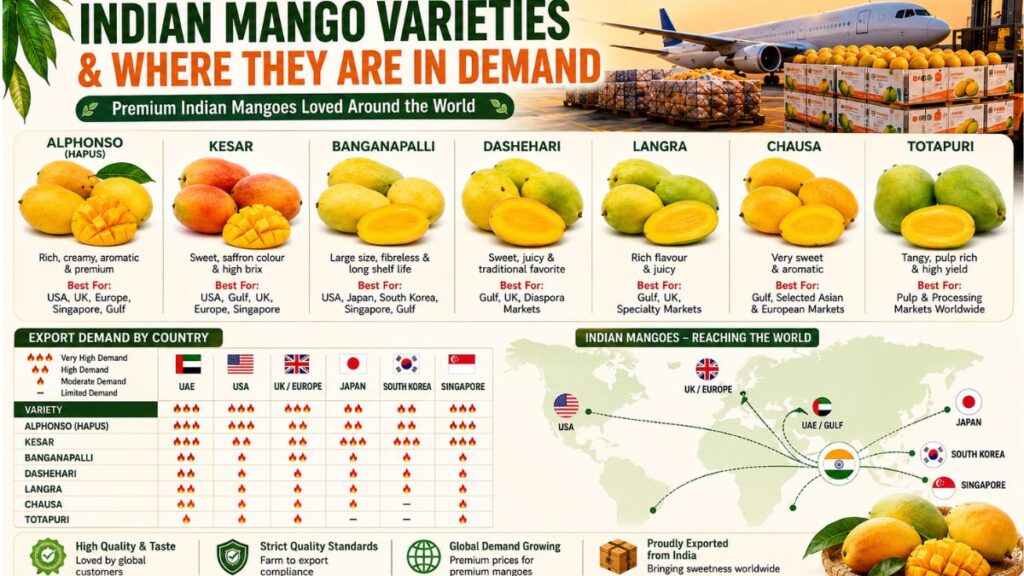
| Middle East / Gulf (UAE, Saudi, Qatar, etc.) | Generally no mandatory quarantine treatment | Easiest | Largest volume destination; huge Indian diaspora; the natural first market |
| UK / EU | Hot-water or vapour-heat treatment; strict phytosanitary and pesticide-residue (MRL) limits | Medium–hard | Premium retail plus diaspora; residue and pest rejections are common |
| USA | Mandatory gamma irradiation at an APEDA-approved facility plus USDA-APHIS inspection | Hard | Large, fast-growing premium fresh market; paperwork errors can destroy whole shipments |
| Japan / South Korea / Australia | Mandatory Vapour Heat Treatment (VHT) at designated facilities plus pre-season inspection | Hardest | Highest prices but small volume and fragile approvals |
The lesson is simple: the Gulf is where sensible newcomers begin. It takes the most volume, has fewer quarantine hurdles, and a ready diaspora market. The US, EU, Japan and Australia pay more but demand expensive, tightly inspected treatments — and, as recent seasons have shown, they can shut the door fast.
Also Read: Bael Farming in India: The Fruit Tree That Grows Where Others Fail
What you legally need to export
For a real export operation, expect to assemble this compliance stack:
- IEC (Import Export Code) from the DGFT — the foundational, mandatory licence for any exporter.
- APEDA registration (RCMC) — required for scheduled agri-products and to access registered packhouses, treatment facilities and export benefits; treat it as essential for a serious mango export business.
- FSSAI registration for food-business compliance.
- Phytosanitary certificate issued by India’s plant quarantine authority (NPPO) for each shipment, certifying the fruit is pest-free.
- An APEDA-registered packhouse for sorting, grading and packing, plus the country-specific treatment (irradiation for the US, VHT for Japan, hot-water/VHT for parts of the EU).
- Certificate of Origin and the standard export shipping documents.
Increasingly, buyers also want Good Agricultural Practices (GAP) and traceability — the ability to trace fruit back to a specific registered orchard — especially for the EU’s strict residue limits.
Varieties that travel
Not every mango exports well. The workhorses are:
| Variety | Export role |
|---|---|
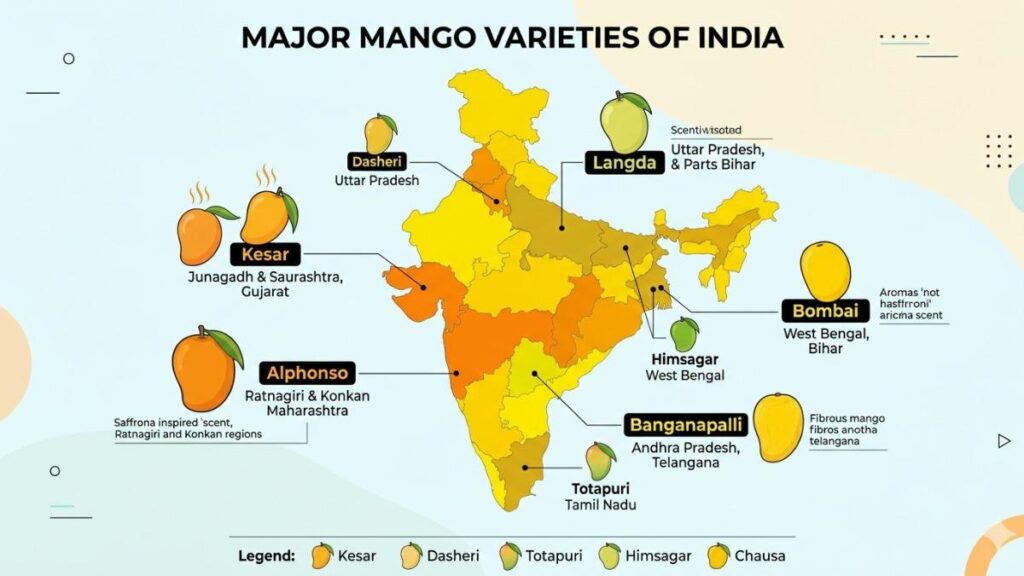
| Alphonso (Hapus), GI Ratnagiri / Devgad | Premium for the US, UK and EU; delicate, often air-freighted |
| Kesar, GI Talala Gir | High sugar (Brix); ships better; strong in Gulf and B2B |
| Banganapalli | Large, travels well; popular in several markets |
| Totapuri | Mainly exported as pulp for processing |
Alphonso commands the top price but is delicate and short-lived, which pushes it toward costly air freight. Kesar and Banganapalli hold up better and suit sea shipping — a real economic advantage.
The cold chain is the business
Mango is intensely perishable, and this is where fortunes are made or lost. From the moment of harvest you’re racing spoilage: fruit needs careful harvesting at the right maturity, prompt pre-cooling, cold storage, and either reefer (refrigerated) sea containers or air freight.
Sea freight is far cheaper and makes bulk exports viable, but only works with good post-harvest handling and shipping-tolerant varieties. Air freight is fast and protects quality for premium fruit like Alphonso, but it’s expensive — and freight costs themselves swing with global events, as recent West Asia disruptions pushed rates up sharply. Get the cold chain wrong and you don’t just lose quality — you can lose the entire consignment.
The risks nobody advertises
This is the honesty that separates a useful guide from a sales pitch. The mango export business carries real, recurring risks:
Compliance is fragile, and failures are brutal. A single facility or paperwork lapse can wipe out shipments and even close a whole country market. In 2024, around 15 US-bound consignments were rejected and destroyed over an irradiation-documentation issue. In 2026, Japan suspended Indian mango imports for the season after inspectors found deficiencies at vapour-heat-treatment facilities — cancelling contracts and leaving premium fruit stranded. These are not rare horror stories; they’re the nature of the trade.
Rejections are catastrophic, not just costly. A rejected consignment abroad usually can’t be re-routed — it’s often destroyed. You lose the fruit, the freight, the treatment cost and the buyer’s trust in one blow.
Competition is ready to pounce. When India stumbles, Pakistan, Mexico, Peru, Brazil, Vietnam and Thailand step in. Buyers who switch may not switch back.
Supply itself is at climate risk. Heatwaves in the Konkan belt have devastated Alphonso crops in recent seasons, meaning you can have buyers and licences ready and still lack fruit.
Working capital is heavy. Treatment, cold chain, freight and long payment cycles tie up serious money before you’re paid — and one bad consignment can swallow the profit of several good ones.
None of this means “don’t do it.” It means respect it, start small, and build compliance discipline before scale.
A realistic way to enter
Given all that, here’s a grounded path rather than a leap:
- If you’re a farmer: focus on producing genuine export-grade fruit — right variety, GAP, maturity, minimal residues — and supply an established APEDA-registered exporter or an FPO with export tie-ups. Learn the standards before taking on the risk.
- If you’re an entrepreneur: start with the Gulf market, partner with or use a registered packhouse rather than building one on day one, move small trial consignments, and get every document perfect before you scale.
- Build relationships and traceability early, and lean on APEDA’s buyer-seller meets and market development support to find genuine buyers.
- Only attempt the US, EU or Japan once you’ve mastered the basics — those markets punish mistakes hardest.
Government support
The trade has real institutional backing worth using:
- APEDA is the nodal export-promotion body — it provides registration, financial-assistance schemes, quality and infrastructure support, and buyer-seller meets to connect you with overseas buyers.
- MIDH and state horticulture departments support cold-chain, packhouse and post-harvest infrastructure, and NABARD-linked finance can fund it.
Scheme details, assistance levels and eligibility change, so confirm the current position with APEDA and your state before relying on any figure.
Is the mango export business worth it?
For the disciplined and well-capitalised, yes — the mango export business is a real opportunity. Demand for Indian mangoes is genuine and growing across the Gulf, the UK, Europe and North America; premium varieties fetch prices the domestic market can’t match; and India’s production base is unmatched. If you respect the compliance, start with easier markets, and treat quality and paperwork as non-negotiable, it can be a strong agribusiness.
But be clear about the downsides:
- Compliance is unforgiving — one facility or documentation failure can cost shipments or an entire market.
- Rejections are total losses, not partial ones.
- Perishability and post-harvest losses are relentless and demand real cold-chain investment.
- Working capital needs are heavy, and payment cycles are long.
- You compete globally, and buyers switch fast when India slips.
The smartest entry is rarely to become an exporter overnight. It’s to master export-grade production and reliable supply first, begin trading with the forgiving Gulf market, keep every document flawless, and scale only once you’ve proven you can do it without a rejection. In this business, consistency beats ambition — the profit belongs to those who never let a shipment fail.
Frequently asked questions
Do I need a licence to export mangoes from India?
Yes. At minimum you need an IEC (Import Export Code) from the DGFT, and for a serious operation you’ll want APEDA registration plus FSSAI compliance. Each shipment also needs a phytosanitary certificate, and regulated markets require country-specific treatment at approved facilities. Confirm current requirements with APEDA before starting.
Which country is the easiest to export Indian mangoes to?
The Gulf countries — UAE, Saudi Arabia, Qatar and neighbours — are generally the easiest and take the largest volume, thanks to fewer mandatory quarantine treatments and a large Indian diaspora. The US, EU and Japan pay more but demand strict, inspected pest treatments, so most newcomers should start with the Gulf.
Why do Indian mango shipments get rejected?
Usually because of pest-treatment or documentation failures, pesticide residue above the importing country’s limits, or quality and phytosanitary issues. Rejections can be severe — in recent seasons the US destroyed consignments over irradiation paperwork and Japan suspended imports over treatment-facility deficiencies — and rejected fruit generally can’t be re-routed.
Which mango varieties are best for export?
Alphonso (Hapus) is the premium choice for Western markets but is delicate and often air-freighted, while Kesar and Banganapalli travel better and suit sea shipping and the Gulf. Totapuri is mainly exported as pulp. Choosing a variety that ships well can matter as much as its taste.
Can a small farmer export mangoes directly?
Directly exporting is difficult for a small farmer because of the licences, packhouse, treatment, cold chain and working capital involved. A far more realistic route is to grow export-grade fruit and supply an established exporter or join an FPO with export tie-ups, then move up over time.
Should I use air freight or sea freight?
It depends on variety and market. Air freight is fast and protects delicate premium fruit like Alphonso but is expensive; sea freight in reefer containers is much cheaper and suits bulk shipments of hardier varieties like Kesar, provided your post-harvest handling is good. Freight costs also fluctuate with global conditions.