



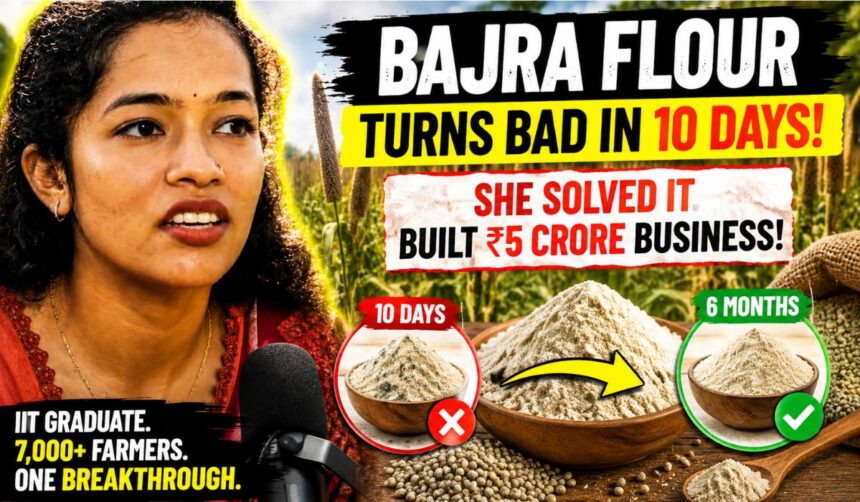
Bajra Flour Shelf Life: Most millet “success stories” skip the boring detail that actually decides whether a business survives: bajra flour turns bitter in about ten days. When I sat down with Vidhya Parshuramkar, the 24-year-old founder of Agrozee Organics (brand: Millets Now), what struck me wasn’t the ₹5-crore revenue figure — it was that she built the whole company by first fixing that one unglamorous problem. If you grow millets, run an FPO, or want to start an agri-food business, this is a rare case where the real lesson is in the plumbing, not the pitch. Here’s what holds up, what to check, and what you can actually copy.
I’ve fact-checked her main claims against independent sources rather than take the numbers at face value — which is exactly the point of these interviews.
Who is Vidhya, and why does this matter?
Vidhya Parshuramkar is a farmer’s daughter from Gondia, Maharashtra, and an M.Tech in Food Technology from IIT Kharagpur — the first postgraduate in her family. Her company, Agrozee Organics, runs the Millets Now brand and a child-nutrition programme called Nutri Dabba, and works with over 7,000 smallholder farmers plus women’s self-help groups. In 2025 she won the Rohini Nayyar Prize (a ₹10 lakh award for young rural changemakers). All of that is independently verifiable. What began it was personal: despite being a food technologist, she was herself anaemic — which pushed her toward pearl millet (bajra) as a natural, affordable iron source rather than lifelong supplements.
The problem she actually solved
Whole bajra grain stores for about a year, but the moment you mill it into flour, the clock starts. Within roughly ten days the flour goes rancid and bitter. That isn’t folklore — it’s enzyme chemistry: milling triggers lipase and related enzymes that oxidise the flour’s fats, and peer-reviewed food-science work confirms exactly this lipase-driven rancidity in pearl millet flour. That short shelf life is the single biggest reason bajra value-added products barely exist on shelves, while ragi and jowar products do.
Vidhya’s answer is a process she calls Hydro-NIR technology, which she says deactivates that enzyme so the flour keeps for about six months without preservatives and without stripping out nutrition — unlike older fixes (high-pressure processing, heavy heat treatment) that are expensive and tend to cost you the very nutrients you’re selling. The shelf-life extension to six months is confirmed in independent reporting on her award, and she says the technology is patented and now under a commercialisation discussion with the Swiss grain-tech firm Bühler. Treat the Bühler tie-up as her account for now, but the core innovation is real and is the foundation everything else sits on.
Do the numbers hold up?
She’s refreshingly specific with figures. Here’s how they sit against independent data.
| Claimed in the interview | Reality-check (official/independent) | What to verify |
|---|---|---|
| Bajra flour shelf life: ~10 days → ~6 months | Consistent — the 10-day rancidity is documented; the 6-month figure matches independent reporting on her tech | Third-party lab shelf-life report |
| Farmer yield ~1 → 1.8 t/acre with her variety + practices | Plausible but on the high side — national pearl millet average is ~1.3–1.5 t/ha (well under 1 t/acre); these look like good-management/irrigated numbers | Local yields for the variety [VERIFY] |
| Farmer price ₹22–25/kg market → ₹31–32/kg to her | Credible — bajra MSP is ~₹2,625/quintal (₹26/kg); many sell below it, so her ₹31–32 is a genuine premium | Current bajra MSP and mandi rate |
| ~30% farmer income rise; “up to ₹40,000/acre” | Directionally reasonable (better yield + premium price + no middleman), though the per-acre figures don’t fully reconcile | Farm-level records |
| High-iron variety (Dhanashakti / AHB 1200 Fe) | Real — ICRISAT’s biofortified pearl millet carries ~70–85 ppm iron vs ~20–50 in conventional | Seed source and Fe content |
| ₹5 crore revenue, 7,500 farmers, 80% repeat rate | Self-reported business figures; farmer count matches “7,000+” in public sources | Audited numbers |
The pattern: the science and the biofortified-variety facts are solid; the farm-yield and revenue figures are her own and should be read as self-reported, not audited.
How the model actually works
What makes this more than a flour brand is that Vidhya works the whole chain, not just the factory.
It starts with the seed. She supplies farmers a biofortified high-iron pearl millet variety (in the Dhanashakti / AHB 1200 Fe family) sourced from agricultural universities. This matters for the nutrition claim: these are genuine ICRISAT-bred cultivars — Dhanashakti was India’s first mineral-biofortified crop release — carrying far more grain iron than ordinary bajra. So the “iron-rich” promise is anchored in the variety, not marketing.
Then training, through FPOs. Rather than chase 7,000 farmers one by one, she works through Farmer Producer Organisations and runs pre-sowing webinars with university scientists on good agricultural practices — sowing time, soil moisture, package of practices. Field support kicks in for the roughly one in seven farmers who hit problems.
Decentralised primary processing. Cleaning and primary processing happen near the farms, often run by women’s self-help groups — which both cuts transport and, in her words, put more women visibly into the value chain. She then buys the graded grain directly, above the market rate, cutting out the middleman who usually takes the largest slice.
Value addition, then nutrition. The Hydro-NIR-treated flour becomes a range she puts at around 15 products — flour, rava, cookies, laddus and khichdi/upma premixes — the same value-addition ladder wheat enjoys. The social edge is Nutri Dabba: iron-, zinc- and vitamin-A-focused millet kits served to schoolchildren through NGOs and CSR partners (she cites reaching about 4 lakh children with partners like HarvestPlus).
The honest question: how much more does the farmer really earn?
More, but not a windfall. The uplift comes from three stacked levers — a higher-yielding biofortified variety, a buy price above MSP/mandi (₹31–32 vs ₹22–25/kg), and removing the middleman — which she puts at about 30% higher income, up to roughly ₹40,000/acre. That’s a real, meaningful gain for a bajra grower, and the premium price above the ~₹2,625/quintal MSP is the most verifiable part of it. Two honest caveats: the per-acre yield figures look like good-management numbers rather than the rainfed national average, and the fat margin in the chain still sits at the processed-product end — though in this model a chunk is reinvested into child nutrition.
Also Read: The Basmati Rice Farming Business Is Huge. Farmers Don’t Get the Whole Story
Can you earn well from millet farming?
On its own, modestly — bajra is drought-hardy, needs little water or chemicals, and frees the field in about three months for a second crop, but raw-grain prices are low and volatile. The real income comes from a biofortified high-yield variety, selling through an FPO above MSP, and moving up into processing or branded value-added products.
Can you replicate this?
Split it by who you are.
If you’re a millet farmer: the copyable moves are switching to a biofortified high-iron variety, joining or forming an FPO, and selling graded grain directly to processors (or doing simple primary processing yourself) to escape the middleman. Bajra’s low water and input needs and short 90-day cycle are genuine advantages, especially in dryland regions.
If you’re an agri-entrepreneur: Vidhya’s playbook is unusually clean. She solved a real technical bottleneck (shelf life) rather than launching yet another “organic” label; she funded it with equity-free government grants instead of diluting ownership — NIDHI-PRAYAS (a Department of Science & Technology prototype grant of about ₹10 lakh, disbursed in milestone tranches), plus later grants from IFAD, NSRCEL at IIM Bangalore and others; and she started tiny — around ₹70,000, one hired cook, five kilos of laddus a day, small kadhai-scale machines — proving demand before buying big equipment. Her repeated advice: value addition beats trading, and let product and repeat customers do the marketing (she claims ~80% repeat buyers and near-zero ad spend so far).
What you can’t copy is her patented process, and what you shouldn’t underestimate is the sector’s hard reality: millet awareness is still low, shelf life without preservatives is genuinely difficult, prices swing wildly (she’s bought browntop millet anywhere from ₹100 to ₹350/kg within months), and production is concentrated in a few states — so backward linkage (strengthening farmers) has to come before you scale manufacturing.
A realistic starting picture
Costs vary by state, product and scale — confirm locally before budgeting.
- Seed money: she began at roughly ₹70,000, deliberately using small equipment [VERIFY current small-machinery costs]
- Grants to fund R&D/machines: NIDHI-PRAYAS ~₹10 lakh (equity-free, milestone-based); larger nutrition/agri grants (e.g. IFAD) can run higher [VERIFY current windows]
- First products: flour, laddu, cookies — start with roasting/grinding at small scale, not a full plant
- The real cost: grant-writing capability, food-tech know-how, and time spent building farmer supply before demand
Is it worth copying?
As a farmer, moving to a biofortified variety and selling through an FPO is low-risk and sensible. As an entrepreneur, this is one of the better-structured millet playbooks going — but only if you respect what makes millets hard. The failure modes: thin awareness and demand, a shelf-life problem that defeats most people without real food-tech, brutal price volatility, and a supply base that must be built patiently. Vidhya’s edge is that she engineered a genuine fix, used non-dilutive grants, and grew from a single kadhai — not that millets are an easy win. Copy the discipline, not just the idea.
FAQ
Why does bajra (pearl millet) flour spoil so fast?
Milling activates enzymes (mainly lipase) that oxidise the flour’s fats, turning it rancid and bitter in about ten days. Whole grain stores far longer; it’s the flour that’s the problem — which is why bajra value-added products are rare.
Is millet farming profitable for a small farmer?
Raw grain earns modestly and prices swing, but bajra needs little water or inputs and frees the field in ~90 days. Better returns come from biofortified high-yield varieties, FPO sales above MSP, and value addition.
What is biofortified pearl millet?
Varieties like Dhanashakti (India’s first biofortified crop release) and AHB 1200 Fe are bred to carry much more grain iron (~70–85 ppm) than ordinary bajra (~20–50 ppm), helping tackle iron-deficiency anaemia through everyday food rather than supplements.
How can a young entrepreneur fund an agri-food startup without giving up equity?
Government innovation grants like NIDHI-PRAYAS (DST) offer around ₹10 lakh for a working prototype without taking equity, released against milestones. Nutrition and agri bodies (IFAD, incubators like NSRCEL) offer larger grants for validated ideas.
Are millets really better for the environment?
Broadly yes — pearl millet uses far less water than rice, needs minimal fertiliser or pesticide, and is a hardy C4 crop suited to drylands. That’s a real advantage where water is scarce, though it doesn’t by itself guarantee farmer income.
Can millet products be preservative-free and still last?
It’s difficult — most shelf-stable millet flours on the market use preservatives or lose nutrition to heavy processing. Preservative-free long shelf life requires specialised technology, which is exactly the gap Vidhya’s process targets.