




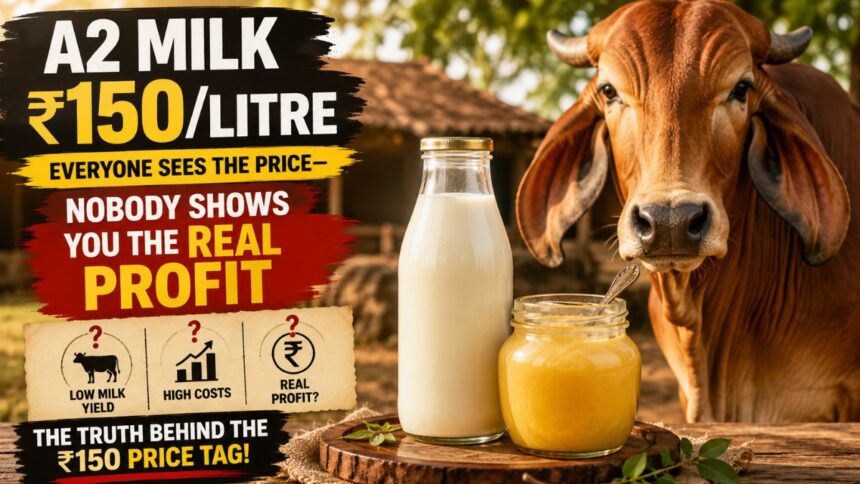
The A2 milk business is one of the hottest premium-dairy opportunities in India — desi cow milk in glass bottles selling for three times the price of ordinary milk, and A2 ghee at eye-watering rates. This guide is for farmers and entrepreneurs who want the complete, honest picture before investing: what A2 milk actually is, where the health claims and rules really stand, the breeds and the business models, exactly how to start, and the blunt economic reality that decides who profits. It’s a genuine opportunity — but only if you understand what you’re really selling.
- What A2 milk actually is
- The part most guides skip: the science and the rules
- Is the A2 milk business profitable?
- The economic reality that makes or breaks it
- Choose your business model
- The breeds that produce A2 milk
- How to start an A2 milk business, step by step
- The money: prices, costs and honest expectations
- Where to sell
- Government support
- Is the A2 milk business worth it?
- Frequently asked questions
What A2 milk actually is
Milk protein is roughly 80% casein, and about 30% of that casein is beta-casein, which comes in two main forms: A1 and A2. A2 milk is simply milk in which the beta-casein is the A2 type. Most Indian indigenous (desi) cow breeds — such as Gir, Sahiwal, Tharparkar, Red Sindhi and Rathi — naturally produce A2 milk, while several exotic and crossbred cows associated with the White Revolution (like Holstein Friesian, and Jersey to varying degrees) produce A1 or mixed milk.
Around this simple protein difference, a premium product category has been built, wrapped in the language of easier digestion, “satvik” desi-cow purity, Ayurveda and clean-label health food. That marketing is powerful — and it’s also where the honesty has to start.
The part most guides skip: the science and the rules
Before you invest a rupee, understand this clearly, because it shapes the entire business.
The health claims are genuinely debated, not settled. Proponents and some studies suggest A2 milk is gentler on digestion for certain people; other research and regulators have not found conclusive proof that A2 milk is broadly healthier than A1. The honest position is that the science is contested and evolving, not a proven fact you can safely build a brand’s promises on.
The labeling rules in India are unsettled. In August 2024, the FSSAI issued a directive calling A1/A2 differentiation claims on milk and dairy “misleading,” noting that India’s milk standards don’t formally recognise an A1/A2 classification, and ordered businesses to remove such claims. Within days, after pushback from ICAR and the industry, the FSSAI withdrew that directive for further consultation. The result is a grey zone: there is currently no formal FSSAI standard or certification specifically for “A2” milk, and the regulator has signalled that unsubstantiated A1/A2 claims can be considered misleading.
The practical takeaway for you as a founder: build the business on real, verifiable strengths — genuine desi-breed cows, freshness, hygiene, traceability and trust — not on unproven health claims or a label that may not survive regulation. That honesty isn’t just ethical; it’s the safest commercial foundation in a category this scrutinised.
Is the A2 milk business profitable?
The A2 milk business can be profitable, but only as a premium, direct-to-consumer brand. Indigenous cows give far less milk than crossbreds, so the higher price has to be captured by selling directly to health-conscious customers. Because the health claims are debated and the labeling rules unsettled, lasting profit comes from real quality, breed authenticity and trust — not from the “A2” tag alone.
The economic reality that makes or breaks it
Here is the single most important business fact, and it’s simple arithmetic. Indigenous A2 cows produce much less milk than crossbred cows. A Gir or Sahiwal typically gives in the range of 6–12 litres a day, while a Holstein Friesian or Jersey cross can give 15–30 litres. You are running a low-volume operation by design.
That means the whole business rests on one thing: capturing a big premium by selling directly to the customer. Sell your low-volume A2 milk to a cooperative or the general market at commodity rates and you will lose money — low volume at ordinary prices is a poor business. Sell it as a branded, fresh, traceable premium product straight to health-conscious households at ₹90–150+ a litre, and the numbers can work well.
| Factor | Indigenous (desi) A2 breeds | Crossbred (HF / Jersey) |
|---|---|---|
| Milk yield | Lower — roughly 6–12 litres/day | Higher — roughly 15–30 litres/day |
| Realistic price model | Premium, direct-to-consumer | Commodity / cooperative |
| Fat content | High (around 4.5–5.5%) — excellent for ghee | Lower |
| Hardiness | Heat-tolerant, disease-resistant, low-input | Needs cooling and more care |
| Best-fit business | Premium D2C brand + value addition | Volume dairy |
The desi cow’s lower yield is partly offset by real advantages: hardiness, disease resistance, low feed and vet costs, long productive life, and high fat that makes superb ghee, curd and paneer. But never forget the core logic — A2 milk is a premium brand business, not a volume dairy business.
Choose your business model
There are three realistic ways to enter, with very different capital needs:
- Full farm plus D2C brand. You own the herd, produce the milk, process value-added products, and sell direct. Highest capital and effort, highest control and margin.
- Aggregator-processor brand. You source genuine A2 milk from desi-cow farmers, then chill, process, brand and sell it. Lower livestock capital, but you must guarantee authenticity and supply.
- Value-added / ghee-focused. You concentrate on A2 ghee and other products rather than fresh milk delivery, avoiding daily cold-chain logistics. Ghee’s long shelf life and very high price make this a popular, lower-logistics entry.
Pick the model that matches your capital, land and appetite for daily logistics before anything else.
The breeds that produce A2 milk
If you’re keeping cows, breed choice is foundational — and authenticity is a real risk, because the market is flooded with mixed-breed animals sold as purebreds.
| Breed | Notes |
|---|---|
| Gir | Gujarat origin; prized for A2 ghee, high fat, strong heat tolerance |
| Sahiwal | Punjab-region breed; among the best desi milk yields, heat-tolerant |
| Tharparkar | Rajasthan; hardy, dual-purpose |
| Red Sindhi | Hardy and widely adaptable |
| Rathi | Rajasthan; good yield for a desi breed |
| Gangatiri / Hariana | Gangetic belt and North India |
Buy from reputable, verifiable sources, insist on breed authenticity, and be wary of paying purebred prices for mixed animals.
Also Read: Bael Farming in India: The Fruit Tree That Grows Where Others Fail
How to start an A2 milk business, step by step
This is the practical core — the everything-you-need sequence.
1. Decide your model and scale. Full farm, aggregator, or ghee-focused; and start small enough to learn without betting everything.
2. Source authentic desi cows (or milk). Select your breed, verify purity, and check health and productive history. If aggregating, contract genuine desi-cow farmers with clear terms.
3. Set up housing and feed. Provide a clean, well-ventilated shed with shade and water, and plan year-round green fodder, dry fodder and concentrate. Desi cows are lower-input, but nutrition still drives both yield and milk quality.
4. Manage herd health and breeding. Arrange routine veterinary care, vaccination, and sensible breeding and calf management. Ethical, cruelty-free calf rearing isn’t only humane — it’s central to the trust premium A2 buyers pay for.
5. Nail hygiene and the cold chain. Practise clean milking, chill milk immediately, and maintain a strict cold chain to the customer. For fresh raw or pasteurised milk, freshness and safety are your product.
6. Add value. A2 ghee — often made by the labour-intensive bilona (curd-churn) method that uses far more milk per litre of ghee — commands the highest margins, alongside paneer, curd and buttermilk. Value addition is where much of the real profit sits.
7. Get licensed and compliant. Obtain your FSSAI registration/licence (mandatory for selling milk and dairy), register for GST, use food-grade packaging (the FSSAI has flagged food-grade packaging as critical to food safety), declare milk class and heat treatment correctly, and — importantly — keep your labeling compliant and defensible given the unsettled A1/A2 position.
8. Build the brand and D2C channel. This is where A2 businesses win or lose. Use traceability and a genuine farm story, quality packaging (glass bottles are common), a subscription/doorstep-delivery model, your own website, quick-commerce and marketplace listings, premium local retail, and select hotels.
9. Price with a real justification. Charge a premium, but anchor it to verifiable quality, freshness, breed and ethics — not to a health claim you can’t substantiate.
10. Market honestly. Emphasise what’s true and provable. Avoid unproven medical claims, both to stay on the right side of regulation and to build durable trust.
The money: prices, costs and honest expectations
On the revenue side, A2 milk commonly retails at ₹90–150+ per litre (premium raw or branded milk can go higher), and A2 ghee often sells at roughly ₹1,500–2,500 per litre at retail. Those are strong prices — but they’re gross, and they exist only in direct premium channels.
On the cost side, plan for the animals (good desi cows are a significant purchase), housing, feed and fodder, labour, veterinary care, chilling and cold chain, food-grade packaging, and delivery and marketing. Value-added products like ghee improve margins but consume a lot of milk per unit.
The honest framing: you profit through premium pricing and value addition on low volume, sold direct — not through scale. Be sceptical of the viral “huge profit per cow” figures; they assume full premium pricing, strong direct sales, authentic high-yielding cows and flawless execution, which take time to achieve. Expect a learning period and a real payback timeline, and start small.
Where to sell
Your customers are premium, health-conscious urban households, fitness and wellness buyers, Ayurveda-oriented consumers, and the gifting market (especially for ghee), with some export interest in desi-cow ghee from markets like the US, Japan and Europe. Reach them through subscription doorstep delivery, your own online store, quick-commerce and marketplaces, premium and organic retail, and select hotels. Consistency, authenticity and trust are what turn first-time buyers into the loyal subscribers this business depends on.
Government support
Several schemes back indigenous-breed dairy:
- The Rashtriya Gokul Mission supports development and conservation of indigenous cattle breeds — directly relevant to A2 dairy.
- The National Livestock Mission and NABARD-linked dairy entrepreneurship finance can help fund animals, sheds and processing infrastructure.
Scheme details, subsidy levels and eligibility change and vary by state, so confirm the current position with your district animal husbandry office or NABARD before relying on any figure.
Is the A2 milk business worth it?
For the right founder, the A2 milk business is a real and attractive opportunity. Demand for premium, traceable desi-cow dairy is rising fast, the price premiums are genuine, indigenous cows are hardy and low-input, value-added ghee earns excellent margins, and government schemes support indigenous breeds. If you build a genuine brand with authentic cows, strong hygiene, a reliable direct channel and honest marketing, it can be a rewarding premium-dairy business.
But go in clear-eyed about the downsides:
- The health claims are debated and the “A2” labeling rules are unsettled — build on quality and trust, not on the claim.
- Desi cows yield much less milk, so this is a low-volume, premium-only model.
- It only works direct-to-consumer — commodity selling loses money here.
- Authenticity is a constant challenge, with mixed breeds passed off as purebreds.
- It’s three hard businesses at once — livestock, food processing and D2C brand-and-logistics.
The smartest way in is to start small, choose your model deliberately, secure authentic animals or supply, get your FSSAI licensing and honest labeling right from day one, and grow a direct customer base you genuinely earn. Treated as a premium brand built on real quality rather than a health-claim shortcut, the A2 milk business can be a strong, durable venture.
Frequently asked questions
Is A2 milk really healthier than normal milk?
The evidence is debated. Some people report easier digestion with A2 milk and some studies are supportive, but there is no conclusive proof that it is broadly healthier than ordinary milk, and regulators have questioned blanket health claims. Treat it as a contested area, not settled science, and avoid making unproven claims.
Is the A2 milk business profitable in India?
It can be, but only as a premium, direct-to-consumer brand. Because indigenous cows give less milk, the model depends on selling at a high price straight to customers and adding value through products like ghee. Sold as ordinary milk at commodity rates, the low volumes make it unprofitable.
Can I label and sell my milk as “A2”?
This is currently a grey area. The FSSAI issued a directive against A1/A2 claims in 2024, then withdrew it for further consultation, and there is no formal FSSAI standard for “A2” milk. Check the current position before printing labels, keep any claim substantiated and compliant, and consult the FSSAI rules directly.
Which cow breed is best for A2 milk?
Popular indigenous A2 breeds include Gir and Sahiwal, valued for milk quality and high fat that makes excellent ghee, along with Tharparkar, Red Sindhi and Rathi. The best choice depends on your region and goals, and breed authenticity matters greatly, so buy from verifiable sources.
How much investment is needed to start an A2 milk business?
It varies widely by model. A ghee-focused or aggregator model needs less livestock capital than a full farm, while a farm requires buying desi cows (a significant cost), housing, feed, cold chain, packaging and marketing. Starting small to learn the business before scaling is the sensible approach.
Where can I sell A2 milk and ghee?
Through direct-to-consumer channels: subscription doorstep delivery, your own website, quick-commerce and online marketplaces, premium and organic retail, and select hotels, with ghee also selling well as a gifting and export product. Building a loyal, trusting direct customer base is central to success.