




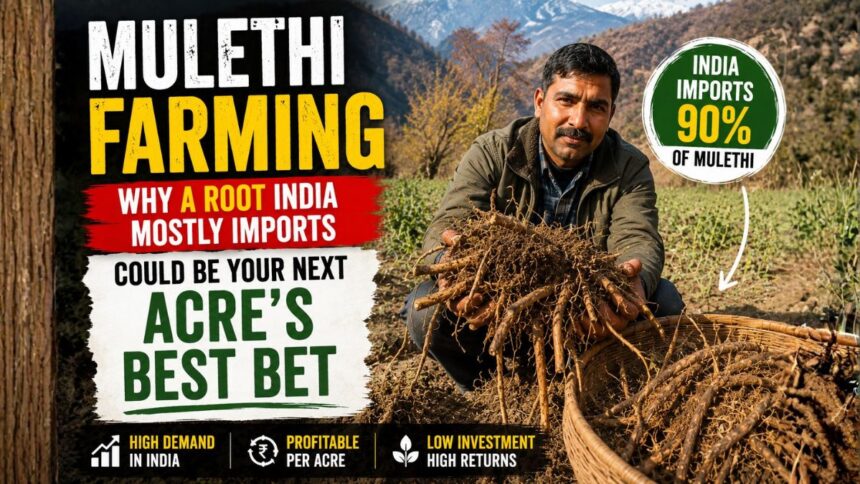
Walk into any ayurvedic store in India and pick up a pack of mulethi powder — there’s a real chance that root travelled further to reach the shelf than you did to buy it. Most of the licorice sold in India is still wild-collected and imported from Afghanistan and Iran, not grown domestically. That gap between demand and Indian-grown supply is exactly why mulethi farming has started showing up in conversations I’m having with farmers in Himachal Pradesh, Punjab, and parts of Uttarakhand.
I’m not going to tell you this is the next big cash crop everyone should switch to. It isn’t. But for the right farmer, in the right region, with patience for a multi-year crop, it’s worth understanding properly before you write it off — or romanticise it.
What Mulethi Actually Is
Mulethi, botanically Glycyrrhiza glabra, is a perennial shrub grown for its root — the same root that gives liquorice its sweetness, used heavily in Ayurvedic formulations, herbal teas, and as a flavouring agent. It’s known by several names depending on where you are: liquorice, Yashtimadhu, Madhukah, Jethimadh.
This isn’t a crop you sow and harvest in one season. The plant takes two and a half to three years in the field before the roots are mature enough to dig up. That single fact changes everything about how you should plan, budget, and think about this crop — it behaves more like a plantation investment than a seasonal harvest.
Why Indian Farmers Are Looking at This Now
Two things are pulling mulethi into farmer conversations this year. First, the supply gap. Most commercial mulethi in India is still wild-harvested abroad rather than cultivated here, which is part of why CSIR-Institute of Himalayan Bioresource Technology (CSIR-IHBT), Palampur, recently distributed mulethi planting material to farmers in Himachal Pradesh for organized commercial cultivation — the first such effort in the state. When a government research institute starts pushing planting material into farmers’ hands, that’s usually a signal worth paying attention to.
Second, there’s policy support. The Ministry of AYUSH, through the National Medicinal Plants Board, runs a Central Sector Scheme that subsidises 30 to 75 percent of cultivation cost for a list of around 140 prioritized medicinal plants grown on farmers’ land. I’d treat this as a “check before you plant” item rather than a guarantee — the prioritized species list and subsidy slabs are revised periodically, so confirm mulethi’s current status with your State Medicinal Plants Board before assuming you’ll get the subsidy.
On the demand side, India’s broader herbal and AYUSH export sector is genuinely growing — India exported around $628 million worth of AYUSH and herbal products as of 2022–23, and ayurvedic and wellness companies (Dabur, Patanjali, Himalaya, and dozens of smaller manufacturers) all use mulethi as a raw material. That said, growth in exports doesn’t automatically mean a strong farmgate price for raw root — I’ll get to that honestly in the risks section.
Cost to Start — Per Acre, 2025–26
Because mulethi stays in the ground for 2.5 to 3 years, I’m breaking this down by year rather than as one lump cost. These figures are [ESTIMATE] ranges built from typical north Indian input costs for a root crop with this labour and irrigation profile — I haven’t found an official per-acre cost sheet specifically for mulethi, so treat these as planning numbers, not guarantees.
Year 1 (establishment):
- Planting material (root/stem cuttings, ~100–120 kg/acre): ₹5,000–7,000
- Land preparation (ploughing, levelling, bed formation): ₹8,000–10,000
- Farm Yard Manure / organic inputs (chemical fertiliser is generally avoided on medicinal plant crops): ₹10,000–12,000
- Labour (planting plus three to four weeding-cum-hoeing rounds): ₹15,000–18,000
- Irrigation (diesel/electricity for repeated watering): ₹8,000–10,000
- Miscellaneous (bio-pesticide prep, boundary protection): ₹4,000–5,000
- Year 1 Total: roughly ₹50,000–62,000/acre
Year 2 (maintenance only): two weeding-cum-hoeing rounds plus irrigation — roughly ₹15,000–18,000/acre.
Year 3 (maintenance plus harvest): maintenance costs similar to Year 2, plus harvesting. Manual root digging is genuinely expensive labour-wise; using a disc harrow to overturn the soil is the more economical route mentioned in technical literature. Budget ₹15,000–20,000 for digging, drying, sorting, and grading.
Total investment over the full 2.5–3 year cycle: roughly ₹1,15,000–₹1,40,000 per acre [ESTIMATE], before any NMPB subsidy is applied.
Agro Potli Daily Farm Expense Tracker
Realistic Income Potential — Two Honest Scenarios
This is where I’d ask you to sit down with a calculator before getting excited about mulethi farming. Yield data from agricultural research stations shows a wide spread, which tells you this crop’s economics aren’t simple.
Trial yields at Hissar, Haryana have recorded 70 to 80 quintals of dry root per hectare, while at Anand a 10-to-20-month crop averaged 20 to 25 quintals per hectare. Converting to per-acre terms (1 hectare ≈ 2.47 acres):
Conservative scenario: Lower-end yield around 800 kg dry root per acre over the full cycle, sold at a farmgate price of roughly ₹60/kg [ESTIMATE, based on current B2B trade listings for dried mulethi root ranging from about ₹60 to ₹220 per kg as of mid-2026, with farmgate typically running below trader resale price]. That’s around ₹48,000 per acre across nearly three years — which, after subtracting your input cost, may leave you at breakeven or even a loss if costs run high. This is the scenario where mulethi farming does not pay off, and you need to know that going in.
Optimistic scenario: Higher-end yield around 2,800–3,000 kg dry root per acre, sold at a stronger farmgate price of around ₹120/kg. That’s roughly ₹3,40,000–3,60,000 per acre over the cycle, leaving a net profit in the ₹2–2.2 lakh range after costs — or roughly ₹70,000–75,000 per acre per year averaged out.
The gap between these two numbers is the entire story of this crop. Yield depends heavily on soil, irrigation discipline, and variety; price depends on whether you can reach a serious buyer instead of a local trader squeezing margins. An older NMPB technical note pegged returns at ₹3.5 to 4 lakh per hectare back in 2001 — I’d ignore that figure for planning purposes; it’s two and a half decades old and the note itself flags that medicinal plant markets are volatile.
Step-by-Step Growing Guide
Land and soil: Mulethi does best in sandy loam, fertile soil with pH between 6 and 8.2, in locations getting 50–100 cm annual rainfall, supplemented with irrigation. Good drainage is non-negotiable — waterlogging is one of the biggest killers of this crop.
Planting time: Fresh planting works best in February–March or July–August, which roughly maps to the late Rabi-to-Zaid transition or the start of Kharif, depending on your region. Cuttings of 15–25 cm with two to three eye buds are planted 6–8 cm deep, at spacing around 60×45 cm to 90×45 cm depending on row layout.
Establishment phase: Light, frequent irrigation is needed right after spring planting until the cuttings sprout, which typically takes 15–20 days. Expect three to four rounds of weeding-cum-hoeing in the first year.
Ongoing care: From the second year, two weeding rounds are usually enough. Avoid chemical fertilisers — most growers rely on FYM, vermicompost, and bio-pesticides made from neem or similar materials, partly because buyers in the ayurvedic supply chain prefer organically grown material.
Irrigation: Roughly seven to ten irrigations across the cropping cycle, spaced 30–45 days apart in the dry season. The plant sheds leaves around November and needs no watering through winter dormancy.
Harvest: Roots are dug up in November or December, after the plant has matured for 2.5–3 years, when glycyrrhizic acid content is highest. Roots come out with 50–60% moisture and need sun-drying for two to three days, followed by shade-drying for another ten to twelve days, until moisture drops below 10%, before grading and storage in lined bags.
Where to Sell Mulethi
This is the part most first-time growers underestimate. Don’t assume your local mandi has an active mulethi buyer — many APMCs simply don’t trade this crop regularly, since most of India’s supply still moves through trader networks rather than formal mandis.
Realistic buyer channels include:
- Ayurvedic and herbal manufacturers directly, or through their regional procurement agents — companies like Dabur, Patanjali, and Himalaya source raw herbs at scale, though direct contracts usually need volume and consistent quality.
- B2B trade platforms like IndiaMART, where dried mulethi root currently trades in a wide range depending on grade and bulk, giving you a sense of going rates before you negotiate locally.
- Farmer Producer Organisations (FPOs) focused on medicinal and aromatic plants — selling through an FPO gives you collective bargaining power that you won’t have alone with a single quintal or two.
- State Medicinal Plants Boards and CSIR-IHBT’s market-linkage support, which has actively helped connect growers to buyers under its Aroma Mission and related programmes in Himachal Pradesh.
- Local Ayurvedic pharmacies and wholesalers, especially in Punjab, Haryana, and parts of Rajasthan where mulethi trade has existing informal networks.
Before you plant a single cutting, I’d strongly recommend having at least one buyer conversation. Growing a crop with no clear exit is the single most common mistake I see with niche medicinal plants.
What Goes Wrong With Mulethi Farming
Your capital is locked in for years. Unlike wheat or vegetables, you don’t see income until year three. If you need cash flow every season, this crop will frustrate you badly.
Root rot from waterlogging. Stagnant water in the field causes soil-borne infections that rot the root system — exactly the asset you’re farming for. Drainage planning at the land prep stage isn’t optional.
Thin or absent local markets. Many regions simply don’t have an organized buyer nearby. Farmers who plant without a sales plan often end up accepting whatever price the first trader who shows up offers, which can be far below what processed mulethi powder sells for at retail.
Competition from cheap imported root. Afghan and Iranian licorice, much of it wild-harvested at low cost, keeps a ceiling on Indian farmgate prices. This is the honest limitation of this crop — Indian cultivation has to compete with a global supply chain that doesn’t carry India’s cultivation costs.
Who Should — and Shouldn’t — Try This
Mulethi farming makes sense if you have land you can commit for three years without needing income from it every season, access to assured irrigation, and ideally a connection to an ayurvedic buyer, FPO, or a state programme like the one CSIR-IHBT runs in Himachal Pradesh. It works particularly well in Himachal Pradesh, Punjab’s sub-Himalayan tracts, and parts of Uttarakhand, where the sandy loam soils and cooler winters suit the plant’s natural growing pattern.
It’s a poor fit if you’re farming on a tight annual budget, need yearly cash flow, have heavy or waterlogging-prone soil, or have no buyer lined up. I’d also caution against treating this as a guaranteed high-return crop based on old return figures floating around online — the spread between my conservative and optimistic scenarios above should make clear how much this depends on execution, not just planting and waiting.
Frequently Asked Questions
Is mulethi farming profitable in India?
It can be, but only with good yields and a real buyer lined up — conservative scenarios can leave you near breakeven, while strong yield and price combinations can return a healthy profit over the 2.5–3 year cycle.
How many years does it take for mulethi to be ready for harvest?
Roots are typically harvested after two and a half to three years in the field, when glycyrrhizic acid content peaks, usually dug up in November or December.
Which states in India are best for mulethi cultivation?
Himachal Pradesh, Punjab’s sub-Himalayan belt, and parts of Uttarakhand suit it best, thanks to sandy loam soils and the cooler winter dormancy the plant needs.
Where can I sell mulethi root after harvest?
Through ayurvedic manufacturers’ procurement agents, FPOs dealing in medicinal plants, B2B trade platforms, and state medicinal plant board market-linkage programmes — not every APMC mandi trades it actively, so lining up a buyer before planting matters.
A note on the numbers in this article: Yield and cultivation data are drawn from National Medicinal Plants Board (NMPB) technical literature and government sources cited inline. Cost estimates marked [ESTIMATE] are built from typical 2025–26 input costs for comparable root crops in north India, since no official per-acre mulethi cost sheet was available at the time of writing. Always verify current subsidy eligibility with your State Medicinal Plants Board before investing.