




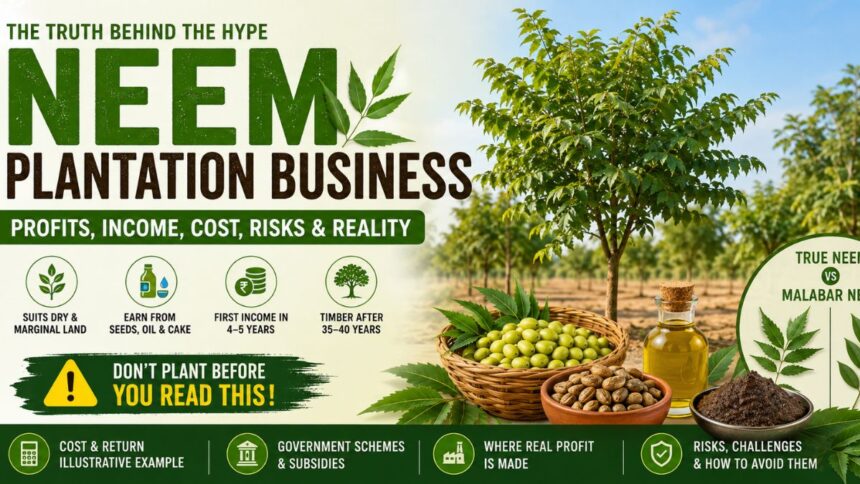
If you own dry or marginal land and keep seeing headlines about earning lakhs from neem, this guide is for you. I’ll walk through what a neem plantation business actually earns, how long you wait, which land suits it, and — just as importantly — where the hype falls apart. No fake farmer stories, no invented numbers. Just the real trade-offs so you can decide before you plant a single sapling.
- First, an important warning: there are two “neems”
- Is neem plantation a profitable business?
- The four ways a true neem tree actually makes money
- Which land and climate suit neem?
- True neem vs Malabar neem: choosing the right business
- An illustrative cost and return picture (read this as a hypothetical, not a promise)
- The demand story: why neem income is structurally real
- Government schemes and rules you should check
- Where the real profit hides: value addition
- Is neem plantation worth it?
- A note on “guaranteed buyback” plantation schemes
- Frequently asked questions
First, an important warning: there are two “neems”
This is the single biggest confusion in this space, and it trips up thousands of first-time growers every year.
When most viral articles say “neem plantation earns ₹10 lakh in 4 years,” they are almost always talking about Malabar neem (Melia dubia) — a fast-growing timber tree from the mahogany family, grown for plywood and pulp. It is not the neem your grandmother used for medicine.
The true neem (Azadirachta indica) — the bitter, pest-repelling tree found across every Indian village — is a completely different business. It grows slowly, and its money comes from seeds, oil, and cake, not quick timber.
So before you invest, be clear about which tree the nursery is actually selling you. A “guaranteed lakhs in 4 years” pitch is a Malabar neem (timber) claim wearing a true-neem costume — and the two have different economics, different buyers, and different risks. This article is mainly about the true neem business, with an honest comparison to Malabar neem so you can choose.
Is neem plantation a profitable business?
Neem plantation is a steady long-term business rather than a quick one. True neem earns mainly from seeds, oil, and cake, with the first useful harvest around year four to five and full yield by year ten to twelve. Timber comes only after decades. It suits dry, marginal land and pays best when combined with processing or value addition.
The four ways a true neem tree actually makes money
A neem plantation is not one income stream — it’s four, arriving at different times and requiring very different effort.
1. Neem seeds and kernels. This is the core. A mature true-neem tree bears fruit from roughly year four to five, reaching full yield by year ten to twelve. Estimates from forestry sources put a mature tree at around 30–50 kg of fruit per year, with oil content in the seed of about 35–45%. Raw seed sold to an aggregator fetches modest farm-gate prices, and those prices swing sharply by region and season.
2. Neem oil. Cold-pressed neem oil is the value driver. Agricultural-grade oil (used to make biopesticides) is valued for its azadirachtin content — typically in the 1,000–3,000 ppm range for pesticide use — while deodorised, cosmetic-grade oil sells at a premium to the personal-care industry. The catch: extracting oil profitably needs an expeller, clean handling, and buyers. Selling raw seed captures a fraction of this value.
3. Neem cake. After oil is pressed out, the leftover cake is a sought-after organic fertiliser and natural nitrification inhibitor. It’s also the raw material behind India’s neem-coated urea programme (more on that below). Cake is a genuine by-product income, not an afterthought.
4. Timber — but think in decades, not years. True neem heartwood resembles mahogany, resists termites, and is used for furniture and construction. But neem is a slow timber tree: it’s typically harvested for wood only after 35–40 years. If you’re planting for wood income in this decade, true neem is the wrong tree — that’s the Malabar neem lane.
Which land and climate suit neem?
Neem’s real strength is that it thrives where fussier crops fail. That makes it a sensible choice for land you can’t otherwise use well.
- Rainfall: performs best in the 450–1,200 mm range; survives on far less where roots can reach groundwater.
- Soil: tolerates poor, shallow, sandy, rocky, even mildly saline and alkaline soils. It does not like waterlogged or seasonally flooded ground — avoid low-lying, poorly drained plots.
- Temperature: loves heat and drought; frost and temperatures below about 5 °C damage it, so cold pockets are risky.
- Spacing: wider spacing (around 8 × 8 m) for timber-oriented stands; denser planting for seed-focused blocks or boundary rows. Your goal decides the layout.
For a farmer in a hot, dry, water-scarce district, neem as a boundary plantation or block on degraded land is one of the lowest-input tree options available. For someone with prime irrigated land, the opportunity cost is high — that land usually earns more under a regular crop.
Also Read: Mulethi Farming: Why a Root India Mostly Imports Could Be Your Next Acre’s Best Bet
True neem vs Malabar neem: choosing the right business
| Factor | True neem (Azadirachta indica) | Malabar neem (Melia dubia) |
|---|---|---|
| Main product | Seed, oil, cake (pesticide/fertiliser) | Timber (plywood, veneer, pulp) |
| First meaningful income | ~4–5 years (seed) | ~4–7 years (timber) |
| Full economic yield | ~10–12 years, then recurring | One harvest per rotation |
| Timber harvest age | 35–40 years | 4–7 years |
| Income pattern | Recurring annual seed + long-term wood | One-time payout per rotation |
| Typical buyers | Oil units, biopesticide makers, cake buyers | Plywood and veneer mills |
| Main risk | Low seed prices, seasonal collection, processing | Timber price cycles, “buyback” scams |
| Best fit | Dry/marginal land, value-addition entrepreneurs | Growers targeting the plywood supply gap |
Neither is “better” in the abstract. True neem is a slow, recurring, product-based business. Malabar neem is a faster, one-shot, commodity-timber bet. Pick the one that matches your land, your patience, and your access to buyers.
An illustrative cost and return picture (read this as a hypothetical, not a promise)
As an illustrative example only, here is roughly how a 1-acre true-neem block oriented toward seed and oil might look. Every figure below is a range that varies by state, nursery, labour rate, and season — treat them as planning estimates, not quotes.
| Item (illustrative, per acre) | Rough range |
|---|---|
| Quality saplings (150–250 plants) | ₹3,000–7,500 |
| Pit digging + planting labour | ₹5,000–10,000 |
| Weeding, protection, light irrigation (years 1–3) | ₹5,000–10,000 per year |
| Approx. establishment cost (years 1–3) | ₹30,000–60,000 |
| First seed income | from year 4–5 onwards |
| Raw neem seed farm-gate price | Highly variable, often modest |
Two honest points about this table. First, the establishment cost is genuinely low compared with most orchard crops — neem is hardy and cheap to keep alive. Second, raw-seed income alone is modest, because supply is diffuse (neem grows semi-wild everywhere), which keeps farm-gate prices down. The plantation becomes properly profitable when you either aggregate volume or move up the chain into oil and cake.
In the early years, intercropping short-duration crops between young neem rows can offset costs while the trees establish — a common and sensible practice on dryland farms.
The demand story: why neem income is structurally real
Unlike many “trending crop” fads, neem sits on top of a large, policy-backed demand base — which is the strongest thing this business has going for it.
Neem-coated urea. India mandates neem coating on subsidised urea (introduced in 2015) to slow nitrogen release and stop illegal diversion of cheap urea to industry. This alone consumes a substantial quantity of neem oil every year and is a durable, government-driven demand floor for neem inputs.
Biopesticides and organic farming. Azadirachtin, neem’s active compound, is effective against hundreds of pest species and is approved for organic production in India and abroad. As organic acreage and export-oriented residue-free farming grow, so does demand for neem-based inputs.
Cake and cosmetics. Neem cake feeds the organic-fertiliser market; deodorised oil feeds a growing natural personal-care segment.
Published agronomic estimates suggest India collects several lakh tonnes of neem seed annually, yielding tens of thousands of tonnes of oil and lakhs of tonnes of cake — a value chain that already exists and keeps expanding. In other words, the market is not the problem. Your access to that market — as a small raw-seed seller versus an organised supplier — is the problem.
Government schemes and rules you should check
Neem planting can qualify for support under India’s agroforestry programme, but the specifics change by state and year, so verify locally before you count on any figure.
- Agroforestry support under RKVY. The former Sub-Mission on Agroforestry now runs as an agroforestry component under the Rashtriya Krishi Vikas Yojana (RKVY), with a focus on quality planting material, nurseries, and block/boundary plantation. ICAR-CAFRI is the technical nodal agency. Assistance patterns and per-plant rates vary by state category.
- State forest and horticulture department schemes. Many states run their own farm-forestry incentives; your district horticulture or forest office is the place to ask.
- Transit rules matter. Some states require transit permits to fell and transport trees. Neem is often placed under relaxed transit rules, but this is state-specific — confirm it before planting, because it affects how easily you can sell wood later.
- Financing. NABARD-linked agri credit and regional rural banks can fund nursery and plantation costs. Your nearest KVK can give species and scheme guidance for your agro-climatic zone.
Where the real profit hides: value addition
Here’s the part the hype skips. The money in neem is in processing, not in raw plantation. A grower who only sells raw seed to a middleman captures the smallest slice. The margin lives in:
- Oil extraction — running an expeller to sell neem oil instead of seed.
- Neem cake — bagging and selling the pressing residue as organic fertiliser.
- Formulation — standardised azadirachtin biopesticide, which commands far higher prices but needs quality control and, for sale, proper registration.
- Cosmetic-grade oil — deodorised oil for the personal-care market.
This is capital- and quality-intensive, and it’s a genuinely different business from farming. But it’s also why neem rewards entrepreneurs who can aggregate seed from many nearby trees and process it more than it rewards a lone farmer selling raw seed. If you already have a rural network or trade presence, that aggregation edge is your real asset.
Is neem plantation worth it?
Neem plantation is worth it as a long-term, low-input land asset — not as a get-rich-quick scheme.
It makes strong sense if you:
- have dry, marginal, or degraded land where little else grows well;
- can wait years for recurring seed income and treat timber as a multi-decade bonus;
- can add value or aggregate — press oil, sell cake, or collect seed across many trees.
It’s a poor fit if you:
- want cash within a year or two (nothing here delivers that);
- have prime irrigated land better used for a regular crop;
- expect to get rich selling raw seed alone at low, diffuse-supply prices;
- fall for a “neem” pitch that’s actually Malabar-neem timber with a guaranteed buyback — a common trap.
The downsides are real: slow returns, seasonal and labour-heavy seed collection, seeds that lose viability and can develop toxins if not dried and stored quickly, and modest raw-material prices because neem is abundant. Go in with those eyes open and it’s a sound, resilient choice. Go in expecting the viral-video payday and you’ll be disappointed.
A note on “guaranteed buyback” plantation schemes
Be very cautious with nurseries or companies that promise a fixed per-tree income and a guaranteed buyback after a few years. Many such pitches — especially around fast timber trees marketed loosely as “neem” — rely on selling you overpriced saplings, not on any real downstream market. Before paying, ask for the actual buyer of the end product, get any buyback promise in writing, verify the species with a botanist or KVK, and check the seller’s track record. If the returns sound like a mutual fund brochure, treat them like one.
Frequently asked questions
Is neem farming profitable in India?
It can be, as a long-term business built on seeds, oil, and cake rather than quick timber. Profitability improves sharply if you add value (oil extraction, cake) or aggregate seed. Raw-seed selling alone yields only modest returns because supply is widespread.
How many years does a neem tree take to give income?
True neem starts bearing fruit around year four to five and reaches full economic yield by roughly year ten to twelve. Timber, if you want it, comes only after about 35–40 years. It is a patience crop, not a season crop.
How much does one neem tree earn per year?
A mature tree may yield roughly 30–50 kg of fruit annually, but the rupee value depends entirely on whether you sell raw seed or processed oil and cake, and on local prices, which vary widely. Treat any single “per tree” figure with caution and verify against local rates.
Is neem the same as Malabar neem?
No. True neem (Azadirachta indica) is a slow seed/oil/pesticide tree. Malabar neem (Melia dubia) is a fast-growing timber tree from the mahogany family, grown for plywood. Most “earn lakhs fast” claims refer to Malabar neem, not true neem.
Can I get a government subsidy for neem plantation?
Possibly, through the agroforestry component under RKVY and various state forest and horticulture schemes, but rates and eligibility differ by state and change over time. Confirm current support with your district horticulture office or KVK before planning around it.
What is the biggest risk in a neem plantation business?
Two main ones: overestimating raw-seed income (prices are modest because neem is abundant), and falling for misleading “guaranteed buyback” timber schemes sold under the neem name. Both are avoidable with realistic expectations and species verification.