



Tribal collectors in Chhattisgarh’s forests have been handing over sacks of a viciously bitter green herb to government procurement centres for years, long before any Ayurvedic company put it in a capsule and charged you ₹400 a bottle for it. That herb is Kalmegh, and it’s one of the few medicinal crops in India where a documented, government-backed buyback system already exists.
I get asked about Kalmegh farming a lot from farmers who’ve seen “high-value medicinal crop” reels and want to know if it’s real money or just content. It’s real, but it’s a narrower, more specific opportunity than people assume. Let me walk you through what it actually takes.
What Kalmegh Actually Is
Kalmegh (Andrographis paniculata), also called Bhuinim or “King of Bitters,” is a short, bushy herb traditionally used in Ayurveda for liver support, fever, and as a general bitter tonic. It’s not a food crop and it’s not something you sell at your local sabzi mandi, it’s a raw material for the Ayurvedic, Unani, and herbal extract industry.
The whole plant is harvested, dried, and sold either as raw dried herb or processed further into extract powder standardized for andrographolide content, the bitter compound responsible for most of its medicinal activity. CSIR’s Central Institute of Medicinal and Aromatic Plants (CIMAP), Lucknow, developed an improved cultivar called CIM-Megha specifically to push up both biomass yield and andrographolide percentage.
Why Farmers Are Looking at Kalmegh Right Now
Two things are pulling Kalmegh into farmer conversations this season. First, demand for immunity and liver-support herbal products hasn’t slowed down since the pandemic, and Kalmegh sits right in that category as an antiviral and hepatoprotective ingredient used across cold, flu, and immunostimulant formulations.
Second, and more important for farmers, the Ministry of AYUSH actually subsidizes growing it. Under the National AYUSH Mission’s medicinal plants component, Kalmegh is one of 140 prioritized species eligible for cultivation subsidy at 30%, 50%, or 75% of cost, depending on the species’ availability and demand status. The scheme works through clusters, a minimum of 2 hectares, with farmers drawn from within a 15 km radius, and it explicitly encourages industry tie-ups where a herbal company agrees on price and buyback before the crop goes into the ground.
That last point matters more than the subsidy itself. I’ll come back to it.
Cost to Start Kalmegh Farming (Per Acre, 2025–26)
There’s no official government cost sheet published for Kalmegh specifically, so the figures below are built from CSIR-CIMAP’s published fertilizer recommendations and standard regional labor rates. I’m marking this clearly as an [ESTIMATE]– treat it as a planning range, not a quote.
- Seedlings/nursery material: ₹7,000–9,000
- Land preparation (ploughing, bed formation): ₹3,500–4,500
- Fertilizer and manure (vermicompost/FYM + NPK, per CIMAP’s recommended dose): ₹6,000–7,500
- Labor (transplanting, two hand-weedings, harvesting, primary drying): ₹14,000–16,000
- Irrigation (light supplemental watering during dry spells): ₹2,500–3,500
- Plant protection and miscellaneous (transport, packing material): ₹3,000–4,000
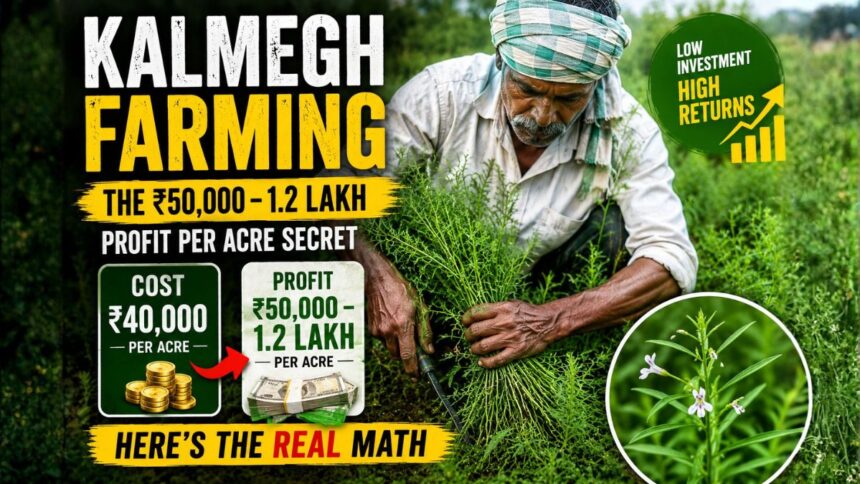
Total estimated cost: ₹36,000–44,500 per acre, averaging around ₹40,000.
Kalmegh is a low-input crop compared to vegetables, mainly because it’s a short-duration herb, you’re not feeding it through a full season.
Agro Potli Daily Plant Audit Tool
Realistic Income Potential: Two Scenarios
CIMAP’s research on the CIM-Megha variety puts dry herb yield at 32-40 quintals per hectare, which works out to roughly 13–16 quintals (1,300–1,600 kg) per acre, with the crop maturing in 120-135 days. On the price side, dried raw Kalmegh herb is currently trading on bulk trade platforms in the ₹70-100/kg range, note this is trade-marketplace pricing, not an official mandi rate, since Kalmegh isn’t a notified commodity on Agmarknet in most states.
Conservative scenario (lower yield, lower price): 1,300 kg × ₹70/kg = ₹91,000 gross revenue Minus ₹40,000 input cost = ₹51,000 net profit per acre
Optimistic scenario (good yield, better-quality buyer price): 1,600 kg × ₹100/kg = ₹1,60,000 gross revenue Minus ₹40,000–45,000 input cost = ₹1,15,000–1,20,000 net profit per acre
These numbers land close to the ₹2.5-3 lakh per hectare profit range that industry sources quote for Kalmegh, which is a reasonable cross-check, but don’t treat either figure as guaranteed. Medicinal herb pricing moves on demand from a relatively small number of pharma and extract buyers, not a broad commodity market.
Step-by-Step Growing Guide
Season: Kalmegh is primarily a Kharif crop. Seed is sown in nursery beds in May, and seedlings are transplanted into the main field once the monsoon sets in, around June–July.
Nursery: Per NMPB’s cultivation note, raising seed for one hectare needs about three nursery beds of 10×2 m, tilled, pulverized, and levelled in May, with generous organic manure. Kalmegh seed has a natural dormancy period of five to six months, so plan your seed sourcing well ahead, fresh, untreated seed often won’t germinate reliably.
Spacing: Closer spacing (around 20×10 cm) gives higher total dry herbage yield per acre. Wider spacing (around 30 cm) tends to produce a higher andrographolide percentage per plant, according to CIMAP row-spacing trials. If your buyer pays on andrographolide content, lean wider; if they pay flat per kg of dried herb, go closer.
Fertilizer: CIMAP’s Tarai-region trial found the best combination to be vermicompost at 5 tonnes/ha along with 75 kg nitrogen/ha applied in two splits, plus 50 kg each of phosphorus and potash per hectare.
Intercropping: Kalmegh tolerates partial shade and actually performs better as an intercrop in some CIMAP trials — combinations with pigeon pea, okra, and pearl millet increased dry herbage yield by up to 30% over sole-cropped Kalmegh, while also giving you a second income stream from the companion crop.
Weeding: Two hand-weedings are usually enough, the crop is short-duration and doesn’t need intensive weed management once established.
Harvest: Cut at the 50% flowering stage, around 120–135 days after transplanting, which is when andrographolide content peaks. Dry in shade rather than harsh direct sun, heavy direct sun exposure during drying is known to degrade the active compound, which directly affects what buyers will pay.
Where to Sell Kalmegh
This is the part most “high-value crop” content skips, and it’s the part that actually decides whether you make money.
- State Minor Forest Produce Federations, especially in forest-heavy states. Chhattisgarh’s own MFP Federation lists Kalmegh (as Bhuinim) among 61 forest produce items it purchases at a state-fixed support price, this is a real, existing procurement channel, not a future scheme.
- NMPB’s e-CHARAK portal, which publishes fortnightly prices for around 100 medicinal plants from 25 herbal markets across India. Check this before you sell anywhere, so you’re not negotiating blind.
- Direct buyback contracts with Ayurvedic and herbal extract manufacturers, set up before sowing under the National AYUSH Mission’s cluster model. This is the safest route for a first-time grower.
- Herbal raw material traders and aggregators, concentrated in hubs like Indore, Ghaziabad, and New Delhi, who supply extract manufacturers.
- FPOs that aggregate medicinal plant produce, selling as a group gets you better terms than walking into a trader’s office alone with one sack.
What Goes Wrong
I’ve seen the same problems repeat across medicinal crop ventures, and Kalmegh isn’t an exception.
No price discovery before harvest. Because Kalmegh doesn’t trade on regulated APMC mandis, farmers often have no idea what fair price looks like until a trader names one. Check e-CHARAK before you commit to anything.
Growing first, selling later. Farmers plant the crop, then go looking for a buyer once it’s ready, and end up in a distress sale to whoever shows up first. The NAM scheme’s whole design is meant to flip this: lock a buyback agreement with an industry partner before you sow.
Bad drying ruins quality. Andrographolide content drops if the herb is sun-dried aggressively or stored with residual moisture. Extract buyers test for active content, and a load that fails their spec gets rejected or marked down hard.
Yellowing during the rainy season. CIMAP and other research stations have documented leaf yellowing in Kalmegh during heavy monsoon conditions, which cuts both yield and andrographolide content. Good drainage and avoiding waterlogged fields helps; some studies show specific bio-inoculants reduce the problem, though that’s still mostly a research-station practice, not something every input dealer stocks yet.
Who Should Try This – and Who Shouldn’t
Try it if you’re in a state where Kalmegh already has institutional pull – Chhattisgarh, Madhya Pradesh, Jharkhand, Uttar Pradesh, Tamil Nadu, Kerala, Andhra Pradesh, or Gujarat (which has its own released variety, Anand Kalmegh-1, for irrigated Kharif conditions). It’s also a good fit if you can join an FPO or a NAM cultivation cluster, since that’s where the buyback security and subsidy access actually live.
Skip it if you’re expecting mandi-style liquidity like wheat or paddy, there isn’t one for Kalmegh. It’s also not the crop to plant on a gamble without a buyer lined up, or in a low-rainfall year without backup irrigation, since CIM-Megha needs reasonably consistent moisture to hit its yield potential. This is a steady, modest-return short-duration crop for a grower who does the buyer homework first — not a windfall crop.
Frequently Asked Questions
Is Kalmegh farming profitable in India?
Yes, within a modest range — based on current trade prices and CIMAP yield data, net returns work out to roughly ₹50,000–1,20,000 per acre depending on yield and the price you negotiate, after input costs.
What is the current price of Kalmegh per kg?
Dried raw Kalmegh herb is trading around ₹70–100/kg on bulk trade platforms as of 2025, though this varies by region, quality, and buyer. Check NMPB’s e-CHARAK portal for the latest fortnightly herbal market prices before you sell.
Which states are best suited for Kalmegh cultivation?
Chhattisgarh, Madhya Pradesh, Jharkhand, Uttar Pradesh, Tamil Nadu, Kerala, Andhra Pradesh, and Gujarat all have documented cultivation or institutional buying support for Kalmegh.
How long does Kalmegh take to grow and when should I harvest it?
It’s a short-duration Kharif crop, sown as nursery seedlings in May and transplanted in June–July. Harvest at 120–135 days, at the 50% flowering stage, when andrographolide content peaks.