




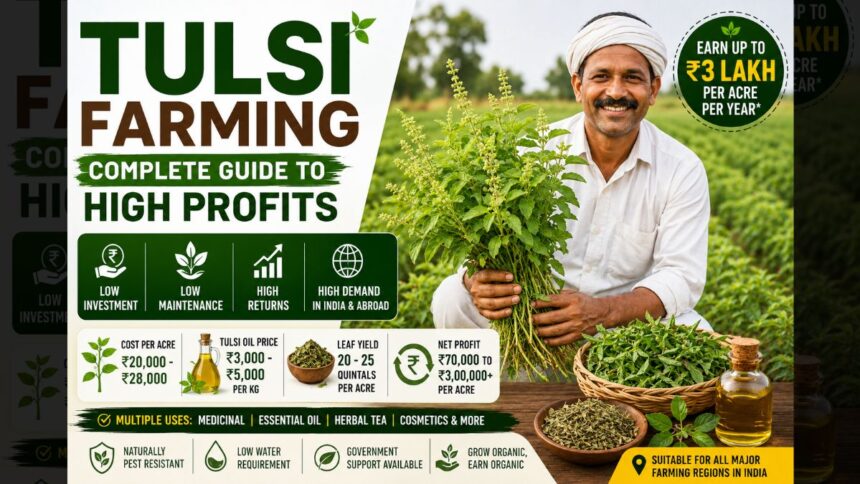
Most Indian farmers still don’t know this: that little Tulsi plant growing in a clay pot outside your home is quietly making some farmers lakhs of rupees per year.
- What Is Tulsi Farming?
- Why Tulsi Farming Makes Sense for Indian Farmers in 2026
- Tulsi Farming Cost Breakdown Per Acre (2026 Estimates)
- Agropotli Profit Calculator
- Tulsi Farming Profit Per Acre — Realistic Numbers
- Step-by-Step Tulsi Cultivation Guide
- Step 1: Choose the Right Season
- Step 2: Prepare Your Land
- Step 3: Nursery and Seed Treatment
- Step 4: Transplanting
- Step 5: Irrigation
- Step 6: Weeding and Fertilization
- Step 7: Harvesting
- Real Success Story: Alok Pattnaik, Odisha
- Where to Sell Your Tulsi
- Expert Tips for Maximum Profit from Tulsi Farming
- Common Mistakes to Avoid
- Tulsi Farming vs. Traditional Crops: A Quick Comparison
- Is Tulsi Farming Worth It in 2026?
- FAQs About Tulsi Farming in India
Tulsi, scientifically known as Ocimum sanctum or Ocimum tenuiflorum, has been cultivated in India for centuries for multiple uses. But in 2026, it is no longer just a spiritual herb — it has become a serious commercial crop with a growing global buyer base. Times of Agriculture
If you have 1 acre of land lying idle, or you want to start your first farming business with low risk, Tulsi farming deserves your full attention. This guide covers everything — what it costs, what you can realistically earn, and exactly how to grow it the right way.
What Is Tulsi Farming?
Tulsi farming is the commercial cultivation of the Holy Basil plant for its leaves, seeds, and essential oil. The Tulsi plant is typically grown for its leaves, which are used for medicinal purposes, and for its seeds, which are used for oil production.
There are three main varieties worth knowing:
- Rama Tulsi — Best for essential oil extraction and commercial farming
- Krishna Tulsi — Preferred for medicinal and Ayurvedic use
- Vana Tulsi — Wild variety, used in herbal teas and supplements
Rama Tulsi is preferred for oil extraction; Krishna Tulsi is preferred for medicinal purposes.
Why Tulsi Farming Makes Sense for Indian Farmers in 2026
Here’s why thousands of farmers are shifting to Tulsi:
Multiple revenue streams from a single crop: Entrepreneurs exploring Tulsi farming should focus on producing high-quality leaves with exceptional flavor and aroma, which can command premium prices. Diversification through value-added products, such as essential oils and cosmetics, offers avenues for enhanced profitability. Times of Agriculture
Low input costs, high margins: Not a huge amount is required for starting Tulsi farming. Only an investment of around ₹15,000–₹20,000 is needed for one hectare.
Growing domestic and export demand: The global basil essential oil market was valued at 88.9 million dollars in 2022 and is expected to reach 159.5 million dollars by the end of 2032. About 70 percent of the demand for basil essential oil in South Asia comes from India.
Government support: The CSIR-Central Institute of Medicinal and Aromatic Plants (CIMAP), located in Lucknow, gives free saplings and support to farmers under the CSIR-Aroma Mission. This mission aims to boost farmer incomes and promote crop diversification through the cultivation of aromatic and medicinal plants.
Hardy nature of the crop: Since medicinal plants are hardy and naturally resistant to most pests, they rarely need chemicals or fertilisers. This keeps costs in check.
Tulsi Farming Cost Breakdown Per Acre (2026 Estimates)
Let’s get straight to what you actually spend. These are India-specific, realistic numbers:
| Expense Item | Estimated Cost (₹) |
|---|---|
| Land preparation (ploughing 2–3 times) | ₹3,000 – ₹4,000 |
| FYM / Organic manure (10–15 tonnes) | ₹4,000 – ₹5,000 |
| Seeds / Seedlings | ₹1,500 – ₹2,500 |
| Transplanting labour | ₹2,000 – ₹3,000 |
| Irrigation (seasonal) | ₹2,000 – ₹3,000 |
| Weeding (2–3 rounds) | ₹3,000 – ₹4,000 |
| Harvesting labour | ₹3,000 – ₹5,000 |
| Miscellaneous | ₹1,500 – ₹2,000 |
| Total (approx.) | ₹20,000 – ₹28,000 |
The cost of cultivation for 1 acre of Tulsi farming is around ₹28,000–₹30,000. This includes the cost of seeds, seedlings, fertilizers, pesticides, irrigation, and labour. Times of Agriculture
This is significantly less than most vegetable or cash crops. And unlike many crops, most Tulsi cultivation is organic, meaning no fertilizers or pest control are required. The only bit of regular work is weeding.
Agropotli Profit Calculator
Tulsi Farming Profit Per Acre — Realistic Numbers
Here’s what you can actually earn, broken into two scenarios:
Scenario 1: Selling Dry Leaves
You can expect around 20–25 quintals of dry Tulsi leaves per acre. The price of Tulsi leaves varies, but in general you can expect to get around ₹50–₹80 per kg for dry Tulsi leaves. Times of Agriculture
- Revenue: 20–25 quintals × ₹50–₹80/kg = ₹1,00,000 to ₹2,00,000
- Cost: ~₹28,000
- Net Profit: ₹70,000 – ₹1,70,000 per year
Scenario 2: Essential Oil Extraction (High Value Path)
This is where the real money is.
One acre yields 10–15 kg of Tulsi essential oil, fetching ₹3,000–₹4,000/kg in export markets.
- Revenue: 10–15 kg × ₹3,500 (average) = ₹35,000 – ₹52,500 per harvest
- With 2–3 harvests per year: ₹70,000 – ₹1,50,000+ from oil alone
Combining profits from sales of dry Tulsi leaves and essential oils, you can expect to earn a profit of up to ₹3 lakhs from Tulsi farming, and that too in just 3 months. Times of Agriculture
Quick Answer for Featured Snippet: Tulsi farming profit per acre in India ranges from ₹70,000 to ₹3,00,000 per year depending on whether you sell dry leaves or extract essential oil. Essential oil fetches ₹3,000–₹5,000/kg, making it the most profitable route.
Step-by-Step Tulsi Cultivation Guide
Step 1: Choose the Right Season
Tulsi can be planted in June–July for the Kharif season and February–March for the Rabi season. For most Indian states, June–July (just before or at the monsoon onset) gives the best results.
Step 2: Prepare Your Land
Plough 2–3 times to fine tilth. Add 10–15 tons of FYM per acre. Prepare seedbeds 4–6 ft wide. Maintain spacing of 40×40 cm.
Avoid fields that get waterlogged. Tulsi prefers well-drained, fertile soil with good organic matter content. Times of Agriculture
Step 3: Nursery and Seed Treatment
Establish a nursery by sowing seeds on well-prepared raised beds about 4–6 weeks before the planned transplanting date. Sow the seeds at a depth of 2 cm, lightly cover them with farmyard manure or soil, and irrigate using a sprinkler to maintain adequate moisture.
Seed Rate: 100–120 grams per acre for direct sowing or transplanting seedlings after 6 weeks.
Pro tip: Pre-soak seeds for 12 hours to improve germination.
Step 4: Transplanting
Seedlings are considered ready for transplant when they are six weeks old, approximately 8–10 cm tall and have developed 4–6 true leaves. To facilitate easy uprooting and preserve seedling turgidity, water the nursery beds thoroughly 24 hours in advance.
Maintain row-to-row spacing of 45–50 cm and plant-to-plant spacing of 30–40 cm.
Step 5: Irrigation
Irrigation requires light, frequent applications, especially during establishment (first 4–6 weeks) and dry summers (3 per month). No irrigation is needed in the rainy season, totaling 12–15 irrigations yearly.
Drip irrigation is highly recommended if you can invest in it — it saves water and reduces fungal disease risk.
Step 6: Weeding and Fertilization
Weed 2–3 times in the first 60 days. After that, the Tulsi canopy itself suppresses most weeds. Avoid synthetic pesticides — this is an organic crop with premium value.
Step 7: Harvesting
By three months following transplantation, the plants begin to yield. Harvesting occurs when the plant is fully bloomed. Krishi Jagran
The first harvest happens 90 days from replanting and every 45–90 days thereafter. A total of 4–5 harvests is possible in a year, with each harvest yielding around 10–12 quintals per acre.
Cut the stems at about 15–20 cm from the ground. This encourages fresh regrowth for the next harvest.
Real Success Story: Alok Pattnaik, Odisha
After his MBA and a career with Tata Automotive, Alok Pattnaik returned to his native village in Odisha and launched what he calls “Tulsi Kshetra.” Today, he cultivates five varieties of Tulsi on ten acres of land, having procured 100 acres of tribal grazing land on lease to expand his basil operation.
One quintal of Tulsi yields one litre of essential oil, which sells at ₹3,000 per litre and can go up to ₹5,000 per litre depending on demand. He extracts seven to eight litres of oil daily at his distillation unit, resulting in a turnover of around ₹21,000 per day or over ₹6 lakh per month.
His buyers include herbal companies like Shree Herbal and Kalinga Medicine — and he was in talks with Dabur India Ltd.
What makes his story instructive for beginners: he started small, connected with CIMAP for technical support and seedlings, and focused on oil extraction rather than raw leaf sales. That single decision multiplied his income.
Where to Sell Your Tulsi
This is where most new farmers go wrong — they grow first, then worry about selling. Do it the other way.
Domestic buyers: Companies like Dabur, Vicco, and Emami are major buyers of organic and natural medicinal herbs from farmers.
Contract farming: In Gujarat, Tulsi growers work with Patanjali to guarantee a repurchase, which lowers their risk. Explore similar arrangements with Himalaya Drug Company, Baidyanath, and local Ayurvedic manufacturers.
Export markets: Tulsi has high demand in the USA, Europe, and the Middle East.
Herbal tea brands: India’s herbal tea industry is booming. Brands like Organic India and Tata Tea’s herbal range actively source Tulsi.
Direct selling: Dried Tulsi leaves, Tulsi oil, Tulsi powder — pack and sell locally or on Amazon/Flipkart through your own brand.
Always secure a buyer or buyback agreement before you plant. Cultivating Tulsi first and later trying to find buyers often results in loss of productivity and stress.
Expert Tips for Maximum Profit from Tulsi Farming
- Go for oil, not just leaves. Tulsi oil is more profitable for exports than selling leaves alone.
- Intercrop smartly. Tulsi can be successfully intercropped during the initial 2–3 months with short-duration crops such as chillies, tomatoes, onions, garlic, or coriander. Tall or dense-canopy crops should be avoided to prevent shading.
- Contact CIMAP. The Central Institute of Medicinal and Aromatic Plants in Lucknow provides free seedlings, training, and technical support under the Aroma Mission.
- Apply for NMPB subsidies. The National Medicinal Plants Board (NMPB) helps farmers financially by subsidizing species by as much as 75%.
- Harvest at full bloom. Oil content is highest when the plant is fully in flower. Never delay harvest beyond that point.
- Soil test first. Aim for a pH of 6.0–7.5 for best essential oil content.
Common Mistakes to Avoid
1. Planting without a buyer lined up This is the #1 mistake. Tulsi is not a mandi crop like wheat or rice — it requires direct buyers or contracts.
2. Ignoring waterlogging risk Avoid waterlogging; it reduces plant survival and oil content. Never plant Tulsi in low-lying fields.
3. Using chemical pesticides This kills your premium value. Tulsi’s edge in the market is its organic, natural nature. Any chemical use immediately reduces what buyers will pay.
4. Harvesting too early or too late Early harvests yield less oil. Delayed harvests reduce regrowth quality. Harvest exactly at full bloom.
5. Skipping value addition Selling raw leaves gives you the lowest margin. Even basic drying and packaging doubles or triples your per-kg realization.
Tulsi Farming vs. Traditional Crops: A Quick Comparison
| Parameter | Wheat (1 acre) | Rice (1 acre) | Tulsi (1 acre) |
|---|---|---|---|
| Cost of cultivation | ₹20,000–₹25,000 | ₹25,000–₹30,000 | ₹20,000–₹28,000 |
| Annual income | ₹30,000–₹40,000 | ₹35,000–₹45,000 | ₹80,000–₹3,00,000 |
| Chemical inputs needed | High | High | Very Low |
| Market risk | Medium | Medium | Low (contract farming) |
| Harvests per year | 1 | 1–2 | 4–5 |
Tulsi cultivation in Uttar Pradesh produces ₹50,000 per acre, which is already more than wheat’s ₹33,105 — proving the economic benefit of medicinal plants even in conservative estimates.
Is Tulsi Farming Worth It in 2026?
Yes — with one condition. You need a buyer before you plant.
Tulsi farming is one of the lowest-risk, high-reward crops available to Indian farmers right now. The investment is under ₹30,000 per acre, the crop is hardy and requires no pesticides, and the demand from Ayurvedic companies, herbal tea brands, and essential oil exporters is only growing.
If you can secure a contract or buyback agreement, and if you invest in even a small distillation unit over time, Tulsi farming can genuinely become a ₹2–₹6 lakh per year business on just one acre of land.
Start small. Learn the market. Then scale.
FAQs About Tulsi Farming in India
Q1. How much does Tulsi farming cost per acre in India? The total cost of Tulsi cultivation per acre is approximately ₹20,000–₹30,000 for one crop cycle, including seeds, land preparation, labour, and irrigation.
Q2. How much profit can I make from 1 acre of Tulsi farming? Profit ranges from ₹70,000 to ₹3,00,000 per acre per year depending on whether you sell dry leaves or extract essential oil. Oil extraction is significantly more profitable.
Q3. Which is the best variety of Tulsi for commercial farming? Rama Tulsi is best for essential oil extraction and export. Krishna Tulsi is preferred for direct medicinal and Ayurvedic buyers. Both are commercially viable.
Q4. Where can I sell Tulsi commercially in India? You can sell Tulsi to Ayurvedic companies (Dabur, Patanjali, Himalaya), herbal tea brands (Organic India), essential oil exporters, or through contract farming arrangements. CIMAP and NMPB also help farmers connect with buyers.
Q5. Does the Indian government support Tulsi farming? Yes. Under the CSIR-Aroma Mission, CIMAP provides free seedlings, training, and technical guidance to farmers. The National Medicinal Plants Board (NMPB) also offers subsidies of up to 75% for medicinal plant cultivation. Contact your nearest Krishi Vigyan Kendra (KVK) for local support.









नमस्कार सर मैं बिहार से अंजनी कुमार मैं तुलसी की खेती के बारे में जानकारी लेना चाहता हूं आपसे. धन्यवाद
Please DM me on my instagram @agropotli 🙂
Intersted for the cultivation of tulsi, moringa and lemongrass in Una Himachal Pradesh.