




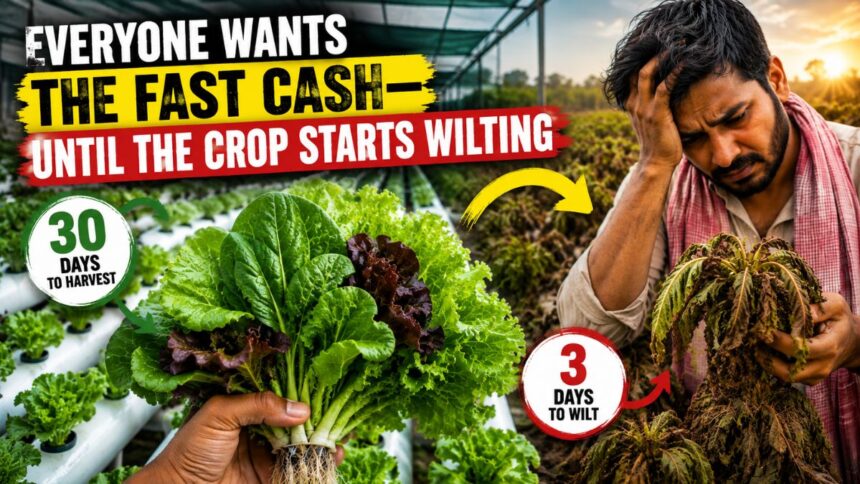
Leafy Greens Farming in India: Leafy greens are the quickest way to earn from a plot of land — many are ready to sell in three to six weeks, with low capital and little space. That makes them one of the best crops for small farmers, near-city growers and beginners. This guide is for anyone weighing leafy greens as a business, whether that’s a few beds of palak and methi or a hydroponic unit growing gourmet lettuce for restaurants. It covers which greens actually pay, the two very different markets they sell into, how to grow them, and the one hard problem that ruins careless growers: they spoil in days.
- Why leafy greens are such an attractive crop
- Is leafy greens farming profitable?
- The two very different businesses inside “leafy greens”
- The perishability problem the thing that decides your profit
- The heat-and-bolting problem and why shade helps
- Which greens to grow, and how fast they pay
- How to grow leafy greens
- The money – honestly
- Where to sell
- Government support
- Is leafy greens farming worth it?
- Frequently asked questions
Why leafy greens are such an attractive crop
The appeal is real and specific:
- They’re the fastest-cycle crop there is. Many greens go from sowing to harvest in about 20 to 45 days, so you can grow multiple crops a year and see money come back quickly.
- Low capital, low space. You can start small, even on marginal land or a rooftop, without the big investment that orchards or protected cultivation demand.
- Steady, frequent income. Because cycles are short and you can stagger sowings, greens can pay you every few weeks rather than once a season.
- Constant demand. Every Indian kitchen uses greens, and urban health trends have added a fast-growing premium market on top.
For a small or beginner farmer wanting quick, frequent returns, few categories beat leafy greens. But that speed comes with a catch that this whole guide is built around.
Is leafy greens farming profitable?
Leafy greens farming can be profitable and offers the fastest, most frequent income in vegetable farming, with many greens ready in 20 to 45 days. But they are extremely perishable and common greens face gluts, so profit depends on selling fast and locally, or on growing premium and exotic greens for urban buyers who pay more.
The two very different businesses inside “leafy greens”
Before you plant, understand that leafy greens split into two tiers that are almost different businesses, with different crops, markets, methods and margins.
| Factor | Common desi greens | Premium and exotic greens |
|---|---|---|
| Examples | Spinach (palak), fenugreek (methi), coriander, amaranth, mustard | Lettuce, kale, arugula, basil, microgreens |
| Typical price | Low — roughly ₹10–40/kg, and it crashes in a glut | Premium — roughly ₹80–300+/kg; microgreens far higher |
| Main market | Local mandi and vegetable vendors | Urban retail, hotels, restaurants, cloud kitchens, quick-commerce |
| Usual method | Open field or shade net | Often net house or hydroponic |
| How you earn | Thin margin — volume and speed | Higher margin — quality and a premium buyer |
| Best suited to | Near-city farmers with reliable daily demand | Entrepreneurs with a secured urban market |
Get this choice right first. Common greens are a high-volume, thin-margin, sell-it-today business; premium greens are a quality-and-market business. Trying to sell gourmet lettuce into a wholesale mandi, or common palak to a five-star hotel, is how growers end up disappointed.
Also Read: Saffron Farming in India: Everyone Sees ₹5 Lakh/Kg, Nobody Talks About the Scam Risk
The perishability problem the thing that decides your profit
Here is the single most important reality: leafy greens are among the most perishable produce there is. Tender greens can wilt within hours in the heat and typically stay saleable for only one to three days even with careful handling. That changes everything:
- You must sell fast and local. Greens can’t be trucked long distances cheaply the way onions or potatoes can. Market proximity beats yield.
- Post-harvest losses are brutal if handling, cooling or selling is slow — a poorly timed harvest can lose much of its value before it reaches a buyer.
- You can’t wait out a bad price. Unlike stored grain, unsold greens are worthless in days, which is exactly why common greens crash so hard in a glut.
The practical takeaways: harvest in the cool of the morning, handle gently, cool quickly, and — above all — have your buyer lined up before you cut. For greens, speed to market matters more than almost anything you do in the field.
The heat-and-bolting problem and why shade helps
Most leafy greens are cool-season crops. In the Indian summer’s heat and direct sun, they bolt — shoot up premature flowers that turn the leaves bitter and unsaleable — and quality collapses in the open field.
This is why a shade net or net house is so valuable for greens: a 50% shade structure keeps things cooler, prevents bolting, and lets you produce quality greens through the summer, exactly when open-field supply drops and prices rise. For premium greens and herbs, which are delicate and heat- and pest-sensitive, protected cultivation is often the only way to get consistent quality year-round.
Which greens to grow, and how fast they pay
| Green | Approx. time to harvest | Tier |
|---|---|---|
| Coriander (dhania) | ~30–40 days | Common |
| Spinach (palak) | ~30–40 days | Common |
| Fenugreek (methi) | ~25–30 days | Common |
| Amaranth (chaulai) | ~25–30 days | Common |
| Mustard greens (sarson) | ~30–40 days | Common |
| Lettuce | ~30–45 days | Premium |
| Kale / arugula | ~30–45 days | Premium |
| Basil and soft herbs | Cut repeatedly over weeks | Premium |
| Microgreens | ~7–14 days | Premium |
A smart approach for either tier is staggered (successive) sowing — planting small batches every week or two — so you harvest continuously and never dump everything into one glut.
How to grow leafy greens
The soil method (for most common greens)
Leafy greens like fertile, well-drained soil rich in organic matter. Most common greens are direct-sown, germinate fast, and need frequent light irrigation to keep leaves tender — drip or careful watering works well, and consistent moisture prevents toughness and bitterness. Feed based on a soil test, keep beds weed-free, and harvest young and tender; some greens allow a cut-and-come-again harvest for a second flush. Because greens are eaten fresh, keep chemical use minimal and follow safe, approved practices — low-residue, clean greens are exactly what premium buyers want. Watch for aphids, leaf miners and caterpillars, and for damping-off and leaf diseases in humid conditions.
The hydroponic method (for premium and exotic greens)
Hydroponics — growing in nutrient-rich water without soil — suits leafy greens especially well because they’re fast, light and high-value. The Nutrient Film Technique (NFT) is the most popular system for leafy greens in India, with vertical racks and LED lighting used for indoor and urban setups. The upsides are real: year-round production, far less water, clean produce, and high yield per square foot. The downsides are just as real: significant upfront cost, high energy dependence (energy can be a large share of running costs), technical skill in managing nutrients, pH and EC, and the risk of a market mismatch if you can’t sell premium produce at premium prices. Confirm current setup costs and the right system for your crop and scale before investing.
The money – honestly
Leafy greens economics work differently in each tier.
Common greens are cheap to grow and quick to return, but margins are thin and volatile. You make money through volume, fast turnover, low losses and reliable local demand — not through a high price per kilo. A glut, a heatwave, or a slow sell-through can turn a crop unprofitable fast. This is a steady, small-margin, high-frequency business, best run close to a dependable market.
Premium and hydroponic greens carry higher setup and running costs but much better margins, because lettuce, kale, arugula, basil and especially microgreens sell at premium prices to urban and food-service buyers. But those returns depend entirely on securing that premium market.
Be sceptical of the viral figures. You’ll see claims of very large annual profits from small hydroponic units — several lakh, even tens of lakh, per year. Those are best-case numbers that assume premium prices, full sell-through, low energy costs and flawless management — not what a beginner earns while learning the system and building buyers. Treat them as a ceiling, not a plan. The soundest advice, echoed across the sector: line up committed buyers for a large share of your first harvest before you build anything, and start small.
Where to sell
Match the channel to the tier. Common greens sell through local mandis, vegetable vendors, and increasingly quick-commerce and online grocery platforms, which are a natural fit for fast, fresh, perishable greens near cities. Premium and exotic greens and herbs sell to premium and organic retail, hotels and restaurants, cloud kitchens, juice and salad bars, and through subscription and direct-to-consumer models. Across both, the winners are the growers who deliver freshness and consistency and who move produce fast — because with greens, a reliable, nearby buyer is worth more than a high theoretical yield.
Government support
Leafy greens can draw on horticulture support, especially for protected and soil-free cultivation:
- MIDH / the National Horticulture Mission and your state horticulture department support vegetable cultivation and protected cultivation (net house and shade net), and several states support hydroponics.
- The National Horticulture Board and NABARD-linked finance can help fund structures and infrastructure.
Subsidy rates and eligibility vary by state and change over time, so confirm the current position and apply through your district horticulture office.
Is leafy greens farming worth it?
For the right grower, leafy greens are one of the smartest crops in Indian farming. They pay fast and often, need little capital or space, suit small and near-city farms, and ride both everyday demand and a booming premium-greens trend. If you have a reliable local market for common greens, or a secured urban and food-service market for premium and hydroponic greens, they can deliver steady, quick income.
But go in clear-eyed about the downsides:
- Extreme perishability means you must sell fast and local — this is the defining risk.
- Common greens are thin-margin and glut-prone, so a bad price or slow sale hurts.
- Heat and bolting limit open-field summer production without shade.
- Premium and hydroponic greens need a secured market and higher investment, and the viral profit figures are best-case.
- It’s a speed-and-market business, so being far from buyers is a serious disadvantage.
The smartest way in is to start small, choose your tier deliberately, sow in staggered batches, secure your buyer before you plant, and get produce to market fast and fresh. Treated as a quick-turnover, market-led business rather than a set-and-forget crop, leafy greens reward the growers who respect both their speed and their fragility.
Frequently asked questions
Which leafy green is most profitable to grow?
It depends on your market. Common greens like spinach, methi and coriander pay through fast volume near a reliable market, while premium greens like lettuce, kale, arugula, basil and microgreens earn far more per kilo if you can sell to urban retail, restaurants and cloud kitchens. Microgreens command the highest prices but need premium buyers.
How long do leafy greens take to grow?
Most are remarkably fast — commonly 20 to 45 days from sowing to harvest, with microgreens ready in about a week to two. This short cycle lets you grow several crops a year and stagger sowings for continuous income, which is a big part of why leafy greens suit small and beginner farmers.
Why do leafy greens farmers lose money despite the fast cycles?
Perishability and gluts. Greens spoil within days, so a slow sale, poor handling, or a market flooded with the same crop can wipe out value quickly. Farmers who don’t have a reliable, nearby buyer and can’t sell fast are the ones who lose money, even with a good harvest.
Can leafy greens be grown in summer in India?
Open-field summer growing is hard because heat makes most greens bolt and turn bitter. A shade net or net house keeps conditions cooler, prevents bolting, and allows year-round production — often at better prices, since summer supply is lower. Premium greens and herbs especially benefit from protected cultivation.
Do I need hydroponics to grow leafy greens?
No. Most common greens are grown perfectly well in soil, and that’s the low-cost way to start. Hydroponics suits premium and exotic greens for urban markets, offering clean, year-round, high-density production, but it needs significant investment, technical skill and a premium buyer to pay off.
Where can I sell leafy greens?
Common greens sell through local mandis, vegetable vendors and quick-commerce apps, while premium greens and herbs go to organic and premium retail, hotels, restaurants, cloud kitchens and juice bars, plus direct-to-consumer subscriptions. Because greens are perishable, a reliable buyer close to your farm matters more than almost anything.