



Saffron is the world’s most expensive spice, and a wave of “grow red gold anywhere, earn lakhs” content has made saffron farming — especially indoor aeroponic saffron — one of the most hyped agri-business ideas in India. This guide is for farmers in saffron-suitable regions and for entrepreneurs tempted by the indoor route, and it gives you the honest picture: the real yields, the real costs, how the two very different growing methods actually work, and the corm-and-course scams that are quietly emptying people’s pockets. The opportunity is real. So are the traps.
- What saffron really is and why it costs so much
- Before you invest: two different businesses and a lot of hype
- Is saffron farming profitable?
- Traditional saffron farming: where it actually works
- Indoor aeroponic saffron: how it really works
- The corm question and the scam you must avoid
- Traditional vs indoor at a glance
- How to start saffron farming, step by step
- The money: honest expectations
- Where and how to sell
- Government support
- Is saffron farming worth it?
- Frequently asked questions
What saffron really is and why it costs so much
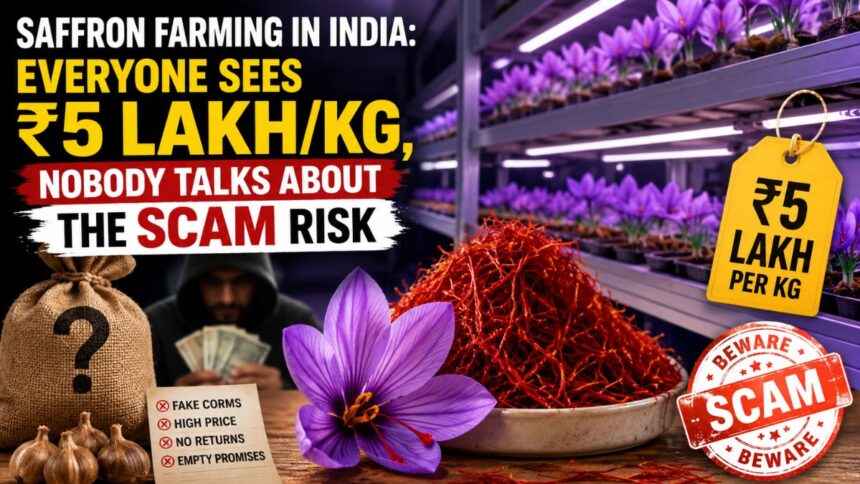
Saffron is the dried red stigma of the Crocus sativus flower. Its astonishing price — commonly ₹3–6 lakh per kilogram depending on quality and origin — comes not from magic but from brutal arithmetic: it takes roughly 1.5 lakh flowers to make a single kilogram of dried saffron, and every flower is hand-picked and every three-threaded stigma is hand-separated. It is the most labour-intensive spice on earth, and the yield by weight is tiny.
Hold that fact in mind through everything below, because it cuts both ways: the price is high, but you’re producing grams, not quintals. Saffron farming is a game of small quantities at extreme value — which is exactly why doing it well, and selling the real thing at real prices, matters so much.
Before you invest: two different businesses and a lot of hype
There are two completely different ways to grow saffron in India, and the online buzz blurs them into one fantasy:
- Traditional field cultivation, which works only in a Kashmir-like cold climate.
- Indoor aeroponic or rack-based cultivation, which can be done in a controlled room almost anywhere — and which is the subject of enormous, often misleading, hype.
And here’s the warning that this whole guide is built around: the indoor-saffron boom has attracted a lot of scams. In a gold rush, the reliable money is often made not by growing saffron but by selling the dream — overpriced or poor-quality corms, expensive “training programs,” and franchise packages sold to hopeful beginners with inflated income promises. Before you spend a rupee, understand both the real method and the real risks.
Is saffron farming profitable?
Saffron farming can be profitable because saffron is the world’s most expensive spice, selling for lakhs per kilogram. But yields are tiny, the labour is intense, and traditional growing needs a Kashmir-like climate. Indoor aeroponic farming can be done anywhere but is costly and scam-prone, so real profit depends on authentic corms, mastering the method, and selling genuine, graded saffron.
Traditional saffron farming: where it actually works
Traditional saffron needs a very specific climate — cold winters for dormancy, mild flowering conditions, and well-drained soil. In India that means Kashmir (the famous Pampore and Pulwama belt), and hill areas of Himachal Pradesh, Uttarakhand and Ladakh. Kashmiri saffron carries a GI tag and is prized worldwide.
The honest backdrop: Kashmir’s saffron production has been declining for years, with output falling substantially over the past decade or so, widely attributed to erratic weather and climate change. That decline is part of what has driven interest in indoor cultivation.
For a field grower, corms are planted around mid-year, flower in the single October–November window, and the corms multiply naturally in the soil over subsequent years — so first-year yields are low and rise as the corm population builds. It’s a genuine, time-tested system, but it’s locked to climate and geography.
Indoor aeroponic saffron: how it really works
Indoor cultivation, popularised in recent years by research including work from SKUAST-Kashmir, lets you grow saffron in a climate-controlled room by recreating the crocus’s natural cycle. In simple terms:
- Healthy, large corms are placed in trays on vertical multi-tier racks.
- They’re kept in a dark, cool room for roughly 90–100 days to simulate dormancy.
- Light and the right conditions then trigger flowering, in the same October–November window.
- The flowers are harvested and the red stigmas hand-separated and dried.
The appeal is obvious: no dependence on Kashmir’s climate, protection from bad weather, and cultivation possible in any city. But now the reality checks the hype conveniently skips:
- Corm multiplication still needs soil. This is the big one. The indoor room triggers flowering, but the corms do not bulk up and multiply properly indoors — after flowering, they generally need a soil or field growing phase to regenerate for the next cycle. So “indoor saffron” is not a fully closed, grow-forever-in-a-room loop; you still need land or a reliable corm-multiplication arrangement, or you’ll be buying fresh corms every year.
- “Multiple harvests a year” is largely misleading. The crocus corm flowers once per annual cycle. Claims of three, four or five harvests a year should be treated with heavy scepticism.
- Yields are modest, not magical. A small indoor unit produces on the order of a few hundred grams of dried saffron a year — meaningful, but not the fantasy figures in viral posts.
- Setup costs are real. A small indoor or aeroponic unit commonly runs anywhere from around ₹4 lakh to ₹10 lakh, and larger aeroponic systems considerably more, before you’ve bought your corms.
Indoor saffron is a genuine, promising technology — but it’s a high-investment, skill-heavy venture, not a shortcut.
Also Read: A2 Milk Business in India: Everyone Sees the ₹150/Litre Price but Nobody Shows You the Real Profit
The corm question and the scam you must avoid
Here is the single most important decision in saffron farming, traditional or indoor: sourcing authentic, healthy, large corms. And it’s where most people get cheated.
Only large, healthy corms (commonly around 8–10 grams and above) flower well; small or diseased corms mostly just produce leaves and no saffron. Because good corms are in limited supply — Kashmir’s corm production can’t easily meet a nationwide indoor boom — the market is full of undersized, low-quality, or diseased corms sold at inflated prices to beginners who don’t know the difference.
Protect yourself:
- Buy from genuine, verifiable growers or research-linked sources, not anonymous intermediaries promising miracles.
- Insist on large, healthy, disease-free corms and, where possible, inspect or verify them.
- Be deeply sceptical of “training + franchise + guaranteed buy-back” packages. Many exist mainly to sell you corms, courses and equipment at a markup, not to make you a saffron income. If someone’s real business is selling you the setup, their incentive isn’t your success.
- Distrust the income claims. The viral “earn several lakhs a month from a tiny room” stories are marketing, not typical results. Run your own numbers on realistic yields and real corm survival.
If you take away one thing from this guide: in saffron, the corm supplier is where fortunes are lost, so treat that relationship with extreme care.
Traditional vs indoor at a glance
| Factor | Traditional field | Indoor aeroponic / rack |
|---|---|---|
| Where it works | Kashmir, HP, Uttarakhand, Ladakh (cold climate) | Almost anywhere, in a climate-controlled room |
| Setup cost | Roughly ₹2.5–4 lakh/acre | Roughly ₹4–10 lakh for a small unit; more for larger |
| Corm multiplication | Happens naturally in the soil | Still needs a soil/field phase — not fully indoor |
| Harvest cycle | One annual flowering (Oct–Nov) | One annual flowering (claims of many are mostly hype) |
| Main risks | Climate limits, declining regional yields | High cost, corm scams, steep learning curve |
| Best suited to | Farmers in suitable hill climates | Capital-ready tech entrepreneurs with authentic corms |
How to start saffron farming, step by step
This is the practical sequence, whichever method you choose.
1. Pick your method honestly. If you’re in a suitable cold-climate region, traditional field cultivation is the proven path. Elsewhere, indoor is your only real option — go in knowing its costs and the corm-multiplication catch.
2. Source authentic corms. The make-or-break step. Secure large, healthy, disease-free corms from a verifiable source, and buy the quantity your space actually needs rather than over-committing on your first cycle.
3. Prepare the setup. For field growing: well-drained soil, correct spacing, and land preparation. For indoor: a climate-controlled room with cooling, humidity control, multi-tier racks or trays, appropriate growing media or an aeroponic misting system, and suitable lighting.
4. Plant and manage dormancy/flowering. Plant corms at the right time; indoors, manage the dark cool period and then trigger flowering with the right conditions.
5. Harvest and process by hand. Pick flowers promptly (typically early morning), separate the red stigmas carefully by hand — this is the labour-heavy heart of the crop — and handle gently to protect quality.
6. Dry and grade properly. Dry the stigmas correctly to preserve colour, aroma and flavour, then grade. Genuine grading and lab testing (against recognised quality standards such as ISO 3632) let you prove authenticity and command real prices.
7. Solve corm multiplication. Plan how your corms will regenerate — a soil/field phase or a corm-multiplication arrangement — so you’re not forced to rebuy corms every year.
8. Get licensed and certified. Obtain FSSAI registration to sell a food product, register for GST, and for exports look at APEDA and Spices Board requirements; Kashmir growers can leverage the GI tag.
9. Build your market. Because adulteration is rampant, authenticity and certification are your biggest selling assets. Sell through certified channels, direct-to-consumer, premium retail, Ayurvedic and spice buyers, procurement centres, and export routes.
The money: honest expectations
On price, genuine saffron sells for roughly ₹3–6 lakh per kilogram, with top Kashmiri grades at the higher end and much market saffron being imported. That headline number is what fuels the hype.
But temper it with reality: yields are small (grams from a room, a few kilograms per well-established acre over time), the corm investment and — for indoor — the setup are significant, harvesting and processing are intensely manual, and the price you actually get depends on proven quality and authenticity, not on the top-of-range figure. The eye-catching “₹15–35 lakh per acre” or “₹3 lakh a month from a small room” claims assume best-case yields, top prices, perfect corm performance and flawless execution — they are not what a beginner should plan around. Build your budget on conservative yields, real corm survival, and a realistic price for your grade, and you’ll make sound decisions.
Where and how to sell
Your realistic channels include the Pampore saffron market and procurement centres for Kashmir growers, direct-to-consumer and online sales, premium and specialty spice retail, Ayurvedic and food manufacturers, and export to markets like the UAE, UK and USA through proper channels. Across all of them, certified authenticity is your currency — graded, lab-tested, traceable saffron earns trust and price in a market plagued by fakes.
Government support
Saffron cultivation has institutional backing worth exploring:
- The National Saffron Mission and Jammu & Kashmir’s agriculture and horticulture departments support saffron revival, quality and infrastructure in the traditional belt.
- SKUAST-Kashmir is a key research source for both traditional and indoor methods.
- The Spices Board and APEDA support quality and export, and NABARD-linked finance may help fund infrastructure.
Support, subsidies and eligibility vary and change, and are strongest in the traditional growing region, so confirm the current position with the relevant department before relying on it.
Is saffron farming worth it?
Saffron is genuinely “red gold,” and for the right person, saffron farming can be rewarding. Traditional growers in Kashmir and suitable hill regions work a proven, GI-backed crop with real premium value. Tech-minded entrepreneurs with capital, discipline and — crucially — authentic corms and a solved multiplication plan can build a genuine indoor saffron business, riding strong and growing demand.
But be honest about the downsides before you commit:
- Yields are tiny and labour is extreme — this is grams-at-high-value, not bulk farming.
- Traditional growing is climate-locked to cold regions, with declining yields in Kashmir.
- Indoor is high-cost and not a closed loop — corm multiplication still needs soil, and “multiple harvests a year” is mostly myth.
- The corm supply is the make-or-break, and the space is full of scams selling corms, courses and franchises on inflated promises.
- The viral income figures are best-case marketing, not typical results.
The smartest way in is to treat saffron as a serious, high-skill, high-value venture: verify your climate or your indoor plan, secure authentic corms from a trusted source, start small to learn a full cycle, get proper drying, grading and certification, and sell genuine saffron on proven authenticity. Approach it that way and it can pay. Chase the “grow red gold in your spare room and get rich” advert, and you’re the one being harvested.
Frequently asked questions
Is saffron farming really profitable in India?
It can be, because saffron sells for lakhs per kilogram, but profitability is far from automatic. Yields are tiny, labour is intense, corms are costly, and prices depend on proven quality. Done well with authentic corms and real market access it can pay; done on hype and poor corms, it loses money.
Can saffron be grown outside Kashmir or indoors?
Yes. Traditional field cultivation needs a cold, Kashmir-like climate (also parts of Himachal, Uttarakhand and Ladakh), but indoor aeroponic and rack-based systems can grow saffron in a climate-controlled room almost anywhere. However, indoor setups are expensive and corm multiplication still generally needs a soil phase.
What is the biggest risk in indoor saffron farming?
Corms — both cost and authenticity — plus scams. Many “indoor saffron” schemes make their money selling overpriced or poor-quality corms, training and franchises with inflated income claims. Undersized or diseased corms won’t flower, so verifying corm quality and source is the most important thing you can do.
How much does it cost to start saffron farming?
Traditional field cultivation runs roughly ₹2.5–4 lakh per acre, while a small indoor or aeroponic unit commonly costs around ₹4–10 lakh before corms, with larger systems costing more. Corms are a major additional cost, so budget carefully and start small to limit risk.
How much saffron does one unit or acre produce?
Quantities are small: a small indoor room typically yields a few hundred grams of dried saffron a year, and a well-established field can produce a few kilograms per acre once corms have multiplied over several years. This is why realistic, conservative yield planning matters so much.
Where can I sell saffron and at what price?
Genuine saffron sells for roughly ₹3–6 lakh per kilogram through the Pampore market and procurement centres, direct-to-consumer and online, premium spice retail, Ayurvedic and food buyers, and export channels. Because fakes are common, graded, lab-tested, certified saffron earns both trust and the best prices.