



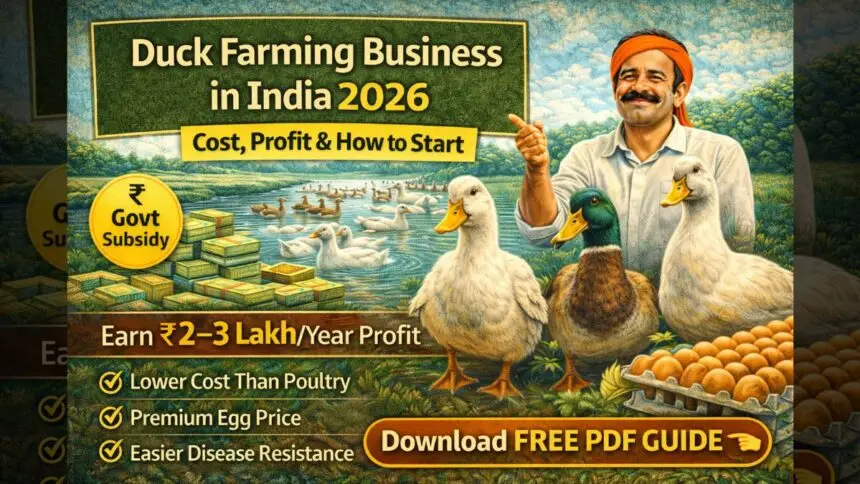
Most people who think about animal farming jump straight to chickens. And that’s exactly why duck farming is still a wide-open opportunity.
- What Is Duck Farming?
- Why Duck Farming Makes Sense in 2026
- Best Duck Breeds for Farming in India
- Duck Farming Cost Breakdown (India-Specific, 2026)
- Profit Potential: How Much Can You Actually Earn?
- Step-by-Step Guide to Starting a Duck Farming Business
- Step 1: Plan Your Scale and System
- Step 2: Set Up the Housing
- Step 3: Source Ducklings from Certified Suppliers
- Step 4: Feed Management
- Step 5: Health and Vaccination
- Step 6: Start Egg Collection and Marketing
- Step 7: Sell Through Multiple Channels
- Agro Potli Daily Plant Audit Tool
- Government Subsidies You Should Know About in 2026
- Real Success Story: Suresh Mandal from West Bengal
- Expert Tips for Duck Farming Success
- Common Mistakes to Avoid
- Duck Farming vs. Chicken Farming: Which Is Better?
- Is Duck Farming Worth Starting in 2026?
- Frequently Asked Questions (FAQs)
While everyone is chasing the broiler and layer chicken market, smart farmers across West Bengal, Kerala, Assam, and Tamil Nadu are quietly building steady incomes from duck farming — with lower disease risks, lower mortality rates, and premium-priced eggs that outsell regular chicken eggs in many local markets.
If you have even half an acre of land near a water source, a modest budget, and the willingness to learn, a duck farming business could genuinely change your financial situation in 2026. This guide will walk you through everything — what it costs, what you earn, how to start, and what mistakes will kill your profit before you even begin.
What Is Duck Farming?
Duck farming means raising ducks commercially for eggs, meat, or both. It is considered a strong alternative to chicken poultry farming and is especially well-suited for wetland and semi-wetland regions of India.
Ducks comprise only about 4–5% of the total poultry population in India but contribute 6–7% of total eggs produced. That gap tells you something important — the market is growing, but the competition is still low.
There are three main systems of duck rearing in India:
Backyard System — Small-scale, with ducks roaming freely. Good for 20–50 birds. Very low cost, ideal for beginners.
Extensive System — Ducks are allowed to feed in paddy fields and natural water sources during the day, collected at night. This works well in rural areas with open land.
Intensive/Stall-Fed System — Ducks are housed fully and fed commercial rations. Higher cost, but higher control over production and better suited for 200+ bird operations.
Why Duck Farming Makes Sense in 2026
Before you invest a single rupee, here’s why this business genuinely makes sense:
Fewer diseases, less stress. Ducks show around 50% higher resistance to common poultry diseases like Ranikhet compared to chickens, reducing medical expenses and risk significantly.
Higher egg production. Khaki Campbell ducks lay up to 300 eggs per year, compared to around 250 eggs per year by most desi hens.
Longer productive life. Ducks lay eggs for 2–3 years, which is considerably longer than most chicken breeds.
Lower feed costs. Ducks can obtain up to 30–35% of their daily nutrition from natural scavenging — snails, insects, and plants — making them ideal for paddy field integration and low-input farming.
Multiple income streams. Beyond eggs and meat, you can sell duck feathers for around ₹60/kg to cloth makers, manure for ₹6/kg to farms, or pickled eggs for ₹16 each, adding up to ₹18,000 extra per year.
Integrated farming advantage. Ducks can be integrated with rice farming, where they help control pests and weeds while fertilizing the fields with their droppings — a genuinely sustainable and cost-saving practice.
Best Duck Breeds for Farming in India
Choosing the wrong breed is the fastest way to waste your investment. Here are the top choices:
Khaki Campbell — The best choice for egg production. Lays up to 300 eggs per year. Adaptable, hardy, and widely available across India.
Indian Runner — Another excellent egg producer. Upright posture, active foragers. Works very well in paddy-integrated farming.
Pekin (White Pekin) — The go-to breed for meat production. Pekin is a multi-purpose breed raised for both meat and eggs due to its docile and affectionate behaviour. Reaches market weight quickly.
Muscovy — Good for both meat and eggs. Hardy bird that adjusts well to different climates.
Rule of thumb: If your goal is egg production, start with Khaki Campbell or Indian Runner. If you want to target restaurants and meat markets, go with Pekin.
Duck Farming Cost Breakdown (India-Specific, 2026)
Here is a realistic cost estimate for starting a 200-duck operation, which is a good beginner scale:
One-Time Setup Costs
| Item | Estimated Cost (₹) |
|---|---|
| Duck shed construction (basic, 400 sq ft) | ₹25,000 – ₹35,000 |
| 200 ducklings (at ₹70–₹90 each) | ₹14,000 – ₹18,000 |
| Feeders, waterers, equipment | ₹5,000 – ₹8,000 |
| Small water pond/trough setup | ₹3,000 – ₹5,000 |
| Total Setup Cost | ₹47,000 – ₹66,000 |
Monthly Running Costs (200 Ducks)
| Item | Monthly Cost (₹) |
|---|---|
| Feed (rice bran, grains, mash) | ₹8,000 – ₹12,000 |
| Medicines and vitamins | ₹800 – ₹1,200 |
| Labour (1 worker part-time) | ₹3,000 – ₹5,000 |
| Electricity and water | ₹500 – ₹800 |
| Monthly Total | ₹12,300 – ₹19,000 |
Annual Running Cost: approximately ₹1.5 lakh – ₹2.3 lakh
If you integrate with paddy fields or allow free-range foraging, your feed costs can drop by 25–30%, bringing the annual operating cost down meaningfully.
Profit Potential: How Much Can You Actually Earn?
Let’s break this down with real numbers for a 200-duck operation.
Egg Production Income
- 150 laying ducks (assuming some are meat birds) × 280 eggs/year = 42,000 eggs
- Duck eggs sell for ₹8–₹12 each in most Indian markets (sometimes higher in cities)
- At ₹10/egg average: 42,000 × ₹10 = ₹4,20,000/year
Meat Income
- Remaining 50 ducks sold as meat birds × 2.5 kg each = 125 kg
- Duck meat sells at ₹200–₹350/kg in wholesale
- At ₹250/kg: 125 × ₹250 = ₹31,250
Total Annual Income: approximately ₹4,50,000
Subtract annual operating cost of ₹2,00,000
Net Profit: ₹2,50,000 – ₹3,00,000 per year from 200 ducks.
You can expect 30–45% profit margins in duck farming if feeding is managed well. For small farms, net profits can reach ₹80,000+ per year even at the 100-duck level.
Your return on investment (ROI) typically kicks in by month 10–14 if you manage feed costs through partial free-range grazing.
Step-by-Step Guide to Starting a Duck Farming Business
Step 1: Plan Your Scale and System
Decide whether you want to start with 50, 100, or 200 ducks. For a complete beginner, 100 ducks is a safe starting point. Decide on backyard, extensive, or intensive rearing based on your land and water access.
Step 2: Set Up the Housing
Ducks don’t need elaborate housing. A simple bamboo and corrugated tin shed works well.
- Allow 3–4 square feet per duck
- Keep the floor elevated about 1 foot from the ground
- Ensure good ventilation and sunlight
- Place the shed near a water source — a small pond, canal, or even a concrete trough
Step 3: Source Ducklings from Certified Suppliers
You can buy ducklings from the Central Poultry Development Organisation (CPDO) in Bangalore, local hatcheries, or Krishi Vigyan Kendras (KVKs) in your district. Always buy from disease-free, certified sources.
Step 4: Feed Management
A proper feeding schedule makes the single biggest difference in your profit margin.
- Week 1–3 (Starter phase): High-protein mash (20–22% protein)
- Week 4–8: Grower ration with rice bran, corn, and soybean
- Post-8 weeks (Layer phase): Layer mash with added calcium (shell grit) for egg production
Allow foraging time in paddy fields or open areas. This alone cuts feed costs by ₹2,000–₹4,000 per month for a 200-duck flock.
Step 5: Health and Vaccination
Regular health check-ups and vaccinations are crucial to prevent diseases like Duck Plague, Duck Cholera, and Avian Influenza. Consult your nearest government veterinary officer for a vaccination schedule. Prevention costs far less than treatment.
Step 6: Start Egg Collection and Marketing
Ducks generally start laying eggs at 6–7 months of age. Collect eggs in the early morning. Store in a cool, dry place. Duck eggs stay fresh for up to 3 weeks without refrigeration, giving you more marketing flexibility than chicken eggs.
Step 7: Sell Through Multiple Channels
- Local markets and weekly haats
- Hotels, bakeries, and restaurants (duck eggs are prized in baking)
- Direct-to-consumer via WhatsApp groups
- Joining a Farmer Producer Organisation (FPO) for better price negotiation
Agro Potli Daily Plant Audit Tool
Government Subsidies You Should Know About in 2026
This is where many farmers leave money on the table.
National Livestock Mission (NLM): The NLM scheme offers a capital subsidy of up to 50% for livestock ventures including poultry and duck farming. https://aimindia.in/ Applications are made online at www.nlm.udyamimitra.in.
NABARD Poultry Scheme: NABARD provides 25% of the total outlay as back-ended capital subsidy for general category farmers, and 33.33% for SC/ST applicants, hill regions, and North Eastern states.
Kisan Credit Card (KCC): Can be used for working capital — feed, medicine, labour costs.
Animal Husbandry Infrastructure Development Fund (AHIDF): Provides a loan up to 90% of the estimated project cost with an interest subvention of 3% for eligible entities including individual entrepreneurs and FPOs. Department of Animal Husbandry and Dairying
Visit your nearest District Agriculture Office or Krishi Vigyan Kendra to understand which scheme fits your situation best.
Real Success Story: Suresh Mandal from West Bengal
Suresh Mandal, a marginal farmer from Nadia district, West Bengal, started duck farming in 2021 with just 100 Khaki Campbell ducks and a loan of ₹60,000 from a cooperative bank. He integrated duck rearing with his 1-acre paddy field, allowing ducks to forage freely during the day.
By the end of his first year, his ducks were producing 250+ eggs per day. He sold eggs directly to local bakeries and tea stalls at ₹10 each. His gross income in year one was over ₹2.8 lakh, and after deducting costs, his net profit was nearly ₹1.2 lakh — more than double what he earned from paddy farming that same year.
In 2023, he scaled to 300 ducks, applied for a subsidy under the NLM scheme, and today earns approximately ₹3.5 lakh annually from his integrated duck-paddy farm. He now employs two workers from his village full-time.
His advice: “Start small, learn the feeding properly, and never skip the vaccination schedule. The rest takes care of itself.”
Expert Tips for Duck Farming Success
- Match breed to your goal. Don’t buy Pekin when you want eggs. Don’t buy Khaki Campbell when you want meat. Seems obvious, but it’s a common beginner mistake.
- Water management is critical. Ducks need water not just for drinking but to wet their feed and keep nasal passages clean. A shallow trough or small pond is enough — you don’t need a full swimming lake.
- Never crowd the shed. Overcrowding triggers stress, disease, and reduced egg production. Stick to 3–4 sq ft per duck.
- Track your feed conversion ratio. For every kg of feed, a well-managed duck should gain 2.5–3 kg of body weight (for meat birds) or produce 3–4 eggs (for layers). If your ratio is off, check your feed quality first.
- Build a buyer relationship before you scale. Know where you will sell 200 eggs per day before you expand your flock to 300 birds.
Common Mistakes to Avoid
Buying ducklings from unknown sources. Disease enters your farm through unhealthy birds. Always buy from certified hatcheries or KVKs.
Ignoring ventilation in the shed. Poor airflow leads to respiratory infections, especially in humid regions. Build ventilation into your shed design from day one.
Mixing young ducklings with adult birds. Age segregation is non-negotiable. Young ducklings get bullied, eat less, and grow poorly when housed with adults.
Skipping vaccinations to save money. Duck Plague can wipe out an entire flock in days. The ₹500–₹800 vaccination cost protects a ₹90,000 investment.
Relying on a single buyer. If your one hotel buyer stops purchasing, your entire cash flow stops. Always have at least 3–4 buyers lined up.
Not accounting for seasonal demand dips. Egg sales tend to peak in winter and can fall around 8% during summer months. Plan your flock cycle and cash reserves accordingly.
Duck Farming vs. Chicken Farming: Which Is Better?
| Factor | Duck Farming | Chicken Farming |
|---|---|---|
| Disease Resistance | Higher | Lower |
| Startup Cost | Lower | Moderate |
| Egg Price | ₹8–₹12 (premium) | ₹5–₹7 |
| Laying Period | 2–3 years | 1–1.5 years |
| Feed Cost | Lower (free-range) | Higher |
| Market Availability | Regional | Pan-India |
| Water Requirement | Moderate | Low |
Duck farming wins on unit economics and disease resilience. Chicken farming wins on market reach and buyer familiarity. If you are in a water-accessible, rural region — especially in eastern or southern India — ducks have a clear advantage.
Is Duck Farming Worth Starting in 2026?
Yes — with a clear plan, it absolutely is.
Duck farming is not a get-rich-quick scheme. But it is a genuine, low-risk, scalable rural business that suits marginal farmers, agri-entrepreneurs, and even those starting with a limited budget under ₹1 lakh.
The numbers work. The biology works — ducks are hardy, disease-resistant, and productive for years. The market demand is growing, particularly for premium duck eggs in urban centres and the food processing industry.
Start with 100–150 ducks, focus on mastering feed management, secure at least 3 buyers before you expand, and take advantage of government subsidies through the NLM portal. Within 12–18 months, you will have a solid second income stream — or potentially your primary one.
Frequently Asked Questions (FAQs)
Q1. How much does it cost to start duck farming in India? A beginner can start a 100-duck operation for ₹50,000–₹65,000, covering shed construction, ducklings, feed for the first two months, and basic equipment. A 200-duck setup costs approximately ₹90,000–₹1,10,000 as a one-time investment.
Q2. Which duck breed is best for egg production in India? The Khaki Campbell is the top choice for egg production in India. It lays up to 300 eggs per year, adapts well to different climates, and is available across most states. Indian Runner is the second-best option for egg farming.
Q3. Is duck farming profitable in India? Yes. A well-managed 200-duck farm can generate a net profit of ₹2.5–₹3 lakh per year. Margins improve significantly when ducks are integrated with paddy farming, reducing feed costs by 25–35%.
Q4. Do I need a water pond for duck farming? A large swimming pond is not mandatory, but access to water is important. A concrete trough or a small dug pond is sufficient. Ducks use water to wet their feed, clean their eyes and nostrils, and regulate body temperature.
Q5. What government subsidies are available for duck farming in 2026? The National Livestock Mission (NLM) offers a capital subsidy of up to 50% of project cost. NABARD provides 25% back-ended subsidy for general category (33.33% for SC/ST). Apply online at www.nlm.udyamimitra.in or contact your nearest Krishi Vigyan Kendra for guidance.