




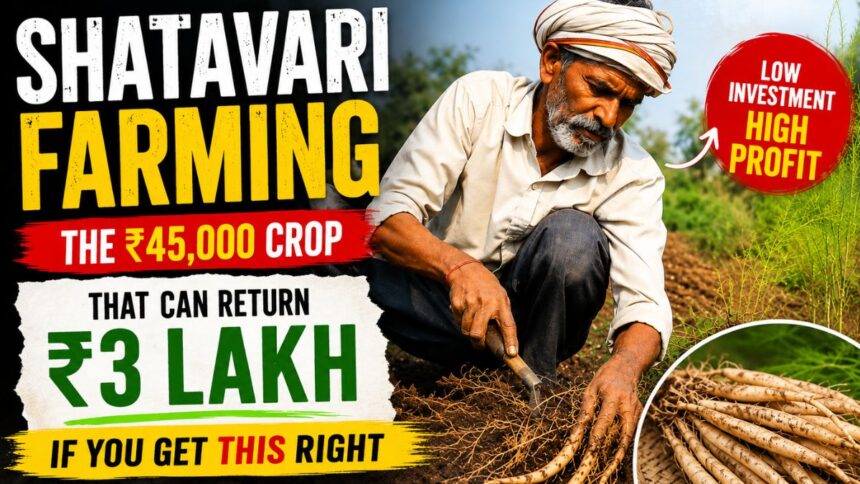
A herb trader in Neemuch once rejected an entire truckload of dried roots because the moisture reading came in at 13% instead of under 10%. The farmer behind that truck had put in nearly two years of work, and he lost the premium rate in one afternoon at the weighing gate.
That’s the real risk hiding inside Shatavari farming. It’s not the crop that trips people up, it’s everything that happens after you dig it out of the ground.
I’ve spent time talking to growers and KVK officers in Madhya Pradesh’s medicinal plant belt, where Shatavari has quietly become a serious cash crop for farmers willing to wait. This article is everything I’d tell a farmer sitting across from me, deciding whether to put one acre into this root for the next two seasons.
What Shatavari Actually Is
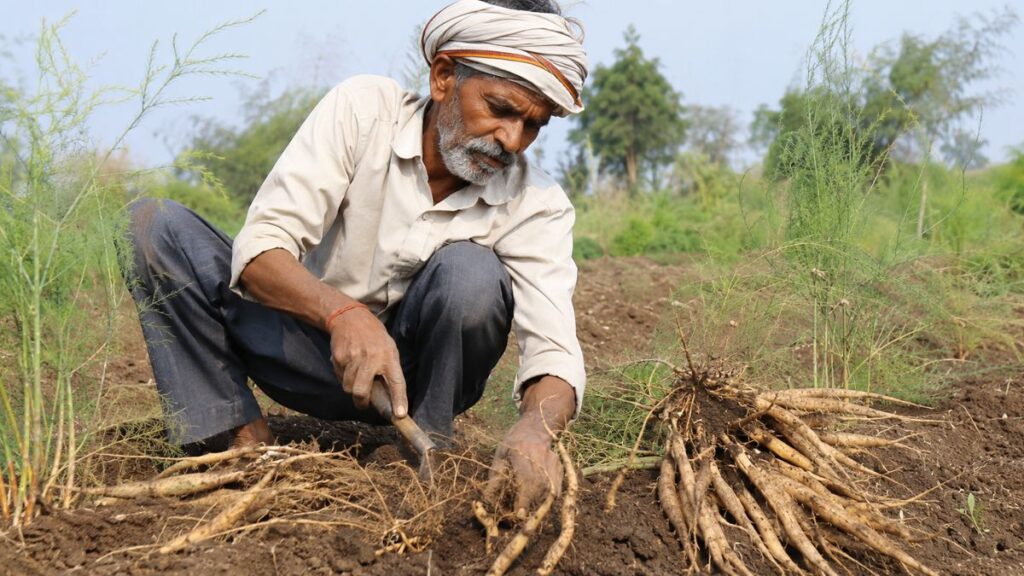
Shatavari (botanical name Asparagus racemosus) is a climbing, thorny medicinal herb grown almost entirely for its tuberous roots. It’s one of the most widely used ingredients in Ayurvedic formulations, valued for its use in women’s health and general wellness products.
Unlike a vegetable or grain crop, you’re not selling Shatavari into a mandi that handles wheat or soybean. You’re selling into a separate, smaller, more specialised trade, herbal traders, Ayurvedic manufacturers, and medicinal plant processing units. That distinction matters for everything that follows, especially where you sell and how prices move.
Why Indian Farmers Are Looking At This Right Now
Three things are pulling farmers toward Shatavari farming at the moment.
First, India’s AYUSH and herbal product exports were valued at roughly ₹5,110 crore (about $580.7 million) between April 2025 and February 2026, according to data cited by IBEF. The domestic Ayurveda market is also growing fast, with industry estimates putting it in double-digit CAGR territory through the early 2030s.
Second, the government has made Shatavari one of its formally prioritized medicinal plants. It sits on the National Medicinal Plants Board’s (NMPB) list under the National AYUSH Mission, which means structured subsidy support exists, something that isn’t true for most crops a farmer might be considering as an alternative.
Third, the current market rate gives a real reference point. At Neemuch mandi in Madhya Pradesh, the country’s largest hub for medicinal plant trade, Shatavari was quoting between ₹270 and ₹315 per kg as of mid-June 2026. Trade listings on B2B platforms show a wider spread, from roughly ₹150/kg for lower-grade dried root up to ₹500–880/kg for cleaner, well-processed material. That spread alone tells you how much post-harvest handling affects what you actually get paid.
Cost to Start: Per Acre, 2025–26 Rates
Shatavari is not a single-season crop. It stays in the ground for 18 to 24 months before the roots are mature enough to dig. So this cost covers the full cycle, not one year.
- Seed/planting material: ₹6,000 (around 400–600g of seed per acre, treated before sowing)
- Land preparation: ₹6,500 (ploughing and harrowing to fine tilth, raised beds)
- Farmyard manure/organic inputs: ₹9,000 (10–15 tonnes/acre is the standard recommendation for this crop)
- Fertiliser (N, P, K): ₹3,500
- Labour (planting, weeding, harvest, processing): ₹16,000 (spread across the full 18–24 month cycle)
- Irrigation: ₹2,500 (Shatavari has low water needs once established)
- Misc/contingency: ₹2,000
Total: approximately ₹45,500 over the full crop cycle
This is on the higher end of what I’d plan for. For reference, NMPB’s own official cost-of-cultivation figure for Shatavari under the National AYUSH Mission is ₹30,250 per acre, and Shatavari is listed as eligible for a 30% subsidy on that cost, which works out to roughly ₹9,075/acre if you qualify and get approved through your State Medicinal Plants Board. The gap between NMPB’s figure and a fuller real-world budget usually comes down to land lease costs (₹5,000–15,000/acre if you don’t own the land) and labour rate differences by region, so treat ₹30,000–45,000/acre as the realistic band, not a fixed number. [ESTIMATE: actual subsidy disbursement timelines and approval rates vary by state and were not independently verified for this article.]
Agro Potli Daily Farm Expense Tracker
Realistic Income: Two Scenarios
I’m not going to promise you a windfall here. Two genuinely different outcomes are possible depending on yield and the price you land.
Conservative scenario Assume a dry root yield of 500 kg/acre (the lower end of the verified range) sold at ₹280/kg, close to the current Neemuch mandi rate.
- Gross revenue: ₹1,40,000
- Minus cultivation cost (~₹40,000): Net return ≈ ₹1,00,000 over the 18–24 month cycle
Optimistic scenario Assume a dry root yield of 700 kg/acre (achievable with good soil, proper FYM, and disease-free planting material) sold at ₹500/kg, near the top end of premium trade rates for clean, well-dried material.
- Gross revenue: ₹3,50,000
- Minus cultivation cost (~₹40,000): Net return ≈ ₹3,10,000 over the 18–24 month cycle
Spread across two years, that’s roughly ₹50,000–₹1,55,000 per acre per year, depending entirely on where you land. The gap between the two scenarios is almost entirely about post-harvest quality and who you sell to, not luck.
Step-by-Step Growing Guide
Land and soil: Medium black soil or sandy loam with good drainage works best. Shatavari roots rot fast in waterlogged or heavy clay soil, so drainage is non-negotiable.
Planting time: Transplanting is done in June–July, timed with the onset of the monsoon, this lines up with the start of the Kharif season in most Shatavari-growing belts.
Seed treatment: Soak seeds in cow urine for 24 hours before sowing in nursery beds. This is standard practice cited across extension material and helps with germination and reduces soil-borne disease risk.
Spacing: Once seedlings reach about 45cm, they’re transplanted into the main field at roughly 60cm x 60cm spacing on raised beds.
Nutrients: Roughly 24kg Nitrogen, 32kg Phosphorus, and 40kg Potash per acre, applied in split doses rather than all at once.
Irrigation: Light irrigation right after planting and during establishment. After that, the crop needs surprisingly little water, irrigate every 10–12 days in summer and every 20–25 days in winter. Over-watering is a bigger risk than under-watering.
Harvest: Roots are dug out carefully after 18–24 months, usually around October–November when the foliage starts turning pale yellow, a sign the roots have matured. Dig gently to avoid damaging the main rootstock, since broken or bruised roots fetch a lower grade.
Post-harvest processing: Wash, slit, and sun-dry the roots for 4–5 days. Moisture content must come down below 10% before storage or sale, this is the exact threshold that cost the Neemuch farmer his premium price.
Where To Sell
This is where most first-time growers underestimate the work involved.
- Neemuch and Mandsaur mandis (Madhya Pradesh): These are the established trading hubs for medicinal plants in India, with the infrastructure and buyer density to handle Shatavari specifically.
- State Medicinal Plants Boards: NMPB operates through 37 state-level boards. They’re worth contacting before you plant, not after, they can connect you to subsidy approval and buyback arrangements.
- Buyback agreements with AYUSH/herbal industry: NMPB has signed MoUs with Ayurvedic industry bodies to encourage buyback arrangements at a pre-decided price and volume. This is the single best way to de-risk the price uncertainty in this crop, and it’s worth pursuing through your local KVK or State Medicinal Plants Board before you commit an acre.
- FPOs: If there’s a Farmer Producer Organisation handling medicinal plants in your district, selling through them usually gets you better grading support and slightly better realisation than going it alone to a trader.
- Direct to Ayurvedic processing units: Larger players source raw material directly, but they expect consistent quality and volume, not a good fit for a first-time, single-acre grower.
What Goes Wrong
No government MSP, unlike food grains. Shatavari prices are set entirely by trader and industry demand. There’s no price floor to fall back on if the market softens in a given season.
Root rot from waterlogging. This is the most common failure I hear about, and it’s almost always a drainage problem, not a disease problem. Poor field selection is the root cause, literally.
Capital locked up for 18–24 months with zero interim income. Unlike a vegetable crop where you get cash flow every few months, Shatavari gives you nothing until harvest. If you need income along the way, this crop alone won’t provide it, you need another income source or intercropping plan running alongside it.
Selling without a buyer lined up first. Farmers who plant first and figure out where to sell later often end up accepting whatever the nearest trader offers, frequently at the low end of the price range. Lining up a buyback or FPO arrangement before transplanting is the single biggest lever you have over your final price.
Who Should – And Shouldn’t – Try This
Good fit: Farmers with access to a State Medicinal Plants Board or FPO connection for buyback support, marginal or semi-arid land that isn’t ideal for high-water crops, and the patience to wait 18–24 months without needing that land’s income sooner.
Not a good fit: Anyone needing quick cash flow, anyone working clay-heavy or waterlogging-prone land, or anyone planning to plant first and worry about buyers later. This crop punishes that order of operations specifically.
One honest caution: yield and price figures for Shatavari vary a lot across sources, and some viral farming articles quote numbers that don’t hold up against basic drying-loss math. Treat any number you read, including the ones in this article, as a planning range, not a guarantee, and verify against your local KVK’s experience before committing real money.
Where This Works Best, Regionally
Madhya Pradesh’s Neemuch–Mandsaur–Ratlam belt is the established center of gravity for Shatavari, mainly because the trading and processing infrastructure already exists there. Parts of Uttar Pradesh, Maharashtra, Chhattisgarh, and Rajasthan also support it well, given similar semi-arid conditions and medium black or sandy loam soils. Some hill regions in Tamil Nadu, like the Kolli hills, grow it too, though market access there is thinner than in MP.
FAQs
How many months does Shatavari take to give a harvest?
Shatavari is typically harvested 18 to 24 months after transplanting, once the roots have matured and the foliage starts turning pale yellow.
What is the current price of Shatavari per kg?
As of mid-2025–26, mandi rates at Neemuch (Madhya Pradesh) were around ₹270–315/kg for dried root, while cleaner, well-processed trade-grade material has sold for ₹500/kg or more.
Is there a government subsidy for Shatavari farming?
Yes. Shatavari is listed under the National Medicinal Plants Board’s prioritized species under the National AYUSH Mission, with a 30% subsidy available on its official cultivation cost of ₹30,250/acre, subject to approval through your State Medicinal Plants Board.
Where can farmers sell Shatavari roots in India?
The main options are medicinal plant mandis like Neemuch and Mandsaur in MP, State Medicinal Plants Board–facilitated buyback arrangements with Ayurvedic industry players, FPOs handling medicinal plants, and direct sale to herbal processing units for larger, consistent-quality lots.
This is a sensitive financial decision involving real investment risk. The figures above are planning estimates based on government and trade data available as of mid-2026; actual yields, prices, and subsidy outcomes vary by region, soil, and season. Consult your local KVK or State Medicinal Plants Board before committing land or capital.