




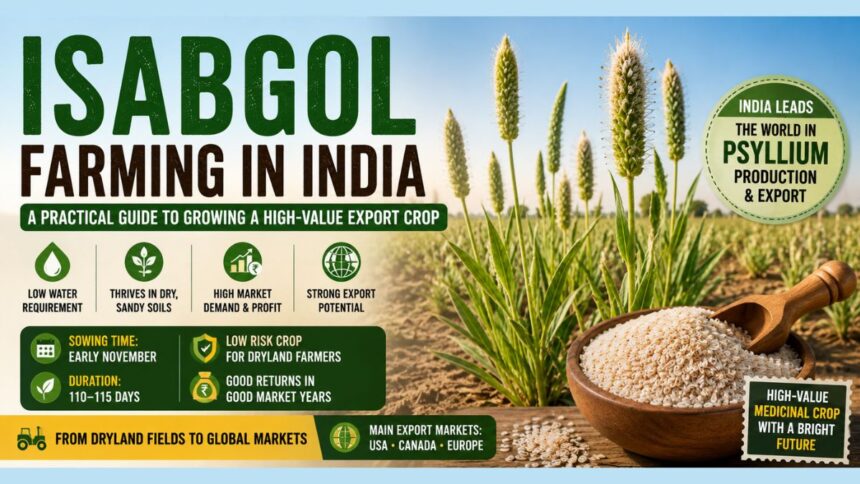
If you farm in a dry, cool-winter region and you’re tired of low-margin cereals, isabgol (psyllium) is worth a serious look. This guide is for farmers and agri-entrepreneurs in Gujarat, Rajasthan, Madhya Pradesh and neighbouring belts who want the honest picture — where isabgol makes sense, what it actually costs to grow, what can go wrong, and how the money moves once your seed leaves the field.
- What is isabgol and why does it matter?
- Is isabgol farming profitable?
- Also Read: Neem Plantation Business: The Truth About Profits, Income & Why Most Farmers Get It Wrong
- Where isabgol grows — and whether your land is suitable
- Choosing a variety
- How to grow isabgol: the field steps
- The weather risk you cannot ignore
- Harvesting, drying and the seed-versus-husk question
- The economics: costs, yields and returns
- Where and how to sell
- Government support and where to check
- Is isabgol farming worth it? An honest verdict
- Frequently asked questions
What is isabgol and why does it matter?
Isabgol is the Indian name for Plantago ovata, the plant whose seed husk is sold worldwide as psyllium — the natural fibre used in laxatives, digestive-health supplements, and a growing list of food products. It is a short-stemmed Rabi (winter) herb, and the husk that coats the seed is the real prize: it’s what pharmaceutical and food companies pay a premium for.
The reason this crop is interesting for Indian farmers is simple: India grows and exports the overwhelming majority of the world’s psyllium, with the bulk of production shipped to the United States, Canada, and Europe. That export pull is what keeps isabgol prices well above ordinary Rabi crops in good years — and it’s also why those prices swing so much.
Is isabgol farming profitable?
Isabgol farming can be profitable in dry, cool-winter regions like Gujarat and Rajasthan, where it needs little water and sells into a strong export market. But returns depend heavily on volatile seed prices and on avoiding unseasonal rain near harvest, which can shatter the crop and wipe out much of your income in a single bad spell.
That two-sided answer is the honest one. Below, we break down both halves so you can decide whether your land, climate, and risk appetite fit.
Also Read: Neem Plantation Business: The Truth About Profits, Income & Why Most Farmers Get It Wrong
Where isabgol grows — and whether your land is suitable
Isabgol is grown mainly in Rajasthan, Gujarat, and parts of Madhya Pradesh and Haryana. Rajasthan carries a large share of the cultivated area — districts in the western arid belt like Barmer, Jalore, Nagaur, Jodhpur and Jaisalmer are strongholds — while Gujarat is the processing and trading heart of the crop through the Unjha mandi.
What makes the crop attractive is exactly what makes those regions suit it: isabgol thrives on light, well-drained, low-fertility soils and needs very little water. It’s one of the few genuinely rewarding options for sandy, marginal land where cereals struggle.
Your land is a good fit if:
- Soil is sandy loam or loam, well-drained, with a slightly alkaline pH (roughly 7.3–8.4). Heavy, water-retaining, or poorly drained soils are a poor match.
- Climate gives you cool, dry winters and — critically — dry, sunny, rain-free weather during the maturity and harvest window. This is the single biggest condition.
- Water is limited. Isabgol is a low-irrigation crop, which is a real advantage where borewell water or canal supply is tight.
If your area gets untimely winter rain, heavy dew, or humid cloudy spells around February–March, treat isabgol with caution. That climate is the crop’s biggest enemy, as we’ll see.
Choosing a variety
Several improved varieties are available, differing in seed yield, husk recovery and disease tolerance. Rather than chasing the “highest yield” number, pick a variety proven in your district and buy certified seed from a reliable source.
| Variety | Notes | Suited to |
|---|---|---|
| Gujarat Isabgol-1 (GI-1) | Older, widely adapted line; broadly grown | Gujarat, Rajasthan, MP |
| Gujarat Isabgol-2 (GI-2) | Higher yield potential than GI-1 | Gujarat, Rajasthan |
| Gujarat Isabgol-3 (GI-3) | Improved Gujarat selection | Gujarat belt |
| Haryana Isabgol-5 (HI-5) | Reported higher yields | Haryana, north-west |
| RI-89 | Developed for Rajasthan arid conditions | Rajasthan |
| Jawahar Isabgol-4 (JI-4) | Central India line | Madhya Pradesh |
| Niharika | Improved variety | Multiple states |
Confirm the current recommended variety and certified-seed source for your district with your local Krishi Vigyan Kendra (KVK) or state agricultural university before buying [VERIFY: check the latest district-recommended variety and package of practices with your KVK/SAU].
How to grow isabgol: the field steps
Sowing time
This is where many first-timers lose money. The ideal sowing window is early winter — around the first week of November in most of the growing belt. Sow too early and you invite disease; sow too late and the crop matures into warmer, riskier weather and is more prone to shattering. Fixing the sowing date to your local season is more important than almost anything else you’ll do.
Land preparation and seed rate
Prepare a fine, weed-free, well-levelled seedbed with beds laid out so irrigation is easy and even. Work in well-rotted farmyard manure during land preparation. Because the seed is tiny, it’s usually broadcast after mixing with fine sand or sieved manure to spread it evenly, then covered very lightly — deep burial hurts germination.
Irrigation
Give the first irrigation immediately after sowing; germination typically begins within a few days. After that, isabgol needs only a handful of light irrigations across the season — far fewer than most cereals. Avoid over-watering, which encourages disease and lodging.
Nutrition and weeding
Base nutrition on your soil test rather than a fixed recipe. A light dose of nitrogen and phosphorus, on top of the farmyard manure worked in earlier, is typical. Plan for two to three hand weedings in the early stages, when weeds compete hardest with the slow-starting crop.
The main disease to watch
Downy mildew is the key disease risk. It shows up in cool, humid, cloudy conditions and can spread fast. Scout the crop regularly, avoid excess irrigation, and follow locally recommended, approved control measures. Aphids can also appear and are worth monitoring.
The weather risk you cannot ignore
Isabgol has one dangerous weakness, and every serious grower needs to understand it before planting: the crop is extremely sensitive to moisture at maturity. A mild dew, a cloudy humid spell, or a light shower just before or during harvest can cause the seed to shatter and fall — literally shedding your yield onto the ground.
This is why sowing on time matters so much, why harvesting is done in the cool of the morning, and why isabgol is a poor choice for regions with unreliable late-winter or early-spring rain. There is no spray that fixes shattering; the defence is good timing, the right variety, and honest realism about your local weather. Plan as if one badly timed rain could take a chunk of your income — because it can.
Harvesting, drying and the seed-versus-husk question
The crop matures in roughly 110–115 days depending on variety. Harvest in the cool morning to reduce shattering, then thresh, clean, and dry the seed thoroughly before storage or sale. Good drying and clean, dry storage directly protect both your quality grade and your price.
Here’s a distinction that shapes the whole business: farmers sell seed, but the money in the value chain sits in the husk. The husk is only a fraction of the seed’s weight [VERIFY: confirm typical husk recovery, commonly around 25–30%], which is why de-husking and processing are done by specialised units — mostly around Unjha — and why processed husk commands a far higher price than raw seed. As a grower, you’re selling the raw material into that chain, not the finished psyllium on the pharmacy shelf. Knowing that keeps expectations grounded.
The economics: costs, yields and returns
Let’s put real ranges on the table — with a clear warning. Every number here is an estimate that varies by region, season, variety and, above all, market price. Do not plan your finances on these figures; use them to sanity-check your own local numbers.
Typical seed yield is commonly around 700–1,200 kg per hectare (7–12 quintal/ha), with well-managed improved varieties reaching the higher end. Cost of cultivation is moderate for a Rabi crop.
Illustrative economics per hectare (estimates only — verify locally):
| Item | Conservative season | Favourable season |
|---|---|---|
| Seed yield | ~7 quintal/ha | ~11 quintal/ha |
| Mandi price | lower end of range | higher end of range |
| Gross income | modest | strong |
| Cost of cultivation | ₹25,000–35,000 [VERIFY] | ₹25,000–35,000 [VERIFY] |
| Net return | modest / can be thin | can be very good |
The gap between those two columns is not mainly about your farming skill — it’s about price. And isabgol prices move a lot. As a reference point, seed traded in the Unjha market in the ₹11,000–13,000 per quintal range in the early-2026 season [VERIFY: check today’s rate on Agmarknet / Unjha APMC before planning], but the crop has seen both much softer years and sharp spikes. Because the market is export-driven, global demand, the rupee, and the size of the domestic harvest all push the number around.
The practical takeaway: treat isabgol as a good crop in strong years and a modest one in weak years, not as a fixed-income crop. Dry your seed well, store it properly, and sell when rates are favourable rather than dumping at the first arrival price.
Where and how to sell
Most isabgol funnels through a fairly concentrated chain. Farmers sell in a local mandi or to a village-level trader; from there, the bulk of the crop makes its way to the Unjha mandi in Gujarat, the country’s main psyllium hub, where processors and de-husking units buy it. From processors, the husk moves into export, pharmaceutical, and food channels, with the large majority of production ultimately exported.
For you as a grower, that means:
- Price discovery is centralised. Watch Unjha and Agmarknet rates, not just your nearest small mandi.
- Quality and moisture matter. Clean, well-dried seed grades better and fetches more.
- Selling on the spike is a real strategy. Because prices swing, timing your sale can matter as much as your yield.
Government support and where to check
Isabgol is recognised as a priority medicinal crop by the National Medicinal Plants Board (NMPB) under the Ministry of Ayush, which supports cultivation, post-harvest handling and training — usually delivered through State Medicinal Plants Boards. State agriculture and horticulture departments in the main growing states also run relevant schemes from time to time.
Support levels, eligibility and application processes change and vary by state, so don’t rely on any fixed figure you read online. Apply and confirm current assistance through your district agriculture office or State Medicinal Plants Board [VERIFY: confirm current scheme, rate and eligibility at your district office / state board].
Is isabgol farming worth it? An honest verdict
For the right farmer, in the right place, isabgol is one of the more rewarding Rabi options — it uses land and water that cereals waste, feeds a genuine export market, and can deliver strong returns in a good price year.
But it is not a safe, set-and-forget crop, and anyone selling it that way isn’t being straight with you. Weigh the downsides honestly:
- Price volatility is the headline risk. Returns are tied to a global, export-driven market you can’t control.
- Weather sensitivity at harvest is brutal. One badly timed rain or humid spell near maturity can shatter the crop.
- It’s climate- and soil-specific. Outside cool, dry-winter, well-drained regions, it’s a poor fit.
- Downy mildew demands active scouting and management.
- The value sits downstream. You sell raw seed; processors capture the husk premium.
A reasonable way to start: trial isabgol on a small plot of suitable land before scaling. Learn the sowing timing, the harvest window, and the local marketing rhythm on a size where a bad year won’t hurt you — then expand once you’ve seen a full season with your own eyes.
Frequently asked questions
Is isabgol farming profitable for small farmers?
It can be, especially on marginal, low-water land where alternatives are weak. But profit swings with market price, so treat it as a variable-income crop. Starting small and selling well-dried seed at a favourable rate matters more than chasing maximum acreage.
How much water does isabgol need?
Very little compared with most crops — a light irrigation after sowing and only a few through the season. This low water demand is one of its biggest advantages in arid regions, though the exact schedule depends on your soil and local conditions.
When is isabgol sown and harvested?
It’s a Rabi crop, sown in early winter — around the first week of November is widely considered ideal — and harvested in spring after roughly 110–115 days, depending on variety. Getting the sowing date right for your area is one of the most important decisions in the whole cycle.
What is the biggest risk in isabgol farming?
Two things: volatile prices and moisture at harvest. Unseasonal rain, dew, or humid cloudy weather near maturity can shatter the seed and destroy a big share of your yield. Downy mildew is the main disease to watch.
Where do I sell isabgol seed?
Most seed moves through local mandis and traders to the Unjha mandi in Gujarat, the main processing and trading hub, and from there into export and pharma channels. Track Unjha and Agmarknet rates so you’re not selling blind.
Can isabgol be grown outside Gujarat and Rajasthan?
Yes, in parts of Madhya Pradesh, Haryana and other regions with the right dry, cool-winter climate and well-drained soil. The limiting factor is rarely the state border and almost always the weather at harvest, so match the crop to your local conditions rather than to a map.