



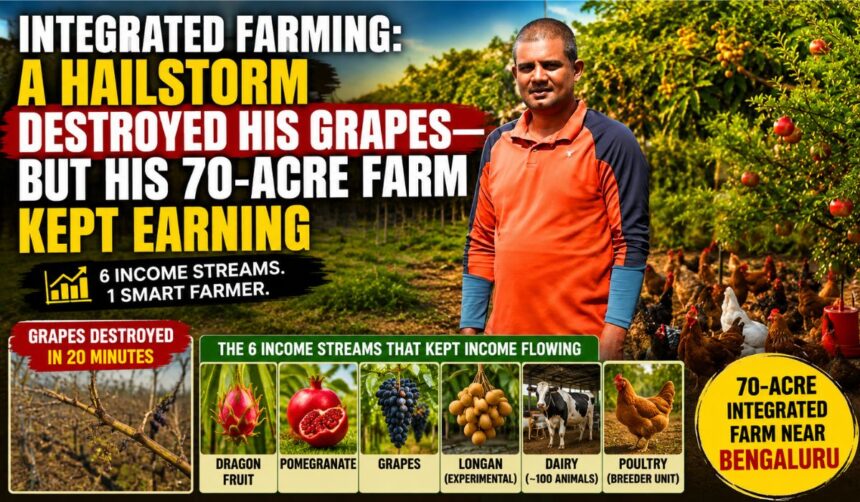
On 17 March, a 20-minute hailstorm shredded a grape crop and a flowering pomegranate block on a farm about 40 km from Bengaluru. Months of work, gone in one afternoon. What struck us when Agro Potli visited was that the owner wasn’t panicking — because five other income streams on the same farm kept the money flowing while those crops recovered. This is that farm, and this post is for any farmer weighing whether “integrated farming” is a real risk-buffer or just a buzzword. We’ve laid out what each enterprise actually earns, checked the numbers against official crop economics, and been honest about the one thing the tour didn’t dwell on: how much capital this really takes.
- The one idea that holds the whole farm together
- Do the numbers hold up?
- How the model actually works, enterprise by enterprise
- Is integrated farming really more profitable than single-crop farming?
- What it really takes the part the tour glosses over
- Can you replicate this?
- Is it worth copying? Our verdict
- FAQ
The farmer, Chetan, trained as a civil engineer and worked a year in Bengaluru before coming back to the family land, where his father had grown grapes for three to four decades. Over roughly eight years he turned it into a 70-acre integrated operation: dragon fruit, pomegranate, grapes, an experimental longan block, a dairy of about 100 animals, and a poultry breeder unit. Everything he told us below is his account of his own farm, shared during our visit; the reality-checks and outside data are ours.
The one idea that holds the whole farm together
Chetan’s argument is simple and, in our view, correct: in open-field horticulture, income is never fixed — it goes up and down, and one bad weather event can erase a season. His answer isn’t a better single crop; it’s refusing to depend on any single crop. Dairy and poultry throw off daily and weekly cash, which pays wages and running costs even when the grapes have just been hailed flat. The waste from one unit feeds the next: cattle dung becomes the farmyard manure (FYM) that his fruit crops run on, crop residue and home-grown fodder feed the animals, and his own poultry unit supplies feed ingredients. When we asked how he survives a wipe-out, his reply was basically the whole thesis of this article — that’s exactly why you build an integrated farm.
This isn’t fringe advice. India’s agricultural research and finance institutions (ICAR, NABARD) have promoted integrated farming systems for years precisely because diversification stabilises income and recycles nutrients on-farm.
Do the numbers hold up?
Every figure below is Chetan’s claim for his own farm, not audited data. We’ve put each against typical or official ranges so you can see where his numbers sit.
| Claimed on the farm | Realistic range (official/typical) | What to verify |
|---|---|---|
| Dragon fruit ~₹6–7 lakh/acre setup (500 poles) | ₹3–5 lakh/acre is the common range; poles + planting are ~65% of it. His is on the higher side | Current pole + planting-material rates [VERIFY] |
| Dragon fruit up to 20 t/acre (year 3+) | Ministry of Agriculture model puts mature yield near 10 t/acre; well-run farms hit 8–12 t. 20 t is best-case | Your tree age, variety, pruning |
| Dragon fruit price fell from ₹120–130 to ~₹75/kg | Consistent with oversupply; Indian wholesale now ₹70–200/kg depending on colour/season | Live wholesale rate near your market |
| Pomegranate 7–8 t/acre, ~₹110/kg, ₹4–5 lakh profit | ICAR/Maharashtra baseline 4–6 t/acre; ₹110/kg is a good-year, export-grade price, not a floor | Grade, bahar, live farm-gate rate |
| Grapes 15–20 t/acre, ₹40–50/kg, ₹5–7 lakh profit | In line with national norms (~9–12 t/acre average; good farms 15–20 t). Mantap costs ₹7–8 lakh/acre | Variety, weather at harvest |
| Dairy ~450 L/day, ₹40–42/L, ₹4–5 lakh/month | Plausible for ~40 milking animals; margins depend heavily on fodder cost | Your milk buyer + fodder self-sufficiency |
| Poultry breeder: 6,000–7,000 hatchable eggs/day ≈ ₹21,000/day | Believable for an 11,000-bird breeder unit; hatching eggs fetch more than table eggs | Hatchery contract + mortality rates |
The honest headline: Chetan’s numbers are mostly grounded, not inflated — and where they’re optimistic (20 t/acre dragon fruit, ₹110/kg pomegranate), they’re clearly his best seasons, which he himself frames as best-case. He even volunteered that this year his grapes are a total loss and he’s just trying to recover cost. That candour is rare and worth trusting more, not less.
Also Read: Left Job to Build ₹25 Crore Farming Empire: Banana Farming Success Story | 70-30 Model
How the model actually works, enterprise by enterprise
Dragon fruit. A cactus, so fungal disease and insect attack are low and spraying is minimal — a genuine advantage. The catch is the upfront cost (concrete poles at 12×8 ft spacing, ~500 poles/acre) and that marketing is hard. His edge is location: 40 km from Bengaluru means he packs in the evening and sells in the metro next morning, which farms 200–300 km out can’t match. He uses a weed mat (not plastic mulch) at the pole base — it blocks weeds but lets air and rain through, which he rates highly. Fruit comes in ~8–10 flushes every 15 days from roughly May, and off-season artificial lighting in August can stretch harvest and prices by a month.
Pomegranate. 24 acres, ~8,000 Bhagwa plants. The whole game is canopy management — training the plant from day one so midday sunlight reaches the centre and bottom, which cuts fungal pressure. Bhagwa’s real enemy is bacterial blight, and this year, hail at flowering. He’s clear that you judge pomegranate on a three-year average, not any single year — exactly the right framing for a crop this weather-exposed.
Grapes. His Dilkush (Dilkhush) is a high-yielding Indian table variety for the domestic and Bangladesh market, grown on an overhead mantap (pandal) that costs more than the dragon-fruit structure. Grapes are the most weather-fragile of the three: rain during the one-week harvest window causes cracking and a price crash. He now recommends overhead rain/hail covers for premium seedless and Red Globe types.
Longan (the “lychee-like” trial crop). Still an R&D block for him — low-maintenance forestry-type trees, currently imported into India and rare, retailing around ₹400–500/kg and fetching ₹130–150/kg wholesale in Bengaluru last year. He’s grafting his own planting material because the wrong mother plant means wasting three to four years. Treat this as emerging and unproven at scale, not a ready recommendation.
Dairy (~100 animals). The quiet backbone. Beyond milk (sold to a local institution’s hospital and campus), it delivers the FYM the fruit crops depend on — he says producing his own manure saves the ₹20–30 lakh a year he once spent buying it. Fodder is the swing cost, so he grows his own green fodder and makes silage, and mixes his own feed.
Poultry breeder unit. A 10-acre, solar-powered breeder farm producing fertile hatching eggs — weather-independent daily cash, which is precisely the point in an integrated system.
Is integrated farming really more profitable than single-crop farming?
Not always more profitable in a perfect year — a single high-value crop can beat it when everything goes right. But integrated farming is far more reliable: when one enterprise fails, others keep paying, and one unit’s waste becomes another’s input. The trade-off is complexity and capital. It buys stability, not a jackpot.
What it really takes the part the tour glosses over
Here’s the reality check that matters most. This is a large, capital-heavy, owner-operated farm, and its resilience is bought with money and presence, not magic.
Rough establishment costs, by his own figures: dragon fruit ₹6–7 lakh/acre, a grape mantap ₹7–8 lakh/acre (pillars ~₹600 each, GI wire ~₹1.5 lakh/tonne [VERIFY]), plus a ~100-animal dairy, an 11,000-bird breeder unit, solar power, silage bunkers, and automation (self-cleaning Israeli-made filters, air-assisted tractor sprayers, semi-automatic fertigation). Add annual operating costs of roughly ₹1–2.5 lakh/acre on the fruit crops. This is a multi-crore build, not a weekend diversification.
And he was blunt about the non-negotiable: you have to live on the farm. Their day starts at 4 a.m. with dairy and poultry feeding, and he says if the owner isn’t physically present to monitor feeding, milk yield, irrigation and labour, the whole thing unravels. Automation only pays once the scale is large enough to justify it.
Can you replicate this?
Split the question in two.
The principle scales down beautifully. A small or marginal farmer does not need 70 acres to use this idea. One or two horticulture crops, a few dairy animals for cash flow and manure, some poultry, home-grown fodder, and a weed mat instead of a weedicide — that is an integrated farm, and it delivers the same core benefit: a bad season in one line doesn’t sink you. This is the genuinely useful, copyable takeaway.
The 70-acre version does not. Matching Chetan’s setup needs crores in capital, near-metro market access (his Bengaluru proximity is doing a lot of quiet work), years of horticulture skill across four fruit crops, livestock management, and an owner willing to live on-site from 4 a.m. It suits an experienced, well-capitalised farmer near a large city. It’s a poor fit for anyone under-capitalised, far from a big market, new to horticulture, or unable to be present daily.
Is it worth copying? Our verdict
Yes — the philosophy is one of the soundest in Indian farming, and it’s institutionally backed. Diversify so no single crop or weather event can wipe you out; recycle waste into inputs; keep a daily-cash enterprise (dairy/poultry) alongside lumpy horticulture income. Start small and add verticals as you master each.
The failure modes to respect: underestimating the capital and the management load (running six enterprises badly is worse than running one well); assuming his best-case yields (20 t/acre dragon fruit, ₹110/kg pomegranate) are your baseline — they’re not; and copying his crop mix without his market access, since a lot of his margin comes from selling into Bengaluru the next morning. Above all, remember that even this well-run, diversified farm is taking a real loss on grapes this year. Integrated farming softens the blows; it doesn’t abolish them. Built patiently and at a scale you can actually manage, though, it’s one of the most robust models a farmer can adopt.
FAQ
What is integrated farming?
Running several linked farm enterprises together — crops plus livestock plus allied units — so income is diversified and one unit’s waste feeds another. The goal is steadier income and lower risk, not maximum profit from any single line.
Which crops did this farm combine?
Dragon fruit, pomegranate (Bhagwa), table grapes (Dilkush) and an experimental longan block on the horticulture side, plus a ~100-animal dairy and an 11,000-bird poultry breeder unit. Dairy and poultry provide the daily cash that carries the weather-exposed fruit crops.
Is dragon fruit still profitable given falling prices?
It can be, but the easy-money phase is over — prices have dropped as production surged. Success now depends on low input costs (it’s a hardy cactus), good yields from year three, and direct access to a city market rather than distant mandis.
How much does an integrated farm cost to set up?
There’s no single figure — it depends entirely on scale and crop mix. At this farm’s level it runs into crores; but a small farmer can start a mini version with one or two crops and a few animals for a fraction of that, using government support where available.
Do I need to live on the farm to make this work?
For a large, multi-enterprise operation, effectively yes. Dairy and poultry need pre-dawn attention, and daily monitoring of feed, milk, irrigation and labour is what keeps a complex farm from leaking money. Smaller setups are more forgiving.
How do farmers protect crops from hailstorms?
Overhead hail/rain nets and fruit-cover technology (increasingly used on grapes and pomegranate), plus the broader insurance of diversification so a single event can’t take your whole income. Crop insurance schemes are also worth checking with your state horticulture department.