



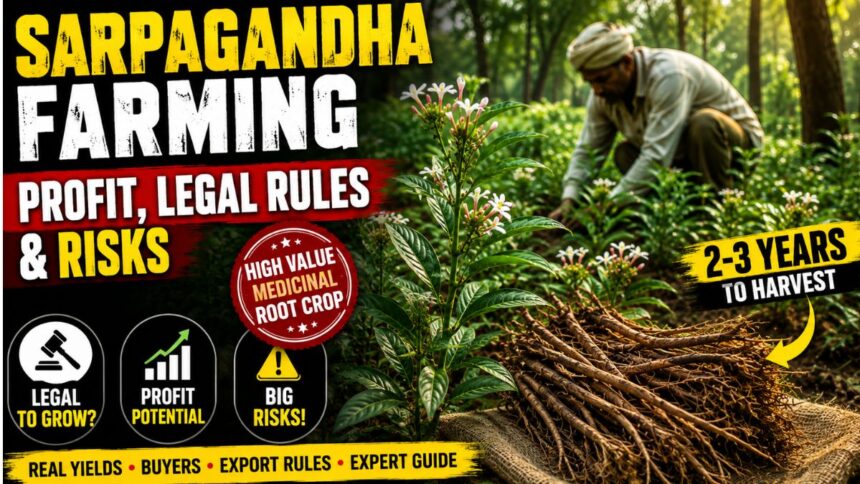
Sarpagandha (Rauvolfia serpentina), known as Indian snakeroot or chota chand, is one of India’s most valuable medicinal plants — and one of the most misunderstood as a crop. This guide is for farmers and agri-entrepreneurs who’ve heard it “sells for thousands per kilo” and want the real picture: what the roots actually earn, the legal rules that make this plant different from any ordinary crop, the two-to-three-year wait, and why finding a buyer matters more than growing the plant.
- What sarpagandha is and why it’s in demand
- Is sarpagandha farming profitable?
- The legal reality you must understand first
- The other hard truth: a long wait and a narrow market
- Climate, soil and the shade advantage
- Propagation – and the germination problem
- How to grow it
- Harvest, yield and an honest look at the money
- A serious word on contract and buy-back offers
- Marketing your roots
- Government support
- Is sarpagandha farming worth it?
- Frequently asked questions
What sarpagandha is and why it’s in demand
Sarpagandha is a perennial medicinal under-shrub whose root is the valuable part. That root is a natural source of alkaloids — most famously reserpine, long used for high blood pressure and certain neurological and psychiatric conditions, along with ajmaline, ajmalicine and serpentine. It feeds both the modern pharmaceutical industry and the Ayurvedic and Unani systems, appearing in classical formulations like Sarpagandha Ghanvati and Sarpagandha Churna.
So be clear from the start about the nature of this crop: you are growing dried roots to sell to the herbal and pharmaceutical industry. There’s no vegetable market, no oil, no daily mandi — the entire business is producing quality roots and getting them to a genuine buyer.
Is sarpagandha farming profitable?
Sarpagandha farming can be profitable if you plan it right. Cultivation is legal and the roots are in real demand from the Ayurvedic and pharma industry. But the plant is a protected, endangered species, the roots take two to three years to harvest, and there’s no mandi — so you must secure a buyer before you plant, not after.
The legal reality you must understand first
This is the section that makes sarpagandha unlike any crop covered so far, and skipping it is how people get into trouble.
Sarpagandha is a red-listed, endangered species in the wild, heavily depleted by decades of over-collection from forests. Because of that, it carries real regulatory status: it is listed under CITES (Appendix II), and India restricts the export of wild-collected Rauvolfia. Digging the plant from the wild for trade is not a legal shortcut — it’s exactly the activity these rules exist to stop.
Here’s the crucial distinction, and the good news: cultivating sarpagandha on your own farm is legal and is actively encouraged by the government through the National Medicinal Plants Board. Cultivated roots can be sold, and can even be exported, but this needs proper documentation proving cultivated origin, and export specifically requires going through the correct CITES certification process.
The practical takeaways for a farmer:
- Cultivate — don’t collect from the wild. Cultivation is the legal, encouraged path.
- Keep documentation of your cultivation from planting material to harvest, because origin proof is what separates legal cultivated trade from restricted wild material.
- For export, work through the proper CITES process and legitimate exporters, not informal channels.
Rules and procedures in this space do change, so confirm the current position before you commit, and route everything through documented, legitimate channels.
The other hard truth: a long wait and a narrow market
Two more realities shape whether this crop makes sense for you.
It’s a two-to-three-year commitment. Sarpagandha is grown for its roots, and the alkaloid content — which is what buyers value — builds up as the plant ages. Roots are typically harvested from plants that are around two to three years old, and harvesting means digging the plant up. So you invest and wait for years before the first income, much like a slow orchard.
There is no mandi — the market is niche and buyer-dependent. You can’t cart dried roots to the local wholesale market and sell them the way you would onions. Your buyers are Ayurvedic and herbal manufacturers, medicinal-plant traders, and extract companies. Aggregate national demand for the roots is genuinely large, but that does not automatically translate into a buyer for one farmer’s few quintals. This is the single biggest reason cautious growers secure a buyer or contract before planting, not after harvest.
Climate, soil and the shade advantage
Sarpagandha suits tropical and subtropical, frost-free conditions with a warm, humid climate. One trait sets it apart from most field crops: it is shade-loving. It naturally grows as a forest-floor plant and does well under partial shade, which makes it genuinely well suited to agroforestry and intercropping — grown in the understorey beneath trees or in an orchard, it can earn from space that would otherwise sit idle.
For soil, it prefers deep, well-drained, organic-rich loam — alluvial loam through to red lateritic or dark loam soils — because the roots run deep. It needs irrigation through dry spells. One clear limit: alkaline and saline soils are not suitable for commercial cultivation.
Propagation – and the germination problem
Sarpagandha can be propagated several ways, and the choice affects both your establishment and your eventual root yield.
| Method | Relative root yield | Practical notes |
|---|---|---|
| Seed (nursery-raised seedlings) | Highest | Best for commercial planting, but germination is low and erratic |
| Root cuttings | Moderate | Reliable establishment; lower yield than seed |
| Stem cuttings | Lowest | Simplest to attempt, but weakest root production |
Research broadly indicates seed propagation gives the best root biomass, with root and stem cuttings trailing well behind.
The catch is real: sarpagandha seed germination is notoriously poor and variable. Using fresh, good-quality seed and following recommended nursery practices matters a great deal, and you should plan for a lower germination rate than you’d expect from an ordinary crop. Many growers raise seedlings in a nursery first, then transplant, to manage this.
How to grow it
Raise seedlings on well-prepared nursery beds, then transplant the young plants — commonly at a spacing in the range of about 45 cm between plants — into deep, organic-rich soil, ideally as the monsoon sets in so they establish with natural moisture. Feed based on a soil test rather than a fixed formula, weed well while the plants are young, and irrigate through dry periods. On the positive side, sarpagandha is relatively hardy against pests and doesn’t demand the intensive spraying that many crops do, which suits low-input and organic systems — an advantage given its buyers often value clean, residue-free roots.
Also Read: Mint Farming in India: The Real Profit, Water Cost & Mentha Oil Price Farmers Need to Know
Harvest, yield and an honest look at the money
Harvest comes at around two to three years, ideally in the cooler, drier part of the year when root alkaloid content is at its peak. The whole plant is lifted, the roots are separated, washed, cut, dried in shade to preserve their potency, and graded before sale.
Yield. As a rough working figure, a well-managed crop may give in the region of 4 to 8 quintal of dried roots per acre over the full cycle, varying widely with soil, propagation method, plant age and management. Seed from mature plants can be a secondary income as planting material, though treat that as a bonus, not the plan.
Price — and a trap to avoid. Look online and you’ll see tiny retail packs of sarpagandha root selling at what looks like several thousand rupees per kilo, and processed extracts priced higher still. Do not mistake those for what a farmer earns. As a grower selling bulk dried roots to traders or manufacturers, your realistic rate is far lower — commonly in the low hundreds of rupees per kilo — and it varies with root age, alkaloid content, quality and your buyer. Confusing retail pack prices with bulk farm-gate rates is the most common costing mistake with medicinal crops.
An illustrative planning frame (estimates only — verify locally):
| Item | Indicative figure (estimate) |
|---|---|
| Time to first root harvest | ~2–3 years |
| Dried root yield | ~4–8 quintal per acre over the cycle |
| Bulk dried-root price | Low hundreds of ₹ per kg |
| Market | Ayurvedic/herbal manufacturers, traders — no mandi |
| Non-negotiable requirement | A secured buyer plus cultivation documentation |
A serious word on contract and buy-back offers
Medicinal plants attract more “guaranteed buy-back, earn lakhs” schemes than almost any other category, and sarpagandha is squarely in that zone. Some offers are genuine; many pair overpriced planting material with vague promises to buy your harvest years later at a rate that may not hold. Treat any such offer with real caution: check the company’s track record with existing growers, get the agreement examined by a lawyer, be wary of inflated sapling or seed costs, and never let a buy-back promise replace your own understanding of who actually buys these roots and at what price.
Marketing your roots
Because there’s no open mandi, your marketing plan is the business. Your realistic routes are direct supply to Ayurvedic and herbal manufacturers, sales through established medicinal-plant traders and aggregators, or supplying extract companies. Grouping with other growers through an FPO can give you the volume and consistency that serious buyers want, and it strengthens your hand on both price and documentation. Clean, well-dried, properly graded roots with good alkaloid content fetch better rates — quality is visible and it’s paid for.
Government support
Sarpagandha sits directly under India’s medicinal-plants programme:
- The National Medicinal Plants Board (NMPB) under the Ministry of Ayush is the nodal body — it promotes cultivation, publishes cultivation guidance, and works through State Medicinal Plants Boards that farmers can approach for support and information.
- Horticulture and agroforestry schemes, and NABARD-linked loans, may help with establishment and the non-earning years, and the crop’s shade tolerance makes it a candidate for agroforestry support.
Support levels, eligibility and the all-important trade and documentation rules change and vary by state, so confirm the current position through your State Medicinal Plants Board or district office before relying on any of it.
Is sarpagandha farming worth it?
For the right grower, sarpagandha is a genuinely worthwhile niche crop. It’s a legal, government-encouraged cultivation of a plant in real and lasting demand; it’s hardy and low-input, which suits organic systems; and its shade tolerance makes it a smart understorey earner for anyone with an agroforestry or orchard setup. If you have a real buyer link — or an FPO or contract into the herbal industry — and the patience for a multi-year crop, it can pay.
But be honest about the downsides before you commit:
- It’s a two-to-three-year wait with no income until the roots are harvested.
- The market is niche and buyer-dependent — no mandi, and demand in aggregate doesn’t guarantee a buyer for you.
- It’s a protected species with real rules — cultivate legally, document origin, and handle export through proper CITES channels.
- Seed germination is poor and erratic, complicating establishment.
- Retail prices mislead, and buy-back schemes need careful scrutiny.
A sensible way in: start small — ideally as an intercrop under existing trees — line up a genuine buyer or FPO first, keep clean cultivation records from day one, and prove one harvest cycle before scaling. If you can’t answer “who will buy my roots, at what documented price,” you’re not ready to plant.
Frequently asked questions
Is it legal to grow sarpagandha in India?
Yes. Cultivating sarpagandha on your own farm is legal and is actively encouraged by the government through the NMPB. The restrictions apply to collecting the plant from the wild and to undocumented trade; cultivated roots can be sold, and exported through proper CITES documentation. Always confirm current rules and keep cultivation records.
How many years before sarpagandha roots can be harvested?
Usually about two to three years. The roots are harvested once the plant matures, because the valuable alkaloid content builds up with age. This long gestation means no income in the early years, so it suits patient growers, ideally those intercropping it under trees to use the time and space better.
Where do I sell sarpagandha roots?
To Ayurvedic and herbal manufacturers, medicinal-plant traders and aggregators, or extract companies — there is no open mandi. Because the market is niche, securing a buyer or joining an FPO before planting is far safer than hoping to sell after harvest.
Why is the online price so high but farmers earn less?
The high figures online are small retail packs and processed extracts, not bulk farm-gate rates. As a grower selling bulk dried roots to industry, you earn considerably less per kilo, with the exact rate depending on root age, alkaloid content, quality and buyer. Confusing the two is a common and costly mistake.
Why is sarpagandha seed germination so poor?
Sarpagandha seed is naturally low and erratic in germination, which is a well-known challenge with this plant. Using fresh, good-quality seed and following recommended nursery practices helps, and many growers raise seedlings in a nursery before transplanting to manage the losses.
Can I export sarpagandha roots?
Cultivated sarpagandha can be exported, but because the plant is CITES-listed, export requires proper certification and proof of cultivated origin, and wild-collected material is restricted. Work through the correct CITES process and legitimate exporters, and confirm the current rules with the relevant authority before committing to an export plan.