




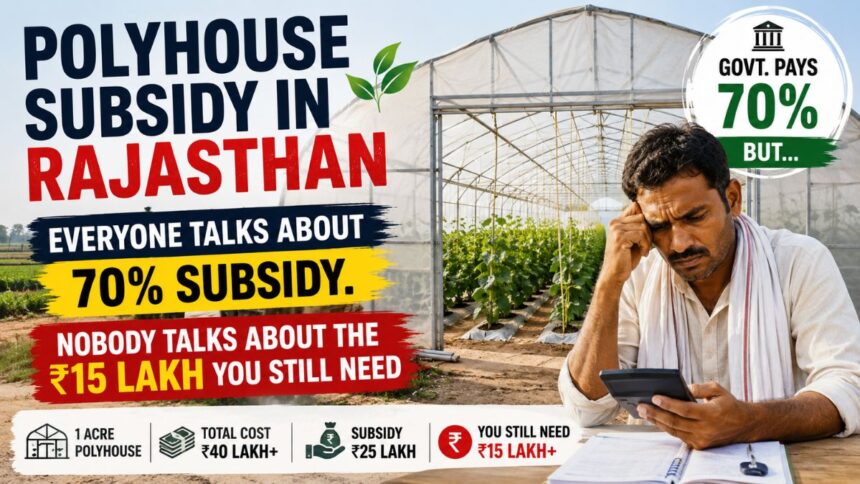
Forty kilometres west of Jaipur, on land that used to grow nothing but bajra and groundnut after the monsoon, there’s now a row of structures that look more like aircraft hangars than farms. Underneath them, farmers are growing cucumbers that get trucked to Delhi and UP within hours of harvest. The government picked up most of the bill for those structures.
- What the Polyhouse Subsidy in Rajasthan Actually Covers
- Why Farmers Across Rajasthan Are Looking at This Right Now
- Polyhouse Subsidy in Rajasthan: What 1 Acre Actually Costs in 2025–26
- Real Income From a Subsidised Polyhouse: Two Honest Scenarios
- Step-by-Step: Building and Cropping Your Polyhouse Across the Season
- Where Rajasthan Polyhouse Farmers Actually Sell Their Produce
- What Goes Wrong With the Polyhouse Subsidy in Practice
- Who Should – and Shouldn’t – Apply for This
- FAQs
That’s the part most people skip when they talk about the polyhouse subsidy in Rajasthan — they talk about percentages and forget to talk about what it costs to actually stand under one of these structures with a working crop inside it.
What the Polyhouse Subsidy in Rajasthan Actually Covers
A polyhouse is a structure built from GI pipes and UV-stabilised polythene film that lets you control temperature, humidity, and light around a crop. In a state where summer touches 45°C and winter nights drop close to freezing, that control is the entire point — open-field vegetables in Rajasthan get hammered by both extremes in the same year.
The Department of Horticulture, Government of Rajasthan, runs the polyhouse subsidy through the Mission for Integrated Development of Horticulture (MIDH) and the National Horticulture Mission (NHM), with the state adding its own top-up on the central base. In practice, this means general category farmers can get 50% of the project cost covered, while small and marginal farmers and SC/ST farmers can go up to 70%. The maximum area eligible under this norm is 4,000 square metres, which works out to roughly one acre — and that’s also the practical ceiling most first-time applicants should plan around.
Why Farmers Across Rajasthan Are Looking at This Right Now
I’ve spoken to farmers in the Sikar–Jaipur belt who switched because open-field vegetables simply weren’t surviving the heat spikes anymore, not because polyhouse farming was trendy. A hailstorm or a heatwave in May can wipe out a standing tomato or cucumber crop in two days — protected cultivation is as much a risk hedge as it is a yield upgrade.
The price signal backs this up. Capsicum mandi rates in Rajasthan have swung between roughly ₹15 and ₹38 per kg on different days this year, with highs touching ₹100/kg in tight-supply windows — that volatility is exactly what off-season, polyhouse-grown produce is positioned to capture, since a controlled structure lets you harvest when the open field can’t. Cucumber follows a similar pattern: regular open-field cucumber moves at ₹10–20/kg in most Rajasthan mandis, but a polyhouse lets you stagger harvests into months when that price is closer to ₹20 than ₹10.
There’s also a structural reason this is picking up specifically in Jaipur, Sikar, Alwar, Udaipur, and Jodhpur districts — proximity to urban demand. A polyhouse only pays off if you can move perishable produce to a buyer within a day or two, and these districts sit close enough to Jaipur, Delhi, and Ahmedabad mandis to make that workable. Try the same model 100 km from any city market and the freight cost alone eats your margin.
Polyhouse Subsidy in Rajasthan: What 1 Acre Actually Costs in 2025–26
This is where most online guides get sloppy. They quote the subsidy percentage and stop. Here’s an itemised breakdown for a Naturally Ventilated Polyhouse (NVPH) on 4,000 sq. metres — the standard, no-cooling-fan structure most Rajasthan applicants build:
| Item | Approx. Cost (₹) |
|---|---|
| Structure & UV-stabilised polyfilm (govt. cost norm ~₹900/sqm) | 36,00,000 |
| Drip irrigation & fertigation system | 70,000 |
| Land levelling & site preparation | 40,000 |
| Planting material (hybrid seedlings, ~10,000/acre) | 1,20,000 |
| Fertiliser, bio-inputs & crop protection (first season) | 60,000 |
| Labour (erection + first-season cultivation) | 1,00,000 |
| Miscellaneous (DPR, soil/water testing, application fees) | 25,000 |
| Total | ~40,15,000 |
The government’s cost norm for the structure component runs somewhere around ₹850–935 per square metre depending on which scheme tranche you’re under — I’ve rounded to ₹900/sqm here. Subsidy is calculated on this norm, not on whatever you actually pay your contractor.
At 50% (general category), the subsidy on structure plus drip works out to roughly ₹18.3 lakh, leaving the farmer to arrange about ₹21.8 lakh through savings and a bank loan. At 70% (small/marginal or SC/ST category), the subsidy rises to roughly ₹25.7 lakh, bringing the farmer’s outlay down to around ₹14.5 lakh. [ESTIMATE: exact cost-norm figures change every financial year — confirm the current rate with your District Horticulture Officer before budgeting.]
One thing I tell every farmer before they sign anything: the subsidy is credit-linked and back-ended. You take a bank loan first, build the structure, and the subsidy gets credited into your loan account only after a geo-tagged inspection — typically in two instalments, around 40% at construction stage and the remaining 60% after completion. You’re carrying the full cost on a loan for months before any subsidy money shows up.
Real Income From a Subsidised Polyhouse: Two Honest Scenarios
I’m going to give you a wide range here on purpose, because the gap between what vendor brochures promise and what peer-reviewed farm economics studies show is genuinely large.
Conservative scenario: A published economic study of polyhouse cucumber cultivation found yields of roughly 245 quintals (24.5 tonnes) per acre per cycle, with net returns over cultivation costs of about ₹97,000 per acre per cycle under fairly ordinary market conditions. Scaling that to current input and price levels, with one full crop cycle and modest mandi prices, a realistic first-year net profit for a new grower without strong buyer contacts is closer to ₹2–3 lakh per acre. That number assumes you’re learning fertigation and pest management as you go, which most first-timers are.
Optimistic scenario: A Bikaner farmer who shifted from wheat, gram, and mustard into polyhouse cucumber now reportedly earns ₹12–15 lakh per acre from cucumber alone, as part of a broader ₹80 lakh annual operation that also includes dairy. Subtracting realistic annual operating costs of ₹3–4 lakh per acre for fertigation, labour, packaging, and transport, net profit in that kind of well-managed, well-networked operation could land in the ₹8–11 lakh per acre range.
Both numbers are real and both are possible — the difference is almost entirely about market access and crop choice, not the subsidy itself. The subsidy lowers your entry cost; it does nothing for your selling price.
Step-by-Step: Building and Cropping Your Polyhouse Across the Season
- Apply before you build anything. Register on the Raj Kisan Saathi portal using Jan Aadhaar and land records. Building first and applying later is the single most common reason applications get rejected.
- Get your Letter of Intent / administrative approval. Don’t order materials before this lands — I’ve seen farmers lose subsidy eligibility entirely by jumping the gun.
- Construction window (3–4 months). Best started post-monsoon (October–November) so the structure is ready before peak summer heat, which is also when labour for erection is easier to find.
- First planting — time it against the Kharif gap. Open-field cucumber and capsicum supply typically dips just after the Kharif season ends; planting your polyhouse crop to harvest into that window is where the price advantage shows up.
- Rabi-season crop cycle. This is usually your strongest cycle for colour capsicum or cherry tomato, since cooler night temperatures suit fruit-set better than peak summer.
- Zaid/summer cycle (optional second crop). Cucumber tolerates the heat better than capsicum here, but you’ll need active ventilation or shade netting if daytime temperatures cross 38–40°C consistently.
- Post-verification and subsidy claim. Once construction and the first crop are underway, the horticulture officer does a geo-tagged inspection before the second instalment of subsidy is released.
Where Rajasthan Polyhouse Farmers Actually Sell Their Produce
Don’t plant a single seedling without knowing your buyer. The realistic channels are:
- APMC mandis — Jaipur’s Muhana mandi, Bikaner mandi, and Kota mandi are the main wholesale outlets for polyhouse vegetables in their respective belts.
- FPOs/FPCs — clusters like the one formed around Sikar’s polyhouse villages negotiate collectively, which protects individual farmers from single-buyer price pressure.
- Private aggregators and contract buyers — exotic and colour vegetables increasingly move through private collection agents who supply urban retail and hospitality demand in Jaipur and Jodhpur.
- Direct buyer agreements — the Bikaner cucumber grower mentioned earlier built repeat-buyer relationships with traders rather than relying on spot mandi sales every harvest, which is a big part of why his margins hold up.
What Goes Wrong With the Polyhouse Subsidy in Practice
The cost-norm gap. The government calculates your subsidy on its fixed cost norm, not on what GI pipe and polyfilm actually cost today after recent steel price increases. If your real construction bill runs higher than the norm — which it usually does — your effective subsidy percentage ends up well below the 50–70% headline figure. Budget for this gap with 15–20% contingency cash.
Cash flow during the back-ended wait. Since the subsidy lands only after construction and inspection, farmers who under-budget their margin money end up stalling construction halfway, which delays everything further.
Building before approval. I can’t stress this enough — starting construction before your Letter of Intent is issued is grounds for outright rejection, no exceptions.
Selling into a crash. A good capsicum or cucumber harvest with no buyer lined up in advance can mean dumping produce at distress prices in the local mandi. The subsidy gets you the structure; it doesn’t get you a buyer.
Who Should – and Shouldn’t – Apply for This
This makes sense if you have clear land title or a long-term registered lease, a reliable water source (bore well or canal-fed, tested for EC and pH), at least one acre to commit, and either savings or loan eligibility for the unsubsidised share upfront. It also helps enormously if you’re within practical trucking distance of Jaipur, Jodhpur, Kota, or Udaipur.
It doesn’t make sense if your land title is disputed, your water source is unreliable or saline, you’re more than a couple of hours from a real vegetable market, or you’re expecting quick returns without six to twelve months of learning curve. A polyhouse without a tested water source is, frankly, a bigger risk than open-field farming — drip irrigation concentrates whatever’s in your water straight onto the root zone.
Agro Potli Daily Farm Expense Tracker
FAQs
How much subsidy does Rajasthan give for polyhouse farming?
General category farmers can get up to 50% of the project cost, while small, marginal, and SC/ST farmers can get up to 70%, capped at a maximum eligible area of 4,000 square metres under current MIDH-NHM norms with the state top-up.
What is the actual cost of building a 1-acre polyhouse in Rajasthan?
The government’s cost norm works out to roughly ₹34–37 lakh for the structure alone on 4,000 sq. metres, with total project cost including drip irrigation, planting material, and labour running closer to ₹40 lakh. Actual market rates can run higher than the official norm.
How do I apply for polyhouse subsidy in Rajasthan online?
Apply through the Raj Kisan Saathi portal (rajkisan.rajasthan.gov.in) using your Jan Aadhaar and land records, then wait for the Letter of Intent before starting construction.
Which crops give the best returns in a Rajasthan polyhouse?
Colour capsicum, parthenocarpic (seedless) cucumber, and cherry tomato are the three most consistently profitable choices, based on current mandi price patterns and real grower results from Sikar and Bikaner districts.
Note: Subsidy percentages and government cost norms are revised periodically. Confirm current rates with your District Horticulture Officer before budgeting or applying.