



Polyhouse Subsidy in Uttar Pradesh: You have the land. You want better income. But every time someone mentions polyhouse farming, the first thought is: “This must cost a fortune.”
- What Is a Polyhouse and Why Does It Matter for UP Farmers?
- How Much Polyhouse Subsidy Can You Get in UP in 2026?
- Agropotli Profit Calculator
- Why Polyhouse Farming Makes Financial Sense in UP
- Real Farmer Success Story: Kamlesh Singh from Agra
- Who Is Eligible for Polyhouse Subsidy in Uttar Pradesh?
- Documents Required for Polyhouse Subsidy in UP
- Step-by-Step Process to Apply for Polyhouse Subsidy in UP 2026
- Best Crops to Grow in a Polyhouse in UP
- Common Mistakes to Avoid
- Polyhouse vs. Open Field Farming: A Quick Comparison
- Is the Polyhouse Subsidy in UP Worth It?
- Frequently Asked Questions (FAQs)
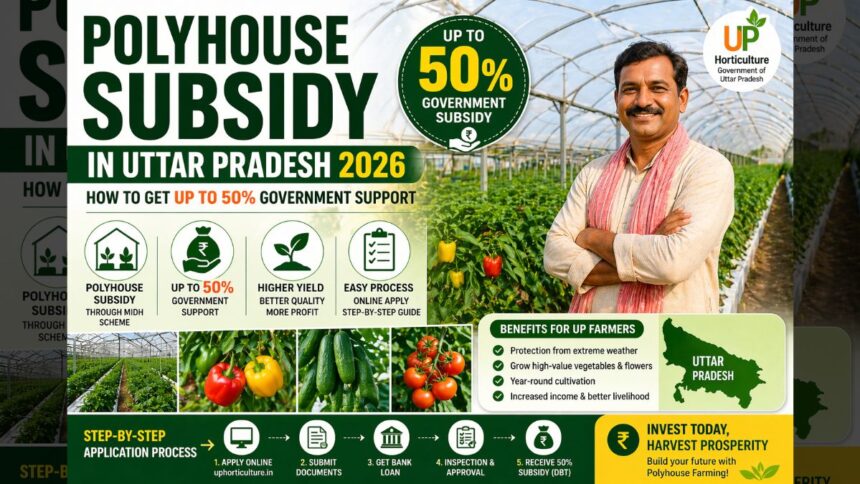
That’s fair — a standard polyhouse setup can run anywhere from ₹10 lakh to ₹35 lakh or more. But here’s what most farmers in Uttar Pradesh don’t know: the UP government, under the MIDH (Mission for Integrated Development of Horticulture) scheme, provides a flat 50% subsidy on the normative construction cost. That means the government pays roughly half the bill — directly into your bank account through DBT.
Uttar Pradesh manages its protected cultivation subsidies heavily through the Mission for Integrated Development of Horticulture (MIDH) and the State Horticulture Mission, offering a flat 50% subsidy on the government’s normative cost for setting up a polyhouse, shade net, or walk-in tunnels.
This guide covers everything — what the scheme actually is, how much money you can realistically get, what documents you need, and the exact step-by-step process to apply in 2026. No fluff. Just the real picture.
What Is a Polyhouse and Why Does It Matter for UP Farmers?
A polyhouse is a tunnel-shaped structure made of galvanised iron (GI) pipe frames covered with UV-stabilized polyethylene film. Inside, you can control temperature, humidity, and light — creating a stable growing environment that open fields simply cannot offer.
Polyhouse farming allows farmers to grow high-value crops in a fully controlled environment, shielding crops from extreme weather conditions, pests, and diseases while significantly increasing yield and quality.
For UP farmers specifically, this solves a critical problem. The state experiences brutal summer “Loo” winds, harsh winters with frost risk, and erratic monsoon flooding. A polyhouse creates a buffer against all of this.
Three types are typically eligible under the UP subsidy scheme:
- Naturally Ventilated Polyhouse (NVPH): Uses natural airflow. Most economical to build. Government normative cost: ₹844–₹1,000 per sq. meter.
- Fan and Pad Polyhouse: Climate-controlled with automated cooling. Higher cost, but ideal for Western UP districts near Delhi/NCR.
- Shade Net House: Lightest structure. Normative cost around ₹710 per sq. meter. Best for shade-loving crops and beginners with tighter budgets.
How Much Polyhouse Subsidy Can You Get in UP in 2026?
The polyhouse subsidy rate in 2026 is a flat 50% on the project cost, and the subsidy is credit-linked — you must take a bank loan to be eligible and cannot self-finance the entire project.
Here’s how the numbers work in practice for a standard 1,000 sq. meter naturally ventilated polyhouse in UP:
| Item | Amount |
|---|---|
| Normative construction cost (govt. rate) | ₹10–₹14 lakh |
| 50% government subsidy | ₹5–₹7 lakh |
| Your effective cost after subsidy | ₹5–₹7 lakh |
| Additional: planting material subsidy (50%) | Up to ₹1–₹2 lakh extra |
| Additional: micro-irrigation subsidy (PDMC) | Up to ₹0.5–₹1 lakh extra |
UP also offers separate 50% subsidies for planting material — especially for high-value crops like Gerbera and Carnations — and micro-irrigation under the Per Drop More Crop (PDMC) scheme.
For larger setups of 4,000 sq. meters (roughly 1 acre), the total subsidy receivable can reach ₹15–₹18 lakh.
One important reality check: Because the government’s normative cost norms are often lower than actual 2026 market rates, the effective subsidy typically works out to around 35–40% of your total actual expense rather than the full 50% headline figure. Always carry 15–20% extra cash over and above your 25% margin money to cover this gap.
Agropotli Profit Calculator
Why Polyhouse Farming Makes Financial Sense in UP
Before getting into the process, let’s talk about whether this investment actually pays off.
According to the UP Horticulture Department, an 8,000 sq. meter polyhouse can accommodate 50,000 Gerbera plants. Each plant produces 20 flowers annually, and with a market price of at least ₹5 per flower, farmers can earn around ₹20 lakh annually, excluding farming costs.
Even at smaller scale, the economics are strong. A 1,000 sq. meter polyhouse growing colored capsicum (shimla mirch) can realistically produce:
- Yield: 8–12 kg per plant × 1,200–1,500 plants = 10,000–15,000 kg per crop cycle
- Price: ₹40–₹80 per kg (off-season pricing)
- Gross income per cycle: ₹4–₹10 lakh
- Two cycles per year: ₹8–₹18 lakh annual revenue
- Net profit (after input costs): ₹4–₹10 lakh per year
For Western UP farmers, the Azadpur Mandi in Delhi is the ultimate destination for English Cucumber and Capsicum, setting benchmark pricing across North India. Farmers near Agra, Varanasi, or Noida can also bypass mandis entirely and tie up directly with 5-star hotels and premium catering services.
Real Farmer Success Story: Kamlesh Singh from Agra
Kamlesh Singh, a 38-year-old farmer from Fatehpur Sikri near Agra, was growing wheat and mustard on his 2-acre land. Annual income: barely ₹1.5 lakh. In 2023, he heard about the polyhouse subsidy through his local horticulture officer.
He applied through the UP Horticulture DBT portal for a 1,000 sq. meter naturally ventilated polyhouse. Total project cost came to ₹12.5 lakh. After receiving the 50% back-ended subsidy of approximately ₹6 lakh, his effective out-of-pocket cost was around ₹6.5 lakh — of which he financed ₹5 lakh through an SBI agriculture term loan.
His first crop: colored capsicum (red and yellow varieties). He sold directly to a vegetable aggregator supplying hotels in Agra’s tourism circuit. First year income from the polyhouse: ₹7.2 lakh. His loan EMI: ₹12,000/month. He broke even in under 2 years.
Today, he is expanding to a second polyhouse and has joined an FPO to get better prices. His words: “Pehle mujhe lagta tha ki ye sirf bade kisan ke liye hai. Ab mujhe pata hai ki ye chhote kisan ke liye hi bana hai.”
Who Is Eligible for Polyhouse Subsidy in Uttar Pradesh?
The eligibility criteria are straightforward:
- You must be a registered farmer in Uttar Pradesh with valid Aadhaar and land records
- Your name must clearly be on the Khatauni (Record of Rights). If the land is leased, you need a registered lease agreement of at least 7–10 years specifically stating permission for protected cultivation.
- You must not have previously received a polyhouse or greenhouse subsidy under this scheme
- The applicant must invest at least 10% of the total amount themselves, and the land must be used exclusively for agricultural purposes.
- Both individual farmers and Farmer Producer Organisations (FPOs) can apply
Documents Required for Polyhouse Subsidy in UP
Keep these ready before starting your application:
- Aadhaar card (linked to your mobile number)
- Khasra-Khatauni (land record) — from the revenue department
- Bank passbook (nationalized bank preferred — SBI, Bank of Baroda, PNB)
- Passport-size photograph
- Caste certificate (for SC/ST/OBC category applicants)
- Registered lease deed (if land is not in your name)
- Vendor quotation from a registered polyhouse supplier (with GST number)
- Bank sanction letter for term loan (required before final approval)
Step-by-Step Process to Apply for Polyhouse Subsidy in UP 2026
The process is now digitized. Here is the exact path:
Step 1: Register on the UP Horticulture DBT Portal The application process is digitized via the UP Agriculture Department’s DBT (Direct Benefit Transfer) portal, with approvals handled on a first-come, first-served basis against district-level targets. Visit uphorticulture.in and register with your Aadhaar and mobile number.
Step 2: Contact Your District Horticulture Officer (DHO) The most important official in your journey is the District Horticulture Officer (DHO). They process the files, verify the initial land status, and send the proposal to the state headquarters in Lucknow. Visit your district’s horticulture office early in the financial year (April–June) when targets are fresh.
Step 3: Get Vendor Quotations Contact 3–4 registered polyhouse vendors for written quotations with GST details. This forms the basis of your project cost. Do not accept verbal quotes.
Step 4: Prepare a Detailed Project Report (DPR) Your DPR should include construction costs, chosen crop plan, irrigation details, water source, and 3-year financial projections. This is the most important document in the entire process — a Detailed Project Report that aligns with both bank standards and government guidelines.
Step 5: Get Bank Loan Sanctioned Approach a nationalized bank (SBI, Bank of Baroda, Canara Bank) with your DPR. Get a formal Term Loan sanction letter. Without this, your subsidy file cannot proceed.
Step 6: Submit Online Application Log in to uphorticulture.in → Select “Protected Cultivation” under MIDH schemes → Fill in land details, bank info, structure type → Upload all documents. You will receive an acknowledgment SMS.
Step 7: Field Inspection A horticulture officer visits your site to verify land suitability, water source, and quotation reasonableness. Be present on that day with all original documents.
Step 8: Receive Letter of Intent (LOI) / Administrative Approval Critical rule: You cannot start construction until you receive the Letter of Intent (LOI) from the department. Starting construction before getting the LOI will disqualify you entirely — no exceptions.
Step 9: Build the Polyhouse Construct using the approved vendor with BIS-certified GI pipes and UV-stabilized polyfilm as per government technical standards.
Step 10: Joint Inspection and Subsidy Release Once your polyhouse is built, a joint inspection team comprising the DHO, an agricultural engineer, and bank officials will verify that you used BIS-certified materials before releasing the 50% back-ended subsidy directly to your bank account.
Best Crops to Grow in a Polyhouse in UP
Choosing the right crop determines your ROI. Avoid growing wheat or regular tomatoes in a polyhouse — the returns won’t justify the investment.
High-return crops for UP polyhouses in 2026:
- Colored Capsicum (Red/Yellow/Green): ₹60–₹100/kg wholesale, two crops annually
- Seedless Cucumber (English variety): Fast crop cycle (55–60 days), strong demand from Delhi
- Gerbera (flowers): Long-duration crop (3 years), ₹5–₹8 per flower, low maintenance
- Dutch Roses: Premium pricing, ideal for Ghazipur Flower Mandi supply
- Cherry Tomatoes: Premium urban market product, ₹80–₹150/kg
Common Mistakes to Avoid
1. Starting construction before LOI This is the single most common reason for subsidy rejection. Build nothing until you have the official approval letter in hand.
2. Using non-certified materials The Joint Inspection Team checks whether you used approved quality materials. Using MS pipes instead of B-Class GI pipes, or sub-standard polyfilm, can result in subsidy rejection at the final stage.
3. DPR and actual construction don’t match If your DPR says Naturally Ventilated Polyhouse with rose cultivation and you build a net house with vegetables — you will fail inspection. What’s on paper must match what’s on the ground.
4. Applying too late in the financial year Each district gets a fixed target for the number of polyhouse subsidies per year. Applications are approved on a first-come, first-served basis. Apply in April–May, not December.
5. Not planning the market before harvest Many farmers build the polyhouse and grow the crop — then scramble to find a buyer. Projects in UP do not fail because of a lack of demand — they fail due to poor market planning. Identify your buyer (mandi, aggregator, hotel, FPO) before your first seedling goes in.
Polyhouse vs. Open Field Farming: A Quick Comparison
| Factor | Open Field Farming | Polyhouse Farming |
|---|---|---|
| Weather risk | Very high | Very low |
| Yield (capsicum) | 8–12 tonnes/acre | 20–40 tonnes/acre |
| Annual income potential | ₹1–₹2 lakh/acre | ₹6–₹15 lakh/acre |
| Water usage | High | 50–70% lower |
| Market price realized | Average | Premium (off-season) |
| Government support | Minimal | Up to 50% subsidy |
Is the Polyhouse Subsidy in UP Worth It?
Yes — but only if you treat it as a business, not an experiment.
The polyhouse subsidy in Uttar Pradesh under MIDH is one of the most accessible and genuinely impactful government schemes available to UP farmers in 2026. With the government covering 50% of the farming cost to promote off-season vegetable and flower cultivation, the scheme has the potential to change farmers’ economic position significantly.
The process takes patience — typically 4–8 months from application to first subsidy release. But with input costs halved by government support and crop revenues 5–10x higher than open-field farming, the math clearly works in your favor.
Start by visiting your District Horticulture Officer (DHO) office, or apply directly at uphorticulture.in. Apply early in the financial year. Get your DPR right. And never start construction before your LOI arrives.
The money is available. The market is ready. The only thing missing is your application.
Frequently Asked Questions (FAQs)
Q1. How much polyhouse subsidy can a farmer get in Uttar Pradesh in 2026?
A UP farmer can receive a 50% subsidy on the government’s normative cost for constructing a polyhouse under the MIDH scheme. For a 1,000 sq. meter unit, this typically translates to ₹5–₹7 lakh. For a 4,000 sq. meter (approximately 1 acre) setup, the subsidy can be ₹15–₹18 lakh. Additional subsidies are available for planting material and micro-irrigation.
Q2. Where do I apply for polyhouse subsidy in Uttar Pradesh?
Apply online through the official UP Horticulture DBT portal at uphorticulture.in. You can also visit your District Horticulture Officer (DHO) office in person. It is advisable to do both — apply online and keep your DHO informed about your application.
Q3. Can I start building the polyhouse before getting the government approval?
No. This is the most critical rule. You must wait for the official Letter of Intent (LOI) or Administrative Approval before beginning any construction. Starting early will disqualify you from receiving the subsidy entirely, with no appeal.
Q4. Is the polyhouse subsidy a loan or a grant?
It is a back-ended grant — you do not repay it. However, you must first take a bank term loan to build the structure. After government inspection confirms the completed polyhouse meets all standards, the subsidy amount is credited directly to your bank loan account, reducing your outstanding balance.
Q5. Can I apply for polyhouse subsidy on leased land in UP?
Yes. You can apply on leased land provided you have a registered lease agreement of at least 7–10 years that specifically mentions permission for protected cultivation. The lease must be registered at the block/tehsil level — a notarized agreement alone may not be accepted in all districts.