



If you are a farmer in Haryana thinking about polyhouse farming, but the cost is holding you back — this guide is exactly what you need.
- What Is Polyhouse Farming?
- What Is the Polyhouse Subsidy in Haryana?
- Why Polyhouse Farming Makes Sense for Haryana Farmers
- Polyhouse Subsidy in Haryana 2026: Scheme-Wise Breakdown
- 1. NHM Scheme (National Horticulture Mission) — Best for Small Farmers
- 2. NHB Scheme (National Horticulture Board) — Best for Large Commercial Projects
- 3. Haryana State Top-Up Subsidy
- Cost Breakdown: What Does a Polyhouse Actually Cost in Haryana?
- Profit Potential: What Can You Realistically Earn?
- Agropotli Profit Calculator
- Real Success Story: Suresh Kumar from Karnal, Haryana
- Step-by-Step Process to Apply for Polyhouse Subsidy in Haryana
- Best Tips for Polyhouse Success in Haryana
- Common Mistakes to Avoid
- Polyhouse vs. Open-Field Farming: Quick Comparison
- Conclusion: Is the Polyhouse Subsidy in Haryana Worth It?
- Frequently Asked Questions (FAQs)
Setting up a polyhouse can cost anywhere between ₹20 lakh to ₹50 lakh depending on size and type. That is a big number. But here is what most farmers do not know — the government of Haryana, combined with the central government, is currently offering up to 65% of the total project cost as a subsidy through the polyhouse subsidy in Haryana scheme. That means for a ₹35 lakh project, you may only need to arrange around ₹12–15 lakh from your own pocket.
This guide covers everything — what the scheme is, how much you can get, what documents you need, how to apply, real profit numbers, and a real farmer’s success story. No theory. Just actionable information.
What Is Polyhouse Farming?
A polyhouse is a tunnel or room-shaped structure covered with UV-stabilized polythene film. Crops grow inside this structure in a controlled environment — protected from extreme heat, hailstorms, rain, pests, and off-season conditions.
It is a form of protected cultivation where crops are grown inside a transparent structure made of UV-stabilized polythene, steel frames, insect-proof nets, and climate control systems — allowing higher yields and quality produce year-round.
Think of it as giving your crops a permanent, weather-proof shelter. You decide the temperature, humidity, and water supply inside — not the weather.
What Is the Polyhouse Subsidy in Haryana?
The polyhouse subsidy in Haryana comes from two sources working together:
1. Central Government Support (NHB / NHM under MIDH) Under the NHM scheme within MIDH, eligible farmers can receive up to 50% subsidy on their total polyhouse project cost. This scheme is managed by the local District Horticulture Officer, and applications from Haryana farmers can be submitted through the HodaHaryana portal.
2. Haryana State Government Top-Up Among North-Indian states, Haryana provides up to 65% of subsidy on total project costing, making it one of the better-supported states for polyhouse farming.
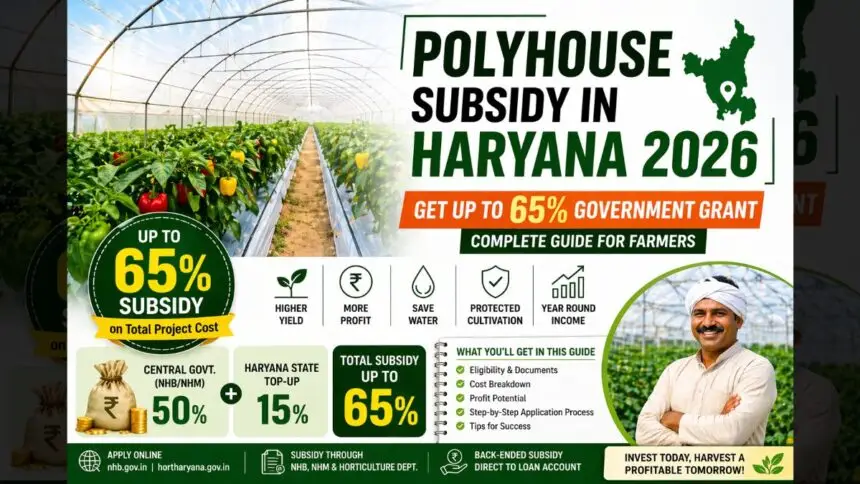
So in practical terms — the central government gives 50%, and the Haryana state government adds another 15% on top through its State Horticulture Mission (SHM), bringing the total to 65%.
For SC/ST category farmers, this support can go even higher depending on the specific scheme and year.
Why Polyhouse Farming Makes Sense for Haryana Farmers
Haryana’s climate is tough on open-field crops — extreme summers, unpredictable monsoons, and winter frost can destroy an entire season’s work in days. Polyhouse farming changes that equation completely.
Protected cultivation enables 2–5x higher yields compared to open farming, allows year-round production of high-value crops like capsicum, cucumber, tomato, and lettuce, and saves up to 80% water through drip and fertigation.
Beyond that, here is what makes it a solid business decision in 2026:
- You can grow premium crops like capsicum, gerbera, tomato, and cucumber even in peak summer
- Supermarket chains and food companies prefer consistent, clean, polyhouse-grown produce
- You get better price per kg compared to market-dependent open-field farming
- Multiple crop cycles per year mean more income from the same land
Polyhouse Subsidy in Haryana 2026: Scheme-Wise Breakdown
1. NHM Scheme (National Horticulture Mission) — Best for Small Farmers
- Subsidy: 50% of project cost
- Area Covered: 500 sq. meters to 4,000 sq. meters
- Apply Through: District Horticulture Officer (DHO) or the Haryana Horticulture Department portal at hortharyana.gov.in
- Who Should Apply: Small and medium farmers with land up to 1 acre
This scheme covers polyhouse area ranging from 500 square meters to 4,000 square meters, making it accessible to farmers with smaller landholdings.
2. NHB Scheme (National Horticulture Board) — Best for Large Commercial Projects
- Subsidy: 50% of project cost (credit-linked, back-ended)
- Maximum Subsidy Limit: ₹56 lakhs
- Minimum Area: 4,000 sq. meters (roughly 1 acre)
- Apply Through: nhb.gov.in (online application)
- Who Should Apply: Farmers planning 1 acre or larger polyhouse setups
NHB offers up to 50% subsidy on total project cost for commercial horticulture including polyhouses, capped at ₹56 lakh per project. The subsidy is credit-linked and back-ended, applicable for project areas above 2,500 sq. meters.
3. Haryana State Top-Up Subsidy
On top of the central scheme, the Haryana government adds approximately 15% through its own State Horticulture Mission budget. Every state has its own SHM scheme where a top-up subsidy of 15%–40% or more may be provided on the 50% given by NHM, making the total subsidy range between 50% to 90% statewide.
Cost Breakdown: What Does a Polyhouse Actually Cost in Haryana?
Here is a realistic cost estimate for a 1,000 sq. meter naturally ventilated polyhouse in Haryana (2026 rates):
| Component | Estimated Cost |
|---|---|
| Structure (GI pipes + polythene) | ₹8,00,000 – ₹10,00,000 |
| Drip irrigation + fertigation | ₹1,50,000 – ₹2,00,000 |
| Land leveling & site preparation | ₹50,000 – ₹80,000 |
| Seedlings / planting material | ₹40,000 – ₹60,000 |
| Shade net / insect net | ₹30,000 – ₹50,000 |
| Miscellaneous (labor, tools) | ₹30,000 – ₹50,000 |
| Total Approximate Cost | ₹11,00,000 – ₹13,50,000 |
With 65% subsidy on ₹12 lakh total cost — you get approximately ₹7.8 lakh as subsidy. Your actual out-of-pocket investment drops to roughly ₹4–5 lakh (including the 25% margin money for the bank loan).
For a 4,000 sq. meter (1 acre) project costing ₹35–40 lakh, the 65% subsidy translates to ₹22–26 lakh covered by the government. Your net investment: roughly ₹9–13 lakh.
Profit Potential: What Can You Realistically Earn?
Let us take a 1,000 sq. meter capsicum polyhouse as an example.
Annual Revenue Estimate (Capsicum / Bell Pepper):
- Production: Approx. 8,000–10,000 kg per year from 1,000 sq. meters
- Selling price: ₹40–80 per kg (wholesale to retail)
- Gross Revenue: ₹3,20,000 – ₹8,00,000 per year
Annual Operating Cost:
- Seeds, fertilizers, pesticides, labor: ₹1,00,000 – ₹1,50,000 per year
Net Profit: ₹2,00,000 – ₹6,50,000 per year from just 1,000 sq. meters
Investment recovery is usually possible within 2–3 years due to faster crop cycles and higher profitability.
For high-value flower crops like gerbera or rose, the profit can be significantly higher — but they require more technical management.
Agropotli Profit Calculator
Real Success Story: Suresh Kumar from Karnal, Haryana
Suresh Kumar, a 42-year-old farmer from Karnal district, had been growing wheat and paddy on 3 acres for most of his farming life. His annual income rarely crossed ₹1.5 lakh. In 2024, after attending a horticulture department workshop, he decided to try polyhouse farming.
He applied through the Haryana Horticulture Department portal for a 2,000 sq. meter naturally ventilated polyhouse. His total project cost was ₹22 lakh. After receiving the Letter of Intent (LOI), he took a term loan from Punjab National Bank. The government subsidy of 65% (₹14.3 lakh) was credited back to his loan account after the Joint Inspection Team verified the completed structure.
He planted colored capsicum — red, yellow, and green varieties — which fetch premium prices in Delhi and Chandigarh markets. Within 14 months, his loan EMI was fully manageable from crop income, and his net annual income crossed ₹4.5 lakh — three times what he earned from open-field farming.
Farmers from Haryana who installed polyhouses with 50% NHB subsidy and produced premium crops year-round have seen their earnings double within 8 months and secured contracts with supermarket chains.
Step-by-Step Process to Apply for Polyhouse Subsidy in Haryana
Getting the subsidy is not complicated — but the sequence matters. Follow this order strictly.
Step 1: Choose Your Scheme Decide between NHM (for smaller projects under 4,000 sq. m) or NHB (for 1 acre and above). Contact your nearest District Horticulture Officer (DHO) to confirm current year targets and availability.
Step 2: Prepare Your Documents
- Aadhaar card and PAN card
- Land ownership documents (Jamabandi / Fard)
- Bank account details (passbook copy)
- Soil and water testing report
- Crop plan / proposed crop details
- Caste certificate (if applicable for SC/ST higher subsidy)
- Registered lease deed (if land is leased — minimum 10–12 year lease required)
Step 3: Submit Online Application
- For NHM: Apply through hortharyana.gov.in or visit your District Horticulture Office
- For NHB: Apply online at nhb.gov.in with an application fee of approximately ₹5,000–₹10,000
Step 4: Get Your Letter of Intent (LOI) This is the most critical step. You must apply first, get the In-Principle Approval or Letter of Intent from NHB or your state horticulture department, and only then begin construction. Building before the LOI will permanently disqualify your application.
Step 5: Apply for Bank Loan Take a term loan from any nationalized or scheduled bank. The bank will finance approximately 75% of the project cost. You arrange 25% as margin money.
Step 6: Construct the Polyhouse Build the structure as per NHB technical specifications. Use B-Class GI pipes and approved UV polythene. Keep all bills and invoices. Do not deviate from the DPR (Detailed Project Report).
Step 7: Joint Inspection Team (JIT) Verification After completion, a team of bank officials, NHB officers, and state agriculture officers will visit your farm to verify the structure matches the DPR.
Step 8: Subsidy Released to Loan Account Once the JIT report is positive, the subsidy amount is credited directly to your bank loan account — reducing your outstanding loan.
Best Tips for Polyhouse Success in Haryana
These are things that experienced polyhouse farmers wish someone had told them from day one:
- Choose your crop before your structure. Different crops need different types — naturally ventilated, fan-and-pad, or shade net structures. Do not build first and then decide what to grow.
- Get a soil and water test done. Haryana has salinity and pH issues in many districts. Growing without testing is a gamble.
- Connect with your local DHO early. Subsidy budgets are released district-wise on a first-come-first-serve basis. Late applicants often miss the annual allocation.
- Talk to at least 3 vendors before selecting one. Material quality varies widely. A cheaper quote often means thinner GI pipes or lower-grade polythene that degrades within 2 years.
- Keep every receipt and invoice. The JIT will ask for proof of expenditure. Missing bills can delay or reduce your subsidy.
Common Mistakes to Avoid
Mistake 1: Starting Construction Before LOI This is the single biggest reason applications get rejected. Build after approval — never before. The government rejects nearly half of all applications due to technical errors, including starting construction before getting the Letter of Intent.
Mistake 2: Choosing the Wrong Scheme Applying under NHB for a 500 sq. meter project will get rejected (minimum is 4,000 sq. m). Know which scheme fits your area.
Mistake 3: Skipping the Detailed Project Report (DPR) A weak DPR leads to bank loan rejection. Hire an experienced agri consultant or contact Pioneer Agritech or your DHO office to help prepare it.
Mistake 4: Ignoring Crop Market Research Growing tomatoes in a district where 20 other polyhouse farmers also grow tomatoes will crash your price. Study local market gaps before choosing your crop.
Mistake 5: Using Substandard Materials to Save Money Cheap polythene degrades faster, cheap GI pipes corrode — and the JIT can reject the structure during inspection if it does not meet standards.
Polyhouse vs. Open-Field Farming: Quick Comparison
| Factor | Polyhouse Farming | Open-Field Farming |
|---|---|---|
| Yield | 5–10x higher | Standard |
| Weather dependence | Very low | Very high |
| Water consumption | 50–70% less | High |
| Crop cycles per year | 2–3 | 1–2 |
| Income stability | High | Low to medium |
| Setup cost | High (but subsidized) | Low |
| Profit per sq. meter | ₹200–600 | ₹30–80 |
The math is clear. With government subsidy reducing your setup cost to 35% of the actual project value, polyhouse farming has a stronger ROI than almost any other agricultural investment for Haryana farmers right now.
Conclusion: Is the Polyhouse Subsidy in Haryana Worth It?
Absolutely — if you go in with a plan.
The polyhouse subsidy in Haryana in 2026 is one of the most generous agricultural support schemes in the country. With state top-ups, total subsidy support in Haryana can reach 65%, significantly reducing your out-of-pocket investment. Combined with the rising demand for fresh, quality produce in urban markets, polyhouse farming gives Haryana farmers a real shot at doubling or tripling their income within 2–3 years.
The key is to follow the process correctly — apply first, get the LOI, take the bank loan, build the structure, and only then claim the subsidy. Do not cut corners on materials or paperwork.
If you are serious about it, visit your nearest District Horticulture Office this week. Subsidy budgets are released every financial year and seats fill up fast.
Frequently Asked Questions (FAQs)
Q1. How much polyhouse subsidy can I get in Haryana in 2026? In Haryana, you can get up to 65% of the total project cost as subsidy — 50% from the central government through NHB or NHM, and an additional 15% from the Haryana state government through its State Horticulture Mission. For SC/ST category farmers, this may be higher depending on the specific year’s scheme guidelines.
Q2. Can I apply for polyhouse subsidy on leased land in Haryana? Yes. You can get a subsidy on leased land, provided you have a registered lease deed for a minimum period of 10 to 15 years (varies by scheme). Make sure the lease is legally registered — an unregistered lease will not be accepted.
Q3. What is the minimum area required to apply for polyhouse subsidy in Haryana? Under the NHM scheme, you can apply with as little as 500 sq. meters. The NHM scheme covers polyhouse area from 500 square meters to 4,000 square meters, making it accessible to small farmers. For NHB, the minimum is 4,000 sq. meters (approximately 1 acre).
Q4. Where do I apply for polyhouse subsidy in Haryana? You can apply online through the Haryana Horticulture Department portal at hortharyana.gov.in, or visit your District Horticulture Officer (DHO) in person. Farmers can apply and register online and upload all required documents. For any assistance, contact the local Horticulture Department. For NHB scheme (large projects), apply at nhb.gov.in.
Q5. Is the polyhouse subsidy in Haryana a direct cash grant or a loan? It is neither a cash grant nor a loan — it is a credit-linked, back-ended subsidy. You must first take a bank term loan, build the polyhouse, get it inspected by the Joint Inspection Team (JIT), and only then the subsidy amount is released directly to your bank loan account to reduce your outstanding balance. You do not receive cash in hand.