




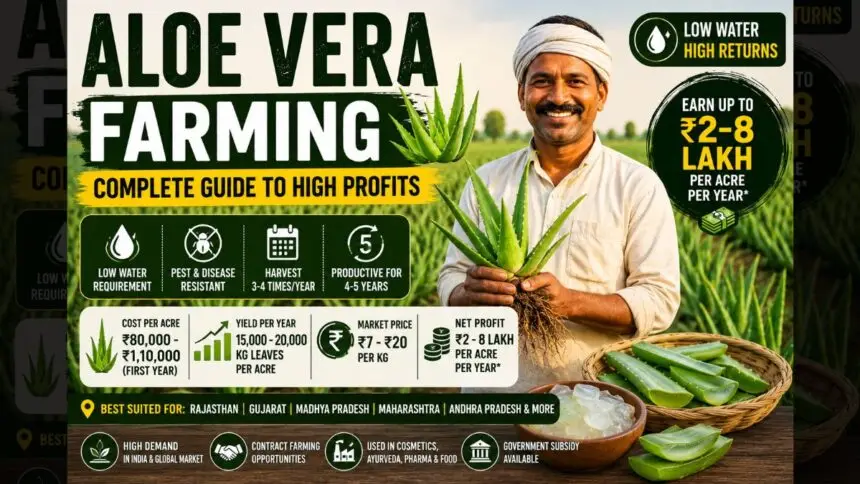
What if you could plant a crop once and keep earning from it for the next five years — using very little water, almost no pesticides, and a fraction of the labor you’d spend on wheat or sugarcane?
- What Exactly Is Aloe Vera?
- Why Aloe Vera Farming Makes Sense in 2026
- Aloe Vera Farming Cost per Acre in India (2026 Estimate)
- Aloe Vera Farming Profit per Acre — Realistic Numbers
- Conservative scenario (open market, fresh leaves)
- Moderate scenario (contract farming or direct company sale)
- Best-case scenario (value-added products or gel extraction)
- Agropotli Profit Calculator
- Best Aloe Vera Varieties for Indian Farmers
- Step-by-Step Aloe Vera Cultivation Guide
- Step 1 — Soil and land preparation
- Step 2 — Selecting and treating suckers
- Step 3 — Planting
- Step 4 — Irrigation
- Step 5 — Fertilization
- Step 6 — Weed control
- Step 7 — Harvesting
- Where to Sell Your Aloe Vera — Marketing Channels
- Real Farmer Success Story: From Tea Stall to Aloe Vera Empire
- Expert Tips for Aloe Vera Farming Success
- Common Mistakes New Farmers Make (And How to Avoid Them)
- Aloe Vera Farming vs. Other Common Crops — Quick Comparison
- Government Support for Aloe Vera Farmers in 2026
- Is Aloe Vera Farming Worth It?
- FAQs on Aloe Vera Farming in India
That’s exactly what aloe vera farming offers. This humble succulent — the one sitting in pots on people’s balconies — has quietly become one of India’s most profitable medicinal crops. Cosmetics brands, Ayurvedic companies, pharma units, and juice manufacturers are all hungry for it, and farmers who figured this out early are laughing all the way to the bank.
If you’ve been thinking about starting aloe vera farming but aren’t sure where to begin, this guide breaks down everything — the real numbers, the right steps, the common pitfalls, and a real farmer’s story that proves it works.
What Exactly Is Aloe Vera?
Aloe vera (scientific name: Aloe barbadensis miller) is a succulent plant belonging to the family Asphodelaceae. The thick, fleshy leaves hold a gel-like substance packed with medicinal compounds. The plant is also called “Ghrit Kumari” in Ayurveda.
It’s a desert-adapted plant, which means it thrives where many crops struggle — in dry heat, poor soil, and limited rainfall. That’s why states like Rajasthan, Gujarat, Madhya Pradesh, Maharashtra, Andhra Pradesh, and Tamil Nadu are its biggest growing zones in India.
Quick fact: Aloe vera is often called the “plant of immortality” — not just for its healing properties, but because it keeps producing for 4–5 years after a single planting. For farmers, that’s 4–5 years of harvests from one investment.
Why Aloe Vera Farming Makes Sense in 2026
The aloe vera business in India has been growing steadily year after year. The Indian aloe vera market was valued at over ₹1,965 crore in 2017 and has been growing at a CAGR of more than 10%. Global demand for aloe vera extracts alone crossed $2.29 billion in 2024.
Why is this relevant for you as a farmer? Because companies — from Patanjali to Himalaya to international cosmetics exporters — need a reliable supply of fresh leaves and gel. And India, with its climate and land, is perfectly positioned to meet that demand.
- Low water requirement: Aloe vera grows well with just 50–300mm annual rainfall. Perfect for drought-prone areas.
- Low pest pressure: Naturally resistant to most pests and diseases. Chemical costs stay minimal.
- Multiple harvests per year: 3–4 cuttings per year from the same plant.
- 5-year production cycle: Plant once, harvest for years.
- Government support: Under the National Medicinal Plants Board (NMPB) scheme, farmers cultivating aloe vera and other medicinal crops are eligible for financial assistance to reduce their initial investment burden.
- Contract farming options: Several companies offer buyback agreements at fixed prices of ₹15–20/kg, giving you income security.
Aloe Vera Farming Cost per Acre in India (2026 Estimate)
One of the first questions any farmer asks is: “Kitna lagega?” Here’s a realistic, India-specific breakdown for one acre of aloe vera farming.
| Expense Item | Approximate Cost |
|---|---|
| Sucker/planting material (≈22,000 plants) | ₹30,000 – ₹35,000 |
| Land preparation & ploughing | ₹10,000 – ₹15,000 |
| Labour (planting + ongoing) | ₹15,000 – ₹20,000 |
| Organic manure / fertilizer | ₹10,000 – ₹15,000 |
| Irrigation setup (drip irrigation recommended) | ₹10,000 – ₹15,000 |
| Miscellaneous (tools, transport, etc.) | ₹5,000 – ₹10,000 |
| Total First-Year Investment | ₹80,000 – ₹1,10,000 |
Tip: From the second year onwards, you don’t need to buy suckers again — the plant produces its own offsets (pups). So your cost drops sharply, while your income stays the same or grows.
Note: Some sources quote figures up to ₹1.8–2 lakh per acre, which typically include drip irrigation systems or land development on new plots. For farmers with existing irrigation setup, the ₹80,000–₹1.1 lakh range is realistic.
Aloe Vera Farming Profit per Acre — Realistic Numbers
Plants per acre – 22,000
Leaf yield/year – 15,000–20,000 kg
Market price range – ₹7–20/kg
Typical net profit/acre – ₹2–8 lakh
Let’s be straightforward about the numbers, because there’s a lot of variation out there.
Conservative scenario (open market, fresh leaves)
- Yield: 15,000 kg per acre per year
- Price: ₹5–7 per kg (open market, wholesale)
- Gross income: ₹75,000 – ₹1,05,000
- After deducting ₹30,000–₹40,000 running costs: Net profit ≈ ₹40,000–₹65,000/year
Moderate scenario (contract farming or direct company sale)
- Yield: 18,000 kg per acre per year
- Price: ₹10–15 per kg (contract farming rate)
- Gross income: ₹1.8 – ₹2.7 lakh
- Net profit after costs: ₹1.2 – ₹2 lakh/year
Best-case scenario (value-added products or gel extraction)
- If you process the gel or make juice, soaps, or powder yourself, profit can reach ₹6–10 lakh/acre/year
- This requires additional investment in a processing unit, but multiplies your margins dramatically
Reality check: Avoid anyone promising guaranteed ₹10 lakh profit per acre without any value addition. That number is achievable, but only with processing or very high-quality contract agreements. For raw leaf farming, expect ₹1.5–3 lakh/acre in a well-managed setup.
Agropotli Profit Calculator
Best Aloe Vera Varieties for Indian Farmers
Not all aloe vera is the same. Picking the right variety matters — especially if you’re selling to Ayurvedic or cosmetic companies who specify minimum gel content requirements.
- AL-1 (CIMAP variety): Developed by the Central Institute of Medicinal and Aromatic Plants (CIMAP), Lucknow. High gel content, ideal for commercial farming. Most recommended.
- IC-111271, IC-111280, IC-111269, IC-111273: Varieties with 20–23% aloin content. High medicinal value and widely grown commercially.
- Aloe barbadensis Miller (Barbie Denis): Exotic high-gel variety. Some farmers in Rajasthan use this for export markets.
Practical advice: If you’re signing a contract with a company, ask them which variety they prefer before buying your suckers. Buying the wrong variety is a costly mistake that beginners often make.
Step-by-Step Aloe Vera Cultivation Guide
Step 1 — Soil and land preparation
Aloe vera grows best in well-drained loamy or sandy loam soil with a pH of 7–8.5. Waterlogging is its biggest enemy — it kills the roots quickly. Before planting, plough the land 2–3 times and add 60–80 quintals of well-rotted cow dung manure per acre. Make raised beds with proper drainage channels.
Step 2 — Selecting and treating suckers
Buy healthy suckers (offshoots) that are 4 months old, about 20–25 cm tall. After purchasing, dry them in the shade for 24 hours before planting. If there’s any risk of root fungus, treat with a Trichoderma solution. Avoid very small or overly large suckers.
Step 3 — Planting
The best planting time is July–August (monsoon season) if you’re relying on rain. With irrigation, you can plant throughout the year except in winter months. Maintain a spacing of 45 cm × 40 cm or 60 cm × 30 cm, which gives you approximately 22,000 plants per acre. Plant the sucker straight, 15 cm deep, and give light irrigation immediately after.
Step 4 — Irrigation
First irrigation right after planting. Summer months: irrigate every 15 days. Rainy season: usually no irrigation needed. Winter: once every 25–30 days. Drip irrigation is strongly recommended — it saves water, prevents waterlogging, and improves yield by 20–30%.
Step 5 — Fertilization
Aloe vera is not a heavy feeder. Over-fertilization actually harms gel quality. Use the full dose of organic manure during land preparation. A balanced dose of NPK can be split — half at planting, half at 3 months. In organic farming, vermicompost and Jeevamrit work well.
Step 6 — Weed control
The first 3 months are critical. Do 2–3 rounds of weeding and hoeing to prevent weeds from competing with young plants. After the canopy spreads, the plants themselves suppress most weeds.
Step 7 — Harvesting
You can start your first harvest 8–10 months after planting. Cut 3–4 outer mature leaves per plant per harvest. There are 3–4 harvests per year. After cutting, let the leaves wilt in the shade for 24–72 hours before sending to buyers. Keep them away from direct sunlight and excess moisture.
Where to Sell Your Aloe Vera — Marketing Channels
This is where many beginners get stuck. Growing the crop is half the job — finding the right buyer is the other half.
- Ayurvedic and pharma companies: Patanjali, Himalaya, Dabur, Emami, Nandini Herbals — these companies are major buyers of fresh leaves and gel
- Contract farming arrangements: Some companies offer buyback at ₹15–20/kg. Ensure the contract is written and signed before you plant
- Local mandis: Wholesale markets in Rajasthan, Gujarat, MP — prices here fluctuate (₹4–8/kg), but it’s a reliable off-take
- Direct processing: Setting up a small unit to make juice, gel, or powder dramatically improves margins
- Krishi Vigyan Kendras (KVK): Contact your district KVK — they often connect farmers with buyers and provide market intelligence
Real Farmer Success Story: From Tea Stall to Aloe Vera Empire
Success Story
Ajay Swamy, Parlika village, Hanumangarh, Rajasthan
Ajay Swamy had nothing but two bighas of inherited land and a tea stall to survive on. One morning, he read about aloe vera cultivation in a newspaper and decided to try it — not because he was an expert, but because it needed very little water (crucial in drought-prone Rajasthan) and relatively small investment.
He started small, using aloe vera suckers he found in a cemetery in a nearby village where locals had been planting them for years. He grew the crop, but instead of just selling raw leaves, he bought a simple mixer and made his first batch of bottled aloe vera juice. He sold 10 bottles in his village on day one.
Word spread. Companies came calling. He shut the tea stall and went full-time into aloe vera. He then visited the Krishi Vigyan Kendra to learn how to make soaps, creams, shampoos, conditioners, and sweets from aloe vera. Today, Ajay sells 45 different aloe vera products and earns in lakhs annually — all from two bighas of land in a region where water is scarce.
His advice to new farmers: “Take care of the plants in winter — that’s when most beginners lose their crop. And innovate — if you just sell leaves, you’ll always be at the mercy of someone else’s price.”
Expert Tips for Aloe Vera Farming Success
- Always ensure proper drainage — more aloe vera farms fail from waterlogging than from drought
- Dip suckers in Trichoderma solution before planting to prevent early root rot
- Never harvest all leaves from a plant — leave at least 3–4 inner leaves so the plant recovers
- Drip irrigation alone can boost your yield by 20–30% compared to flood irrigation
- Check with your district agriculture office or KVK for state-specific subsidies — many states offer 30–50% subsidy on medicinal plant cultivation under NMPB guidelines
- If you’re in Rajasthan, Gujarat, or MP, you’re in a natural advantage zone — use it
- Try to sell directly to processing companies rather than through commission agents to maximize your margins
- Keep records of your harvest quantities, expenses, and sale prices — this helps you negotiate better contracts
Common Mistakes New Farmers Make (And How to Avoid Them)
- Planting without a buyer lined up: Grow first, find buyer later is a recipe for selling at throwaway prices. Identify your buyer or contract before you even order suckers.
- Ignoring drainage: The single biggest killer of aloe vera crops. Spend the time to create proper raised beds and drainage channels.
- Buying the wrong variety: If a company wants AL-1 and you’ve grown a local variety, they may reject your produce. Always match variety to buyer requirements.
- Over-irrigating: More water is not better. Excess moisture causes root rot. Stick to the schedule.
- No value addition: Farmers who only sell raw leaves earn the least. Even basic processing — bottling juice, making dry powder — can multiply income 3–5 times.
- Harvesting too early: Wait for 8–10 months for the first harvest. Immature leaves have lower gel content and get rejected by buyers.
Aloe Vera Farming vs. Other Common Crops — Quick Comparison
| Crop | Approx. Cost/Acre | Profit/Acre/Year | Water Needed | Crop Cycle |
|---|---|---|---|---|
| Aloe Vera | ₹80K–₹1.1L | ₹1.5–3L (raw); up to ₹8–10L (processed) | Very Low | Plant once, 4–5 years |
| Wheat | ₹25,000–₹35,000 | ₹20,000–₹40,000 | High | Seasonal |
| Soybean | ₹20,000–₹30,000 | ₹20,000–₹35,000 | Moderate | Seasonal |
| Ashwagandha | ₹30,000–₹50,000 | ₹50,000–₹1.5L | Low | 7–8 months |
The numbers speak clearly. Aloe vera demands more upfront investment than cereals, but the returns — especially with value addition — are in a different league.
Government Support for Aloe Vera Farmers in 2026
The Central Government’s Revised Central Sector Scheme for the National Medicinal Plants Board (NMPB) provides financial assistance to farmers cultivating aloe vera and other medicinal crops. Farmers receive support to reduce their initial investment burden and also get training on organic farming and integrated pest management.
Additionally, under the Mission for Integrated Development of Horticulture (MIDH), various subsidies are available for infrastructure development. Contact your district agriculture office or Krishi Vigyan Kendra to find out what’s available in your state — several states offer 30–50% subsidies on medicinal plant cultivation costs.
Is Aloe Vera Farming Worth It?
Yes, aloe vera farming is genuinely worth considering in 2026 — especially for farmers in semi-arid regions with limited water availability. It’s a low-water, low-pesticide, multi-year crop with strong and growing market demand. The key to maximizing profit is connecting directly with buyers or processors before planting, choosing the right variety, and eventually exploring value addition. It won’t make you rich overnight, but it’s one of the most stable and scalable medicinal crops available to Indian farmers today.
FAQs on Aloe Vera Farming in India
1. How much profit can I earn from aloe vera farming per acre?
Profit from aloe vera farming ranges from ₹1.5–3 lakh per acre per year for raw leaf sales. If you add value through processing (juice, gel, powder, soap), it can reach ₹6–10 lakh per acre per year. The actual figure depends on your yield, market price, and whether you sell through contract farming or open market.
2. How long does it take for aloe vera to be ready for harvest?
The first harvest can begin 8–10 months after planting. The plant fully matures in 18–24 months. You get 3–4 harvests per year, and the same plant continues producing for 4–5 years from a single planting.
3. Which states in India are best for aloe vera cultivation?
Aloe vera is commercially grown across Rajasthan, Gujarat, Madhya Pradesh, Maharashtra, Andhra Pradesh, Tamil Nadu, Karnataka, and Uttar Pradesh. Rajasthan and Gujarat are especially well-suited because of dry climate and naturally low pest pressure.
4. Is contract farming available for aloe vera in India?
Yes. Several Ayurvedic and herbal product companies offer buyback contracts for aloe vera at rates of ₹15–20 per kg. These contracts provide price security and guaranteed off-take. Always verify the company’s credibility and get the agreement in writing before you plant.
5. Does the Indian government provide any subsidy for aloe vera farming?
Yes. Under the National Medicinal Plants Board (NMPB) scheme and the Mission for Integrated Development of Horticulture (MIDH), farmers cultivating aloe vera can receive financial assistance and training. Many states offer 30–50% subsidies on cultivation costs. Contact your district agriculture office or local Krishi Vigyan Kendra for details specific to your state.