



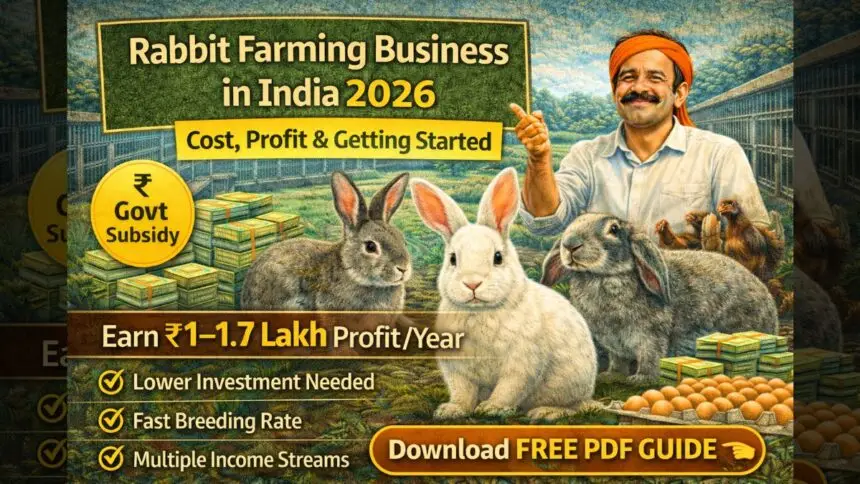
Most Indian farmers think about goats, poultry, or dairy when looking for extra income. But there’s a smaller, quieter animal sitting right at the edge of your field that can generate serious money with far less investment — the rabbit.
- What Is Rabbit Farming?
- Why Rabbit Farming Makes Sense for Indian Farmers in 2026
- Best Rabbit Breeds for Indian Farmers
- Rabbit Farming Cost Breakdown (India 2026)
- Rabbit Farming Profit — Realistic Numbers for India
- Step-by-Step Guide to Starting Your Rabbit Farm
- Step 1 — Plan Your Business Model
- Step 2 — Build Your Housing
- Step 3 — Source Quality Breeding Stock
- Step 4 — Set Up a Feeding Routine
- Step 5 — Start Breeding
- Step 6 — Health Management
- Step 7 — Market Your Product
- Government Schemes and Subsidies for Rabbit Farmers
- Real Success Story: How One Farmer Built a ₹1 Lakh+ Annual Income
- Expert Tips to Maximize Profit
- Common Mistakes New Rabbit Farmers Make
- Rabbit Farming vs Poultry Farming — A Quick Comparison
- Is Rabbit Farming Right for You?
- Frequently Asked Questions (FAQs)
The rabbit farming business in India is growing fast, and the reason is simple. With low startup costs, rapid growth rates, and multiple revenue streams, rabbits offer a promising opportunity for small and marginal farmers, as well as agri-entrepreneurs looking to diversify. Yet 90% of farmers haven’t even considered it.
This guide will give you the complete, practical picture — from day one setup to your first sale.
What Is Rabbit Farming?
Rabbit farming, technically called cuniculture, is the business of raising domestic rabbits for meat, fur, wool, or sale as breeding stock and pets. There is very high demand for rabbit meat in the market and there are not enough suppliers to fulfill this growing demand.
This supply gap is your opportunity.
With an initial setup cost of ₹50,000–₹80,000, farmers can rear popular breeds like New Zealand White and Soviet Chinchilla for meat, fur, or pets, requiring minimal space and offering quick reproduction.
Think of it like this: a small room, a backyard, or even a section of your existing shed is enough to get started.
Why Rabbit Farming Makes Sense for Indian Farmers in 2026
This is not a random business trend. There are solid, practical reasons why rabbit farming works especially well in India.
1. Reproduction is extraordinary. A single doe (female) can produce 25–40 kits (baby rabbits) per year, and this fast breeding cycle allows for quick herd expansion and a faster return on investment.Compare that to goats or cows — no other small livestock animal multiplies this fast.
2. Feed costs are very low. Rabbits thrive on green fodder — maize leaves, lucerne, cowpea, grasses — all of which either grow wild or are cheap to source. You can cut your feed bill significantly by growing fodder alongside your farm.
3. They need almost no space. A 400–500 sq ft area is sufficient for a starter unit of 10–12 does. No need to buy land. Use your backyard, an unused shed, or even the side of your house.
4. Multiple income streams. You earn from meat sales, selling live breeding pairs, rabbit manure (which sells to organic farmers at ₹5–8/kg), and even pet rabbits in urban markets.
5. Rabbit meat is gaining market value. Rabbit meat contains lots of omega-3 fatty acids, which is why it is very good food for heart patients. Urban consumers, hospitals, and specialty restaurants are increasingly seeking rabbit meat as a lean, healthy protein alternative.
Best Rabbit Breeds for Indian Farmers
Choosing the right breed is your most important first decision. Here is a practical breakdown:
New Zealand White — The top choice for commercial meat production in India. Fast-growing, good feed-to-meat ratio, and handles the Indian climate well. Ideal for beginners.
Soviet Chinchilla — Larger body size, excellent meat quality, and hardy. Good choice if you want to also sell the pelt.
Grey Giant — Another large meat breed, slower but produces heavy carcasses.
Angora — Chosen for wool production. Requires more care and grooming, but Angora wool fetches ₹800–1,000/kg, which can be a premium niche.
Pro tip: Start with 1 buck and 4–5 New Zealand White does. This ratio gives you consistent litters and avoids over-breeding stress on your females.
Rabbit Farming Cost Breakdown (India 2026)
One of the most common questions beginners ask is — how much does it actually cost to start? Here is a realistic, India-specific estimate for a small starter unit of 10 does and 2 bucks.
One-Time Setup Costs:
- Cage construction (wire mesh, GI pipe frames for 12 cages): ₹25,000–₹35,000
- Breeding stock (10 does + 2 bucks): ₹15,000–₹22,000
- Feeders, water bowls, nesting boxes: ₹4,000–₹6,000
- Initial feed supply (3 months): ₹8,000–₹12,000
- Veterinary medicines and first vaccines: ₹3,000–₹5,000
Total estimated setup: ₹55,000–₹80,000
Monthly Operating Costs:
- Pellet feed + green fodder: ₹3,000–₹4,000
- Veterinary and preventive care: ₹500–₹800
- Electricity and miscellaneous: ₹300–₹500
Total monthly running cost: ₹3,800–₹5,300
This is dramatically lower than poultry or goat farming, and you can recover your investment within the first year.
Rabbit Farming Profit — Realistic Numbers for India
Requiring minimal space and offering quick reproduction of 6–8 litters per year, the business can yield profits of ₹50,000 to ₹1.5 lakh annually. The feeding cost is low, and rabbits grow fast, making it a sustainable and scalable venture.
Let’s work out the numbers for a 10-doe unit:
Annual Production Estimate:
- 10 does × 6 litters/year × 6 kits per litter = 360 kits per year
- Mortality rate (approx. 15%): 306 kits survive to market age
- Each rabbit reaches 1.5–2 kg live weight in 3–4 months
Revenue Calculation:
- Meat sales (300 rabbits × 1.7 kg × ₹400/kg): approximately ₹2,04,000
- Manure sales: ₹8,000–₹12,000
- Breeding stock premium sales (10% sold as breeders at ₹800–₹1,200/pair): ₹12,000–₹18,000
Total Annual Revenue: ₹2,20,000–₹2,34,000 Annual Expenses (feed + vet + misc): ₹55,000–₹65,000 Net Annual Profit: ₹1,55,000–₹1,70,000
You can start this business with an investment of about ₹4 lakh and get ₹8 lakh in return for a larger commercial unit. As you scale to 50 does and above, the numbers improve substantially.
Step-by-Step Guide to Starting Your Rabbit Farm
Step 1 — Plan Your Business Model
Decide before you spend a single rupee: are you farming for meat, wool, breeding stock, or a mix? Meat farming is the easiest entry point with the most stable demand. Breeding stock sales give you higher price per animal but require a reputation first.
Step 2 — Build Your Housing
Use the cage system — individual wire mesh cages, each approximately 3 ft × 2 ft × 1.5 ft per rabbit. Wire mesh flooring allows droppings to fall through automatically, keeping hygiene easy. Build your shed in a dry, well-ventilated location away from direct sun and predators.
Separate cages for bucks, does, pregnant does, and growing kits. Do not overcrowd — stress and disease spread fast in overcrowded conditions.
Step 3 — Source Quality Breeding Stock
Buy your initial does and bucks from a certified government farm, KVK (Krishi Vigyan Kendra), or a reputable breeder. Avoid buying from random local sources — poor genetics is the number-one reason new farms fail.
Step 4 — Set Up a Feeding Routine
Rabbits do best on a combination of pellet feed and fresh green fodder. Feed twice a day — morning and evening. Always keep fresh, clean water available. Green fodder like lucerne, cowpea, and maize leaves can replace 40–50% of pellet intake, cutting your feed costs significantly.
Step 5 — Start Breeding
Does are ready to breed at 5–6 months of age. The gestation period is short, only 28–31 days, and kits are weaned at 4–6 weeks. Introduce the doe to the buck’s cage — never the other way around — to avoid territorial fights.
Step 6 — Health Management
Vaccinate against common diseases like Rabbit Hemorrhagic Disease (RHD) and Myxomatosis, and consult a local veterinarian for a vaccination schedule. Clean cages twice a week minimum. Check your herd daily for signs of lethargy, diarrhea, or loss of appetite.
Step 7 — Market Your Product
Connect with local butchers, restaurants, supermarkets, and wholesale meat markets before your first batch is ready. Contact urban restaurants that serve continental or specialty cuisines — rabbit meat commands premium pricing there. Also explore WhatsApp groups and local organic food communities for direct sales.
Government Schemes and Subsidies for Rabbit Farmers
This is something most new farmers miss entirely, and it can cut your investment significantly.
The National Livestock Mission (NLM) Scheme was created to improve the production of meat, milk, eggs, and animal fodder in India. Through it, the central government provides huge financial help as capital subsidy — free financial support given by the government that you do not have to return. https://aimindia.in/
Loan amount goes up to ₹25 lakh for small enterprises and ₹2 crore for large projects, with 25–50% subsidy based on category and location.
With generous 50% capital subsidies and a well-structured implementation mechanism, NLM is designed to generate employment.
Apply through the official NLM portal at nlm.udyamimitra.in or visit your nearest NABARD or commercial bank branch.
Additionally, the PM Mudra Yojana offers collateral-free loans of up to ₹10 lakh for livestock businesses. State governments also run their own animal husbandry schemes — check with your district’s Animal Husbandry Department.
Real Success Story: How One Farmer Built a ₹1 Lakh+ Annual Income
Meet Ramesh Patel, a marginal farmer from Pune district, Maharashtra. With just 2 acres of land and inconsistent crop income, Ramesh was looking for a way to earn year-round.
In 2022, he attended a Krishi Vigyan Kendra training on rabbit farming. He started with just 8 does and 1 buck, investing around ₹45,000 in cage setup and initial stock. By month 8, his first batch was ready for sale. Local restaurants in Pune city were willing to pay ₹450–₹500/kg for fresh rabbit meat — higher than he expected.
By the end of year two, Ramesh had scaled to 30 does. His annual income from rabbit farming crossed ₹1.2 lakh, separate from his crop income. He now supplies to three restaurants and sells breeding pairs to five other farmers he trained personally.
His advice: “Start small, focus on hygiene, and sell to restaurants directly. The price difference is worth the effort.”
Expert Tips to Maximize Profit
- Grow your own green fodder — lucerne and cowpea are easy to grow and can halve your feed costs.
- Maintain detailed records of litter dates, weights, and mortality. Data helps you identify your best-performing does.
- Build buyer relationships before you have product. Never wait until animals are ready to start marketing.
- Sell rabbit manure to vegetable farmers and home gardeners — it is prized organic fertilizer, and the revenue adds up over time.
- Join state-level rabbit farmer WhatsApp groups and associations. Collective selling gets better prices.
- Apply for KVK training before investing — most are free and will save you costly beginner mistakes.
Agropotli Profit Calculator
Common Mistakes New Rabbit Farmers Make
Buying cheap, low-quality stock. Poor genetics means slow growth, low litter sizes, and constant health problems. Always buy from a verified source.
Ignoring ventilation. Rabbits are very sensitive to heat and humidity. A poorly ventilated shed during Indian summer months can wipe out an entire batch.
Starting too big. Many beginners overinvest in 50+ animals before they understand management. Start with 8–10 does and scale after your first profitable cycle.
No market planning. Having 200 rabbits ready for sale and no buyer lined up is a real disaster. Build your market before your stock matures.
Skipping vaccination. Rabbit Hemorrhagic Disease can devastate an entire farm in days. Prevention costs almost nothing compared to loss.
Rabbit Farming vs Poultry Farming — A Quick Comparison
| Factor | Rabbit Farming | Poultry (Broiler) |
|---|---|---|
| Setup Cost | ₹55,000–₹80,000 | ₹1.5L–₹3L+ |
| Space Required | 400–500 sq ft | 1,000+ sq ft |
| Disease Risk | Low–Medium | High |
| Market Competition | Low | Very High |
| Meat Price | ₹400–₹600/kg | ₹120–₹180/kg |
| Odor / Waste | Minimal | Significant |
| Entry Barrier | Very Low | Medium–High |
For a farmer with limited capital and land, rabbit farming is clearly the better starting point.
Is Rabbit Farming Right for You?
Rabbit farming is emerging as a highly profitable and sustainable livestock enterprise for Indian farmers. The numbers are real, the entry barrier is low, and the market is underfilled.
If you have a spare room, a backyard, or an unused shed — you have everything you need to start. With ₹55,000–₹80,000 and a bit of dedication, you can realistically earn ₹1–1.7 lakh per year from a small unit, and scale from there.
The biggest risk is not taking the first step.
Frequently Asked Questions (FAQs)
Q1. How much does it cost to start rabbit farming in India? You can start a small rabbit farming unit in India with ₹55,000–₹80,000. This covers cage construction, breeding stock (10 does + 2 bucks), initial feed, and basic veterinary setup.
Q2. How much profit can I earn from rabbit farming in India per year? A well-managed small unit of 10 does can generate a net profit of ₹90,000–₹1.7 lakh per year, depending on your market and management practices.
Q3. Which is the best rabbit breed for farming in India? New Zealand White is the most recommended breed for Indian conditions. It grows fast, has an excellent feed-to-meat ratio, and adapts well to varying Indian climates.
Q4. Is there any government subsidy for rabbit farming in India? Yes. The National Livestock Mission (NLM) scheme provides capital subsidy that you do not have to return. https://aimindia.in/ Subsidy ranges from 25–50% based on category and location, with loans available up to ₹25 lakh for small enterprises. Apply at nlm.udyamimitra.in.
Q5. How long does it take for rabbits to reach market weight? With proper feeding, New Zealand White rabbits reach a live weight of 1.5–2 kg in approximately 3–4 months from birth, making them one of the fastest-growing meat animals available to Indian farmers.