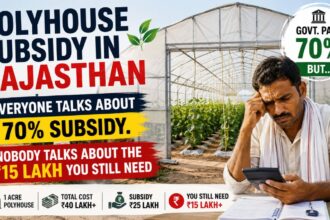




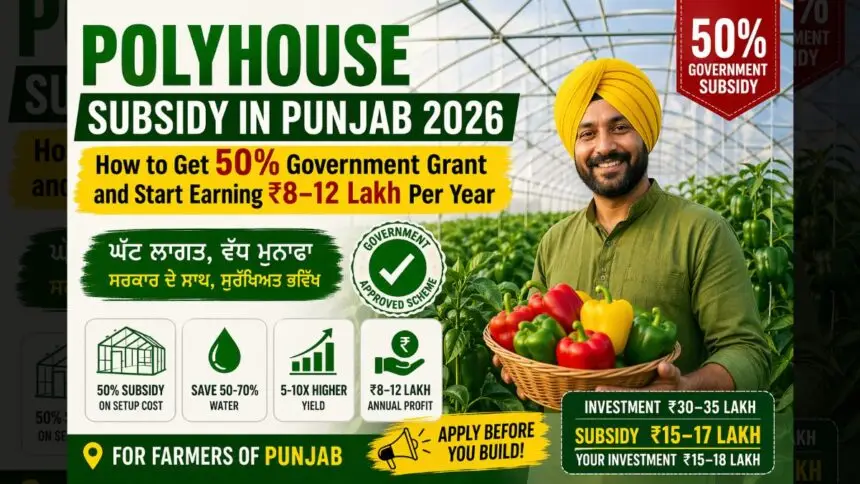
Picture this: you set up a modern polyhouse worth ₹35–40 lakh on your land. The Punjab government and the central government together quietly pay ₹17–20 lakh of that bill — as a grant you never have to return.
- What Is a Polyhouse? (Simple Explanation)
- Why Polyhouse Farming Makes Sense in Punjab Right Now
- Polyhouse Subsidy in Punjab 2026: How Much Will You Get?
- Cost Breakdown: How Much Does a Polyhouse Cost in Punjab?
- Agro Potli Daily Farm Expense Tracker
- Profit Potential: What Can You Actually Earn?
- Step-by-Step: How to Apply for Polyhouse Subsidy in Punjab
- Real Farmer Story: Gurpreet Singh from Jalandhar, Punjab
- Expert Tips to Maximize Your Polyhouse Returns in Punjab
- Common Mistakes to Avoid
- Polyhouse vs. Open-Field Farming in Punjab: A Quick Comparison
- Is the Polyhouse Subsidy in Punjab Worth It in 2026?
- Frequently Asked Questions (FAQs)
That is exactly what the polyhouse subsidy in Punjab offers in 2026. And yet, thousands of farmers across the state either don’t know it exists, or they start construction without following the right process — and lose their eligibility entirely.
If you are a farmer, a young agri-entrepreneur, or someone who’s been thinking about switching from wheat-paddy farming to something more profitable, this guide is written specifically for you. No jargon. No vague advice. Just a clear, step-by-step breakdown so you can actually claim this money.
What Is a Polyhouse? (Simple Explanation)
A polyhouse is a greenhouse-type structure built using a galvanized iron (GI) frame and covered with UV-stabilized polyethylene film. It creates a controlled environment inside — meaning you can manage temperature, humidity, and light regardless of what the weather outside is doing.
Think of it as a protective bubble for your crops.
Inside a polyhouse, your vegetables or flowers are shielded from:
- Harsh summer heat and Punjab’s dry hot winds (loo)
- Unseasonal rains that destroy open-field crops
- Pest and disease pressure from the outside environment
- Temperature swings that damage flowering and fruiting
The controlled environment ensures thicker fruit walls, a longer shelf life, and enables the production of high-value coloured varieties that command premium market prices. You also get the ability to grow year-round, run multiple crop cycles, and supply to retailers and exporters who need consistent quality produce throughout the year.
Why Polyhouse Farming Makes Sense in Punjab Right Now
Punjab farmers have been caught in a tough cycle — wheat and paddy yield decent output, but input costs have skyrocketed, margins are thin, and the groundwater situation is becoming critical.
Polyhouse farming is one of the few models that genuinely changes the economics.
Here is why it makes sense specifically for Punjab in 2026:
Yield is 5 to 10 times higher than open-field cultivation for the same land area. Average yield of capsicum in a polyhouse is 80–100 tons per acre, compared to just 8–15 tonnes per acre in open-field conditions.
Water savings are massive. Polyhouse systems use drip irrigation and fertigation, cutting water use by 50–70%. Given Punjab’s groundwater crisis, this alone is a strong reason to make the shift.
Government is actively subsidizing it. The window for getting 50% of your investment back as a grant is open right now. This is not a loan — it is free government money.
Market demand for high-value crops is growing. Cities like Chandigarh, Ludhiana, Amritsar, and Delhi are constantly demanding coloured capsicum, cherry tomatoes, cucumber, and exotic flowers — crops that are best grown in a polyhouse.
Polyhouse Subsidy in Punjab 2026: How Much Will You Get?
This is the part most farmers want to know first, so let’s be completely direct.
Punjab government provides a 50% subsidy on polyhouse construction through the National Horticulture Mission (NHM). The state government receives approximately 50% support from the central government in return, making this a jointly funded scheme.
Additionally, the central government’s National Horticulture Board (NHB) scheme provides an independent route to subsidy.
Here is a quick breakdown of both:
NHM (State Route — Punjab)
- Subsidy: 50% of project cost
- Managed by: Punjab Horticulture Department / District Horticulture Officer
- Minimum area: 500 sq meters (small farmers can apply)
- Best for: Small to medium farmers
NHB (Central Government Route)
- Subsidy: 50% of project cost
- Maximum NHB subsidy limit: ₹56 lakh per project; typical project sizes range from 2,000–4,000 sq meters.
- Apply at: nhb.gov.in
- Minimum area: 4,000 sq meters
- Best for: Commercial-scale farmers
Important note: This is a back-ended, credit-linked subsidy. You must take a bank loan first, build the polyhouse, get inspected by the government’s Joint Inspection Team (JIT), and then the subsidy amount is credited directly to your loan account. You cannot self-finance and claim subsidy later.
Cost Breakdown: How Much Does a Polyhouse Cost in Punjab?
Let’s look at realistic 2026 numbers for a 1-acre (4,000 sq meter) naturally ventilated polyhouse in Punjab.
One-Time Setup Cost (1 acre)
| Component | Estimated Cost |
|---|---|
| Polyhouse structure (GI frame + UV film) | ₹20–25 lakh |
| Drip irrigation + fertigation system | ₹2–3 lakh |
| Seedlings (e.g., capsicum @ ₹12/plant × 12,000 plants) | ₹1.44 lakh |
| Land preparation, plumbing, electricity | ₹1–2 lakh |
| Total Project Cost | ₹25–32 lakh |
After 50% Subsidy
- Government grant (approx.): ₹14–17 lakh
- Your actual out-of-pocket investment: ₹12–17 lakh (via own funds or balance loan)
For a standard project costing ₹35 lakh, the subsidy amount is approximately ₹17.5 lakh. Some states like Haryana offer an additional top-up taking total subsidy to 65%, but Punjab’s standard rate stands at 50%.
Annual Operating Cost (Year 2 onwards)
- Seasonal inputs (fertilizers, pesticides, labour): ₹3–5 lakh/year
- Electricity and water: ₹50,000–₹1 lakh/year
- Misc maintenance: ₹30,000–₹50,000/year
Agro Potli Daily Farm Expense Tracker
Profit Potential: What Can You Actually Earn?
Here are realistic income projections for a 1-acre polyhouse in Punjab growing coloured capsicum:
- Yield: 25–35 tons per acre per crop cycle (8–10 months)
- Wholesale market price: ₹50–80 per kg (coloured varieties)
- Gross Revenue: ₹15–25 lakh per crop cycle
- Annual Operating Cost: ₹4–6 lakh
- A well-managed 1-acre polyhouse growing coloured capsicum can generate a net profit of ₹8 lakh to ₹12 lakh per year, provided strict climate control and direct marketing are maintained.
For other crops:
- Cucumber: Gross revenue ₹9–12 lakh/acre/year (lower investment, faster return)
- Cherry Tomato: Net profit ₹6–10 lakh/acre/year
- Gerbera Flowers: Revenue potential ₹42–45 lakh/acre, but requires specialist knowledge
Return on Investment (ROI): Most Punjab polyhouse farmers recover their net investment (post-subsidy) within 2 to 3 years of starting production.
Step-by-Step: How to Apply for Polyhouse Subsidy in Punjab
This is the most critical section. Follow this sequence exactly — doing things out of order can disqualify you permanently.
Step 1: Visit Your District Horticulture Office Go to your nearest District Horticulture Officer (DHO) in Punjab. Collect the application form and get information about the current year’s target and fund availability. Offices are located in every district headquarter — Ludhiana, Amritsar, Jalandhar, Patiala, Bathinda, etc.
Step 2: Prepare Your Documents You will need:
- Aadhaar card and PAN card
- Jamabandi (land ownership records)
- Bank passbook (nationalized bank preferred — SBI, PNB, Bank of Baroda)
- Passport-size photographs
- Land map / khasra number
- Soil and water test report (get this done from PAU, Ludhiana or a government lab)
Step 3: Submit Application and Get In-Principle Approval (IPA) Submit your application with all documents. The department will review and issue an In-Principle Approval (IPA) or Letter of Intent (LOI).
You must apply first, get the In-Principle Approval or Letter of Intent from NHB or your state horticulture department, and only then begin construction. Building before LOI will permanently disqualify your application. Agro Potli
Step 4: Prepare a Detailed Project Report (DPR) Get a DPR made with the help of an agricultural consultant or the horticulture department. This document includes your project cost, bank loan details, crop plan, and structure specifications.
Step 5: Take a Bank Loan Visit a nationalized bank such as SBI, Bank of Baroda, or Punjab National Bank with your completed DPR and apply for an Agriculture Term Loan. Also ask your bank specifically about the Agriculture Infrastructure Fund scheme which provides an additional 3% interest subvention on your agriculture loan.
Step 6: Build the Polyhouse After getting the bank loan sanction letter, start construction using NHB-approved specifications (B-class GI pipes, UV-stabilized poly film). Do not cut corners here — the inspection team will verify your structure matches the DPR exactly.
Step 7: Joint Inspection Team (JIT) Visit Once construction is complete, the government will send a JIT — comprising bank officials, horticulture department officers, and NHB representatives — to inspect and verify the structure.
Step 8: Subsidy Credited If the JIT report is positive, the subsidy amount is credited directly to your loan account, reducing your outstanding balance. You start repaying only the remaining loan amount.
Real Farmer Story: Gurpreet Singh from Jalandhar, Punjab
Gurpreet Singh, a 34-year-old farmer from a village near Nakodar in Jalandhar district, was growing wheat and paddy on 5 acres of land. After a devastating hail storm in 2022 wiped out nearly half his wheat crop, he started looking for alternatives.
A friend told him about the polyhouse subsidy scheme. Gurpreet visited the District Horticulture Office in Jalandhar, spoke to the officer, and spent three months understanding the process before doing anything else.
In late 2023, he applied under NHM Punjab, got his LOI, secured a ₹22 lakh loan from Punjab National Bank, and set up a 1-acre naturally ventilated polyhouse. He chose coloured capsicum (red and yellow varieties) based on demand research from Chandigarh mandis and hotel suppliers.
The government subsidy of ₹11 lakh was credited to his loan account after JIT inspection. His effective bank debt came down to ₹11 lakh.
By his second crop cycle in 2025, Gurpreet was selling directly to two hotels in Chandigarh and a fresh produce aggregator at ₹70–90 per kg. His annual net income from the polyhouse crossed ₹9 lakh — more than double what he earned from 5 acres of wheat and paddy combined. He plans to expand to a second acre by the end of 2026.
His advice: “Pehle LOI lo, phir hi kuch shuru karo. Aur market pehle se fix karo.” (Get your LOI first, then start. And fix your market before you harvest.)
Expert Tips to Maximize Your Polyhouse Returns in Punjab
Choose the right structure type. For Punjab’s climate, a Naturally Ventilated Polyhouse (NVPH) works for most crops. A Fan-and-Pad system is needed only if you plan to grow in extreme summer months. Fan-pad adds to electricity costs but is necessary for certain exotic crops.
Get your water tested first. If your water’s EC (electrical conductivity) is above 1.0, install an RO plant first. EC between 0.5–1.0 suits capsicum and gerbera. Only EC below 0.5 allows you to grow roses or orchids.
Start with capsicum or cucumber. Do not start with roses, orchids, or gerbera as your first polyhouse crop. These are high-value but extremely sensitive. Begin with coloured capsicum or cucumber to build your management skills and market connections. Upgrade to flowers in your second or third polyhouse.
Fix your buyer before planting. Contact hotel chains, fruit and vegetable wholesalers, supermarkets, and export aggregators in advance. A price agreement or even an informal buyer commitment changes your financial planning completely.
Track your crop data. Temperature, humidity, fertigation schedules, EC and pH of water — track all of it in a notebook or a free farming app. Polyhouse farming rewards discipline. Open-field habits will lead to losses inside a controlled structure.
Common Mistakes to Avoid
Starting construction before getting LOI. This is the single biggest mistake, and it results in complete disqualification. The rule is non-negotiable.
Choosing low-value crops. Growing regular green capsicum or standard tomatoes inside a polyhouse rarely recovers the investment. Always grow coloured capsicum, cherry tomato, cucumber, or flowers that command ₹50–200 per kg.
Ignoring climate control. In states like Punjab and Haryana, air temperature quickly rises above 30 degrees Celsius in March and summer months, which increases temperature inside the polyhouse. Proper fan-pad or ventilation systems are essential.
Not preparing a proper DPR. An incomplete or unrealistic DPR gets rejected by the bank. Get professional help with this document — it is the foundation of your entire subsidy application.
Relying only on mandi (commission agents). The best profits in polyhouse farming come from direct-to-consumer or direct-to-business sales. Middlemen eat into your margin heavily when your production costs are higher than open-field farming.
Polyhouse vs. Open-Field Farming in Punjab: A Quick Comparison
| Factor | Open-Field Farming | Polyhouse Farming |
|---|---|---|
| Yield (capsicum) | 8–15 tons/acre | 25–40 tons/acre |
| Water use | High | 50–70% less |
| Weather dependency | Very high | Very low |
| Crop cycles per year | 1–2 | 2–3 |
| Price realization | Market rate | Premium (30–50% higher) |
| Government subsidy | Limited | Up to 50% of setup cost |
| Setup cost | Low | High (but subsidized) |
| Net income potential | ₹1–3 lakh/acre | ₹8–12 lakh/acre |
Is the Polyhouse Subsidy in Punjab Worth It in 2026?
Yes — but only if you follow the process correctly.
The polyhouse subsidy in Punjab gives you a genuine opportunity to halve your setup cost through a government grant. The crops you can grow inside a polyhouse command premium prices that open-field farming simply cannot match. And the shift away from groundwater-intensive wheat-paddy farming makes environmental and financial sense at the same time.
The two things that separate farmers who succeed with this model from those who struggle are: following the correct application sequence (LOI before construction, always), and growing the right crops with a pre-arranged market.
If you have land in Punjab, a bank account, and the patience to follow a process — the government is ready to co-invest in your polyhouse. The question is whether you will take the first step.
Start by visiting your District Horticulture Office this week. The rest will follow.
Frequently Asked Questions (FAQs)
Q1. How much polyhouse subsidy can I get in Punjab in 2026?
Punjab farmers can get a 50% subsidy on the total polyhouse setup cost through the National Horticulture Mission (NHM). For a project costing ₹30 lakh, the government grant would be approximately ₹15 lakh. The maximum NHB central scheme subsidy is capped at ₹56 lakh per project.
Q2. Can I apply for a polyhouse subsidy on leased land in Punjab?
Yes, you can apply on leased land. However, you must have a registered lease deed for a minimum of 10 to 15 years (the exact requirement may vary slightly by scheme), along with other standard documents like Aadhaar and land records.
Q3. What is the minimum area required to set up a polyhouse and claim subsidy in Punjab?
Under the NHM state scheme, you can apply with as little as 500 sq meters. Under the central NHB scheme, the minimum area is 4,000 sq meters. For commercial viability, most consultants recommend a minimum of 1 acre (4,000 sq meters).
Q4. Which crops are best for a polyhouse in Punjab?
Coloured capsicum (red and yellow), cucumber, and cherry tomato are the most recommended crops for first-time polyhouse farmers in Punjab. These crops have stable demand, manageable crop cycles, and premium pricing. Flowers like gerbera and Dutch rose are more profitable but require advanced expertise.
Q5. How long does it take to get the subsidy amount after the polyhouse is built?
After the Joint Inspection Team (JIT) visits and verifies your completed polyhouse, the subsidy is typically credited to your bank loan account within 2 to 4 months. The total timeline from application to subsidy credit — including construction — is usually 10 to 18 months.