



Moringa Farming is one of the most talked-about crops in India right now a fast-growing, hardy, and sold everywhere as a superfood. This guide is for farmers and agri-entrepreneurs who want the grounded version: what moringa actually earns, the two very different ways to grow it, and why so many growers who chase the viral “₹1 lakh a month” numbers end up disappointed. If you want the real picture before you plant, you’re in the right place.
- Why moringa gets so much attention
- Is moringa farming profitable?
- The decision that changes everything: pods or leaf powder?
- Where moringa grows and its two hard limits
- Choosing a variety
- How to grow moringa
- Propagation and planting time
- Spacing
- Pruning and coppicing don’t skip this
- Water, nutrition and pests
- When you’ll harvest
- Yield and the honest truth about the money
- About those viral profit figures
- Marketing is the whole game and a caution
- Government support
- Is moringa farming worth it?
- Frequently asked questions
Why moringa gets so much attention
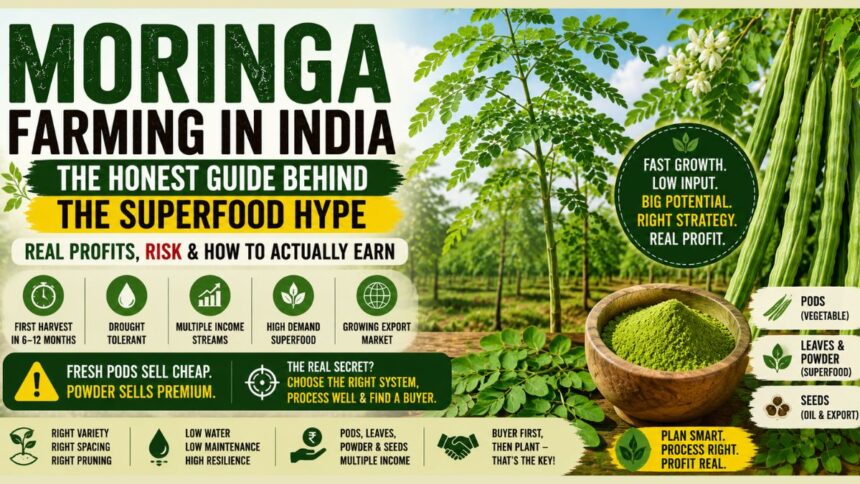
Moringa (Moringa oleifera), known as drumstick, sahjan, munaga, or nugge, is a fast-growing tree native to India. Three things make it genuinely interesting:
- It earns quickly. Unlike most tree crops, modern annual varieties can give a first pod harvest within about a year, and you can start taking leaf harvesting begin within a few months.
- It’s hardy and low-input. It tolerates drought and poor soils and suits dryland farming where fussier crops fail.
- It sells in three forms — pods (a vegetable), leaves and dried leaf powder (a nutraceutical superfood), and seeds — giving you more than one income stream and a genuinely growing health and export market.
That’s a real set of strengths. But moringa also attracts some of the wildest profit claims in Indian farming, and separating the promise from the marketing is exactly what this guide is about.
Is moringa farming profitable?
Moringa farming can be profitable and earns faster than most tree crops, since annual varieties give pods within about a year. But fresh pods and leaves are perishable and prices swing hard, so real profit depends on choosing the right system, drying leaves well, and lining up a buyer before you plant — not on the viral income figures floating around online.
The decision that changes everything: pods or leaf powder?
Before you buy a single seed, understand this: moringa is really two different crops depending on what you grow it for, and they are managed in almost opposite ways. Getting this wrong is the most common and most expensive beginner mistake.
| Factor | Pod (drumstick) system | Leaf / powder system |
|---|---|---|
| Main product | Fresh pods, sold as a vegetable | Fresh leaves and dried leaf powder |
| Spacing | Wider (around 2.5–3 m) | Dense (roughly 0.9–2 m) |
| Plants per acre | A few hundred | Roughly 1,000 up to several thousand |
| Typical varieties | PKM-1, PKM-2 and annual pod types | Leaf-rich and multi-purpose types |
| Who buys it | Vegetable mandis, wholesalers | Nutraceutical, powder and export processors |
| Biggest challenge | Price crashes and perishability | Clean drying, hygiene, quality, finding a buyer |
A pod orchard is planted wide so sunlight reaches the branches and pods set well. A leaf-and-powder plot is planted dense and cut back repeatedly to force fresh leafy growth. You can run a multi-purpose orchard, but decide your primary goal first, because it dictates your variety, spacing, and — most importantly — who you’ll sell to.
Where moringa grows and its two hard limits
Moringa is genuinely hardy. It grows across a warm, dry belt and is cultivated commercially mainly in Tamil Nadu, Andhra Pradesh, Telangana, Karnataka, and other southern and dry-region states, with cultivation spreading into Maharashtra, Madhya Pradesh and beyond.
It likes:
- Warm climate. It thrives in heat; warm, fairly dry conditions actually favour flowering and pod set.
- Well-drained soil. Loam to clay loam is ideal, but it manages on poor and light soils too.
- Low water. It’s drought-tolerant once established, though irrigation lifts yields.
But respect its two hard limits: moringa hates waterlogging and it is frost-sensitive. Prolonged standing water rots the roots, and a hard frost can damage or kill young plants. If your land floods in the monsoon or your winters bring frost, moringa is a poor fit — or needs careful timing and drainage.
Also Read: Amla Farming Looks Like Easy Money. Here’s Why Many Growers Struggle to Profit
Choosing a variety
The first fork is annual versus perennial. Annual types (grown from seed) bear fast and are usually replanted every few years; perennial types (often grown from cuttings) live longer and are prized for pod flavour and leaf quality.
| Variety | Type | Notes |
|---|---|---|
| PKM-1 | Annual | Tamil Nadu; early and heavy pod bearer; widely grown |
| PKM-2 | Annual | Improved, larger/more pods; suited to dedicated pod orchards |
| Bhagya (KDM-1) | — | Karnataka (UAS Dharwad); good multi-purpose pods and leaves |
| Coimbatore-1 | Perennial | Kerala Agricultural University; two harvests a year |
| Local / desi perennial | Perennial | Grown from cuttings; valued for flavour and leaf nutrition |
Match the variety to your system and region, and buy quality seed or cuttings from a reliable source. Confirm the current recommended variety and package of practices with your state agricultural university or KVK before buying.
How to grow moringa
Propagation and planting time
Annual moringa is usually grown from seed — sown directly or raised as seedlings and transplanted — while many perennial types are grown from stem cuttings. Planting is commonly timed to the onset of the monsoon (around June, after the first good showers) so young plants establish with natural moisture, while avoiding frost.
Spacing
Set spacing by your system, not by a single rule. Pod orchards use wider spacing so light reaches the canopy; leaf-and-powder plots use dense spacing to maximise cuttable growth.
Pruning and coppicing don’t skip this
Moringa naturally shoots up tall and leggy. Early pruning — the first “pinching” or cutting back when young plants reach around a metre — forces side branches, keeps pods and leaves within easy reach, and dramatically improves yield. For leaf-powder systems, repeated coppicing is the whole method: you cut low and harvest the flush of tender new leaves again and again.
Water, nutrition and pests
Give light, regular irrigation while establishing, then far less once the trees are away — drip suits it well. Base fertiliser on a soil test rather than a fixed recipe. Watch for the common pests: pod fly and hairy caterpillars are the usual culprits, and pod fly in particular can ruin a crop. Scout regularly and use locally approved control measures rather than blanket spraying.
When you’ll harvest
This is moringa’s headline advantage. Annual varieties can give a first pod harvest within roughly six to nine months to a year of sowing, and leaf cuttings can begin within a few months. Compared with a mango or amla orchard, that’s a very short wait to first income.
Yield and the honest truth about the money
Here’s where you need clear eyes. Under good management, well-run annual pod systems can produce in the range of roughly 8 to 13 tonnes of pods per acre, with leaf systems yielding several tonnes of fresh leaf — but these figures vary enormously with variety, spacing, water and care, and the very high numbers you’ll see quoted online are best-case, not typical.
Yield, though, is not your real problem. Price and perishability are. Consider what each product actually fetches and what it demands of you:
| Product | Indicative price range | What it really takes |
|---|---|---|
| Fresh pods | Roughly ₹10–70/kg, occasionally higher, and it crashes in gluts | Sell fast to a vegetable mandi; highly perishable and volatile |
| Fresh leaves | Roughly ₹25–50/kg | Local or processor demand; perishable, must move quickly |
| Dried leaf powder | Roughly ₹200–500/kg | Clean drying, hygiene, quality control, and a real buyer/certification |
| Seeds | Roughly ₹150–300/kg | Oil extractors or planting-material buyers |
Check today’s live rates before you plan anything, because fresh drumstick prices in particular swing from very low to very high across seasons and mandis.
Look closely at that table and the strategy writes itself. Fresh pods pay the least per kilo and punish you hardest for being far from a market or slow to sell. The real premium sits in dried leaf powder — but that premium is payment for work you must actually do: hygienic drying (ideally shade or controlled drying to protect colour and nutrients), grinding, packaging, quality consistency, and often certification for the nutraceutical or export buyer. Grow leaves, dry them badly, and skip the buyer, and you’ll be back to selling cheap fresh produce at the mandi.
About those viral profit figures
You’ll find articles and reels promising a lakh a month, hundreds of tonnes per acre, and guaranteed buy-back riches. Treat all of it with deep suspicion.
Some of the yield numbers circulating are simply arithmetic errors (confusing per-plant with per-acre). Some profit figures quietly assume you’ll sell everything as premium powder at top price with zero wastage and a buyer already in hand — which is not how it works for a first-time grower. And a chunk of the hype comes from companies selling saplings or “contract farming” packages, not from independent farmers reporting real results.
Being honest about this isn’t discouragement — moringa is a genuinely good crop. It’s about planting on real numbers so you’re not blindsided in year one.
Marketing is the whole game and a caution
For moringa, finding your buyer is harder and more important than growing the crop. Decide your market before you plant:
- Pods need a reliable vegetable channel — mandi, wholesaler, or aggregator — close enough that perishable pods reach it fresh.
- Leaf powder needs a processor, nutraceutical company, or export buyer, plus your own clean drying and grinding setup or a tie-up with one.
Be wary of guaranteed buy-back and contract-farming offers, which are common in the moringa space. Some are legitimate; many pair overpriced planting material with vague promises. Check the company’s track record with existing growers, get any agreement examined by a lawyer, and never treat a buy-back as a replacement for understanding your own market. Grouping with other growers through an FPO can also give you the volume that serious buyers actually want.
Government support
Moringa is a horticulture crop, so orchard establishment, drip irrigation, and sometimes post-harvest and processing infrastructure can fall under horticulture development support — commonly the Mission for Integrated Development of Horticulture (MIDH), your state horticulture department, and the National Horticulture Board (NHB). Value-addition and drying units may also qualify under food-processing or FPO-linked schemes, and NABARD-linked loans can help fund setup.
Support levels, eligibility and processes change and vary by state, so don’t rely on any fixed figure online — confirm current rates and apply through your district horticulture office.
Is moringa farming worth it?
For the right grower, moringa is one of the more genuinely promising options in Indian farming. It earns faster than almost any tree crop, thrives on tough dry land with modest inputs, gives you diversified income, and rides a real and growing superfood and export wave. If you have suitable warm, well-drained land and — this is the part that decides it — you plan your market and, for leaves, your drying and processing before you plant, it can pay well.
Go in aware of the downsides:
- Fresh pods and leaves are perishable and prices swing violently. A glut can crash your rate.
- The premium needs work. Leaf-powder money depends on hygienic drying, quality, and a buyer — not just growing leaves.
- Marketing is the real bottleneck, harder than cultivation.
- It won’t take frost or waterlogging.
- The internet’s profit numbers are inflated, and buy-back offers need careful scrutiny.
A sensible way in: start on a manageable plot, pick one primary system, choose a proven variety, and spend the first season proving both your yield and — just as important — your buyer before you scale.
Frequently asked questions
How long does moringa take to give its first harvest?
Modern annual varieties can produce a first pod harvest within roughly six to nine months to a year of sowing, and leaf cuttings can start within a few months. This fast return is moringa’s biggest advantage over slower tree crops like amla or mango.
Is moringa leaf powder really profitable?
It can be, because dried leaf powder sells for far more than fresh produce. But that price reflects real work — hygienic drying, grinding, quality control, packaging, and often certification — plus a secured buyer. Without processing and a market, you’ll end up selling cheap fresh leaves instead.
How many moringa plants fit in one acre?
It depends entirely on your system. Pod orchards use wider spacing with a few hundred plants per acre, while dense leaf-and-powder plots can hold a thousand up to several thousand. Fix spacing to your variety and purpose before planting.
Should I grow moringa for pods or for leaves?
Choose based on your market, not on which sounds more profitable. Pods suit growers with a good, nearby vegetable channel; leaf powder suits those willing to invest in drying, quality, and a processor or export buyer. Trying to do both without a plan usually does neither well.
Does moringa need a lot of water and care?
No — it’s drought-tolerant, low-input, and hardy once established, which is a big part of its appeal for dryland farmers. It does need good drainage, protection from frost when young, timely pruning, and watchfulness for pests like pod fly.
Can I export moringa leaf powder?
There is real export demand, but exporting means meeting strict quality, hygiene, and certification standards and working with a genuine buyer or exporter. It’s achievable, but treat it as a processing-and-compliance business, not simply as growing and drying leaves.