




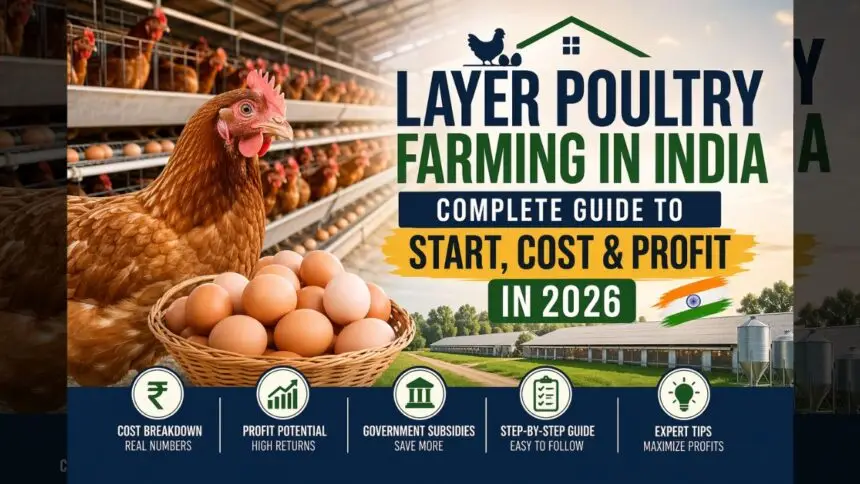
Imagine waking up every morning knowing that your farm is generating income — not seasonally, not once a year, but every single day.
- What Is Layer Poultry Farming?
- Why Layer Poultry Farming Makes Sense in 2026
- Layer Poultry Farming Cost Breakdown (India-Specific, 2026)
- Profit Potential: Real Numbers, Real Expectations
- Government Subsidies You Should Not Miss
- Step-by-Step Guide to Start Layer Poultry Farming
- Step 1 – Do Your Market Research First
- Step 2 – Choose Your Location Wisely
- Step 3 – Build the Right Shed
- Step 4 – Buy Quality Chicks from a Certified Hatchery
- Step 5 – Follow the Feeding Schedule Carefully
- Step 6 – Vaccination Schedule (Do Not Skip This)
- Step 7 – Egg Collection and Marketing
- Agropotli Profit Calculator
- Expert Tips to Maximize Your Profits
- Common Mistakes Beginners Make
- Layer Farming vs. Broiler Farming: Which Is Better for You?
- Real Success Story: Suresh Verma from Madhya Pradesh
- Is Layer Poultry Farming Worth It in 2026?
- FAQs: Layer Poultry Farming in India
That is exactly what layer poultry farming offers Indian farmers and entrepreneurs. While traditional crop farming depends on monsoon and market cycles, a layer hen farm produces eggs 300+ days a year. Cash flows in daily. And the demand? Eggs are one of the most consumed foods across every income group in India — urban, rural, north, south, everywhere.
But here is what most beginners get wrong — they jump in without a proper plan, underestimate costs, or pick the wrong breed. This guide will fix all of that.
Whether you are a farmer looking to diversify your income, an agri-entrepreneur planning your first poultry venture, or someone who simply wants to understand if layer poultry farming is worth it in 2026 — you are in the right place.
What Is Layer Poultry Farming?
Layer poultry farming is the practice of raising hens specifically bred for egg production — not meat. These hens, called “layers,” are selected breeds that begin laying eggs at around 18 to 20 weeks of age and continue for up to 72 to 80 weeks.
Layer hens typically begin laying eggs at approximately 18–20 weeks of age and can continue doing so until they are 70–72 weeks old.
The most common layer breeds used in commercial farming in India include:
- White Leghorn – high egg production, heat-tolerant, widely used across India
- BV-300 and Hy-Line Brown – known for brown eggs, popular in South India
- Babcock B-300 – suited for moderate climates
Each layer bird can produce around 250–300 eggs annually, making it a reliable income source.
Why Layer Poultry Farming Makes Sense in 2026
Before you invest a single rupee, you need to know why this business works. Here is the short answer — eggs are recession-proof food.
Key reasons layer farming is a smart business in 2026:
- Consistent daily income – Unlike broilers (which give income batch-by-batch), layers produce and sell eggs every day
- Low food cost per unit – Layer hens require less feed than their broiler counterparts, and since the productive lifespan is high (up to 72–80 weeks), farmers can enjoy continuous returns in the long run.
- Extra income from manure – Poultry manure is an excellent organic fertilizer and can be sold to farmers or used on your own fields, adding a second revenue stream
- Growing market – The average Indian consumes about 79 eggs per year, and these numbers are growing.
- Government support – Multiple subsidy schemes are available, which we will cover in detail below
- The poultry industry contributes over ₹1.2 lakh crore annually to the Indian economy and employs millions directly and indirectly
Layer Poultry Farming Cost Breakdown (India-Specific, 2026)
This is the section most people look for — and most websites get wrong. Let us break it down realistically.
Small-Scale Setup: 500 to 1,000 Birds
This is the ideal entry point for a first-time farmer.
| Cost Head | Estimated Amount (₹) |
|---|---|
| Shed construction (per sq. ft. ~ ₹200–250) | ₹1,50,000 – ₹2,50,000 |
| Day-old chicks (DOC) @ ₹50–70 per chick | ₹25,000 – ₹70,000 |
| Cages and equipment | ₹80,000 – ₹1,50,000 |
| Feed for first 18 weeks (pre-lay period) | ₹60,000 – ₹1,00,000 |
| Vaccination and medicines | ₹10,000 – ₹20,000 |
| Labour (1–2 workers) | ₹15,000 – ₹30,000/month |
| Miscellaneous and utilities | ₹15,000 – ₹25,000 |
| Total Estimated Investment | ₹3.5 Lakh – ₹6 Lakh |
Medium-Scale Setup: 5,000 to 10,000 Birds
This is where the business becomes commercially serious.
- Total setup cost: approximately ₹15 Lakh to ₹30 Lakh
- This includes shed, battery cage systems, feed silos, water lines, and trained staff
Feed accounts for nearly 70% of the total costs, making it essential to source high-quality yet affordable poultry feed.
Pro Tip: Your single biggest ongoing cost will always be feed. If you can tie up with a local feed supplier or even start a small feed mixing unit, your margins improve dramatically.
Profit Potential: Real Numbers, Real Expectations
Let us do the math straight.
For a 1,000-bird layer farm:
- Each bird produces approximately 280–300 eggs/year
- Total eggs per year: ~2,80,000 to 3,00,000 eggs
- Production cost per egg: approximately ₹3.50
- Farm-gate selling price per egg: ₹4.50 to ₹5.50 (varies by state and season)
- Profit per egg: ₹1 to ₹2
- Annual profit from 1,000 birds: ₹2.8 Lakh to ₹6 Lakh
Layer farming gives ₹6–₹8 profit per egg on average across breed and management conditions.
For a 10,000-bird layer farm:
If you start a layer bird farm with 10,000 birds using cage technology, you can earn around ₹10,000 daily after four months of starting the farm — which means up to ₹3 lakh per month.
ROI Timeline: Expect to recover your full investment within 18 to 24 months for a well-managed medium-scale farm.
Government Subsidies You Should Not Miss
One of the biggest advantages of layer poultry farming in India right now is the financial support available from the government.
National Livestock Mission (NLM) – 2026
The National Livestock Mission (NLM) Scheme was created to improve the production of meat, milk, eggs, and animal fodder in India. Through this scheme, the central government provides financial support as a “capital subsidy” — free financial support that you do not have to return. https://aimindia.in/
The government is highly encouraging women to start livestock businesses. Over 850 animal farming projects led entirely by women and women’s Self-Help Groups (SHGs) have been approved under this scheme. https://aimindia.in/
NABARD Poultry Venture Capital Fund
Under the Entrepreneurship Development and Employment Generation component of the National Livestock Mission, NABARD offers capital subsidy of up to 25–50% on eligible projects, depending on category. Eligible entities include individuals, SHGs, FPOs, cooperatives, and companies. Loansubsidy
Poultry Farm Loan Yojana
Under this scheme, general category applicants get a 25% subsidy on the loan amount. SC/ST/OBC categories receive a 33% subsidy. Interest rates range from 7–14% per annum, depending on the lender.
How to Apply: Visit your nearest SBI, Canara Bank, or Regional Rural Bank branch. Carry your land documents, Aadhaar, and a basic project report. You can also apply online at www.nlm.udyamimitra.in.
Step-by-Step Guide to Start Layer Poultry Farming
Step 1 – Do Your Market Research First
Before building anything, visit local egg traders, hotels, and dhabas in your area. Understand the egg price per tray in your district, who the buyers are, and whether local supply is short or surplus. This 3-day homework can save lakhs.
Step 2 – Choose Your Location Wisely
Your farm should be:
- At least 500 metres away from a residential area (for biosecurity and odour control)
- Close to a good road (for supply logistics)
- Near a water source (layer hens need a lot of clean water daily)
- Well-ventilated — avoid low-lying areas
Step 3 – Build the Right Shed
Layer farms typically use one of two housing systems:
- Cage system (battery cages): Most common in India. Higher initial cost but better hygiene, easier egg collection, and higher productivity per square foot
- Deep litter system: Lower cost but needs more space, more manure management
For 1,000 birds, you will need approximately 1,500 to 2,000 sq. ft. of shed space.
Step 4 – Buy Quality Chicks from a Certified Hatchery
When buying chicks, it is essential to ensure that healthy chicks weigh more than 35–40 grams. The chicks must be free from any diseases, and vaccination is necessary for their well-being. Farmers should purchase chicks from reliable hatcheries. khetivyapar
Step 5 – Follow the Feeding Schedule Carefully
Layer hens have three distinct feed phases:
- Chick phase (0–8 weeks): High protein starter feed (~20–22% protein)
- Grower phase (8–18 weeks): Reduced protein, more fibre (~16–18% protein)
- Layer phase (18 weeks onwards): High calcium feed (~16% protein + 3.5–4% calcium for strong eggshells)
After two weeks, it is advisable to provide the chicks with a 2% calcium solution. This condition persists for six weeks because chicks cannot regulate their body temperature until then. khetivyapar
Step 6 – Vaccination Schedule (Do Not Skip This)
Common diseases in layer hens include Marek’s Disease, Newcastle Disease (Ranikhet), Infectious Bronchitis, and Fowl Pox. Create a vaccination calendar with your local veterinarian from Day 1. A disease outbreak on an unvaccinated flock can wipe out months of income overnight.
Step 7 – Egg Collection and Marketing
Collect eggs twice daily to prevent breakage and microbial contamination. Grade, clean, and pack in standard 30-egg trays. Build relationships with:
- Local traders and egg aggregators
- Grocery stores and supermarkets
- Hotels, bakeries, and sweet shops
- Online platforms like BigBasket, Swiggy Instamart, and Zepto for premium urban markets
Agropotli Profit Calculator
Expert Tips to Maximize Your Profits
- Keep a flock register: Track daily egg production per batch. A drop of 5% or more in a week is a red flag for disease or nutritional deficiency.
- Sell spent hens at the right time: After 72–80 weeks, layer hens are sold as meat. Time this sale to the festive season (Diwali, Eid, Christmas) when meat prices are higher.
- Use manure revenue: Dried poultry manure sells for ₹3–₹5 per kg. A 1,000-bird farm can generate 500–700 kg of dry manure per month. That is ₹1,500–₹3,500 in extra monthly income.
- Start small, scale with confidence: Your first 1,000 birds will teach you more than any course. Once you have the management sorted, scale to 5,000 and beyond.
Common Mistakes Beginners Make
1. Skipping the pre-lay period budget Many beginners forget that hens don’t lay eggs for the first 18 weeks. You are feeding and caring for birds with zero egg revenue. Budget for this carefully.
2. Buying cheap, uncertified chicks Low-quality chicks mean poor egg production. Always buy from ICAR-registered or state government-certified hatcheries.
3. Ignoring ventilation Poor ventilation causes ammonia buildup, respiratory disease, and stress in birds — all of which tank your egg production. Invest in proper fans and cross-ventilation.
4. No marketing plan Building the farm first, thinking about buyers later — this is a classic mistake. Lock in at least 2–3 buyers before your first batch starts laying.
5. Under-spending on biosecurity Disease outbreaks, changes in feed prices, and changing market prices for eggs are the biggest risks in poultry farming. DMI Finance Footbaths, dedicated farm clothes, visitor restrictions — all of these cost very little but save a lot.
Layer Farming vs. Broiler Farming: Which Is Better for You?
| Factor | Layer Farming | Broiler Farming |
|---|---|---|
| Income Type | Daily (egg sales) | Batch-wise (every 6–7 weeks) |
| Initial Investment | Higher | Lower |
| ROI Timeline | 18–24 months | 4–6 months |
| Risk Level | Moderate | Moderate-High (price volatility) |
| Management Complexity | Moderate | Relatively simpler |
| Best For | Long-term stable income | Quick returns, short capital cycle |
Verdict: If you want daily cash flow and a long-term business, layer farming wins. If you want quicker returns and can handle price swings, broiler farming is faster. Many successful farmers combine both.
Real Success Story: Suresh Verma from Madhya Pradesh
Suresh Verma, a 38-year-old farmer from Sehore district in Madhya Pradesh, had been growing soybean and wheat for 12 years. After repeated losses due to unseasonal rains, he decided to diversify in 2022.
He started with 500 layer hens using a ₹4 lakh investment — partly self-funded and partly through a NABARD-linked poultry loan from his local cooperative bank. He received a 25% back-ended subsidy on the loan.
By month 5, his hens were laying 430–450 eggs daily. He tied up with a local trader in Bhopal and two nearby dhabas for regular supply.
By end of Year 1, he had recovered 60% of his investment. By Year 2, he had expanded to 2,000 birds and hired a helper. Today, Suresh earns a net income of ₹40,000–₹55,000 per month from eggs alone — more than double what his crop farming ever gave him. He has also started selling dried manure to neighboring farmers.
His advice to beginners: “Do not skip the vaccination schedule. And never sell eggs through just one buyer — if they drop you, your income stops.”
Is Layer Poultry Farming Worth It in 2026?
Yes — but only if you go in prepared.
Layer poultry farming is one of the most stable and scalable agri-businesses available to Indian farmers and entrepreneurs today. The egg market is large, demand is consistent, government support is available, and the daily cash flow model is far more predictable than seasonal crops.
The key is starting right: choose quality birds, invest in proper housing, follow the vaccination schedule, and lock in buyers before your birds start laying.
Start small with 500–1,000 birds, learn the business hands-on, and then scale up. With the right plan, you can build a layer farm that generates ₹30,000 to ₹3,00,000 per month depending on your flock size — all from eggs.
FAQs: Layer Poultry Farming in India
Q1. How much does it cost to start a layer poultry farm in India?
For a small-scale setup of 500–1,000 birds, the initial investment is approximately ₹3.5 lakh to ₹6 lakh including shed, chicks, cages, feed, and medicines. Medium-scale farms of 5,000–10,000 birds require ₹15–30 lakh.
Q2. How many eggs does one layer hen produce per year?
A healthy layer hen produces approximately 280 to 310 eggs per year under good management and nutrition. Commercial performance depends on breed, feed quality, and lighting management.
Q3. What government subsidy is available for layer poultry farming?
Under the National Livestock Mission (NLM) and NABARD’s Poultry Venture Capital Fund, eligible farmers can get a capital subsidy of 25% (general category) to 33–50% (SC/ST/women categories) on their project cost. Apply through your nearest bank or at nlm.udyamimitra.in.
Q4. What is the profit margin in layer poultry farming in India?
The profit per egg typically ranges from ₹1 to ₹2 depending on feed costs, egg prices, and your state. A well-managed 1,000-bird farm can earn ₹2.5 to ₹5 lakh net profit annually. A 10,000-bird farm can generate up to ₹2–3 lakh per month.
Q5. Which is the best layer hen breed for India?
White Leghorn, Hy-Line Brown, BV-300, and Babcock B-300 are the most popular and productive commercial layer breeds in India. White Leghorn is especially suited for hot climates and is widely available from government-certified hatcheries.









Want to explore and setup egg farming, would please guide me