



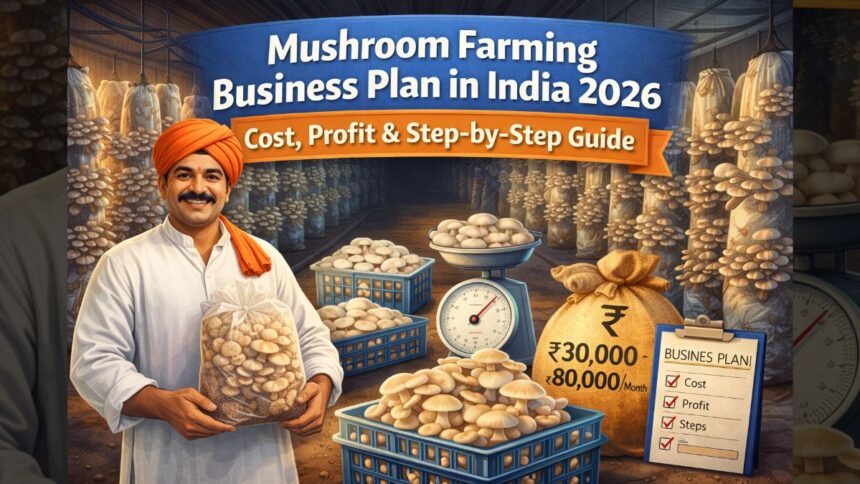
Mushroom Farming: Imagine earning ₹30,000–₹80,000 every month from a single room in your house — no tractor, no big land, no heavy investment. Thousands of farmers across India are doing exactly this with mushroom farming. And the best part? You can start with as little as ₹10,000.
- What Is Mushroom Farming?
- Why Mushroom Farming Is a Smart Business in 2026
- Best Types of Mushrooms to Farm in India
- Mushroom Farming Cost Breakdown (India-Specific, 2026)
- Mushroom Farming Profit Potential — Real Numbers
- Step-by-Step Mushroom Farming Process for Beginners
- Step 1: Choose Your Variety and Arrange Spawn
- Step 2: Prepare the Substrate
- Step 3: Fill and Spawn the Bags
- Step 4: Incubation (Spawning Run)
- Step 5: Create Fruiting Conditions
- Step 6: Harvest
- Step 7: Sell and Market Your Produce
- Expert Tips to Maximize Your Mushroom Farming Income
- Common Mistakes Beginners Make in Mushroom Farming
- Mushroom Varieties Comparison — At a Glance
- Conclusion: Is Mushroom Farming Worth It in 2026?
- FAQs: Mushroom Farming in India 2026
Mushroom farming in India has quietly become one of the most profitable small-scale agri-businesses. In 2026, the demand has never been higher — driven by health-conscious consumers, growing restaurant chains, and rising exports. But most beginners don’t know where to start, what it costs, or how much they can realistically earn.
This guide breaks it all down — practically, with real India-specific numbers. No theory. No fluff. Just what actually works on the ground.
What Is Mushroom Farming?
Mushroom farming is the controlled cultivation of edible fungi in a closed or semi-closed environment. Unlike regular crops, mushrooms don’t need sunlight, fertile soil, or monsoon rains. They grow on organic waste materials like wheat straw, paddy straw, sawdust, or cotton hulls.
This makes mushroom farming ideal for small farmers, urban entrepreneurs, women self-help groups, and anyone with a small shed or spare room. The crop cycle is short — most varieties are ready to harvest in just 30–45 days.
Why Mushroom Farming Is a Smart Business in 2026
- High demand, low supply: India produces around 1.7 lakh metric tonnes of mushrooms annually — but consumption is growing 15–20% every year. The gap is your opportunity.
- Low land requirement: You can grow mushrooms in 200–500 sq ft and earn better returns than farming 2 acres of traditional crops.
- Short crop cycle: Oyster mushrooms are ready in 45 days. You can run 6–8 crop cycles per year.
- Multiple income streams: Sell fresh mushrooms, dried mushrooms, spawn (seed), or value-added products like mushroom powder and pickles.
- Government support: NABARD and state horticulture departments offer subsidies up to 50% for mushroom cultivation units.
Best Types of Mushrooms to Farm in India
1. Oyster Mushroom (Dhingri)
Most popular for beginners. Grows on paddy straw. Ready in 30–40 days. Sells at ₹80–120/kg (fresh). Highly forgiving and widely in demand across India.
2. Button Mushroom
Highest commercial demand. Needs temperature control at 15–22°C. Requires more investment but returns are strong at ₹100–160/kg. Best suited for North India in October–February.
3. Milky Mushroom
Ideal for South and East India where temperatures can go up to 35°C. Grows quickly and sells at ₹60–100/kg. Good for beginners in hot climate regions.
4. Shiitake Mushroom
Premium export-quality variety. Sells at ₹300–600/kg. Needs controlled conditions (AC room or hilly areas). Not recommended for absolute beginners, but very profitable once you have experience.
Beginner’s recommendation: Start with Oyster Mushroom. It’s forgiving, fast-growing, and has strong local market demand everywhere in India.
Mushroom Farming Cost Breakdown (India-Specific, 2026)
Here’s a realistic estimate for a small-scale oyster mushroom farming setup of 500 bags in a 200 sq ft room:
One-Time Setup Cost
| Item | Estimated Cost (₹) |
|---|---|
| Shed/room setup (if not available) | ₹5,000 – ₹20,000 |
| Polythene bags (500 pcs) | ₹500 – ₹800 |
| Thermometer & hygrometer | ₹300 – ₹500 |
| Hand pump sprayer | ₹300 – ₹500 |
| Weighing scale | ₹500 – ₹1,000 |
| Sterilization drum | ₹1,000 – ₹2,000 |
| Total Setup Cost | ₹8,000 – ₹25,000 |
Per Batch / Per Cycle Running Cost (500 Bags)
| Item | Estimated Cost (₹) |
|---|---|
| Paddy straw (substrate) — 100 kg | ₹500 – ₹800 |
| Oyster mushroom spawn — 5 kg | ₹500 – ₹1,000 |
| Chemicals (lime, formalin) for sterilization | ₹200 – ₹400 |
| Electricity & water | ₹200 – ₹400 |
| Labour (if hired) | ₹0 – ₹2,000 |
| Total Per Cycle Cost | ₹1,400 – ₹4,600 |
Agropotli Profit Calculator
Mushroom Farming Profit Potential — Real Numbers
Let’s break down realistic income for a 500-bag Oyster Mushroom batch:
- 500 bags → expected yield ≈ 75 kg fresh mushrooms (15% of dry straw weight)
- Average selling price: ₹90–100/kg at local market
- Gross revenue per cycle: ₹6,750
- Average cost per cycle: ₹3,000
- Net profit per cycle: ₹3,750+
With 6 cycles per year from a 500-bag unit, that’s roughly ₹22,000–₹30,000 net profit annually from a single room. Scale up to 2,000–3,000 bags with a proper shed and your monthly income can reach ₹60,000–₹1.5 lakh per month.
Pro Tip: If you sell dried oyster mushrooms instead of fresh, you can charge ₹500–₹700/kg. One kg fresh mushrooms gives about 100g dried. For direct-to-consumer or online sales, the margins are excellent — worth exploring once you’re stable with fresh sales.
Step-by-Step Mushroom Farming Process for Beginners
Step 1: Choose Your Variety and Arrange Spawn
For beginners, start with Oyster Mushroom spawn. Buy from a certified lab — your state’s horticulture department, ICAR centre, or agricultural university. Cost: ₹80–200/kg. Avoid local market spawn — quality directly determines your yield.
Step 2: Prepare the Substrate
Soak paddy or wheat straw in water for 12–18 hours. Then pasteurize — treat with lime solution or hot water (70°C for 1 hour) to kill competing fungi. Dry to 65–70% moisture content before filling bags.
Step 3: Fill and Spawn the Bags
Alternate layers of straw and spawn in polythene bags. Tie the bags and make small holes for air exchange. Maintain a spawn rate of 15–20% of dry straw weight for best colonization.
Step 4: Incubation (Spawning Run)
Keep bags in a dark, ventilated room at 25–28°C for 15–20 days. White mycelium (fungal threads) will slowly spread through the bag. This is the colonization phase — don’t disturb the bags.
Step 5: Create Fruiting Conditions
Once bags are fully colonized (white throughout), open the bags or make cuts. Increase humidity to 80–90% by spraying water 2–3 times a day. Provide indirect light and fresh air. Baby mushroom pins appear in 5–7 days.
Step 6: Harvest
Harvest mushrooms before the cap edges start curling upward — that’s peak quality. Twist and gently pull — do not cut with a knife, as this damages the next flush. Each bag gives 3–4 flushes before it’s spent.
Step 7: Sell and Market Your Produce
Sell fresh to local sabzi mandis, restaurants, hotels, and WhatsApp customers. For dried or value-added products, try Amazon, Meesho, or Instagram. Tie up with a local distributor early to ensure consistent offtake.
Expert Tips to Maximize Your Mushroom Farming Income
- Always buy spawn from certified labs (ICAR, SAUs, or state agriculture universities). Bad spawn equals zero yield — don’t compromise here.
- Maintain a farm diary — track batch dates, humidity readings, yield per bag, and selling prices. This helps you improve cycle by cycle.
- Start with 100–200 bags as a trial batch before investing in 1,000+ bags. Learn the process first, then scale.
- Join a mushroom farmers’ WhatsApp group or FPO in your district. Collective buying of spawn and group selling to hotels dramatically improves margins.
- If you’re near a tier-2 or tier-3 city, approach restaurants directly. Many pay ₹120–150/kg for fresh mushrooms if you offer consistent quality and delivery.
- Use spent mushroom substrate (leftover straw) as organic compost — rich in nutrients, it reduces your fertilizer cost on other crops.
Common Mistakes Beginners Make in Mushroom Farming
Mistake 1: Skipping Sterilization Properly
Contamination from green mold (Trichoderma) is the #1 reason for crop failure. Never rush the substrate preparation step. If the straw isn’t properly pasteurized, you’ll lose the entire batch.
Mistake 2: Wrong Humidity Levels
Too little moisture = no pins. Too much = bacterial rot. Get a cheap hygrometer (₹200–300 online) and check readings twice daily. Target 80–90% humidity during fruiting.
Mistake 3: Overloading the Grow Room
Poor air circulation spreads contamination fast. Give bags enough spacing and ventilate the room with small fans or vents. Don’t pack the room like a warehouse.
Mistake 4: No Prior Market Research
Many farmers grow mushrooms but don’t know who’ll buy them. Line up buyers — hotels, supermarkets, local markets — before your first harvest. Don’t grow first and then look for buyers.
Mistake 5: Starting Too Big, Too Soon
A ₹2–3 lakh setup on the first attempt without experience almost always results in losses. Start small, learn, then reinvest profits to expand. Slow and steady wins here.
Mushroom Varieties Comparison — At a Glance
| Variety | Difficulty | Best Climate | Market Price/kg | Crop Cycle |
|---|---|---|---|---|
| Oyster (Dhingri) | Easy | All India | ₹80–120 | 40–45 days |
| Button | Medium | North India (Oct–Feb) | ₹100–160 | 60–75 days |
| Milky | Easy–Medium | South, East India | ₹60–100 | 45–60 days |
| Shiitake | Hard | Hill areas / AC rooms | ₹300–600 | 90–120 days |
Conclusion: Is Mushroom Farming Worth It in 2026?
Absolutely — but only if you treat it like a real business, not a hobby. Mushroom farming in India offers one of the best returns-per-square-foot of any agricultural activity. Demand is rising, crop cycles are short, and the startup investment is low enough for almost anyone.
Start with oyster mushrooms. Invest in proper spawn and substrate preparation. Build your local buyer network before you scale. Within 3–6 months of consistent effort, you can have a profitable, repeatable operation running from your backyard.
Mushroom farming isn’t a get-rich-quick scheme — but for those who learn the process and stay consistent, it’s one of the most rewarding agri-businesses available to Indian farmers in 2026.
FAQs: Mushroom Farming in India 2026
How much does it cost to start mushroom farming in India?
A beginner can start mushroom farming with ₹8,000–₹25,000 for a small setup of 200–500 bags. This covers spawn, paddy straw substrate, bags, and basic equipment. If you already have a shed or room, startup costs drop significantly. Larger commercial units (2,000+ bags) typically need ₹50,000–₹2 lakh.
How much profit can I earn from mushroom farming per month?
For a small 500-bag setup, expect ₹3,000–₹5,000 net profit per cycle (45 days). With a medium setup of 2,000 bags and 6+ cycles per year, you can earn ₹30,000–₹80,000/month. Income depends on your variety, yield, local market price, and whether you sell fresh or processed products.
Which mushroom is best for beginners in India?
Oyster mushroom (Pleurotus species), locally called Dhingri, is the best for beginners. It grows on cheap paddy straw, tolerates temperatures of 20–30°C, has a short 40-day cycle, and is in strong demand across India. It is also forgiving of minor mistakes during substrate preparation.
Does mushroom farming require land?
No. Mushrooms grow on organic substrates (straw, sawdust) inside bags — not in soil. You can farm in a spare room, a shaded shed, or even under a tarpaulin. A 200 sq ft space is enough for a 500-bag batch. Land is not a requirement for mushroom farming.
Is there a government subsidy for mushroom farming in India?
Yes. NABARD provides subsidies under its refinance schemes for mushroom cultivation. Most state governments offer 40–50% capital subsidy under horticulture missions (NHM/MIDH). Contact your district horticulture office or Krishi Vigyan Kendra (KVK) to find current 2026 schemes applicable in your state.