



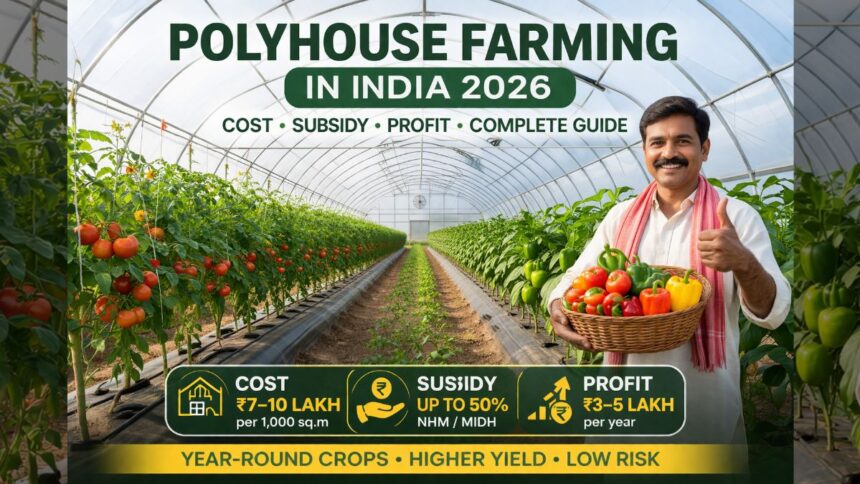
Polyhouse farming in India allows you to grow crops year-round in a controlled environment. A 1,000 sq.m setup costs ₹7–10 lakh, the government offers up to 50% subsidy under NHM/MIDH, and net profit from crops like tomato or capsicum can reach ₹3–5 lakh per year. This guide covers everything from setup cost to crop selection to common mistakes.
- What is Polyhouse Farming?
- Why Farmers Are Choosing Polyhouse Farming
- Real Cost Breakdown for Polyhouse Farming in India (2026)
- Government Subsidy for Polyhouse Farming – How to Get It
- Profit & Income Potential from Polyhouse Farming
- Step-by-Step Guide to Set Up a Polyhouse
- Best Crops for Polyhouse Farming in India
- Expert Tips for Polyhouse Farming Success
- Common Mistakes to Avoid in Polyhouse Farming
- Polyhouse Farming vs Open Field Farming
- Our Verdict: Is Polyhouse Farming Worth It?
- Frequently Asked Questions (FAQ)
Imagine growing tomatoes in Rajasthan in peak summer — or cultivating strawberries in Maharashtra in October. Sounds impossible? Thousands of Indian farmers are already doing it — and making 3 to 5 times more income than traditional open farming.
The secret? Polyhouse farming.
Every year, more progressive farmers across states like Maharashtra, Himachal Pradesh, Karnataka, and Gujarat are shifting to polyhouse cultivation. Why? Because open field farming is at the mercy of rain, pests, and season. Polyhouse farming is not.
But here’s the question most people ask first: “Bhai, kitna paisa lagega? Aur kab wapas milega?” (How much does it cost? And when do I get returns?)
That’s exactly what we’ll answer in this complete polyhouse farming guide for 2026 — with real numbers, honest profit estimates, and step-by-step guidance for beginners.
What is Polyhouse Farming?
🔍 Definition (for Featured Snippet)
Polyhouse farming is a method of growing crops inside a structure made of polyethylene (plastic) film stretched over a frame of GI pipes or bamboo. This controlled environment protects crops from extreme weather, pests, and off-season conditions — enabling year-round cultivation with higher productivity and quality.
Think of it like a greenhouse — but designed and costed for Indian farmers. The polythene cover traps heat, maintains humidity, and blocks UV rays. Inside, you control temperature, water, and even CO₂ levels if you’re going advanced.
There are mainly two types used in India:
- Naturally Ventilated Polyhouse (NVP): Uses roof vents and side openings for airflow. No electricity needed for cooling. Cost-effective and most common in India.
- Fanpad / Climate-Controlled Polyhouse: Uses fans, evaporative cooling pads, and heating systems. Better control, but higher cost. Good for export-quality crops and orchids.
For most Indian farmers just starting out, a naturally ventilated polyhouse is the right first choice — affordable, simple, and still highly effective.
Why Farmers Are Choosing Polyhouse Farming
Here’s why polyhouse cultivation is booming across India:
- 🌦️ No weather dependency — Rain, hail, extreme heat? Doesn’t matter inside the polyhouse.
- 📅 Year-round farming — Grow any crop any time of year. Sell when prices are high.
- 🐛 80% fewer pests & diseases — Less pesticide = lower cost, safer produce, better export potential.
- 💧 Drip irrigation saves water — Up to 50% less water compared to open farming.
- 📈 3–5× higher yield per acre — Same land, far more output.
- 💰 Premium market prices — High-quality polyhouse produce fetches better rates in malls, hotels, and export markets.
- 🏛️ Government supports it — Up to 50% subsidy available under NHM and MIDH schemes.
💡 Real Example A farmer in Nashik, Maharashtra shifted 1 acre from open tomato farming (earning ~₹1.5L/year) to polyhouse cultivation. In the first year after setup, his net income from the same land crossed ₹4.2 lakh — after all expenses.
Real Cost Breakdown for Polyhouse Farming in India (2026)
This is the question most beginners ask, and most websites give vague or outdated answers. Let’s break it down honestly — for a 1,000 sq.m (about 0.25 acre) polyhouse, which is a practical starting size.
One-Time Setup Cost
| Component | Estimated Cost | Notes |
|---|---|---|
| GI frame structure | ₹2,50,000 – ₹3,00,000 | Galvanised iron pipes, long-lasting 15–20 yrs |
| UV-stabilised polythene film | ₹60,000 – ₹80,000 | 200 micron, needs replacement in 3–4 yrs |
| Shade net / insect net | ₹25,000 – ₹35,000 | Keeps insects out, reduces heat in summer |
| Drip irrigation system | ₹50,000 – ₹70,000 | Essential for polyhouse, saves 40–50% water |
| Fertigation unit | ₹20,000 – ₹30,000 | For precise nutrient delivery |
| Rope / trellis system | ₹15,000 – ₹20,000 | For tomato, capsicum, cucumber training |
| Land levelling & preparation | ₹15,000 – ₹25,000 | Depends on existing land condition |
| Installation & labour | ₹40,000 – ₹60,000 | Varies by state |
| Total Setup (approx) | ₹7,00,000 – ₹10,00,000 | Before subsidy |
⚠️ Important Note After government subsidy (up to 50%), your actual out-of-pocket cost can come down to ₹3.5–5 lakh for a 1,000 sq.m polyhouse. This makes polyhouse farming far more accessible than most people assume.
Annual Operating Cost
| Expense Head | Annual Cost (1,000 sq.m) |
|---|---|
| Seeds & seedlings | ₹20,000 – ₹30,000 |
| Fertilizers & nutrients | ₹30,000 – ₹40,000 |
| Pesticides (much lower than open farm) | ₹10,000 – ₹15,000 |
| Labour (1–2 workers) | ₹60,000 – ₹90,000 |
| Water / electricity | ₹12,000 – ₹18,000 |
| Miscellaneous | ₹10,000 – ₹15,000 |
| Total Annual Operating Cost | ₹1,42,000 – ₹2,08,000 |
Agro Potli Daily Farm Expense Tracker
Government Subsidy for Polyhouse Farming – How to Get It
This is where many farmers lose money — not because the subsidy doesn’t exist, but because they build first and apply later. Do it right: apply before construction.
Key Schemes (2026)
- MIDH (Mission for Integrated Development of Horticulture): Up to 50% subsidy for general category farmers. SC/ST farmers may get up to 60%. Administered by state horticulture departments.
- NHM (National Horticulture Mission): Covers naturally ventilated polyhouses, fan-pad systems, and shade net houses.
- Rashtriya Krishi Vikas Yojana (RKVY): Some states offer additional top-up grants under RKVY for high-tech farming.
- PM Kisan & KCC (Kisan Credit Card): Can be used to finance the farmer’s share after subsidy.
How to Apply (Step-by-Step)
1 Visit your State Horticulture Department
Contact the district horticulture officer (DHO) in your area or visit the state NHM portal. Each state has slightly different norms and unit costs.
2 Get a DPR (Detailed Project Report) prepared
Most departments require a formal project report with land details, structure specs, and estimated cost. The horticulture officer can often guide you.
3 Submit application & wait for approval
Once submitted, a field inspection is usually conducted. Approval timelines vary — typically 30 to 90 days depending on state.
4 Build with an approved vendor
States often have an empanelled vendor list. Using an approved vendor makes subsidy disbursal smoother and faster.
5 Claim subsidy after inspection
After construction, a final inspection is done. Subsidy amount is transferred directly to your bank account (DBT).
📌 Pro Tip Call your district horticulture officer (DHO) before doing anything else. In most states, you can also apply online through the state’s NHM or horticulture portal. A few states like Maharashtra and Gujarat have very active programs with shorter waiting periods.
Profit & Income Potential from Polyhouse Farming
Let’s talk real numbers — not “up to ₹10 lakh” fantasy figures. These are conservative, realistic estimates based on a 1,000 sq.m polyhouse growing tomatoes (one of the most common crops):
| Expected tomato yield (annual) | Average selling price per kg | Annual operating cost | Estimated net profit (Year 1+) |
| 8,000 kg | ₹20–25 | ₹1.6–2L | ₹3–4L |
Profit by Crop Type (1,000 sq.m, Per Year)
| Crop | Yield (kg) | Avg Price (₹/kg) | Gross Revenue | Est. Net Profit |
|---|---|---|---|---|
| Tomato | 8,000–10,000 | ₹18–25 | ₹1.8–2.5L | ₹60,000–₹1L |
| Capsicum (Coloured) | 5,000–7,000 | ₹40–80 | ₹2–5.6L | ₹1.5–4L |
| Cucumber | 10,000–15,000 | ₹15–22 | ₹1.5–3.3L | ₹80,000–₹1.8L |
| Rose (cut flowers) | 80,000–1L stems | ₹3–8/stem | ₹2.4–8L | ₹2–6L |
| Gerbera | 60,000–80,000 stems | ₹4–10/stem | ₹2.4–8L | ₹1.8–5L |
| Strawberry | 2,000–3,000 | ₹120–200 | ₹2.4–6L | ₹1.8–4.5L |
Agropotli Profit Calculator
💡 Key Insight Coloured capsicum, roses, gerbera, and strawberries give the best returns per square metre in Indian polyhouses. Tomatoes are lower margin but more stable and easier to market. Beginners: start with tomatoes or cucumber. Move to high-value crops once you understand polyhouse management.
Step-by-Step Guide to Set Up a Polyhouse
1 Choose the Right Location
Pick flat or gently sloping land with good sunlight (minimum 6 hours). Orient the structure East-West to maximise sun exposure. Ensure a reliable water source nearby.
2 Apply for Subsidy First
Before spending a single rupee on construction, visit your district horticulture office and submit your application. Build only after approval.
3 Design the Structure
Standard naturally ventilated polyhouse: ridge height 5–6m, side walls 3–4m. Use 200 micron UV-stabilised poly film. Ensure roof vents cover at least 15% of total area.
4 Prepare the Soil / Growing Medium
Inside the polyhouse, soil needs to be well-drained. Raised beds work best. For high-value crops, consider coco peat + perlite + compost mix (soilless cultivation).
5 Install Drip Irrigation & Fertigation
Non-negotiable. Drip irrigation saves water, reduces disease, and makes fertigation possible. Install it before planting.
6 Choose & Source Quality Seeds/Seedlings
Use hybrid, disease-resistant varieties. For tomato: Syngenta Abhilash, Ruchi, or similar. For capsicum: coloured hybrids from Nunhems or Enza Zaden.
7 Transplant & Train Crops
Transplant seedlings at recommended spacing. Use vertical rope training for tomatoes and capsicum. Regular pruning keeps the crop healthy and productive.
8 Manage Nutrition & IPM
Fertigation schedule is key. Use water-soluble fertilizers in correct ratios. For pest management, prefer sticky traps and bio-pesticides inside the polyhouse.
9 Harvest & Market
Harvest at right maturity. For local markets, sell directly. For better price, explore contract farming with hotels, supermarkets (Reliance Smart, DMart), or food processors.
Best Crops for Polyhouse Farming in India
Not every crop is suited for polyhouse cultivation. Here are the top performers:
Vegetables
- Tomato — Easy to grow, great yield, year-round demand. Best starter crop.
- Coloured Capsicum — High value (₹50–100/kg), exports well. Takes skill but worth it.
- Cucumber — Fast crop cycle (45–50 days to harvest), good for cash flow.
- Lettuce & Microgreens — Short cycle, premium urban market. Growing demand from restaurants.
Flowers (Very High Margin)
- Rose — Most popular polyhouse flower in India. Consistent demand throughout the year.
- Gerbera — Low input, high output flower. Popular in Maharashtra, Tamil Nadu, Karnataka.
- Carnation — Export potential is very high. Himachal Pradesh and Karnataka lead production.
Fruits
- Strawberry — Short season crop (Oct–Feb), but ₹120–200/kg pricing is outstanding. Growing in Maharashtra (Mahabaleshwar region) and Himachal.
- Exotic Melons — Musk melon and honey dew varieties fetch premium prices in urban markets.
Expert Tips for Polyhouse Farming Success
- 🌡️ Monitor temperature daily. Ideal range for most crops: 18–32°C. Install a simple min-max thermometer. If temps cross 35°C, open vents and shade nets.
- 💧 Never over-irrigate. Most polyhouse crop failures are from water stress — either too much or too little. Use a tensiometer or feel the growing medium.
- 🧪 Test your water source. High EC (salinity) water kills your crop slowly. Get a water quality test done before setting up.
- 🦟 Install insect nets at entry points. Thrips, whiteflies, and aphids are the biggest pest threats. A 50-mesh insect net at vents and doors blocks most of them.
- 📒 Maintain crop records. Track what you sprayed, when you fertilized, and what the yields were. This data will improve your next crop cycle significantly.
- 🤝 Find your market before planting. This is the single biggest tip from experienced polyhouse farmers. Know your buyer before the first seedling goes in the ground.
- 🎓 Take a training course. State agricultural universities and KVKs (Krishi Vigyan Kendra) offer free or low-cost polyhouse farming training. Don’t skip it.
Common Mistakes to Avoid in Polyhouse Farming
⚠️ Learn from Others’ Losses Most polyhouse failures happen for predictable, avoidable reasons. Here’s what to watch out for:
- Starting too big. Many beginners invest in 2–5 acres without prior experience. Start with 1,000–2,000 sq.m. Master the basics, then expand.
- Buying cheap structure materials. A substandard GI pipe that rusts in year 2 will cost you more in repairs than what you saved. Don’t compromise on structure quality.
- Ignoring variety selection. Using open-pollinated varieties instead of hybrids designed for protected cultivation leads to poor performance. Use polyhouse-specific hybrid seeds.
- No soil/water testing. Growing in unsuitable soil or high-EC water tanks your entire crop. Always test before planting.
- Skipping crop rotation. Growing the same crop continuously leads to soil-borne disease buildup. Rotate crops every 2–3 cycles.
- No market plan. Building the polyhouse, growing premium produce, then wondering where to sell — this is the biggest mistake beginners make.
- Applying for subsidy after construction. Most schemes require pre-approval. If you build first, you lose the subsidy. Always apply first.
Polyhouse Farming vs Open Field Farming
| Factor | Polyhouse Farming | Open Field Farming |
|---|---|---|
| Setup Cost | High (₹7–10L per 1000 sq.m) | Low |
| Weather dependency | Protected | Fully exposed |
| Yield per acre | 3–5× higher | Standard |
| Crop quality | Premium / export-grade | Varies |
| Pest control cost | 60–80% lower | High |
| Water use | 40–50% less | High |
| Year-round cultivation | Yes | Seasonal |
| Govt subsidy available | Up to 50–60% | Lower/limited |
| Technical skill needed | Moderate to high | Traditional/low |
| ROI (return on investment) | 3–5 years break-even | Year-to-year |
Polyhouse farming is not a replacement for all traditional farming — it’s a strategic upgrade for farmers who want to move up the value chain, farm smarter, and insulate themselves from weather risk and market volatility.
Our Verdict: Is Polyhouse Farming Worth It?
Yes — for the right farmer, in the right location, with the right crop and market plan, polyhouse farming is one of the most profitable agricultural investments available in India today.
It’s not magic, though. It requires upfront capital, basic technical learning, and a clear market strategy. If you’re willing to invest 6–12 months in understanding the system, the rewards are very real: 3–5× higher yields, year-round income, and a farming business that isn’t at the mercy of monsoons.
Our advice: start small (500–1,000 sq.m), apply for subsidy, take a training course at your nearest KVK, pick one crop you can sell easily, and learn from that first cycle. Then scale up.
The polyhouse is not a luxury anymore — it’s a smart business decision for modern Indian farmers. 🌱
Frequently Asked Questions (FAQ)
How much does a polyhouse cost in India per acre?
A naturally ventilated polyhouse costs approximately ₹25–40 lakh per acre (4,047 sq.m) before subsidy. After availing government subsidy under MIDH/NHM (up to 50%), the effective cost for a farmer comes down to ₹12–20 lakh per acre. For beginners, starting with 500–1,000 sq.m (₹3.5–5 lakh after subsidy) is more practical.
Which crops are most profitable in a polyhouse in India?
For vegetables: coloured capsicum, cherry tomato, and cucumber give the best returns. For flowers: rose and gerbera are highly profitable with consistent year-round market demand. Strawberry is excellent for short-season, high-value income. Beginners should start with tomato or cucumber as they’re easier to manage and have a ready local market.
How do I get government subsidy for polyhouse farming?
Visit your district horticulture officer (DHO) before starting construction. Apply under the MIDH (Mission for Integrated Development of Horticulture) or NHM scheme. Subsidy is 50% for general farmers and up to 60% for SC/ST farmers. Important: approval must be obtained before construction — not after. Subsidy is paid via DBT (Direct Benefit Transfer) to your bank account after inspection.
What is the break-even period for polyhouse farming? ▾
With government subsidy, most polyhouse farmers recover their investment (break even) within 3–5 years, depending on the crop grown and market prices. High-value crops like coloured capsicum, gerbera, or roses can lead to break-even within 2–3 years. Tomato or cucumber growers typically see break-even in 4–5 years.
Can polyhouse farming be done without prior experience? ▾
Yes, beginners can successfully start polyhouse farming, but training is strongly recommended. Attend a 5–10 day training program at your nearest Krishi Vigyan Kendra (KVK) or state agricultural university. Many established polyhouse farmers also offer hands-on visits. Start with an easier crop like tomato or cucumber, keep the size manageable (500–1,000 sq.m), and scale up once confident.