




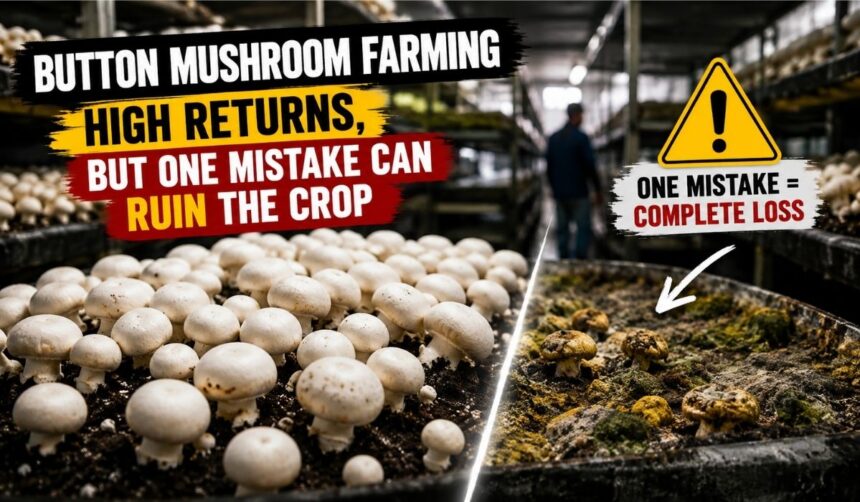
Button mushroom is the mushroom India actually eats — more than two-thirds of the country’s mushroom production — and it can turn a single room into a genuinely profitable, land-free business. This guide is for small, landless and urban entrepreneurs who want the real picture, not the “grow mushrooms, get rich” version. It walks through how button mushrooms are actually grown, the temperature and compost realities that most beginners underestimate, the contamination risk that quietly ruins crops, and exactly what it takes to start and sell. The returns are real. So is the skill it demands.
- Why button mushroom farming appeals
- Is button mushroom farming profitable?
- The first big decision: seasonal or year-round?
- This is a controlled process, not field farming
- The number one reason growers fail: contamination
- Perishability and market — profit is in the selling
- How to start button mushroom farming, step by step
- The money — honestly
- Value addition and the by-product bonus
- Government support
- Is button mushroom farming worth it?
- Frequently asked questions
Why button mushroom farming appeals
The attraction is genuine and specific:
- High yield from little space. Grown on multi-tier racks indoors, button mushrooms produce a lot of value per square foot — no farmland required, just a room.
- Fast cycle. A crop runs roughly six to eight weeks, so money comes back quickly and you can run multiple cycles.
- Rising demand. Health-conscious consumers, restaurants and urban retail have pushed demand up steadily.
- Government-backed and low-land. It’s a horticulture activity with real subsidy support and suits people with no land at all.
For an urban or landless entrepreneur, few agri-businesses pack this much potential into a spare room. But button mushroom is also the most demanding of the common mushrooms, and that’s the part this guide is honest about.
Is button mushroom farming profitable?
Button mushroom farming can be very profitable per square foot, with a short six-to-eight-week cycle and little land needed. But it’s a skilled, hygiene-critical indoor process where compost quality and contamination control decide success. It needs cool temperatures, and the fresh crop is highly perishable, so a quick local market matters as much as growing well.
Also Read: Pig Farming in India: Fast Profits, Huge Demand, But One Disease Can Wipe You Out
The first big decision: seasonal or year-round?
Button mushroom’s defining constraint is temperature. It needs cool conditions — roughly 22–25°C during the spawn-run phase and a cooler 15–18°C for the mushrooms to form, with high humidity throughout. That single fact forces your first decision.
| Factor | Seasonal (winter, no cooling) | AC / controlled (year-round) |
|---|---|---|
| Setup cost | Low | High |
| Growing window | Roughly the cool months (about October–February in the plains) | All year |
| Consistency | Weather-dependent | Steady and controlled |
| Main risk | Temperature swings | Power dependence and higher running cost |
| Best suited to | Beginners, low capital, cooler and hill regions | Serious commercial, year-round urban supply |
Most beginners in the plains start seasonally in winter to keep costs low, while serious commercial units invest in temperature-controlled rooms to grow all year and supply the market consistently (which is where much of the price advantage lies). Decide this before you spend, because it changes your whole budget. It also explains why button mushroom is harder than oyster mushroom, which tolerates warmer conditions and is far more forgiving for first-timers.
This is a controlled process, not field farming
Button mushrooms don’t grow in soil. They grow on specially prepared compost, indoors, through four distinct stages — and understanding them shows you where the real work and risk sit.
- Compost preparation — the heart of everything. Wheat straw is composted with additives and then pasteurised to create a clean, nutrient-rich, selective growing medium. This is the hardest, most technical, most failure-prone stage: poor compost means poor yield and high contamination, no matter how well you do everything else. Many growers, especially beginners, buy ready-made pasteurised and even spawned compost to skip this step and cut their risk.
- Spawning. Quality spawn (mushroom “seed”) is mixed into the compost. Spawn quality is critical, so buy from a certified lab such as ICAR-DMR, Solan.
- Casing. After the mycelium colonises the compost, a casing layer is added on top to trigger mushroom formation.
- Cropping and harvesting. Pinheads appear and grow into buttons, harvested in waves (“flushes”) over a few weeks. Harvest in the cool early morning for freshness.
The lesson: your success is decided far more by compost quality and hygiene than by anything glamorous. This is a craft.
The number one reason growers fail: contamination
If button mushroom farming has a single villain, it’s contamination. Competitor moulds (like green mould), bacteria, flies and mites can invade poorly prepared compost or an unhygienic room and destroy a crop. As experienced growers put it bluntly, one contaminated batch can wipe out a month’s profit.
That’s why hygiene isn’t a tip here — it’s the core discipline. Proper compost pasteurisation, clean rooms, controlled entry, good spawn, correct humidity and temperature, and disinfection between cycles are what separate consistent earners from people who lose crop after crop. If you’re not willing to be meticulous about cleanliness, button mushroom is not the crop for you.
Perishability and market — profit is in the selling
Fresh button mushrooms are highly perishable, staying good for only a couple of days at room temperature and a few days refrigerated. That has two big implications:
- You must sell fast and local, ideally with some cold storage, or your crop loses value quickly.
- Where and how you sell decides your profit as much as your yield. Selling retail, direct-to-consumer, or to hotels and restaurants earns far more than dumping wholesale into a market — and two growers with identical rooms can earn double or half of each other purely on how well they sell.
Your channels: urban retail and premium grocers, hotels and restaurants (which pay for consistent quality), quick-commerce and online grocery, direct-to-consumer, and — crucially — value-added products to absorb any surplus rather than let it spoil.
How to start button mushroom farming, step by step
1. Get trained first. This is skilled work — do a hands-on course at a KVK, a state agricultural university, or ICAR-DMR, Solan before investing. Training is the cheapest insurance you can buy.
2. Decide your model. Seasonal or year-round (AC); and whether you’ll make your own compost or buy ready pasteurised/spawned compost to reduce risk at the start.
3. Set up the growing room. A clean room or shed with multi-tier racks (to maximise yield per square foot), plus humidity control and, for year-round growing, temperature control. Prioritise cleanliness and ventilation in the design.
4. Source quality inputs. Buy certified spawn from a reliable lab and well-prepared pasteurised compost (or master compost-making if going full-scale). Input quality directly sets your outcome.
5. Spawn and let it run. Mix spawn into the compost and maintain spawn-run conditions while the mycelium colonises.
6. Case and crop. Add the casing layer, then manage temperature, humidity and fresh air until pinheads form and grow. Harvest in flushes.
7. Enforce hygiene relentlessly throughout, and disinfect fully between cycles.
8. Sell fast and smart. Have buyers lined up before you harvest, prioritise retail and HoReCa over wholesale, and cool the crop promptly.
9. Add value and use the waste. Turn surplus into dried mushrooms, pickle or powder, and sell spent compost as organic manure — extra income from what would otherwise be loss.
10. Handle licensing. Get FSSAI registration for selling and especially for processed products, plus any local permissions, and keep records as you scale.
The money — honestly
On the numbers: a crop cycle runs about six to eight weeks; yields are commonly in the range of roughly 10–18 kg of mushrooms per 100 kg of compost (biological efficiency varies with compost quality and management); and button mushrooms sell for roughly ₹100–130/kg wholesale and ₹150–250/kg retail, with value-added products earning more [VERIFY: confirm current yields and prices in your market].
The genuine positives: low land need, fast cycles, high value per square foot, and one of the lower entry costs in agriculture. The honest cautions: your biggest costs are compost, spawn and (for AC units) power, and your biggest risk is contamination or poor compost turning a promising batch into a loss.
Be sceptical of the viral figures. You’ll see promises like “earn ₹30,000–₹80,000 a month starting with ₹10,000.” Those sit at the optimistic end and quietly assume clean crops, good compost, no contamination, and strong retail sales — the very things beginners struggle with. Treat such numbers as a best-case ceiling, not a plan, budget conservatively per cycle using your own local prices, and expect a learning curve of a cycle or two before you’re consistent.
Value addition and the by-product bonus
Because fresh mushrooms spoil fast, value addition is both a margin booster and a spoilage insurance: dried button mushrooms (which fetch a good price per kilo), mushroom pickle and powder, and, at scale, canned mushrooms for wider markets. Even the leftover spent compost is saleable as a rich organic manure to nurseries and gardeners. Building these into your plan turns a perishable single product into a more resilient business, and food-processing schemes can support the value-added side.
Government support
Button mushroom, as a horticulture activity, draws real support:
- MIDH / the National Horticulture Mission and state horticulture departments offer capital subsidy for mushroom units — spawn labs, compost units and growing units — commonly cited around 40–50%.
- NABARD-linked credit and the PMFME scheme (for value addition and micro food processing) can fund infrastructure and processing.
- ICAR-DMR, Solan is the national authority for training, quality spawn and technology.
Subsidy rates and eligibility vary by state and change, so confirm current schemes with your district horticulture office or KVK before relying on them.
Is button mushroom farming worth it?
For the right person, button mushroom farming is one of the most rewarding small-scale agri-businesses in India. It needs almost no land, pays back fast, yields high value per square foot, meets a growing market, and enjoys real government backing. If you’re willing to learn the craft, be meticulous about hygiene, manage temperature, and sell smartly, a single well-run room can generate genuine, repeatable income.
But go in clear-eyed about the downsides:
- It’s skill- and hygiene-intensive — compost quality and contamination control decide everything, and beginners commonly fail here.
- It needs cool temperatures — seasonal in the plains, or costly AC for year-round.
- The crop is highly perishable, so you need a fast local market or value addition.
- The viral income figures are best-case, not typical for beginners.
- Profit depends on selling well (retail and HoReCa), not just on growing.
The smartest way in is to get trained first, start small and seasonal, consider buying ready compost to cut early risk, obsess over cleanliness, and secure your buyers before you harvest. Treated as a craft to master rather than a shortcut to quick money, button mushroom farming genuinely rewards the careful — and quietly punishes the careless.
Frequently asked questions
Is button mushroom farming profitable in India?
It can be very profitable per square foot because it needs little land, has a short cycle and meets rising demand. But profit depends heavily on compost quality, strict hygiene to avoid contamination, temperature control, and selling well — ideally retail or to hotels rather than wholesale. It rewards skill, not luck.
What temperature does button mushroom need, and can it grow in summer?
Button mushroom needs cool conditions — roughly 22–25°C for the spawn run and 15–18°C for fruiting, with high humidity. In the plains that means seasonal winter growing, while year-round or summer production needs temperature-controlled (AC) rooms, which cost more. Cooler and hill regions have a natural advantage.
Why do button mushroom growers fail?
The most common reason is contamination from poor-quality or badly pasteurised compost and unhygienic conditions, which lets competitor moulds and pests destroy the crop. Weak spawn, wrong temperature or humidity, and no market for the perishable harvest are other frequent causes. Hygiene and good compost are the difference-makers.
Do I need to make my own compost?
Not to start. Many beginners buy ready-made pasteurised or spawned compost, which removes the hardest and riskiest step and improves early success. Making your own compost gives more control and better margins at scale, but it’s technically demanding, so it’s often better to learn growing first and add composting later.
How much does it cost to start button mushroom farming?
It varies widely by model. A small seasonal setup in a spare room with bought compost can start modestly, while a year-round temperature-controlled commercial unit costs significantly more. Your main costs are compost, spawn, the room and racks, humidity and temperature control, and power for AC units. Build a local, per-cycle budget.
Where can I sell button mushrooms?
Through urban retail and premium grocers, hotels and restaurants, quick-commerce and online grocery, and direct-to-consumer channels, plus value-added products like dried mushrooms, pickle and powder. Because the fresh crop spoils fast, a reliable, nearby buyer and quick selling matter enormously to your profit.