



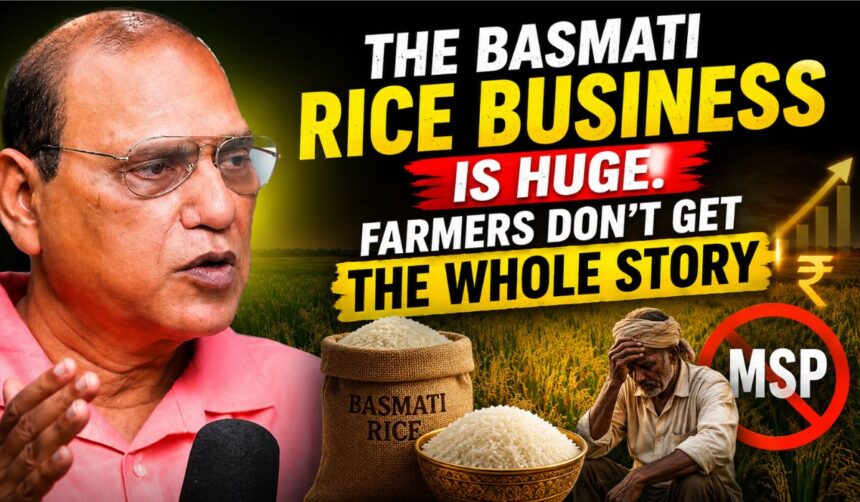
Basmati Rice Farming: Most farming stories we cover are about a farmer who found a way to earn more. This one is different — it’s about the scientist whose rice varieties quietly put better money into millions of basmati farmers’ pockets across Punjab, Haryana and western UP. If you grow paddy or basmati, or you’re deciding whether to, this post pulls out what actually matters for your income from a long interview Dr. A.K. Singh gave — and checks his figures against official data so you get the verified picture, not a highlight reel.
- Who is Dr. A.K. Singh, and why should a farmer care?
- Do the numbers hold up?
- What this actually means for a basmati farmer
- The export rule that can make or break your price
- Saving water and dodging the stubble trap
- Carbon credits: real income or just two words?
- Can you actually earn well from basmati rice farming?
- A realistic per-acre picture (estimate)
- Is basmati rice farming worth it?
- FAQ
Who is Dr. A.K. Singh, and why should a farmer care?
Dr. Ashok Kumar Singh is a plant geneticist who spent nearly four decades at ICAR–IARI (the Pusa Institute) in Delhi, served as its Director until 2024, and was awarded the Padma Shri in 2026 for basmati research. Farmers and traders call him the “Basmati Man.” Over his career he helped develop around 25 improved Pusa Basmati varieties — he was the lead breeder on the hugely popular short-duration Pusa Basmati 1509 and an associate breeder on Pusa Basmati 1121, the world’s longest-grain basmati.
Why this matters to you: the variety name printed on the bag you buy your seed from — 1121, 1509, 1401, 1847, 1885 — largely came out of this one programme, and each was bred to solve a specific problem farmers were losing money to. Understanding what each does is the difference between an average season and a good one.
Do the numbers hold up?
Here the “reality-check” works a little differently than usual. Dr. Singh isn’t a farmer making best-case income claims — he’s the authoritative source, so we’ve checked his statements against independent data mainly to confirm and add specifics.
| Stated in the interview | Independent/official position | What it means for you |
|---|---|---|
| Basmati earns “₹500 crore” in forex | This is a caption slip — the correct figure is about ₹50,000 crore (~$6 billion), ~12% of India’s agri forex (APEDA) | Basmati is a genuinely high-value export crop, not a bulk one |
| 6 MT basmati earns as much as 18–20 MT non-basmati | Confirmed — basmati fetches roughly 3× the price per tonne of ordinary rice | The premium is real; quality and variety decide your price |
| Pusa Basmati 1509: ~25 q/acre, 120 days; 1121: ~18 q/acre, ~145 days | Matches figures Dr. Singh has given elsewhere; widely reported | Short-duration variety = more yield and a free window for a second crop |
| Disease-resistant varieties save ~₹3,000/acre on sprays | Consistent with independent reporting | Fewer sprays also means residue-free grain that passes export tests |
| Basmati farm-gate ₹3,000–4,500/quintal; traditional types more | In range; but basmati has no MSP and price swings by year | Great in tight-supply years, painful in glut years — plan for both |
| Carbon credit ≈ $30–40 each; ~8–10/ha ≈ ₹10,000/acre | Mechanism is real (Grow Indigo etc.), but payouts are early and largely unrealised | Treat as a future bonus, not income you can bank on yet |
The honest headline: his numbers hold up. The only correction is the ₹500-crore caption, which should read ₹50,000 crore. Everything else is either confirmed or a fair, checkable estimate.
What this actually means for a basmati farmer
Strip the interview down to decisions you can act on, and four things stand out.
Variety choice is your biggest lever. The shift Dr. Singh’s team drove — from ~160-day traditional basmati to 120–125-day varieties like Pusa Basmati 1509, 1692 and 1847 — isn’t just about water. A 120-day crop clears the field early enough to slot in a second and even third crop (peas, potato, mustard, sunflower or maize). He estimates that turning a single paddy–wheat cycle into a basmati-plus-two rotation can lift income from roughly ₹1–1.5 lakh to around ₹3 lakh on the same land. That rotation gain is the real money, and it’s available to you now.
Disease-resistant varieties protect both cost and export access. Varieties like Pusa Basmati 1847, 1885, 1886 and 1637 are bred to resist bacterial leaf blight and blast — so you spray less (saving ~₹3,000/acre) and your grain is far less likely to carry the fungicide residues that get consignments rejected abroad. That second benefit is worth more than the spray saving in a good export year.
Understand that basmati has no MSP — on purpose. Ordinary paddy is bought by the government at MSP (around ₹2,300/quintal for common paddy, higher in states like Chhattisgarh) because it feeds the public distribution system. Basmati is a private-market export product, so its price is set purely by demand and supply — typically ₹3,000–4,500/quintal, sometimes more, but with real downside in a bumper year. Dr. Singh’s own view is that MSP isn’t a long-term fix and diversification is healthier. The practical takeaway: basmati offers a higher ceiling than MSP paddy, but you carry the price risk yourself.
Where you farm decides whether you can grow “basmati” at all. Basmati has a GI (Geographical Indication) tag limited to seven states — Jammu & Kashmir (three districts), Himachal Pradesh, Punjab, Haryana, Delhi, 30 districts of western UP, and Uttarakhand. Grow the same seed outside that belt and it’s a fine aromatic rice, but you legally cannot sell it as basmati. If you’re outside the GI zone, your money is better made in other high-value crops than in chasing the basmati label.
Also Read: From IT Job to ₹1 Crore Dairy Business: Real Lessons Every Farmer Must Know
The export rule that can make or break your price
Since 2018 the EU has capped the fungicide tricyclazole at 0.01 ppm — a hundred times stricter than the old 1 ppm limit — and Gulf buyers like Saudi Arabia and Jordan followed. India lost an estimated $200 million in a year and a half to rejected consignments. (For contrast, the US allows 3 ppm and Japan around 10 ppm — the EU limit is a default-low, not a health verdict.)
What this means on the ground: exporters now test paddy before buying, and residue-free grain earns a ₹200–300/quintal premium. Punjab has banned about nine such chemicals on basmati. The cleanest path is to grow the newer disease-resistant varieties that don’t need the spray in the first place, and to strictly avoid the banned-pesticide list. This single discipline can move your price more than almost anything else you do.
Saving water and dodging the stubble trap
Two practices from the interview pay off directly. Direct-seeded rice (DSR) skips the flooded-puddling nursery step and saves roughly 30% water, about ₹5,000/acre in labour, and cuts methane sharply — the catch is weeds, now manageable with herbicide-tolerant varieties (Pusa Basmati 1979, 1985) and the right herbicide programme. Alternate wetting and drying (AWD) — letting the field dry until just before it cracks, rather than keeping it flooded — saves 25–30% water and actually gives healthier, less disease-prone plants. And short-duration varieties buy you the ~3–4 extra weeks between paddy harvest and wheat sowing that let you manage stubble with a Happy/Super Seeder or Pusa Decomposer instead of burning it.
Carbon credits: real income or just two words?
Dr. Singh is refreshingly straight here. The mechanism is real — cut emissions with regenerative practices (DSR, laser levelling, no stubble burning, biofertilisers) and you can earn carbon credits worth about $30–40 each, potentially 8–10 per hectare, roughly ₹10,000/acre, through platforms like Grow Indigo. But it’s early: verification is satellite- and field-checked, and the first cohort of ~500 Punjab/Haryana farmers is only now getting paid after three years. His advice, which we’d echo: fix your farming first; treat carbon credit as a future top-up, not a plan you can budget on today.
Can you actually earn well from basmati rice farming?
Yes, if you’re in the seven-state GI belt, choose a modern short-duration, disease-resistant variety, follow the export pesticide discipline, and use the early-clearing field for a second crop. That rotation, not the paddy alone, is where the ₹3-lakh-an-acre-class income comes from. Outside the GI zone, or without market access, ordinary MSP paddy or other crops will serve you better.
A realistic per-acre picture (estimate)
Figures swing by state, variety and season — confirm locally before budgeting.
- Ordinary paddy: ~₹25,000/acre cost; ~30 quintals at ~₹2,300 ≈ ₹65,000 revenue; ~₹30,000–40,000 profit [VERIFY local MSP and yield]
- Basmati (GI belt): higher and more variable revenue at ₹3,000–4,500/quintal, but no MSP floor — model a bad year too
- The rotation upside: a 120-day basmati + peas/potato/mustard can push combined annual income toward ₹3 lakh/acre, per Dr. Singh [VERIFY with your second-crop economics]
- Residue-free premium: ~₹200–300/quintal for clean, export-grade paddy
- Carbon credit (future): up to ~₹10,000/acre, largely unrealised so far
Is basmati rice farming worth it?
For a farmer inside the GI states with a reliable buyer, basmati is one of the strongest income crops in Indian agriculture — but it rewards discipline, not luck. The upsides are a genuine export premium, a short-duration window that unlocks double/triple cropping, and disease-resistant varieties that cut cost and clear export tests. The failure modes are equally real: no MSP means you eat the price crash in a glut year; the GI rule locks out farmers in most of the country; and one wrong pesticide can get your whole consignment rejected. Grow it with the right variety and clean-input discipline and it pays; treat it casually and the same crop can disappoint. And as Dr. Singh himself stresses, no single crop — basmati included — is a substitute for diversification.
FAQ
Is all aromatic rice basmati?
No. All basmati is aromatic, but many prized aromatic rices — Kalanamak, Kala Jeera, Ambemohar, Katarni — are not basmati. Basmati also needs a specific grain length, roughly double elongation on cooking, non-stickiness, and a set amylose range.
Can basmati be grown anywhere in India?
Officially no. Its GI tag covers only seven states/regions. The same seed grown elsewhere is a good aromatic rice but cannot legally be sold as basmati.
Why is there no MSP on basmati?
Because it’s a high-value private export product, not part of the government’s food-security procurement. Its price is set by market demand and supply — higher potential than MSP paddy, but with no floor. Some farmers do ask for a minimum floor price in glut years.
Is brown or parboiled rice a different variety?
No — any rice can be milled as brown, white or parboiled. Brown rice simply keeps the bran layer (more iron, zinc), and parboiling pushes nutrients into the grain and lowers the glycemic index. It’s a processing choice, not a separate crop.
How can a farmer avoid export rejections?
Grow the newer disease-resistant Pusa Basmati varieties so you barely need fungicides, strictly avoid the banned-pesticide list (tricyclazole and others), and get paddy residue-tested before sale — clean grain earns a premium.
Do farmers really get paid for carbon credits yet?
The system is real but early. Payments have only just begun for the first three-year cohort, and most farmers haven’t received anything. It’s worth registering for the long term, but don’t count it as current income.