



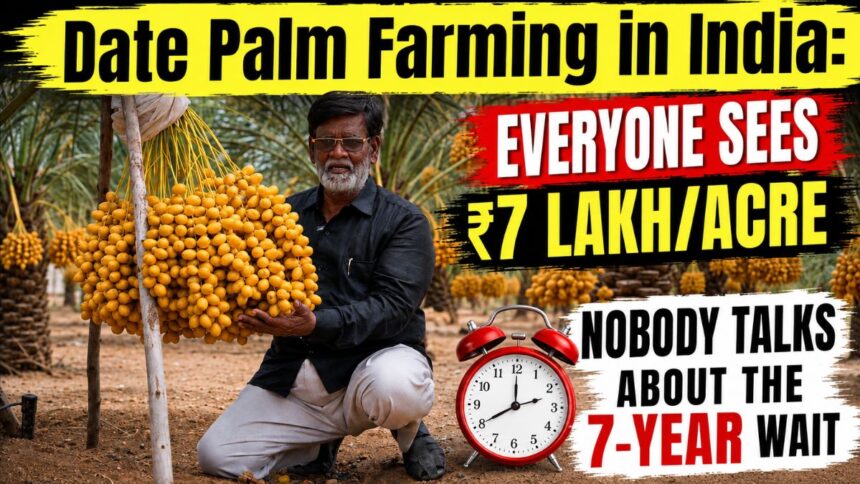
Date Palm Farming in India: If you have ever watched a farming video and thought “wait, can a khajoor tree really pay me like a monthly pension?”, this post is for you. I sat through a detailed field walkthrough on date palm farming, wrote down every number the expert gave, and then spent a few hours checking those numbers against official Indian horticulture data instead of just repeating them. What follows is the honest version — the parts that check out, the parts that are best-case, and what it would actually cost you to try this.
What he actually claims
Told plainly, here is the story..
The nursery imports tissue-culture date palm saplings from labs in Iran, Saudi Arabia and Abu Dhabi, hardens and quarantines them for several months, then sells them to Indian farmers. Because seed-grown date plants turn out roughly 70–75% male (and males bear no fruit, and you cannot tell male from female until years later), the whole pitch for tissue culture is genetic certainty: a sapling taken from a Barhi mother stays Barhi, a Noor stays Noor. That part is agronomically sound and worth internalising before anything else.
On the money side, the story makes several eye-catching claims: that the nursery does ₹6–7 crore of business from a 300 square metre holding; that a farmer can earn ₹6–7 lakh per acre; that a mature tree yields 200–300 kg a year (with a 36-year-old block hitting 300–350 kg); and — the line that will travel fastest on Instagram — that just 10 trees can act like a pension of “₹20,000–30,000 a month.” The story also covers spacing (about 76 female plus 5 male plants per acre at 24×24 ft), hand pollination in January–February, a June–July harvest, drip irrigation, and a curious side business: male pollen powder selling for ₹12,000–14,000 per kg in season.
It is a genuinely informative walkthrough. The problem is that success-story are edited to make the good years look like every year. So let’s test the figures.
Do the numbers hold up?
Every rupee figure below is the speaker’s claim, not verified data. I’ve placed each against typical or official ranges so you can see the gap.
| Claimed in the story | Realistic range (official / typical) | What to verify before you trust it |
|---|---|---|
| Nursery does ₹6–7 crore from 300 sq m | This is the inventory value if all ~10,000 plants sold at the top variety’s price. Stock is “rolling,” most plants are cheaper varieties, and it’s gross turnover — not profit | Plant mix and actual sell-through; import licence and working-capital load |
| Farmer earns ₹6–7 lakh per acre | Plausible only at full maturity (year 7+), well-managed. A documented Barmer case earned ~₹7.5 lakh from ~120 trees (~₹5 lakh/acre equivalent) at ₹80/kg | Your tree age; farm-gate rate on Agmarknet / local mandi |
| ~30 tonnes per acre | Kutch’s state-average productivity is roughly 9.3 MT/ha (~3.8 t/acre). A strong mature acre is nearer 8–15 t | Variety, tree age, spacing, management |
| 200–300 kg per tree | Typical Indian commercial mature yield is ~70–100 kg/tree. 200+ kg is a best-case, top-managed, old-tree number | Age of your trees, not the demo trees |
| Fresh Barhi: ₹1.25–1.5 lakh/tonne wholesale; ₹250/kg export | Farm-gate ₹80–150/kg is realistic; branded retail can reach ₹400–500/kg; export needs cleaning and loses ~25% as rejects | Live mandi and export rate this season |
| Plant price: Barhi ₹1,250 / Noor ₹6,000 | Tissue-culture date saplings run ~₹3,000–3,750 typically, up to ₹6,250 for Medjool-grade [VERIFY current] | Nursery accreditation; sapling age |
| 10 trees ≈ ₹20,000–30,000/month | Dates harvest once a year. 10 mature trees might gross ₹1–3 lakh annually, not monthly — and only after 6–7 years | Realised price × your actual bearing trees |
Two things jump out. First, the “monthly pension” framing is the least honest part of the whole pitch. Dates flower in January–February and are harvested across June–July; there is exactly one payday a year. Spreading that lump sum across 12 months to say “₹25,000 a month” is marketing, not accounting.
Second, the per-acre revenue and yield only work if you quietly assume mature trees. A date palm gives almost nothing for the first three years and only reaches those big numbers around year seven. The ₹6–7 lakh/acre figure is a year-seven-plus figure being used to sell a year-zero decision.
Also Read: Left Job to Build ₹25 Crore Farming Empire: Banana Farming Success Story | 70-30 Model
How this model actually works, step by step
Strip away the hype and the underlying farming is real and fairly well-understood.
Plant selection. Buy tissue-culture, not seedlings — this is the one point the story is completely right about. A minimum four-year-old sapling is ideal: it clears its quarantine period and starts fruiting about two years after transplanting. Barhi (yellow, round, the export workhorse), Medjool/Noor-type (large, premium), and a few others dominate Indian commercial planting.
Spacing and planting. Around 76 female plants per acre at 24×24 ft, plus roughly 5 male plants for pollen. Dig pits, mix in well-rotted cow/goat manure and a little neem cake, and plant. Timing is flexible for planting itself — dates aren’t fussy about that — but flowering and harvest windows are fixed by season.
Water and nutrition. Young plants need about 50 litres twice a week on light red soil, less on heavy clay that holds moisture. The story shows sub-surface drip delivering water and fertigation about 1.5 ft down, which keeps the root zone moist and cuts weeds and evaporation. A rough fertiliser rhythm alternates organic manure with a complex (DAP–potash–urea) dose that scales up as the tree ages.
Pollination. This is the make-or-break annual job. Date palms are dioecious — separate male and female trees — so in January–February you take strands from a male flower and tie them into each female flower by hand. With only a handful of male trees per acre, many growers instead buy male pollen powder, which is itself a niche trade (the story quotes ₹12,000–14,000/kg in season, sourced from Gujarat). It’s a once-a-year task, not hard, but skip it and you get no fruit.
Protection and harvest. Bunches get bird netting and a polythene sheet against rain-cracking, plus a stick-and-rope support so the weight doesn’t snap the branch. Because most of India can’t fully dry dates on the tree (monsoon humidity), fruit is harvested at the yellow khalal stage as fresh dates — which is exactly why India grows fresh dates but still imports most of its dry dates. Colour tells you when it’s ready.
Can you really earn ₹7 lakh per acre from date palm farming?
You can — but only from mature trees, from about year seven onward, on a well-managed acre of roughly 76 bearing palms sold at ₹50–100/kg or better. The first three to four years earn almost nothing while the trees establish, and you first spend several lakh per acre on planting and irrigation. Treat ₹7 lakh as a good-year ceiling, not a starting salary.
What it would realistically cost you (per acre, estimate)
These are ballpark establishment numbers that swing hard by state, soil, water source and season. Confirm each locally before you build a budget on it.
- Saplings — ~76 female + ~5 male, 4-year tissue-culture: ₹2.4–5 lakh at ₹3,000–6,000 per plant [VERIFY current sapling rate with an NHB-accredited nursery]
- Land prep, pits, FYM and neem cake: ₹40,000–70,000 [VERIFY locally]
- Drip irrigation install: ₹40,000–60,000 per acre, partly subsidised under MIDH [VERIFY current subsidy %]
- Water source / fencing (if new): ₹1–3 lakh, highly variable
- Annual operating cost (labour, fertiliser, spray, pollination): the story suggests ~₹40,000–60,000 per acre a year, lower per acre at larger scale
So a realistic all-in year-zero establishment cost is roughly ₹4–8 lakh per acre before a single rupee comes back, followed by a three-to-four-year wait. That upfront capital and the dead years are the real story the “₹25,000/month” clip leaves out. On the plus side, once established the crop is genuinely low-labour — the story claim that one family plus four seasonal hands can run 10 acres is believable, because for four to five monsoon months you barely irrigate.
The government does share some of this load. Under the Mission for Integrated Development of Horticulture (MIDH), date palm gets a higher project cost norm than most crops (₹125 lakh vs ₹75 lakh for area over 2 ha), with credit-linked back-ended subsidy typically at 40% (higher in NE/hilly areas) — but only if you buy planting material from an accredited nursery and get approval before you start
Can you replicate this and should you?
Two very different things are being sold in this one story, and they replicate very differently.
The nursery/import business is not for you if you’re new. ₹6–7 crore of “business” is gross rolling inventory built on 40 years of reputation, import licences, USD/EUR-priced stock, quarantine holding costs and deep working capital. The owner himself warns that a youngster starting a date nursery without import knowledge will simply get their money stuck. Take that warning seriously.
The farming, though, is genuinely replicable — for the right person. It suits a landowner in a hot, low-humidity, arid or semi-arid belt (Kutch, western Rajasthan, parts of Telangana/Karnataka, dry pockets of MP) who has assured water, ₹5–10 lakh they can lock away for four-plus years, and the patience for a perennial crop. It is a poor fit for anyone who needs income within two years, farms high-rainfall land, is leasing short-term, or is stretching borrowed money they’ll need back soon.
The honest replicability test is simple: can you afford to plant, wait four years earning nothing, and still be standing? If yes, dates can become a 50–80 year asset. If no, this is the wrong crop for your situation, however good the story looks.
Is it worth copying?
Date palm farming is a real, high-value, long-life orchard crop — not a scam. But it is a patient-capital, region-specific play, and it should be judged like one.
The genuine strengths: a productive life measured in decades, low ongoing labour, a fruit that (per the story and confirmed by traders) often gets bought at the farm gate rather than needing you to chase a mandi, and rising domestic demand for fresh dates.
The failure modes to respect: the three-to-four-year no-income gap; ₹4–8 lakh/acre upfront that’s dead until the trees bear; total dependence on assured water and a hot, dry ripening window; a once-a-year income that’s easy to romanticise as “monthly”; and the risk of buying cheap seedling plants that turn out mostly male and never fruit. The date “wine” and juice angle the story mentions is experimental and tangled in excise licensing — don’t put it in your business plan yet.
My verdict: worth copying only if you have the right land, real water, spare long-term capital, and you build your projection on ~100 kg/tree at ₹80–100/kg for the first productive years — not on the story best-case 200–300 kg. Plan for year seven, not year one.
FAQ
How long before a date palm starts earning?
With a good four-year tissue-culture plant, fruiting begins about two years after transplanting, but nurseries themselves advise counting on the third year to be safe. Meaningful income really arrives from around year five to seven as yield climbs.
How many date palms fit in one acre?
Roughly 76 female plants plus about 5 male plants at 24×24 ft spacing. The gaps between young palms can be intercropped with short crops like vegetables, watermelon, turmeric or ginger in the early years.
Is date palm farming profitable in India?
It can be, at maturity and in the right climate. Kutch and western Rajasthan are the proven belts. Profitability depends far more on tree age, water and realised price than on the headline “per acre” number in any story.
Why buy expensive tissue-culture plants instead of cheap seedlings?
Seed-grown dates come out about 70–75% male, and males never fruit — and you can’t identify sex for years. Tissue-culture plants are genetically true to a known female variety, which is the whole point of paying more.
What price do fresh dates fetch?
Farm-gate rates commonly sit around ₹80–150/kg depending on variety and season, with branded retail much higher. Export fetches more per kg but needs strict grading and loses roughly a quarter of the crop as rejects. Always check the live rate before assuming.
Can I really run a small date orchard as passive income?
Partly. Once established it’s low-labour, but it is not passive: it needs annual hand pollination, harvest labour, and someone to sell the fruit. And the income arrives once a year, not monthly.