



India grows more bananas than any country on earth, and banana exports are climbing fast — which makes this look like an easy win. This guide is for farmers who want their fruit to reach export buyers and for entrepreneurs weighing a banana export business. It explains how the trade genuinely works: why bananas travel green across oceans, which markets actually buy from India, what licences and cold chain you need, and the blunt truth that this is a thin-margin volume game where money is made on discipline, not on high prices.
- The big picture: number one in production, minor in trade
- Is banana export from India profitable?
- What makes banana export different from every other fruit
- Two roles, two very different businesses
- The markets that actually buy Indian bananas
- The variety and grade standard: it’s Grand Naine
- The green journey: cold chain is the business
- What you legally need – and the incentives on offer
- The honest risks
- A realistic way to enter
- Government support
- Is banana export from India worth it?
- Frequently asked questions
The big picture: number one in production, minor in trade
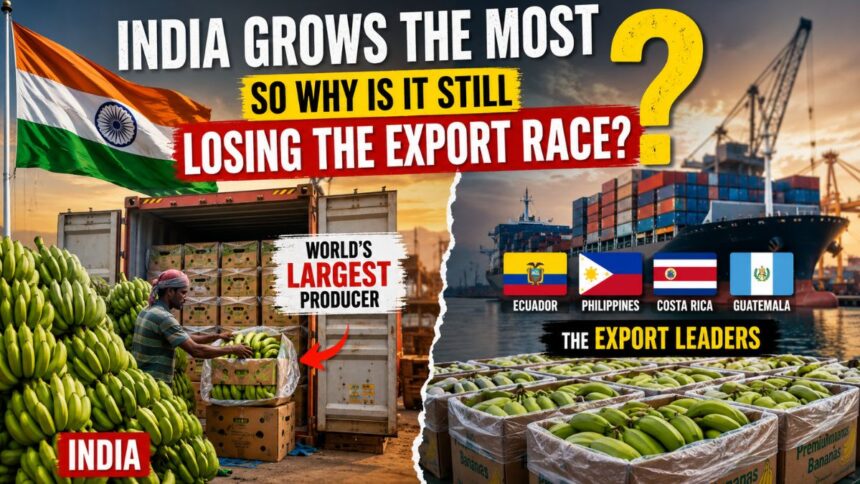
Start with the fact that shapes everything. India is the world’s largest banana producer, growing roughly a quarter of the global crop — yet its share of the world banana trade has stayed modest. The giants of the export trade are Ecuador, the Philippines, Costa Rica and Guatemala, with the Netherlands acting as Europe’s big re-export hub.
The encouraging part: India’s banana exports are growing quickly. They were worth on the order of USD 176 million (about 0.36 million tonnes) in 2023–24, and industry projections put FY2025–26 substantially higher, with the government eyeing a billion-dollar future. So the opportunity is real and expanding — but the gap between “biggest grower” and “small exporter” exists for reasons (infrastructure, cold chain, quality consistency, market access) that you’ll have to work around.
Is banana export from India profitable?
Banana export from India is growing fast and can be profitable at scale, helped by year-round supply and low domestic prices. But it’s a thin-margin, high-volume commodity trade, not a premium one — you earn through consistent export-grade quality, tight cold-chain logistics and reliable buyers, not through high per-kilo prices.
What makes banana export different from every other fruit
Four features set banana apart, and understanding them is the difference between a working business and an expensive lesson.
It’s available year-round. Unlike mango’s short season or many suppliers’ fixed harvest windows, India can supply bananas in every month of the year. For large global buyers who want steady, uninterrupted deliveries, that reliability is a genuine competitive advantage — arguably India’s single biggest edge in this trade.
Bananas travel green and ripen at the destination. Export bananas are harvested unripe, at around 75–80% maturity, deliberately kept green, shipped in refrigerated containers, and ripened in special chambers by the importer at the far end. So banana export isn’t a race against a ripening fruit the way mango is — it’s a discipline of managing “green life” over a long sea voyage.
It’s a sea-freight, cold-chain business. Bananas move by refrigerated (reefer) sea containers held at a controlled low temperature, not by air. That makes bulk volumes economically possible, but it puts your entire success on cold-chain precision from harvest to port.
It’s a thin-margin volume game. Bananas are cheap. Wholesale prices sit around a fraction of a dollar per kilo, so you don’t earn a premium per fruit — you earn by moving large, consistent volumes efficiently at low cost. This is the opposite of a premium export like Alphonso mango, and confusing the two is a costly mistake.
Two roles, two very different businesses
As with any export, be clear which role you’re taking on:
- The grower-supplier produces export-grade bananas and sells them to an exporter, aggregator or FPO who handles licences, packing, cold chain and shipping. This is the realistic, lower-barrier entry point for most farmers.
- The exporter-trader takes on the IEC and APEDA registration, the registered packhouse, the cold chain, the buyer relationships, the shipping documents and the financial risk of every consignment.
Contract farming and FPO-based sourcing are common in banana, with exporters tying up with growers in belts like Jalgaon in Maharashtra and clusters in Andhra Pradesh, Tamil Nadu, Gujarat and elsewhere. Supplying such a chain reliably is a genuine way to earn from export demand without shouldering all the risk.
Also Read: Moringa Farming in India: Real Profit, Cost, Yield & the Hype Explained
The markets that actually buy Indian bananas
India’s banana exports lean heavily on the Middle East and nearby countries, with newer markets opening up.
| Market | Why it matters | Notes and risks |
|---|---|---|
| Gulf — UAE, Saudi Arabia, Qatar, Oman, Bahrain | Largest and steadiest demand | The natural first market; strong, consistent buyers |
| Iran & Iraq | Big-volume buyers | Payment and settlement can be complex — export credit cover is important |
| Nepal, Bhutan, Bangladesh | Neighbouring land-border markets | Road transport; simpler logistics than sea |
| Russia & CIS | Growing; sea shipments being developed | A real diversification opportunity |
| EU and other premium markets | Higher standards, higher expectations | Strict pesticide-residue (MRL) and phytosanitary rules |
Two honest points here. First, the Gulf is where sensible newcomers start — steady demand, large diaspora, and fewer barriers than the EU. Second, Iran and Iraq buy big volumes but carry real payment risk; this is exactly why export-credit insurance (through ECGC) matters for anyone trading there.
The variety and grade standard: it’s Grand Naine
India grows dozens of banana varieties for its home market — Nendran, Robusta, Poovan and many regional types — but the export trade runs on one: Grand Naine (often marketed as G9), a Cavendish banana. Global buyers want the Cavendish look, size and shelf behaviour, graded to a specific standard: the right finger length, uniform bunches, clean unblemished skin, and correct maturity.
The practical takeaway is standardisation. To export, you need consistent Grand Naine of export grade, harvested green at the right maturity — not mixed local varieties or field-run fruit. Matching that specification reliably, batch after batch, is where many first-timers struggle.
The green journey: cold chain is the business
Here is the chain your fruit must pass through, and every link matters:
- Harvest at around 75–80% maturity so the fruit stays firm and green through the voyage.
- Move to an approved packhouse, where bunches are dehanded, washed, graded, and packed into ventilated, cushioned cartons to prevent bruising.
- Pre-cool and load into reefer sea containers held at a controlled low temperature (broadly in the range used to hold bananas green in transit).
- Ship — the fruit stays green across the sea transit.
- Ripen at the destination, where the importer uses ripening chambers to bring the fruit to eating condition before it reaches shelves.
Get any link wrong — harvest too ripe, break the cold chain, bruise the fruit, mistime the voyage — and the fruit can arrive over-ripe or damaged and be rejected. Cold-chain discipline isn’t a detail in banana export; it is the business.
What you legally need – and the incentives on offer
For a real banana export operation, assemble this stack:
- IEC (Import Export Code) from the DGFT — the mandatory foundation for any exporter.
- APEDA registration (RCMC) — for scheduled agri-products and to access packhouse registration, schemes and support; treat it as essential.
- GST registration and FSSAI compliance.
- Phytosanitary certificate from India’s plant quarantine authority (NPPO) for each shipment.
- An APEDA-registered packhouse, correct HS classification (0803) at customs, and standard export documents (commercial invoice, certificate of origin, and so on).
On the plus side, banana export benefits from real government support: export incentive schemes such as RoDTEP and Duty Drawback, ECGC export-credit cover for payment-risk markets, and APEDA infrastructure assistance toward packhouses, cold storage, reefer transport and even trial shipments and quality testing. The exact subsidy rates, coverage and validity change, so confirm the current position rather than relying on any figure you read.
The honest risks
This is the part the “lucrative business” pitches skip:
- Margins are thin. Banana is a low-price commodity; you profit on scale, cost control and reliability, not on premium prices. One badly handled or rejected consignment can erase the margin of several good ones.
- You’re competing with the world’s best. Ecuador, the Philippines and Central America run vast, hyper-efficient plantations with decades-old trade networks and logistics. India competes on price, year-round supply and proximity to the Gulf — not on being the cheapest or most established.
- Quality consistency is hard. Meeting a uniform export grade from fragmented, smallholder production is a genuine operational challenge.
- Cold chain and port gaps can break the green journey, and infrastructure is still developing.
- Residue and phytosanitary rejections, especially for the EU, punish poor spray discipline.
- Payment risk in markets like Iran and Iraq is real — insure it.
- A disease shadow hangs over Cavendish worldwide. The soil fungus Fusarium wilt Tropical Race 4 (TR4) threatens Cavendish-type bananas globally, a long-term risk to any monoculture built on Grand Naine that serious players are watching closely.
None of this says don’t export bananas — India’s trade is growing for good reasons. It says treat it as a disciplined logistics business, not a quick win.
A realistic way to enter
- If you’re a farmer: grow consistent, export-grade Grand Naine, adopt good agricultural practices and residue discipline, and supply an established exporter or an FPO with export tie-ups. Master the grade before taking on the risk.
- If you’re an entrepreneur: start with the Gulf market, use or partner with a registered packhouse and cold chain rather than building everything on day one, move trial consignments, and get every document and every reefer setting right before scaling.
- Use ECGC cover before trading with payment-risk markets, and tap APEDA’s schemes and buyer-seller meets to build infrastructure and find genuine buyers.
- Compete on reliability. In banana, the buyer who gets consistent grade, on time, every month, is the buyer you keep.
Government support
The trade has active institutional backing worth using: APEDA is the nodal export-promotion body offering registration, infrastructure assistance, quality support and buyer connections; NHB, MIDH and state horticulture departments support cold-chain and packhouse infrastructure; and NABARD-linked finance and export incentives (RoDTEP, drawback, ECGC) round out the toolkit. Confirm current scheme details and eligibility with APEDA and your state before relying on.
Is banana export from India worth it?
For the organised and well-capitalised, banana export is a real and growing opportunity. India’s unmatched production, year-round supply, low prices and proximity to the Gulf are genuine strengths, exports are rising, and the government is actively pushing the trade. If you can guarantee consistent export-grade Grand Naine, run a disciplined cold chain, and serve buyers reliably, it can be a solid volume business.
But be clear about the downsides:
- It’s a thin-margin commodity trade — profit comes from scale and discipline, not premium prices.
- You compete with the world’s most efficient exporters.
- Quality consistency and cold-chain precision are non-negotiable, and failures are costly.
- Some big markets carry payment risk, and residue rules can bite.
- A long-term disease threat (TR4) hangs over the Cavendish crop globally.
The smartest entry is rarely to become an exporter overnight. It’s to master export-grade production and reliable supply, begin with the forgiving Gulf market, insure payment risk, keep the cold chain flawless, and scale only once you can deliver the same quality every single month. In banana export, consistency is the whole edge.
Frequently asked questions
Is banana export from India profitable?
It can be, but as a high-volume, thin-margin commodity business rather than a premium one. Profit comes from scale, low costs, consistent export-grade quality and reliable delivery — not from high per-kilo prices. Exports are growing, but one rejected or poorly handled consignment can wipe out a lot of margin.
Which variety of banana is exported from India?
Almost all export focuses on Grand Naine (G9), a Cavendish banana, because global buyers want the Cavendish size, appearance and shelf behaviour graded to a set standard. India grows many other varieties for its home market, but they are generally not the export product.
Which countries import bananas from India?
The Middle East leads — UAE, Saudi Arabia, Iran, Iraq, Oman, Qatar and Bahrain — along with neighbours like Nepal, Bhutan and Bangladesh, and newer markets such as Russia. The Gulf is the steadiest and easiest starting point; Iran and Iraq buy large volumes but carry payment risk.
How are bananas shipped for export — do they ripen on the way?
Export bananas are harvested green at about 75–80% maturity, kept green in refrigerated sea containers, and ripened in special chambers by the importer at the destination. So they don’t ripen during the voyage; managing that “green life” through a disciplined cold chain is the core of the business.
What licences do I need to export bananas?
At minimum an IEC from the DGFT, plus APEDA registration, GST and FSSAI compliance. Each shipment needs a phytosanitary certificate, and you’ll need an APEDA-registered packhouse and correct customs documentation. Confirm the current requirements with APEDA before you begin.
Can a small farmer export bananas directly?
Directly exporting is difficult for a small farmer because of the licences, packhouse, cold chain, volume and working capital involved. A far more realistic route is to grow consistent export-grade Grand Naine and supply an established exporter or an FPO with export tie-ups, then scale up over time.