



Broccoli Farming: Broccoli is one of the few vegetables in India that can fetch a genuinely premium price — and also one of the easiest to lose money on if you grow it in the wrong place. This guide is for farmers and agri-entrepreneurs thinking of taking it up: what it really yields, why the same crop sells for ₹150 a kilo in one place and almost nothing in another, and the market and cold-chain realities that decide whether broccoli pays. Grow it right and it’s rewarding; grow it blind and it’s a fast lesson.
- Why broccoli is booming — and the catch
- Is broccoli farming profitable?
- The one number that tells the whole story
- Where and when to grow broccoli
- Choosing a variety or hybrid
- How to grow it
- Nursery and transplanting
- Nutrition and irrigation
- Pests and disease
- Harvest – and the bonus second pick
- Yield, cost and the money – honestly
- The perishability problem you can’t ignore
- Who actually buys broccoli – plan this first
- Government support
- Is broccoli farming worth it? An honest verdict
- Frequently asked questions
Why broccoli is booming — and the catch
Broccoli has ridden India’s health wave. Urban, health-conscious buyers want it for its antioxidants and nutrition, restaurants and hotels put it on menus, and organic and premium grocery channels stock it year-round. That demand is real and growing.
Here’s the honest catch, though: broccoli is still a niche vegetable in most of India. Outside cities and their supply chains, a lot of households simply don’t cook it. So unlike onion or potato — which sell anywhere — broccoli only commands its premium where there’s a buyer who actually wants it. The vegetable is easy to grow. Finding the right market is the hard part, and it’s the part that determines your profit.
Is broccoli farming profitable?
Broccoli farming can be very profitable near cities and in the off-season, when this premium winter vegetable fetches high prices from urban retail, hotels and health-conscious buyers. But it’s perishable and still niche in India, so without a nearby market the price can crash. For broccoli, market access matters more than yield.
The one number that tells the whole story
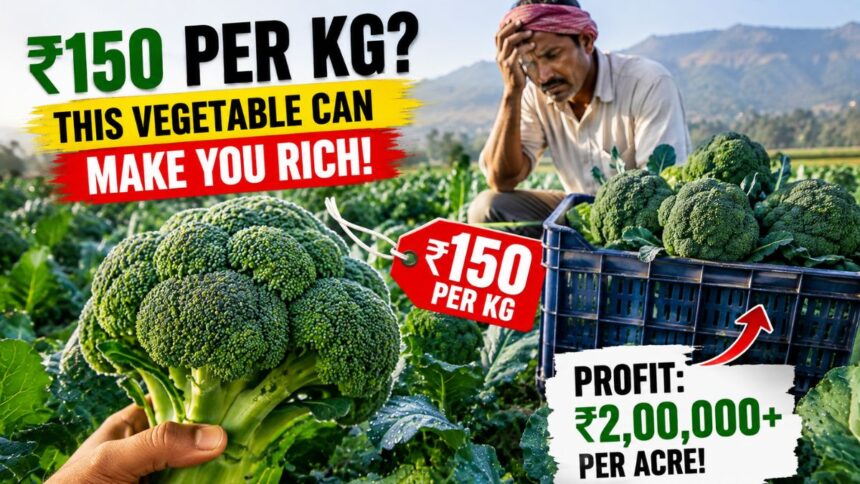
If you look at broccoli’s national mandi price, you’ll see a modal rate somewhere in the range of a few tens of rupees per kilo. That average hides everything important. On a single day, broccoli can trade at a rock-bottom rate of a few rupees a kilo in a glut in one market, and well over ₹200 a kilo in an off-season hill market — with premium urban dealers commonly quoting ₹80–150 a kilo in between.
That enormous spread is the single most important thing to understand about this crop. The same broccoli is worth ten times more depending on where and when you sell it. Two things drive the difference:
- Where: near a city, a HoReCa (hotel-restaurant-catering) supply line, or a premium/organic channel, broccoli earns well. Dumped into a small-town mandi with no broccoli demand, it barely sells.
- When: in peak winter, open-field broccoli floods in and prices soften. In the off-season — summer and the shoulder months — supply is scarce and prices spike, which is why hill-grown and protected-cultivation broccoli can be so lucrative.
Plan your farm around that reality, not around the average price.
Where and when to grow broccoli
Broccoli is a cool-season cole crop, a close cousin of cauliflower, and temperature rules everything.
- Ideal climate: cool weather, roughly 15–25°C. In this range you get tight, firm, deep-green heads.
- Heat is the enemy: in warm weather the plants bolt, flower prematurely, and form loose, small, poor-quality heads — hard to sell at any price.
- Frost can also damage developing heads.
This gives three broad windows in India:
- Winter in the plains — the main open-field season. Nursery sowing is commonly done from around mid-August into September, with transplanting a few weeks later and harvest through winter.
- Spring–summer in the hills — cool hill states like Himachal Pradesh and Uttarakhand can grow broccoli when the plains can’t, catching the high off-season price.
- Off-season under protected cultivation — polyhouse or shade-net growing lets you target the premium off-season market, but the higher investment only makes sense with a confirmed premium buyer.
For soil, broccoli likes well-drained loam or sandy loam rich in organic matter, with a pH of roughly 5.5–6.8. As a cole crop it’s also sensitive to boron — deficiency causes hollow or browned stems — so a soil test and correct micronutrients matter more here than with many vegetables.
Choosing a variety or hybrid
Most commercial growers use F1 hybrids because the market pays for uniform, tight, attractive green heads. Public open-pollinated varieties are cheaper and fine for smaller or local sales.
| Variety / hybrid | Type | Notes |
|---|---|---|
| Palam Samridhi | Open-pollinated | Himachal-released; compact green head |
| Punjab Broccoli-1 | Open-pollinated | Early; suits salad and cooking |
| Pusa Broccoli KTS-1 | Public | IARI line |
| Green Magic / Green Bud (F1) | Hybrid | Uniform, tight heads favoured by premium buyers |
| Fiesta / Lucky (F1) | Hybrid | Widely grown commercial hybrids |
Match the variety to your market and season, and buy quality seed from a reliable source. Confirm the current recommended variety and package of practices with your KVK or state agricultural university before buying.
How to grow it
Nursery and transplanting
Broccoli is raised in a nursery and transplanted. Sow on raised beds, and transplant healthy seedlings after about four weeks at a spacing of roughly 45 cm each way, which fits in the region of 11,000–13,000 plants per acre.
Nutrition and irrigation
Feed on the basis of a soil test rather than a fixed recipe, work in plenty of well-rotted farmyard manure, and pay attention to boron and other micronutrients that cole crops need. Give the first irrigation right after transplanting, then keep the soil consistently moist — broccoli doesn’t like drying out during head formation, but it also won’t tolerate waterlogging.
Pests and disease
Watch for aphids, diamondback moth and other cabbage caterpillars, and thrips, plus diseases like downy mildew and black rot. Use an integrated, locally approved management approach and scout regularly rather than spraying blind — and remember that premium and organic buyers pay close attention to residues.
Harvest – and the bonus second pick
The crop is usually ready in about 60 to 90 days after transplanting, depending on variety. Harvest the central head while the buds are still tight and green, before any yellow flowering shows — timing is everything for quality and price. Cut in the cool of the morning. With many varieties, after the main head you’ll also get a few weeks of smaller side shoots (secondary heads), a useful bonus harvest.
Yield, cost and the money – honestly
Two numbers frame your economics, and the second one is a range so wide it dominates everything.
A well-managed crop yields, very roughly, 6 to 10 tonnes per acre (around 60–100 quintal), varying with variety, season and management. Open-field cost of cultivation typically runs in the region of ₹35,000–50,000 per acre; protected cultivation costs considerably more.
Now the price — and why blanket “₹2 lakh per acre profit” claims are only half-true:
| Item | Indicative figure (estimate) |
|---|---|
| Crop duration (transplant to harvest) | ~60–90 days |
| Yield | ~6–10 tonnes per acre |
| Cost of cultivation (open field) | ~₹35,000–50,000/acre |
| Price (huge spread) | ~₹10–40/kg in a winter glut, up to ₹80–150+/kg premium/off-season |
| Shelf life | ~5–7 days refrigerated |
Look at that price row. At the high end, broccoli is one of the most rewarding vegetables you can grow. At the low end — winter open-field crop, far from a city, sold into a market with no broccoli demand — it can barely cover your costs, or fail to sell at all. The glossy per-acre profit figures online assume you hit the good end of that range with a confirmed buyer. They are achievable, but they are not automatic, and they are not what you get by growing broccoli blind. Plan on the price being uncertain and market-dependent, because it is.
Also Read: Sarpagandha Farming: 2–3 Years to Harvest, But Who Will Buy the Roots?
The perishability problem you can’t ignore
Broccoli is not a crop you can hold and sell later. Fresh heads stay good for only about five to seven days even under refrigeration, and they lose quality and green colour fast in field heat. That means:
- Harvest, cool, and move it quickly. Pre-cooling and cool handling directly protect your price.
- You can’t stockpile to wait for a better rate the way you might with grain or dried roots.
- A cold chain, or at least fast local delivery, is part of the business — not an optional extra.
This perishability is exactly why market access sits at the centre of broccoli farming: you must have somewhere to send a perishable, premium crop within days of cutting it.
Who actually buys broccoli – plan this first
Because broccoli is niche and perishable, decide your market before you sow a single seed. Realistic channels include urban retail and premium/organic grocers, the HoReCa segment (hotels, restaurants and caterers, which value consistent quality), online and quick-commerce grocery platforms, and exporters or processors in some regions. Off-season and hill growers can target the scarcity-driven premium.
The practical playbook for a first-timer: start small — half an acre to an acre — line up your buyer first, stagger your planting so you’re not harvesting everything in one glut week, and compete on quality, since tight, deep-green, uniform heads are what premium buyers pay up for.
Government support
As a horticulture crop, broccoli can draw on horticulture development support:
- The Mission for Integrated Development of Horticulture (MIDH) and your state horticulture department support vegetable cultivation, and — important for broccoli — protected cultivation (polyhouse and shade-net), which is where off-season premiums are won.
- NABARD-linked loans can help fund polyhouses, cold storage and other infrastructure.
Support levels, eligibility and processes change and vary by state, so confirm current assistance — especially any protected-cultivation subsidy — through your district horticulture office before relying on it.
Is broccoli farming worth it? An honest verdict
For the right grower, broccoli is genuinely one of the more rewarding vegetables in India. It’s quick — a crop in two to three months — it’s easy to grow in cool weather, it rides a real and rising health-driven demand, and it can command a premium that few vegetables match, especially off-season. If you have a line to an urban, HoReCa, premium or export market, or a cool hill window, it deserves serious consideration.
But be honest about the downsides before you plant:
- Market access decides everything. Without a real buyer, a perishable niche crop can crash to near-nothing.
- The price swings enormously by place and season, so the headline profit figures are best-case, not typical.
- It’s highly perishable — five to seven days — so you need speed and cool handling, ideally a cold chain.
- Heat ruins it, limiting open-field growing to winter in the plains.
- Off-season premiums need protected cultivation, which raises the investment.
A sensible way in: grow half an acre to an acre in your cool season, secure a buyer first, stagger the planting, obsess over head quality, and move the crop fast. Prove your market with one season before you scale — with broccoli, that’s the difference between a premium crop and a pile of unsold heads.
Frequently asked questions
Is broccoli farming profitable in India?
It can be, but profitability depends far more on market access than on yield. Near cities, in the off-season, or supplying hotels and premium retail, broccoli earns a strong premium. Far from demand or in a winter glut, prices can crash — so secure a buyer before you plant.
In which season is broccoli grown in India?
Broccoli is a cool-season crop grown mainly in winter in the plains, with nursery sowing typically from around mid-August into September and harvest through winter. Cool hill regions can grow it in spring and summer, and protected cultivation allows off-season production for premium prices.
How long does broccoli take to harvest?
About 60 to 90 days from transplanting, depending on the variety, plus roughly four weeks in the nursery beforehand. After the main central head, many varieties also give a few weeks of smaller side shoots as a bonus second harvest.
Where can I sell broccoli?
To urban retail and premium or organic grocers, hotels, restaurants and caterers, online and quick-commerce platforms, and in some areas exporters or processors. Because broccoli is niche and perishable, arranging your buyer before planting is far safer than hoping to sell after harvest.
Can broccoli be grown in the hot plains?
Only in the cool winter months in open fields, because heat makes the plants bolt and form poor, loose heads. Growing broccoli in warm weather or off-season requires a polyhouse or shade net, which costs more but can capture high off-season prices.
How much does it cost to grow broccoli per acre?
Open-field cultivation typically costs in the region of ₹35,000–50,000 per acre, covering seed, labour, manure, fertiliser and irrigation, though this varies by region and inputs. Protected cultivation under a polyhouse costs substantially more but targets the premium off-season market.