



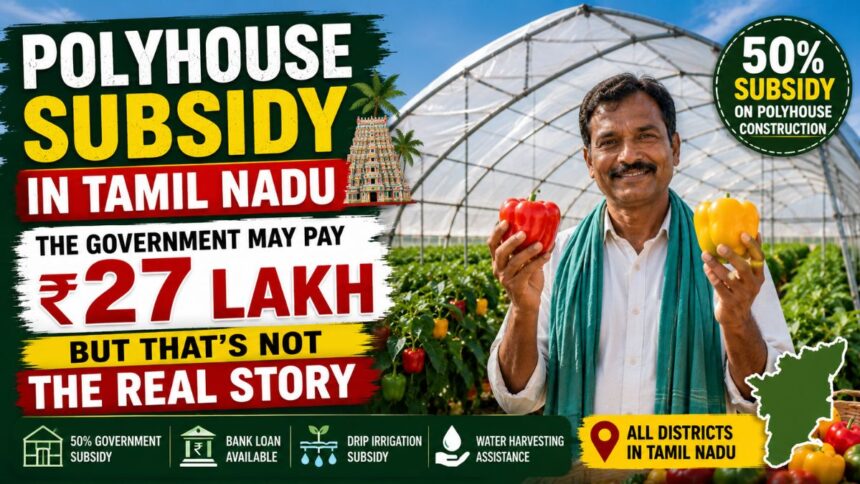
A small farmer in Krishnagiri district told me something that stayed with me: “I spent 30 years fighting the weather. Now the weather cannot enter my farm.” He had just completed his first season of coloured capsicum inside a naturally ventilated polyhouse — and walked away with a net return that beat three years of open-field income. The polyhouse subsidy in Tamil Nadu made that shift possible.
- What Is a Polyhouse and Why Is Tamil Nadu Taking It Seriously?
- Why Tamil Nadu Farmers Are Moving Toward Polyhouses Right Now
- The Polyhouse Subsidy in Tamil Nadu: What You Actually Get
- How Much Does It Cost to Build a Polyhouse in Tamil Nadu? (2025–26)
- Realistic Income Potential: Two Scenarios
- Step-by-Step: From Application to First Harvest
- Step 1 — Register on HORTNET Before Everything Else
- Step 2 — Gather Your Documents
- Step 3 — Visit Your District Horticulture Office
- Step 4 — Get Bank Loan Sanctioned
- Step 5 — Select an Empanelled Vendor and Prepare DPR
- Step 6 — Construction and Joint Inspection
- Step 7 — Planting and Crop Calendar
- Step 8 — Crop Management Essentials
- Where to Sell Your Produce
- What Goes Wrong – And How to Avoid It
- Who Should and Should Not Try This
- Frequently Asked Questions
If you are a farmer in Tamil Nadu looking at protected cultivation seriously, this article covers every number, scheme, document, and step you need — sourced from official district horticulture portals and verified government guidelines.
What Is a Polyhouse and Why Is Tamil Nadu Taking It Seriously?
A polyhouse is a structure built from galvanised iron (GI) pipes and covered with UV-stabilised polyethylene film. It creates a semi-controlled growing environment — protecting crops from heavy rain, excess heat, pest pressure, and erratic weather — while allowing adequate light and ventilation.
Tamil Nadu’s climate, particularly in districts like Krishnagiri, Coimbatore, Dharmapuri, and Nilgiris, is well-suited to protected cultivation. The state has been implementing the Mission for Integrated Development of Horticulture (MIDH) – National Horticulture Mission (NHM) for over a decade, and the polyhouse subsidy is one of its most active components, administered through district horticulture offices across all major districts. (Source: tnhorticulture.tn.gov.in; multiple district NIC portals)
Why Tamil Nadu Farmers Are Moving Toward Polyhouses Right Now
Open-field tomato prices at the Koyambedu wholesale market in Chennai ranged from ₹25 to ₹70 per kg in late 2024 (Source: commodityonline.com, December 2024), with wide seasonal swings. Capsicum at Koyambedu was quoted at around ₹40 per kg retail during peak season. This volatility hurts open-field farmers who cannot time harvests.
Polyhouses change that math in two ways. First, they allow year-round production — so farmers can time harvests to hit peak-price windows. Second, coloured capsicum grown under protected cultivation commands a consistent ₹60–80 per kg at the wholesale level due to superior fruit quality, uniform size, and extended shelf life. (Source: FarmAtma.in capsicum economics analysis, 2025–26)
The MIDH unit cost norm for naturally ventilated polyhouses is ₹1,000 per square metre, which is the government’s reference rate for calculating the 50% subsidy. The actual construction market cost in Tamil Nadu is typically higher — around ₹800 to ₹1,200 per square metre depending on vendor and district — but the subsidy applies strictly to the government’s approved cost norm. (Source: MIDH Operational Guidelines, revised August 2025; NHB)
The Polyhouse Subsidy in Tamil Nadu: What You Actually Get
This is where most articles give you a figure without context. Here is the complete picture.
Under MIDH-NHM, Tamil Nadu’s Department of Horticulture and Plantation Crops provides a 50% subsidy on construction of polyhouses at the rate of ₹467.50 per square metre, for a maximum of 4,000 square metres per beneficiary. (Source: Coimbatore District Horticulture Department, nic.in; Krishnagiri District MIDH-NHM portal, krishnagiri.nic.in)
The same scheme also covers shadenet houses at ₹355 per square metre (50% subsidy, up to 4,000 sqm), which is a lower-cost alternative for certain crops.
At 4,000 sq.m (approximately one acre), the maximum subsidy calculation works out as:
- Government norm: 4,000 sq.m × ₹467.50 = ₹18,70,000 total norm cost
- 50% subsidy = ₹9,35,000 credit-linked back-ended grant
This is a back-ended, credit-linked subsidy. You must take a bank loan, complete construction with an empanelled vendor, pass joint inspection, and then the subsidy amount is credited to your loan account. You do not receive cash upfront.
Lease farmers are also eligible if they hold a registered lease agreement for a minimum of 10 years. (Source: Krishnagiri District MIDH-NHM scheme page, krishnagiri.nic.in)
Can You Stack Other Subsidies?
Yes. Tamil Nadu farmers building a polyhouse can separately apply for:
- Micro-irrigation (drip) subsidy under PMKSY — 100% for small and marginal farmers, 75% for others, up to 5 hectares (Source: Coimbatore District Horticulture, nic.in)
- Water harvesting structure assistance of ₹75,000 per unit
- Mulching subsidy at 50%, up to ₹16,000 per hectare
Combining these significantly reduces your net cash outflow beyond the polyhouse structure.
How Much Does It Cost to Build a Polyhouse in Tamil Nadu? (2025–26)
The following cost breakdown is for a 1-acre (4,000 sq.m) Naturally Ventilated Polyhouse (NVPH) suitable for coloured capsicum or tomato cultivation:
| Component | Estimated Cost (₹) |
|---|---|
| GI structure + polyfilm (UV-stabilised) | 16,00,000 – 20,00,000 |
| Drip irrigation + fertigation system | 1,50,000 – 2,50,000 |
| Land levelling and site preparation | 50,000 – 80,000 |
| Seedlings (capsicum, 12,000 plants @ ₹12/plant) | 1,44,000 |
| First-season fertilizers, crop protection inputs | 1,50,000 – 2,00,000 |
| Labour (transplanting, training, harvesting) | 1,00,000 – 1,50,000 |
| DPR preparation, documentation, miscellaneous | 30,000 – 50,000 |
| Estimated Total Investment | 22,00,000 – 28,00,000 |
[ESTIMATE: These are 2025–26 market estimates for Tamil Nadu based on verified industry sources including FarmAtma.in and Agriplast Protected Cultivation economics reports. Actual costs vary by district, vendor, and structure specifications. Add 18% GST on the polyhouse structure cost — this is commonly excluded from vendor quotes.]
After the 50% subsidy on the government norm (₹9.35 lakh), your effective out-of-pocket cost drops to approximately ₹13–19 lakh for the full project, financed partially through a term loan.
Agro Potli Daily Farm Expense Tracker
Realistic Income Potential: Two Scenarios
Crop reference: Coloured Capsicum in a 4,000 sq.m NVPH, 8–10 month crop cycle.
Planting density: 3 plants per sq.m = 12,000 plants per acre (Source: TNAU, HC & RI, Coimbatore — protected cultivation of capsicum presentation)
Conservative Scenario
- Yield: 32 tonnes per acre (lower end for NVPH; open-field gives 8–15 tonnes)
- Wholesale price: ₹50 per kg (conservative, excluding peak periods)
- Gross Revenue: ₹16,00,000
- Running costs (fertilizers, labour, water, packaging): ₹4,50,000
- Net Return: approximately ₹11,50,000 per crop cycle
Optimistic Scenario
- Yield: 45 tonnes per acre (TNAU reports yield of 100–120 tonnes per hectare, which is 40–48 tonnes per acre under good management)
- Wholesale price: ₹70 per kg (peak season coloured capsicum, Koyambedu market reference)
- Gross Revenue: ₹31,50,000
- Running costs: ₹5,50,000
- Net Return: approximately ₹26,00,000 per crop cycle
Assumptions stated clearly: Optimistic scenario requires excellent fertigation management, well-timed market access, and a crop cycle free from major pest or disease outbreaks. Most first-year farmers land somewhere between the two scenarios. Investment recovery (after subsidy) typically takes 2–3 years for well-managed units. (Source: Agriplast Protected Cultivation, 2025–26 economics data; TNAU capsicum protected cultivation yield benchmarks)
Step-by-Step: From Application to First Harvest
The sequence matters enormously here. Build first, apply later — and you lose the subsidy permanently.
Step 1 — Register on HORTNET Before Everything Else
Visit www.tnhortnet.com or the HORTNET portal at tnhorticulture.tn.gov.in and register as a farmer. Beneficiary selection in Tamil Nadu now happens primarily through the Uzhavan App and the HORTNET platform. (Source: Krishnagiri District Integrated Horticulture Development Scheme page, krishnagiri.nic.in)
Step 2 — Gather Your Documents
The Tamil Nadu horticulture department requires:
- Chitta and Adangal (original land records)
- Field Measurement Book (FMB) sketch
- Aadhaar card
- Bank account details (DBT-linked)
- Registered lease agreement (minimum 10 years) — for lease farmers only
- Ration card or Voter ID as additional identity proof
(Source: Krishnagiri District Integrated Horticulture Development Scheme, krishnagiri.nic.in; Agriplast.co.in Tamil Nadu HORTNET process, verified May 2025)
Step 3 — Visit Your District Horticulture Office
Walk into the Deputy Director of Horticulture office in your district. Do this before signing any contract with a polyhouse vendor. The district officer registers your application under MIDH-NHM, verifies land records, and issues an in-principle approval. No approval = no subsidy, regardless of what a vendor tells you.
Step 4 — Get Bank Loan Sanctioned
The subsidy is credit-linked. Most nationalised banks — Canara Bank, State Bank of India, Indian Bank — sanction term loans for MIDH-approved polyhouse projects. The Government Order Cum sanction letter from the horticulture department supports your loan application.
Step 5 — Select an Empanelled Vendor and Prepare DPR
Your polyhouse must be built by a vendor registered under the MIDH scheme. The Tamil Nadu horticulture department and NHB maintain approved vendor lists. (Note: Agriplast Protected Cultivation Pvt. Ltd. in Hosur, Tamil Nadu is one of the MIDH-listed vendors — Source: AP state MIDH guidelines vendor list; cross-referencing not state-specific so verify with your DHO.)
A Detailed Project Report (DPR) following MIDH format — covering crop plan, construction specs, irrigation, marketing plan, and financial projections — must be submitted with your application. A KVK officer in your district can assist with DPR preparation at no cost.
Step 6 — Construction and Joint Inspection
Build strictly as per the DPR. After completion, the district horticulture team conducts a joint inspection. Photos and bills are uploaded to HORTNET by the Assistant Director of Horticulture (ADH). (Source: Tamil Nadu Protected Cultivation MIDH guidelines document)
Step 7 — Planting and Crop Calendar
For Tamil Nadu’s climate:
- Capsicum transplanting: October to November for the main season (moderate temperatures). A second planting is possible in July–August with fan-pad cooling assistance if available.
- Tomato: June–July or October–November
- Cucumbers: March–April or September–October
Unlike open-field farming, a polyhouse does not follow Kharif or Rabi constraints rigidly — but Tamil Nadu’s heat from March to June is the most difficult period for capsicum without active cooling systems.
Step 8 — Crop Management Essentials
- Use drip + fertigation system from Day 1. Water soluble fertilizers (WSFs) applied through drip lines consistently outperform conventional basal dosing in NVPH. TNAU research from Coimbatore found that WSF application at 120 kg per hectare gave the highest yield and benefit-cost ratio in capsicum under protected cultivation. (Source: TNAU-Coimbatore fertigation study published in YMER Digital, 2022)
- Train plants on GI wire trellis using plastic strings. Capsicum must be double-stemmed and continuously trained upward for 8–10 months.
- Scout weekly for thrips (primary vector of viral diseases) and powdery mildew — the two main challenges inside a Tamil Nadu polyhouse.
Where to Sell Your Produce
Local APMCs: Koyambedu Wholesale Market Complex (KWMC) in Chennai is the primary price discovery point for Tamil Nadu. Hosur APMC, Coimbatore APMC, and Salem APMC are strong secondary markets for farmers in respective regions.
Modern retail: BigBasket, Reliance Fresh, and DMart sourcing teams actively purchase polyhouse-grade coloured capsicum and tomatoes from supplier groups. Contact sourcing offices in Chennai directly or through your district FPO.
Farmer Producer Organisations (FPOs): The Tamil Nadu government has been building FPO networks since the 2017–18 budget announcement to facilitate collective selling. Contact your district horticulture office for FPOs active in your area.
Export: Tamil Nadu’s proximity to Chennai port makes it viable for coloured capsicum export to markets including the UAE, Singapore, and Malaysia. APEDA-registered exporters in Chennai can provide buyback arrangements for consistent, certified produce. Check apeda.gov.in for registered exporter lists.
What Goes Wrong – And How to Avoid It
1. Building before getting approval
This is the single most common and devastating mistake. Vendors sometimes push farmers to start construction before paperwork is complete. A polyhouse built without prior MIDH sanction is permanently ineligible for subsidy — there are no exceptions. The rule is non-negotiable. (Source: MIDH operational guidelines; Agriplast.co.in Tamil Nadu process notes)
2. High-EC water destroying the crop
Tamil Nadu, particularly the northern districts and coastal belts, has pockets with high electrical conductivity (EC) in groundwater. Capsicum is sensitive to salinity stress. Water EC above 1.0 mS/cm can cause leaf burn and yield collapse inside a polyhouse. Always test your water source before finalising the farm location. If EC is high, budget for a basic RO system — an investment that protects a much larger crop value.
3. Underestimating GST on the structure
Polyhouse construction attracts 18% GST. On a ₹20 lakh structure, that is ₹3.6 lakh in taxes that most vendor quotes exclude upfront. Factor this into your total project cost and loan requirement before finalising numbers with the bank.
4. Choosing the wrong crop for your market access
Green capsicum has a much lower realisation than coloured (red, yellow) varieties — often half the price per kg. But coloured capsicum takes 10–12 weeks longer to reach selling maturity and requires stricter temperature management. Farmers without a reliable cold chain or direct buyer often lose on quality by the time the produce reaches market. Match your crop choice to your marketing channel first.
Who Should and Should Not Try This
This works well for you if:
- You have 1–2 acres of own or registered leased land with reliable irrigation water
- You are willing to be physically present at the farm every day or can hire a trained farm supervisor
- You have an identified buyer or market linkage before starting
- You can manage the bank loan and bridge the 6–12 month gap before subsidy disbursal
Be honest with yourself if:
- You are planning to manage this remotely alongside another full-time occupation
- Your only water source is rainwater-dependent
- You are expecting the first season to recover your full investment — it rarely happens
- Your nearest APMC is more than 100 km away and you have no cold chain access
Polyhouse farming is a viable and increasingly attractive investment for serious Tamil Nadu farmers — particularly in Krishnagiri, Coimbatore, Nilgiris, Dharmapuri, and Salem districts where agro-climatic conditions suit protected cultivation and urban markets are accessible. It is not passive income. It is intensive horticulture that rewards preparation and precision.
Frequently Asked Questions
How much polyhouse subsidy do I get in Tamil Nadu and where do I apply?
Under MIDH-NHM, Tamil Nadu provides a 50% subsidy on polyhouse construction at ₹467.50 per square metre for up to 4,000 square metres per beneficiary. Maximum subsidy works out to approximately ₹9.35 lakh per unit. Apply by registering at www.tnhortnet.com and visiting your district’s Deputy Director of Horticulture office before starting any construction.
What documents do I need to apply for polyhouse subsidy in Tamil Nadu?
You need your Chitta and Adangal (original), FMB sketch, Aadhaar card, a DBT-linked bank account, and — for lease farmers — a registered lease agreement covering at least 10 years. Applications are processed through the HORTNET portal and the Uzhavan App.
Can a lease farmer apply for polyhouse subsidy in Tamil Nadu?
Yes. Tamil Nadu’s MIDH-NHM scheme allows lease farmers to apply, provided the lease deed is registered and covers a minimum period of 10 years. The lease document must be produced during the application and joint inspection process.
What crops are most profitable in a Tamil Nadu polyhouse?
Coloured capsicum (red and yellow varieties) is the most consistently profitable crop in Tamil Nadu’s polyhouses — commanding ₹60–80 per kg wholesale versus ₹15–25 per kg for open-field green capsicum. Cherry tomato and seedless cucumber are strong secondary options. Gerbera and Dutch rose are viable in cooler districts like Nilgiris and higher-altitude areas of Krishnagiri.