



Every year, thousands of Indian farmers look for a business that gives quick returns, needs less land, and keeps earning throughout the year. Most crops make you wait 3 to 6 months. Poultry farming? Your first income can come in just 6 weeks.
- What Is Poultry Farming Business?
- Why the Poultry Farming Business Makes Sense in 2026
- Poultry Farming Business Cost Breakdown (India 2026)
- Small Scale (500 to 1,000 Birds — Broiler)
- Medium Scale (2,000 to 5,000 Birds)
- Important Note on Costs
- Profit Potential: What Can You Really Earn?
- Step-by-Step Guide to Starting Your Poultry Farming Business
- Step 1: Research and Decide Your Farming Type
- Step 2: Select Your Location and Land
- Step 3: Construct a Proper Shed
- Step 4: Get Your Licenses and Registration
- Step 5: Source Quality Day-Old Chicks (DOC)
- Step 6: Follow a Strict Feeding and Vaccination Schedule
- Step 7: Sell Smart
- Agro Potli Daily Farm Expense Tracker
- Government Subsidies for Poultry Farming Business in India
- National Livestock Mission (NLM) — 2026
- NABARD Poultry Venture Capital Fund (PVCF)
- Other Benefits Available to Poultry Farmers
- Real-Life Success Story: From ₹3 Lakh Investment to ₹18 Lakh Annual Income
- Expert Tips for Running a Profitable Poultry Farming Business
- Common Mistakes That Kill Profitability
- Broiler vs Layer Farming: Which Is Better for You?
- Conclusion: Is Poultry Farming Business Worth It in 2026?
- FAQs: Poultry Farming Business in India
That is the reason the poultry farming business in India has quietly become one of the most reliable income sources for rural and semi-urban families. From Andhra Pradesh to Bihar, from small backyard setups to large commercial sheds — this business is feeding families and building livelihoods at the same time.
But here is the truth no one tells you clearly: starting without proper knowledge is where most beginners lose money. This guide will walk you through everything — cost, profit, setup process, government schemes, and real mistakes to avoid — so you can start with confidence.
What Is Poultry Farming Business?
Poultry farming means raising domestic birds — mainly chickens — commercially for meat or eggs. It is not just about keeping a few hens in the backyard anymore. Today it is a structured agri-business with organized supply chains, government support, and proven profitability.
There are two main types that dominate the market in India:
- Broiler Farming — Raising chickens for meat. Birds reach market weight in 5 to 7 weeks.
- Layer Farming — Raising hens for continuous egg production. A good layer hen can produce eggs for up to 72 to 78 weeks.
You can also explore backyard farming, free-range farming, and organic poultry farming depending on your budget and target market.
Why the Poultry Farming Business Makes Sense in 2026
India is one of the top egg-producing countries in the world. The numbers make the case:
- India produces over 140 billion eggs annually
- The poultry industry contributes over ₹1.2 lakh crore to the Indian economy
- The market is projected to reach ₹8,43,000 crore by 2033
- Demand from hotels, fast food chains, and households is growing year after year
The average Indian still consumes far fewer eggs and chicken than recommended by nutritionists. That gap means this market has enormous room to grow — and that is where your opportunity sits.
Key advantages of the poultry farming business:
- Quick returns — broilers ready in 6 weeks, eggs start at 18 to 20 weeks
- Low space requirement compared to other livestock
- Year-round income (not seasonal like crops)
- Government subsidies and bank loans available
- Manure as an additional income source (used as organic fertilizer)
- Contract farming options available to reduce risk for beginners
Poultry Farming Business Cost Breakdown (India 2026)
This is the section most guides get wrong. Let us give you realistic, India-specific numbers.
Small Scale (500 to 1,000 Birds — Broiler)
| Cost Head | Estimated Amount |
|---|---|
| Shed construction (500 sq ft) | ₹1,00,000 – ₹1,50,000 |
| Day-old chicks (1,000 birds @ ₹40–50 each) | ₹40,000 – ₹50,000 |
| Feed (6 weeks, ~2.5 kg/bird) | ₹80,000 – ₹1,00,000 |
| Medicines and vaccinations | ₹10,000 – ₹15,000 |
| Equipment (feeders, drinkers, heaters) | ₹20,000 – ₹30,000 |
| Labour and utilities | ₹15,000 – ₹20,000 |
| Total Investment | ₹2,65,000 – ₹3,65,000 |
Medium Scale (2,000 to 5,000 Birds)
Total investment ranges between ₹5 lakh to ₹12 lakh depending on state, land availability, and shed quality.
Important Note on Costs
Feed is the largest single expense — it accounts for roughly 60 to 70% of your total running cost. Managing feed quality and procurement is the single biggest lever for your profitability.
Profit Potential: What Can You Really Earn?
Broiler Farming (Meat Birds)
- A well-managed flock of 1,000 birds can yield a profit of ₹25,000 to ₹40,000 per cycle
- One broiler cycle takes 6 to 7 weeks
- You can run 6 to 7 cycles per year (including the cleaning gap)
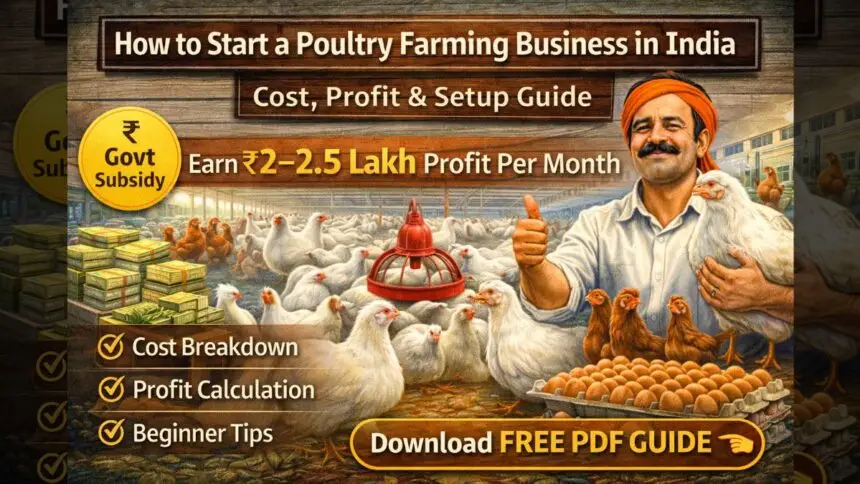
- Annual profit from 1,000 birds: ₹1.5 lakh to ₹2.5 lakh
Per bird, expect a net profit of ₹25 to ₹40 after all expenses. On a good cycle with healthy birds and stable feed prices, this can go up to ₹50.
Layer Farming (Egg Production)
- Each layer hen produces around 250 to 300 eggs per year
- Eggs sell for ₹6 to ₹8 per egg in local markets (₹12 to ₹15 in organic segments)
- With 2,000 layer birds producing 1,600 to 1,800 eggs daily, gross income is substantial
- Net profit per egg after costs: approximately ₹1.50 to ₹2.50
- 2,000 layers can give you ₹3,000 to ₹5,000 net profit per day at peak production
Return on Investment Timeline
- Small-scale broiler farm: ROI in 4 to 6 months
- Medium-scale layer farm: ROI in 10 to 14 months
These numbers assume good bird health, controlled feed costs, and a stable local market. Beginners should budget conservatively and plan for 10 to 15% bird mortality.
Step-by-Step Guide to Starting Your Poultry Farming Business
Step 1: Research and Decide Your Farming Type
Before you spend a single rupee, visit 2 to 3 existing poultry farms near your area. Talk to the farmers. Understand whether broiler or layer farming suits your budget, local market demand, and available resources.
Broiler farming is better for quick cash flow. Layer farming gives more stable, long-term income.
Step 2: Select Your Location and Land
- Keep the farm at least 500 metres away from residential areas to avoid complaints from neighbours
- Ensure access to clean water supply
- Build the shed in an East-West direction for proper ventilation
- Good road connectivity matters for feed delivery and bird transportation
For small-scale farming, even 1,000 to 1,500 sq ft of land is enough to start.
Step 3: Construct a Proper Shed
The shed is your biggest one-time investment. Get this right.
- Allow 1 sq ft per bird for broilers and 0.5 sq ft for caged layers
- Ensure cross-ventilation, proper roof height, and drainage
- Use cheap locally available materials (bamboo, tin sheets) if budget is tight
- Install foggers or fans for summer ventilation — heat stress kills birds and ruins your margins
Step 4: Get Your Licenses and Registration
You will need:
- Trade License from your local municipal office
- FSSAI Registration if you are selling processed products
- Pollution Control Board NOC for medium and large farms
- GST Registration if annual turnover exceeds ₹20 lakh
Contract farmers under large integrators often get help with paperwork from the company itself.
Step 5: Source Quality Day-Old Chicks (DOC)
Buy chicks only from certified, reputed hatcheries. Poor-quality chicks lead to high mortality and low weight gain — two things that destroy your profit.
Popular broiler breeds in India: Cobb 500, Ross 308, Hubbard Popular layer breeds: White Leghorn, Hy-Line Brown, Lohmann
Step 6: Follow a Strict Feeding and Vaccination Schedule
Feed in three phases for broilers: starter (0 to 10 days), grower (11 to 25 days), finisher (26 days to market). Never mix up these phases — it directly affects your weight gain and feed conversion ratio (FCR).
Vaccinate for Marek’s disease, Newcastle disease (Ranikhet), Infectious Bronchitis, and Gumboro as per your veterinary consultant’s schedule.
Step 7: Sell Smart
Connect with:
- Local chicken meat dealers and commission agents
- Nearby hotels, dhabas, and restaurants (for consistent bulk orders)
- Egg traders and local mandis
- Supermarkets and organised retail chains (for branded eggs)
If you are a contract farmer, the integrator company handles the buyback. This removes market risk but also reduces your upside.
Agro Potli Daily Farm Expense Tracker
Government Subsidies for Poultry Farming Business in India
The government actively supports poultry farmers through multiple schemes.
National Livestock Mission (NLM) — 2026
This is the most important scheme to know. Under the NLM Entrepreneurship Development component, eligible farmers and entrepreneurs can get:
- Up to 50% capital subsidy on project cost (up to ₹25 to ₹30 lakh)
- The scheme covers poultry farms, feed units, hatcheries, and breeding farms
- Apply online at www.nlm.udyamimitra.in
NABARD Poultry Venture Capital Fund (PVCF)
- 25% back-ended capital subsidy for general category farmers
- 33.33% subsidy for SC/ST farmers, hilly regions, and North East states
- Bank loan must cover at least 40% of total project cost
- Eligible institutions: Commercial banks, Regional Rural Banks, State Cooperative Banks
Other Benefits Available to Poultry Farmers
- 7% interest subsidy reimbursed for up to 5 years (in some states)
- Electricity duty exemption for up to 10 years (state-specific)
- Stamp duty waiver on land purchase for farming use
- MUDRA loans for small-scale poultry setup
Always approach your nearest District Animal Husbandry Department or NABARD district office to get current, state-specific subsidy details.
Real-Life Success Story: From ₹3 Lakh Investment to ₹18 Lakh Annual Income
Ramesh Yadav, Nandurbar District, Maharashtra
Ramesh was a small farmer growing soybean on 2 acres. After two consecutive bad harvests due to unseasonal rains, he decided to try poultry farming in 2022 with guidance from the local KVK (Krishi Vigyan Kendra).
He started with 1,000 broiler birds, a tin-shed of 1,200 sq ft, and a total investment of ₹3.2 lakh. His first cycle gave him a modest profit of ₹22,000. By the third cycle, he had dialled in his feed management and brought FCR (feed conversion ratio) down from 2.0 to 1.75 — a big deal in broiler farming.
By 2023, he expanded to 5,000 birds per cycle after getting a bank loan of ₹8 lakh and a 25% NABARD subsidy. Today, Ramesh runs 6 cycles per year, earns a net annual income of approximately ₹15 to ₹18 lakh, employs two local workers, and has also started selling poultry manure to neighbouring vegetable farmers at ₹3 per kg.
His advice: “The first cycle will teach you more than any guide. Start small, focus on bird health, and do not cut corners on feed quality.”
Expert Tips for Running a Profitable Poultry Farming Business
- Biosecurity is non-negotiable. Restrict farm visitors, disinfect footwear before entry, and maintain a strict all-in all-out policy. One disease outbreak can wipe out an entire cycle.
- Track your FCR (Feed Conversion Ratio). The ideal FCR for broilers is 1.6 to 1.8. Anything above 2.0 means you are spending more on feed than you should.
- Negotiate feed prices in bulk. Feed is 70% of your cost. Even a ₹1 to ₹2 per kg saving on feed can translate to ₹10,000 to ₹15,000 per cycle in profit.
- Maintain a flock record book. Track bird weight, mortality, feed consumption, and medication dates cycle by cycle. This will help you spot problems early and improve over time.
- Consider contract farming to start. Companies like Suguna Foods, Venkateshwara Hatcheries, and others offer contract farming models where they supply DOC, feed, and veterinary support. You provide the shed and labour. This reduces your market risk significantly.
Common Mistakes That Kill Profitability
1. Buying cheap chicks to save money This backfires every time. Poor-quality chicks have high mortality rates and low weight gain. The ₹10 to ₹15 you save per chick costs you ₹100+ per bird in losses.
2. Overcrowding the shed More birds per sq ft seems like better returns. But overcrowding leads to disease spread, heat stress, and poor weight gain. Stick to the recommended stocking density.
3. Skipping the vaccination schedule Diseases like Ranikhet and Gumboro can kill 30 to 50% of your flock in days. A ₹500 vaccination saves you ₹50,000 in losses.
4. No market linkage before starting Many beginners set up the farm first and think about selling later. This is backwards. Identify your buyers — local dealers, restaurants, or integrator companies — before your first batch of chicks arrives.
5. Ignoring summer and monsoon management Extreme heat (above 35°C) causes heat stress and kills birds. Install exhaust fans, foggers, and ensure shade over the shed. Plan your cycles to avoid the peak of summer if possible.
Broiler vs Layer Farming: Which Is Better for You?
| Factor | Broiler Farming | Layer Farming |
|---|---|---|
| Investment to start | Lower (₹2–5 lakh) | Higher (₹5–12 lakh) |
| Time to first income | 6 to 7 weeks | 18 to 20 weeks |
| Income type | Lump sum per cycle | Daily (eggs) |
| Management complexity | Moderate | Higher |
| Market risk | Higher (price fluctuates) | Lower (stable egg prices) |
| Best for | Quick cash, beginners | Long-term steady income |
If you are a beginner with limited capital, start with broiler farming. Once you understand the business, transition to layers for consistent income.
Conclusion: Is Poultry Farming Business Worth It in 2026?
Yes — without any doubt. The poultry farming business in India offers one of the best combinations of low entry barrier, quick returns, and scalable growth potential in agriculture today.
The market is growing. Government support is real and accessible. And most importantly, the demand for eggs and chicken across India is not going down anytime soon.
Start small. Learn your first two cycles thoroughly. Focus obsessively on bird health and feed management. Then scale up with confidence.
The farmers who fail are not the ones who started small — they are the ones who skipped their research and tried to scale too fast without systems in place.
Your first 1,000 birds is your MBA in poultry farming. Treat it that way.
FAQs: Poultry Farming Business in India
Q1. How much money do I need to start a small poultry farming business in India? You can start a small broiler poultry farm with 500 to 1,000 birds for an investment of ₹2.5 lakh to ₹3.5 lakh. This includes shed construction, chicks, feed, equipment, and medicines. Backyard poultry with 50 to 100 birds can be started for as little as ₹30,000 to ₹50,000.
Q2. How much profit can I earn from poultry farming per month? From a broiler farm of 1,000 birds, you can earn a net profit of ₹25,000 to ₹40,000 per cycle (every 6 to 7 weeks). From a layer farm of 2,000 birds, daily net earnings can range from ₹3,000 to ₹5,000 during peak egg production.
Q3. Which is more profitable — broiler farming or layer farming? Broiler farming gives faster returns (within 6 weeks) and is easier to start. Layer farming gives more stable, daily income over a longer period. For beginners with limited capital, broiler farming is generally recommended as the starting point.
Q4. What government subsidies are available for poultry farming in India? The National Livestock Mission (NLM) provides up to 50% capital subsidy for eligible poultry entrepreneurs. NABARD’s Poultry Venture Capital Fund offers 25% subsidy for general category and 33.33% for SC/ST farmers. You can apply at www.nlm.udyamimitra.in or through your nearest bank linked with NABARD.
Q5. Do I need a license to start a poultry farm in India? For small-scale farming (under 5,000 birds), basic requirements include a trade license from the local municipal body. Larger farms need a Pollution Control Board NOC and FSSAI registration if selling processed products. State-wise requirements differ, so check with your District Animal Husbandry Department for exact documentation.