



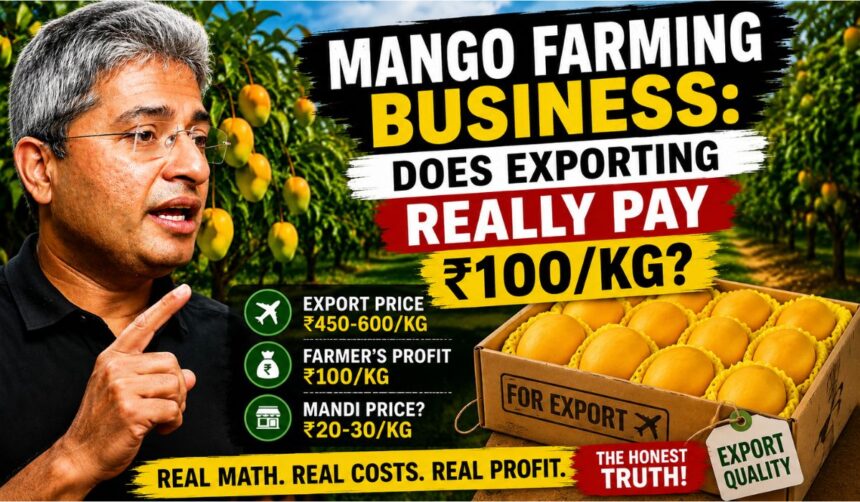
India grows more mangoes than any country on earth and still ships out barely a sliver of them. When I sat down with Suraj Panigrahy — a former tech professional who left a two-decade corporate career to plant 1,450 mango trees on a single acre near Bengaluru — I wanted the unvarnished version of the export dream everyone chases. If you grow mangoes, are tempted by the “export five times more profit” pitch, or are weighing a high-density orchard as a business, this breaks down what the mango farming business actually pays, where the money really goes, and the capital and patience it demands. I’ve checked his claims against official export data rather than take the highlight reel at face value.
- Who is Suraj Panigrahy?
- Do the numbers hold up?
- The honest mango farming business export math: who actually makes the money?
- Why India barely exports its mangoes
- How to actually export mangoes
- The Quantum Density model — and whether the yields are real
- Can a farmer really earn from mango exporting?
- What it really costs
- Is it worth it? An honest verdict
- FAQ
Who is Suraj Panigrahy?
Suraj is a BITS Pilani graduate who spent around twenty years in technology and travel companies before turning to farming. A stint with an agri-tech startup in Europe exposed him to how Spanish and European vineyards grow grapes in tight, precisely managed rows and wrap the whole thing in story and branding — and he came back asking whether the same precision could work for Indian mangoes. His venture, MangoMaze, near Bengaluru on the Deccan plateau, runs roughly 25,000 Ratnagiri Alphonso trees using a very high-density method he calls Quantum Density Farming, and exports Alphonso and Kesar to Europe. Notably, he runs much of it remotely from Barcelona through a team and a farm data system. He’s candid that he’s still early — this is essentially his first export season.
Do the numbers hold up?
Suraj is unusually willing to share figures, and most are directionally sound — with a couple that need context.
| Claimed in the interview | Reality-check (official/independent) | What to verify |
|---|---|---|
| India exports only 1–2% of its mangoes | Even lower for fresh fruit — ~29,900 tonnes in FY2024-25 against 20+ million tonnes produced is under 1%; India’s share of global mango exports is below 5% | APEDA yearly export data |
| Fresh mango export ~30,000–32,000 tonnes | Accurate — official figure is ~29,938 tonnes (FY2024-25) | Current-year APEDA number |
| Air freight = 60–70% of export cost; ~₹7–8 lakh per 1,200 kg pallet | Plausible — air-freighting perishables to Europe is the dominant cost; exact rate varies by route/season | Live air-cargo rate [VERIFY] |
| Farmer profit ~₹100/kg on export vs ₹20–30/kg domestic | Believable for export-grade fruit only (see below); Alphonso FOB can top ~$4,000/tonne | Your own costed price |
| 1,450 trees/acre, ~7x yield vs traditional | Consistent — independently reported at ~7x; ~8–12 kg/tree caps per-tree load | Mature-tree yield on your soil |
| ₹12–15 lakh/acre income in this model | Best-case, mature-orchard, all-export-grade math — realistically lower once the non-export fraction and gestation years are counted | Blended realised price [VERIFY] |
The pattern: the export volumes and the density facts hold up; the per-acre income is a mature-orchard, everything-goes-right figure, not a starting reality.
Also Read: Bajra Flour Shelf Life: How One Millet Startup Turned a 10-Day Problem Into a 6-Month Opportunity
The honest mango farming business export math: who actually makes the money?
Here’s the part the “₹50 a box in America” rumours leave out. To air-freight mangoes to Europe you send roughly a 1,200 kg pallet, and by Suraj’s breakdown the all-in cost — fruit, air freight, pack-house processing, transport, phytosanitary certificate, customs at both ends — lands around ₹7–8 lakh, of which the air freight alone is 60–70%. After all that, the grower’s clean profit is about ₹100 a kilo. The trader abroad, selling a 1.5 kg box for €15–18, isn’t getting rich either — often just $2–5 a box after marketing, manpower and delivery. Most of what a European shopper pays is simply the cost of flying a heavy, perishable fruit across the world.
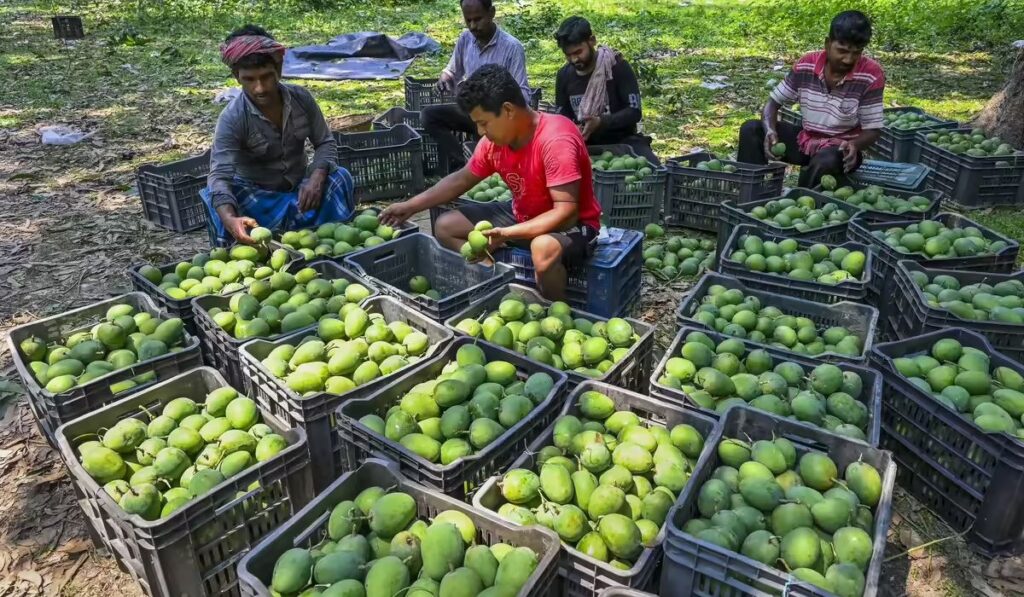
Now the catch Suraj is refreshingly honest about: only about 30–40% of a natural harvest meets the export grade — the uniform 200–250 g size, unblemished skin, consistent colour that buyers and pack houses insist on. The other 60–70%, perfectly good fruit, gets sold in the mandi at ordinary rates. So the ₹100/kg “5x domestic” profit applies only to the export-grade slice, not the whole crop — which means the blended, realised price across everything you grow is far lower. Anyone modelling this in a spreadsheet at ₹100/kg for the full harvest is fooling themselves.
Why India barely exports its mangoes
Three things, mostly. Air freight cost makes small shipments uneconomic for an ordinary farmer. Pesticide and residue limits are strict — the EU and others have historically rejected or banned Indian mango consignments over chemical residue, so residue-free growing and treatments (hot water, irradiation for the US) are mandatory. And there’s an accreditation gap: Karnataka produces over 8 lakh tonnes of mango a year but exports only around 1,000 tonnes, much of it routed through Mumbai and Chennai traders under their own label, because the state lacks enough licensed export pack houses. So a big share of the export premium is captured by traders, not growers.
How to actually export mangoes
The process is structured, not mysterious.
Find the buyer first. No serious overseas buyer commits to a one-tonne one-off — they want a supplier who can deliver reliably through a season (think 15–20 tonnes, or 8–20 consignments), and they vet growers carefully because a batch of sour or spoiled fruit is their loss. Suraj admits his edge was living abroad, which made winning buyer trust far easier — a real hurdle for a first-timer sitting in India.
Get registered. Register your farm with APEDA, obtain an Import-Export Code, and keep basics like PAN, a bank account and an Udyam registration ready. These are largely free and also useful for selling on quick-commerce or e-commerce platforms.
Use an authorised pack house. APEDA-authorised pack houses handle the country-specific treatments (hot water, irradiation), grading, boxing, ripening and the certificate of origin, and will guide first-timers through it. You’ll need a phytosanitary certificate per batch, confirming no restricted residues.
Protect your payment. Because a buyer won’t pay until they’ve received and inspected the fruit, use an escrow arrangement through your bank — the buyer deposits into escrow, and funds release once they confirm receipt. It guards against non-payment. The one hard reality: you must float roughly ₹7–8 lakh per shipment upfront and collect later.
The Quantum Density model — and whether the yields are real
Traditional orchards run 60–70 trees an acre; “high-density” pushes to a few hundred; “ultra-high-density” (a fairly recent, post-2012 idea) reaches 800–1,000. Suraj’s model packs about 1,450 trees an acre — roughly 3 feet between plants, 7–8 feet between rows for a small tractor to pass — with every tree pruned to a 7–8 foot canopy so that all the fruit hangs at knee-to-chest height. That single design choice is the real advantage: harvesting is done by hand with almost no loss, whereas traditional 60–70 foot mango trees lose a lot of fruit that simply can’t be reached.
On yield, his figures are internally consistent. A traditional tree may carry 200–250 kg, but between harvest loss and spacing, a conventional acre realistically nets 3–5 tonnes. In his model each tree is deliberately capped at 8–12 kg (over-fruiting is pruned off to protect tree health), which across 1,450 trees works out to roughly 12–15 tonnes an acre — about five to seven times more. Independent coverage of his farm reports the same ~7x, so the headline holds; just remember it needs mature trees (peak efficiency only by year 8–10) and disciplined management. He adds bee boxes for pollination (a genuine, research-backed 15–30% fruit-set boost) and controls pests largely with a simple neem-oil-and-mild-soap spray rather than heavy chemicals — which also helps meet export residue limits.
Can a farmer really earn from mango exporting?
Yes, but selectively. Export earns roughly ₹100/kg clean profit versus ₹20–30/kg domestically — genuinely higher, but only on the 30–40% of fruit that meets export grade, and only if you can supply a full season, clear APEDA protocols, and float ₹7–8 lakh per shipment upfront. It suits larger, well-capitalised growers, not one-tonne sellers.
What it really costs
Estimates only — land price and rates vary hugely by location.
- Land: he suggests 10+ acres to optimise capex (5 the bare minimum); land itself can run ₹20–25 lakh an acre or more near a city — so ₹1–2 crore is a realistic land outlay before anything is planted [VERIFY local land rates]
- Water: 2–3 borewells at roughly ₹2–5 lakh each, plus drip and fertigation [VERIFY]
- Saplings: ₹50 to ₹400 each depending on age/variety, times 1,450 per acre
- The long wait: ₹1–1.5 lakh per acre per year maintenance for the ~5 years before meaningful income — about ₹15 lakh over the wait for a 10-acre block, earning nothing
- His advice: buy land, don’t lease — a mango orchard is a decades-long asset and leases create trouble
Is it worth it? An honest verdict
For the right person, it’s a strong, fairly predictable business — but respect what it demands. This is capital-heavy (land alone can be ₹1–2 crore), with a 5–6 year gestation during which you earn nothing while spending on upkeep, and the premium price applies only to your export-grade fruit. Suraj’s thumb rule that “any acre, done right, earns ₹10 lakh” and his “₹12–15 lakh an acre” model figure are best-case, mature-orchard numbers that assume everything sells at export prices — treat them as a ceiling, not a forecast, especially in year one. The failure modes: underestimating the gestation and capex, assuming the whole harvest fetches export rates, planting the wrong crop for your agro-climatic zone (he deliberately chose the calamity-free Deccan plateau), and betting on leased land. Go in well-capitalised, patient, and with a buyer lined up, and mango exporting is a real business. Go in expecting quick, easy five-times money, and the maths won’t hold.
FAQ
How much of India’s mango crop is actually exported?
Very little — around 30,000 tonnes of fresh mango a year against 20-plus million tonnes produced, so under 1%. India’s share of global mango exports is below 5%, despite being the world’s largest producer.
Why is exporting mangoes so expensive?
Air freight is the killer — it can be 60–70% of the total export cost, because mangoes are heavy, perishable and mostly flown out. A single ~1,200 kg pallet to Europe can cost ₹7–8 lakh all-in, which most small farmers can’t float upfront.
How much more do you earn exporting versus selling in India?
Roughly ₹100/kg clean profit on export versus ₹20–30/kg domestically — but only on export-grade fruit, which is typically just 30–40% of a harvest. The rest sells at ordinary mandi rates, pulling your blended price down.
What is quantum/ultra-high-density mango farming?
Planting far more, deliberately dwarfed trees per acre — about 1,450 in Suraj’s model versus 60–70 traditionally — pruned so all fruit is within hand-picking reach. It can lift yield roughly 5–7x per acre but needs precise water, nutrition and pruning, and mature trees to hit peak output.
What licences do I need to export mangoes from India?
APEDA farm registration, an Import-Export Code, a phytosanitary certificate per batch, and a certificate of origin, plus produce processed through an APEDA-authorised pack house that does the required treatments. Much of the registration is free.
How long before a new mango orchard makes money?
Expect a 5–6 year gestation with little to no income, then production ramping from about year 4 to full efficiency by year 8–10. Plan for years of maintenance cost before returns, and buy land rather than lease.