



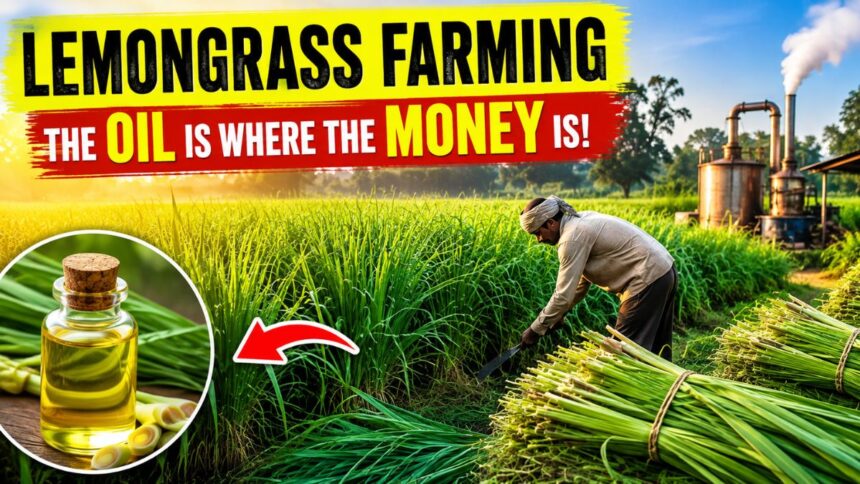
If you’ve read that lemongrass is a hardy, low-care crop that grows on poor land and sells for a fortune, half of that is true – and the missing half is what this guide is about. Lemongrass farming isn’t really a grass business; it’s an essential-oil business, and that single fact changes everything about how you plan, invest, and sell. This guide is for farmers and agri-entrepreneurs who want the honest economics before committing land.
- What lemongrass farming actually is
- Is lemongrass farming profitable?
- The distillation reality – this is the make-or-break
- Where lemongrass grows – and why it suits tough land
- Choosing a variety
- How to grow lemongrass
- Yield, oil price, and an honest look at the money
- About the viral “lakhs per acre” stories
- Marketing: who actually buys the oil
- Government support
- Is lemongrass farming worth it?
- Frequently asked questions
What lemongrass farming actually is
Lemongrass (Cymbopogon, mainly C. flexuosus, the commercial East Indian type) is an aromatic grass grown for one thing: the essential oil steam-distilled from its leaves. That oil, rich in citral, goes into perfumes, soaps, detergents, cosmetics, aromatherapy, flavours, and as a raw material for other aroma chemicals. The grass on its own has almost no market value – nobody buys truckloads of lemongrass leaf. You are farming oil, and the leaf is just how you carry it.
Systematic lemongrass cultivation and distillation began in Kerala over a century ago, and India remains a significant producer and exporter. Today it’s grown across Kerala, Karnataka, Tamil Nadu, Andhra Pradesh, Uttar Pradesh, Assam, Madhya Pradesh and, increasingly, drier states where farmers want a hardy crop for marginal land.
Is lemongrass farming profitable?
Lemongrass farming can be profitable, but the money is in its essential oil, not the grass – so you need distillation, either your own unit or a reliable buyer. It suits hardy, marginal land, and one planting lasts about four to five years. Oil yield, oil quality (citral content), and the volatile bulk oil price ultimately decide your returns.
The distillation reality – this is the make-or-break
Before anything else, understand the part most cheerful articles skip. Fresh lemongrass is bulky, perishable, and worth very little until it’s distilled into oil. That creates three hard realities you must plan around:
- The grass must be distilled quickly and close by.
Hauling tonnes of cut leaf long distances makes no economic sense, and it loses quality as it sits. Your distillation option needs to be near your field. - Distillation means capital or dependence.
You either invest in your own steam distillation unit, share a community unit, use a custom/toll distiller who charges per batch, or sell to a nearby buyer who distills. There is no version of this crop where you skip this step. - Small growers usually can’t go solo efficiently.
A distillation unit runs economically only when it’s fed steadily. As a rough guide, keeping a mid-sized unit busy needs the herbage from a fairly large planted area, so a farmer with an acre or two typically shares a unit, sells grass to a distiller, or joins other growers rather than buying their own still.
Decide your distillation route before you plant. If you can’t answer “where and how will my grass become oil,” you’re not ready to sow – that unanswered question is exactly where lemongrass ventures fail.
Also Read – Moringa Farming in India: Real Profit, Cost, Yield & the Hype Explained
Where lemongrass grows – and why it suits tough land
This is the genuinely attractive side. Lemongrass is one of the hardier commercial crops you can plant:
- Climate: It likes warm, sunny, tropical to subtropical conditions and tolerates a wide range of rainfall. It’s drought-hardy once established, though very cold or frosty conditions don’t suit it.
- Soil: It grows on a broad range of soils across a wide pH band and tolerates poor, marginal ground – even hill slopes. It avoids only waterlogged, poorly drained land.
- Bonus traits: Its dense clumps bind soil well, making it useful for erosion-prone slopes, and because it’s aromatic, grazing animals generally leave it alone – a real advantage where stray-cattle damage is a headache.
In short, lemongrass can turn land that won’t support fussier crops into a productive plot – provided the distillation and market side is sorted.
Choosing a variety
Variety matters here more than in a food crop, because it directly sets your oil percentage and citral content – and citral is what buyers pay for. Most improved varieties come from CSIR-CIMAP, Lucknow.
| Variety | Source | Notable trait |
|---|---|---|
| OD-19 (Sugandhi) | KAU, Odakkali (Kerala) | Old, established; citral around 84–86% |
| Krishna | CSIR-CIMAP | Suits irrigated, rainfed and hill slopes |
| Pragati | CSIR-CIMAP | Dwarf, higher oil content, high citral |
| Cauvery | CSIR-CIMAP | Improved yield |
| CKP-25 | CSIR-CIMAP | Hybrid; heavy herbage in north Indian plains |
Choose a variety proven in your region and buy quality planting material from a reliable source. Confirm the current recommended variety and package of practices with CSIR-CIMAP or your state agricultural university before buying.
How to grow lemongrass
Propagation and planting
Lemongrass is best grown from slips – small clumps split from a well-grown mother plant – which give more uniform quality and oil than seed. Slips are planted at close spacing (around 40 cm each way is common) at the onset of the monsoon or under irrigation, so plants establish with moisture.
The harvest cycle
Here’s the rhythm that makes lemongrass a steady earner:
- The first cutting comes roughly four to six months after transplanting.
- After that, you harvest every 60–70 days, cutting the grass with a sickle about 10–15 cm above ground.
- That gives roughly three to four harvests a year, and a single planting keeps producing for about four to five years before it declines and needs replanting.
Oil yield and quality are lowest in the first year and during the heavy monsoon months, and typically peak around the second and third year before tapering. Cut grass is usually allowed to wilt briefly, then distilled promptly.
Care
Lemongrass is refreshingly low-maintenance. Weed well in the early establishment phase, feed based on a soil test rather than a fixed recipe, give supplementary irrigation in dry spells for better yield, and you’ll face relatively few serious pest or disease problems compared with most crops. This low input burden is a big part of its appeal for dryland farmers.
Yield, oil price, and an honest look at the money
Two numbers drive your income: how much oil you get, and what it sells for.
Oil yield builds over the plantation’s life. A realistic working range is roughly 50 to 100 kg of oil per acre per year, lower in the first year and higher from the second year onward with a good improved variety and management. Oil recovery from the grass is only a small fraction of its fresh weight, which is exactly why you need volume and efficient distillation.
Oil price is where you must be careful – and honest with yourself:
| What you see | Typical figure | What it really means |
|---|---|---|
| Small retail bottles online | ₹300–₹850 for 100 ml and up | Branded, packaged retail – not what a farmer earns |
| Bulk farm-gate / trade oil | Roughly ₹1,000–1,600 per kg | Closer to what you actually sell drums of oil for |
| Export-grade, high-citral oil | Higher, quality-dependent | Needs consistent quality and a genuine export buyer |
Do not plan your farm on those retail bottle prices. Seeing “lemongrass oil ₹350 per 100 ml” online and assuming ₹3,500 per kg is the single most common costing mistake first-timers make. As a producer selling bulk oil in drums, your realistic rate is far lower and swings with quality (citral %), season, and demand.
An illustrative planning frame (estimates only – verify locally):
| Item | Indicative figure (estimate) |
|---|---|
| Planting material (slips, one-time) | a one-time cost covering ~4–5 years |
| Oil yield per acre per year | ~50–100 kg |
| Bulk oil price | ~₹1,000–1,600/kg |
| Plantation life | ~4–5 years before replanting |
| Distillation | Own unit (capital) or custom/shared (per-batch charge) |
The positives are real: the planting cost is one-time across several years, the crop is hardy and cheap to maintain, and it earns three to four times a year. The honest caution is equally real: distillation cost or charges, the labour of cutting and distilling, and a volatile, quality-linked oil price all sit between you and that headline yield.
About the viral “lakhs per acre” stories
You’ll find articles promising huge, effortless lemongrass riches. Read them critically. Many quietly assume you already own a distillation unit, run a top improved variety at peak yield, sell every kilo at the best price, and – a frequent slip – confuse litres and kilograms (oil is sold by weight, and a litre weighs a bit less than a kilo, which quietly inflates the maths). Some of the most-shared income figures also come from large multi-acre operators with their own stills, not from a farmer with two acres and no distillation. Plan on grounded ranges, not viral screenshots.
Marketing: who actually buys the oil
Your buyers are aroma-chemical companies, essential-oil traders and aggregators, exporters, and the cosmetics/soap industry – not a local vegetable mandi. Because the bulk oil market is relatively opaque, line up a buyer or aggregator before you scale, and understand that consistent quality and citral content directly affect the price you’re offered. Grouping with other growers to distill and sell together gives you both the volume and the bargaining position that serious buyers want.
Government support
Lemongrass sits at the centre of India’s push on aromatic crops, so there’s genuine institutional backing worth checking:
- The CSIR Aroma Mission, led by CSIR-CIMAP, actively promotes lemongrass and other aromatic crops with quality planting material, training, and distillation support – this is the flagship program for exactly this crop.
- The National Medicinal Plants Board (NMPB) under the Ministry of Ayush supports cultivation of aromatic and medicinal plants through State Medicinal Plants Boards.
- Horticulture schemes via MIDH / the National Horticulture Board (which publishes a lemongrass model project report) and NABARD-linked loans can help with orchard/plot development and processing infrastructure.
Support levels, eligibility and processes change and vary by state, so confirm current assistance – including any help toward distillation units – through your district office or CSIR-CIMAP before counting on it.
Is lemongrass farming worth it?
For the right grower, lemongrass is a genuinely smart use of tough land. It’s hardy and low-maintenance, turns marginal or sloping ground into income, earns several times a year, costs little to maintain once planted, and plugs into a real aromatic-oil industry with active government backing. If you have suitable warm-climate land and – this is the deciding factor – a clear, nearby distillation and buyer plan, it can pay well over a four-to-five-year cycle.
But go in clear-eyed:
- You can’t skip distillation. No unit and no distiller nearby means no viable business.
- Small solo growers are at a disadvantage unless they share a unit or aggregate.
- Bulk oil prices are volatile and quality-linked, and far below the retail bottle prices that mislead beginners.
- Fresh grass is bulky and perishable, so distance to distillation matters.
- Yield and quality dip in year one and in the rains, and the plantation must be replanted after a few years.
A sensible way in: start on a modest plot, tie up your distillation route and a buyer first, choose a proven CIMAP variety, and prove one full harvest cycle before you expand.
Frequently asked questions
Do I need my own distillation unit to grow lemongrass?
Not necessarily, but you need a plan. Your options are your own unit, a shared or community unit, a custom distiller who charges per batch, or selling grass to a nearby buyer who distills. Small growers usually share or aggregate rather than buying their own still, because a unit runs economically only when fed steadily.
How much lemongrass oil can I get per acre?
A realistic range is roughly 50 to 100 kg of oil per acre per year, lower in the first year and during the monsoon, and higher from the second year with a good improved variety and management. Actual yield depends heavily on variety, soil, water, and distillation efficiency.
How many years does one lemongrass planting last?
About four to five years. Oil yield is lower in the first year, peaks around the second and third year, then declines, after which the plantation is dug up and replanted. Because the planting cost is one-time across that whole period, it spreads well over several years.
Why is lemongrass oil so cheap compared to the bottles I see online?
Those small retail bottles are branded, packaged consumer products, not bulk oil. As a farmer you sell oil in drums at a far lower per-kg rate – realistically in the four-figures-per-kg range, not the retail equivalent. Confusing the two is the most common costing mistake beginners make.
Does lemongrass really grow on poor or dry land?
Yes, this is one of its real strengths. It tolerates poor, marginal, and even sloping soils across a wide pH range, is drought-hardy once established, and is generally left alone by grazing animals. It only truly dislikes waterlogged, badly drained ground and frost.
Which lemongrass variety gives the best oil?
It depends on your region, but improved CSIR-CIMAP varieties like Krishna, Pragati and Cauvery, along with the established OD-19 (Sugandhi), are widely grown for good oil and citral content. Confirm the best fit for your area with CSIR-CIMAP or your state agricultural university.