



Sugar prices are rising, diabetes cases are exploding, and food companies are desperately looking for natural, zero-calorie sweeteners. Right in the middle of all this sits a small green plant that most Indian farmers have never planted — Stevia.
- What Is Stevia Farming?
- Why Stevia Farming Makes Sense for Indian Farmers in 2026
- Stevia Farming Cost Breakdown Per Acre (2026 Estimates)
- Stevia Farming Profit Per Acre — Realistic Numbers
- Agro Potli Daily Farm Expense Tracker
- Real Success Story: Rajpal Singh Gandhi, Punjab
- Step-by-Step Stevia Cultivation Guide
- Step 1: Choose the Right Climate and Soil
- Step 2: Get Quality Planting Material
- Step 3: Prepare Land and Raised Beds
- Step 4: Transplanting
- Step 5: Irrigation
- Step 6: Fertilization
- Step 7: Harvesting
- Where to Sell Your Stevia Leaves
- Expert Tips to Maximize Stevia Farming Profit
- Common Mistakes to Avoid in Stevia Farming
- Stevia vs. Traditional Crops: Side-by-Side Comparison
- Is Stevia Farming Worth It in 2026?
- FAQs About Stevia Farming in India
Stevia farming is quietly turning into one of the most profitable agri-business opportunities in India right now. The net income from paddy is ₹30,000 per acre and stevia can generate ₹1,20,000 — that is four times more income from the same piece of land.
If you are looking for a crop that requires low water, no chemical inputs, and gives you multiple harvests over five years from a single planting — read this guide fully before making your next farming decision.
What Is Stevia Farming?
Stevia (Stevia rebaudiana) is a natural, zero-calorie sweetener plant native to South America. Its leaves contain steviol glycosides that are 250–300 times sweeter than sugar.
Stevia plantation means growing stevia plants, harvesting the sweet leaves two to three times a year, and selling them to processors, brands, or health product companies. It is a perennial crop, meaning you plant once and harvest for 4–5 years with proper care — making it an ideal long-term income crop.
The dried leaves are sold to food companies, pharmaceutical firms, herbal tea brands, and sugar-free product manufacturers. In processed form, stevia goes into everything from Coca-Cola’s zero-sugar drinks to diabetic-friendly sweets.
Why Stevia Farming Makes Sense for Indian Farmers in 2026
The timing could not be better. Here is why:
India’s diabetes crisis is creating demand: India had an estimated 31,705,000 diabetics in the millennium year, which is estimated to grow by over 100% to 79,441,000 by 2030. Every one of those patients is a potential consumer of stevia-based products.
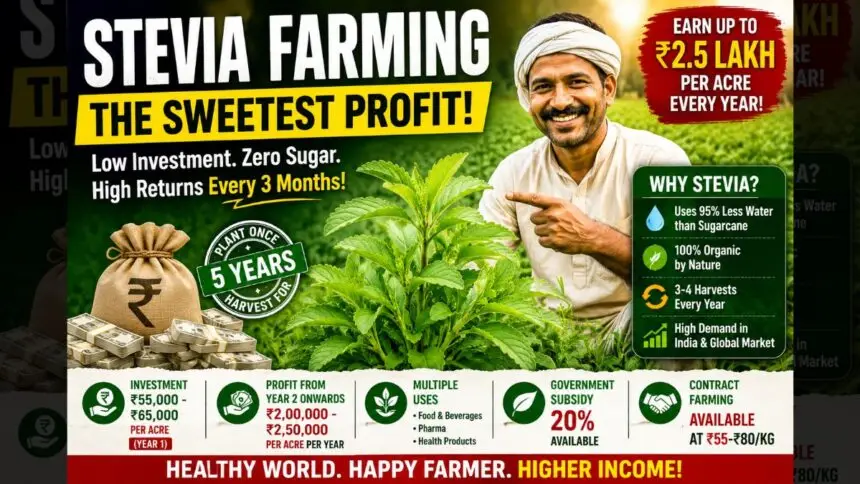
Massive water savings: Stevia uses only 5% of water used for sugarcane cultivation. It takes 1,500 litres of water to make one kg of processed sugar and just 75 litres for stevia. For farmers in water-scarce regions of Maharashtra, Rajasthan, or Gujarat, this is a game-changer.
Organic by nature: Stevia is an organic plant by default due to its low nutrient requirements and its antibacterial and antioxidant properties. This means you save thousands of rupees every year that other farmers spend on pesticides and chemicals.
Plant once, harvest for five years: Crops like wheat or paddy have to be planted every year and stevia can be harvested every three months for five years. Each plant can give up to 15 harvests.
Growing global market: Global demand for stevia extract has grown at 8–10% annually as food companies reformulate products for diabetic and health-conscious consumers. India is emerging as a major stevia producer, with several large processors — Morita Chemicals, PureCircle, and domestic companies — offering contract farming agreements that guarantee buyback at ₹55–80 per kg of dried leaf.
Government support: The National Medicinal Plants Board (NMPB) has announced a 20% subsidy on stevia cultivation to farmers.
Stevia Farming Cost Breakdown Per Acre (2026 Estimates)
This is what a beginner should expect to spend in year one:
| Expense Item | Estimated Cost (₹) |
|---|---|
| Land preparation (deep ploughing, raised beds) | ₹5,000 – ₹7,000 |
| Tissue culture seedlings (30,000–45,000 plants) | ₹30,000 – ₹45,000 |
| Drip irrigation setup (one-time) | ₹15,000 – ₹20,000 |
| Organic manure / FYM | ₹4,000 – ₹6,000 |
| Labour (planting, weeding, harvesting) | ₹8,000 – ₹12,000 |
| Shade net for establishment (7–10 days) | ₹2,000 – ₹3,000 |
| Miscellaneous / transport | ₹2,000 – ₹3,000 |
| Total Year 1 | ₹55,000 – ₹65,000 |
From year two onwards, no replanting is needed — significantly reducing your annual costs. Year two onward costs drop to roughly ₹15,000–₹20,000 per acre per year for labour, irrigation, and minor inputs.
Input costs are ₹40,000–₹60,000 per acre per year in year one, with TC planting material being the largest cost. Net income from year two onwards, when replanting cost drops to 20%, is ₹1–₹1.5 lakh per acre per year.
Stevia Farming Profit Per Acre — Realistic Numbers
Let’s look at this honestly, not with inflated claims.
Yield per acre: Yield per cutting is 400–600 kg of dried leaf per acre per cut, with 3–4 cuts per year — giving 1,500–2,400 kg per acre per year.
Market price: The cost of stevia leaves per kg is ₹100 on average. The total amount of dry leaves produced annually per acre is 2,700 kg.
Income and profit projection:
| Year | Revenue | Cost | Net Profit |
|---|---|---|---|
| Year 1 | ₹2,70,000 | ₹2,19,500 | ₹50,500 |
| Year 2 onwards | ₹2,70,000 | ₹16,000 | ₹2,54,000 |
During the first year, the profit earned from stevia cultivation is approximately ₹50,500. In the second and subsequent years, the profits earned are approximately ₹2,54,000.
Quick Answer for Featured Snippet: Stevia farming profit per acre in India is approximately ₹50,000 in year one and ₹2,00,000–₹2,50,000 per year from year two onward, as the planting cost is eliminated. With 3–4 harvests per year at ₹80–₹100 per kg, stevia is significantly more profitable than wheat or paddy.
Agro Potli Daily Farm Expense Tracker
Real Success Story: Rajpal Singh Gandhi, Punjab
Rajpal Singh Gandhi from Punjab runs Green Valley Farms, where he sells stevia leaves, powder, and other value-added products such as herbal infusions. He has helped hundreds of farmers switch to stevia cultivation and increase their income.
His ₹12-crore processing plant can process 5 tonnes of stevia leaves in a shift of 8 hours — equivalent to the crop from 5 acres. “We turned challenges into opportunities and now we have the only stevia-processing unit in the country,” Gandhi says.
His story was not a straight line to success. He started with kinnow orchards, switched to other crops, and suffered losses. Then he discovered stevia, traveled to China, Colombia, and Paraguay to understand the plant, and eventually partnered with IIT Mumbai to build India’s first stevia processing prototype.
Gandhi’s tissue-culture laboratory in Nawanshahr district is certified by the Indian Department of Scientific and Industrial Research (DSIR), and his processing plant was built with a soft loan from the Department of Biotechnology under the Ministry of Science and Technology.
What he built next was even more significant. Using his calculations, Rajpal claims to have trained over 500 farmers across Maharashtra, Gujarat, Uttar Pradesh, Madhya Pradesh, Rajasthan, and Punjab.
One of those farmers, Dr. Kulbhushan Chander from Rohtak — a retired agricultural department officer — planted 30,000 saplings on one acre. His first harvest yielded around two quintals of stevia, which he sold to Green Valley Farms. “Compared to wheat and paddy, the profits are much higher, investment cost and water usage is very less,” he says.
The lesson: find a buyer first, then grow. Gandhi’s model is exactly the template beginners should follow.
Step-by-Step Stevia Cultivation Guide
Step 1: Choose the Right Climate and Soil
Stevia grows well in warm and sunny climates. The ideal temperature range is 20–30°C. It needs moderate rainfall but should not be waterlogged. It prefers sandy loam soil with good drainage — heavy clay soils are not suitable.
Target soil pH: 6.5–7.5. Do a soil test before you invest in planting material.
Step 2: Get Quality Planting Material
Always use tissue culture (TC) seedlings — not seed-grown plants. TC plants have consistent stevioside content, which determines how much processors pay you.
You will require 30,000 seedlings per acre. Source them from CIMAP Lucknow, state agricultural universities, or reputable private suppliers. Verify that the variety has been tested for high glycoside content before purchasing.
Step 3: Prepare Land and Raised Beds
Land preparation begins with deep ploughing (20–30 cm) to break soil compaction, followed by 2–3 harrowings to achieve a fine tilth. Raised beds measuring 15–20 cm in height and 1–1.2 m in width should be prepared and properly leveled to ensure good drainage.
Add well-decomposed FYM or vermicompost during the final ploughing. Stevia does not tolerate standing water — raised beds protect against root rot.
Step 4: Transplanting
Plant stevia in the evening or on cloudy days. Water immediately after transplanting. Maintain light shade for 7–10 days using a 30% shade net — TC plants are sensitive to transplant shock under full sun.
Planting density: 40,000–50,000 plants per acre on raised beds with 30 cm × 30 cm spacing. Drip irrigation should be used to maximize leaf yield per acre.
Step 5: Irrigation
Establishment irrigation: twice daily for 7 days; once daily for the next 15 days; then switch to a drip irrigation schedule.
Stevia requires light, frequent irrigation every 4–7 days during dry periods while avoiding waterlogging. Adequate watering is particularly critical during the first month after planting and during post-harvest regrowth, but it should be reduced before harvest to enhance glycoside concentration in the leaves.
Step 6: Fertilization
Keep it simple and organic wherever possible.
For inorganic fertilization, nitrogen should be applied at 50–60 kg per acre in split doses. Phosphorus (P₂O₅) should be applied at 40–50 kg per acre as a basal dose. Potassium (K₂O) is recommended at 40–50 kg per acre in split applications. Avoid excessive nitrogen application — it leads to lush vegetative growth at the expense of steviol glycoside content, reducing the sweetness of the leaves.
Step 7: Harvesting
The first harvest (cutting) happens 60–75 days after transplanting. Subsequent cuttings occur every 70–90 days.
Always harvest before or at the onset of flowering — this is when stevioside content peaks. After cutting, dry the leaves in shade or using a hot-air dryer. Never dry in direct sunlight, as UV exposure degrades glycoside quality.
Where to Sell Your Stevia Leaves
This is the make-or-break question. Secure a buyer before you plant. Period.
- Contract farming partners: Companies like Morita Chemicals, PureCircle, and Green Valley Farms offer buyback agreements
- Ayurvedic and pharma companies: Patanjali, Himalaya, and Baidyanath source stevia for herbal products
- Herbal tea brands: Organic India and similar brands are active buyers
- Direct export: Japan, Germany, and USA are top importers — at premium prices
- NMPB and state boards: Medicinal plant boards in UP, Gujarat, and Maharashtra connect farmers to buyers
Stevia farming in India is most successful under contract farming arrangements. Processors supply tissue culture planting material, provide technical guidance, guarantee minimum purchase prices, and ensure quality standards are met.
Expert Tips to Maximize Stevia Farming Profit
- Always go for TC seedlings. Seed-grown plants are inconsistent in stevioside content and will fetch lower prices from processors.
- Install drip irrigation from day one. It saves water, reduces disease, and pays for itself within two harvests.
- Shade dry your leaves. Sun-drying damages glycoside content, which directly reduces your selling price.
- Reduce water before harvest. Irrigation should be reduced before harvest to enhance glycoside concentration in the leaves.
- Intercrop in early months. Intercropping stevia with short-duration legumes like beans and peas, as well as radish, garlic, or marigold as a trap crop, is highly suitable. Tall or competitive crops such as maize or sugarcane should be avoided.
- Contact CIMAP. The Central Institute of Medicinal and Aromatic Plants in Lucknow provides technical support and helps connect farmers with buyers under the Aroma Mission.
Common Mistakes to Avoid in Stevia Farming
1. Buying seeds instead of TC plants Stevia seed germination is unpredictable and plants grown from seeds vary widely in sweetness. Processors reject inconsistent leaf quality. Always use tissue culture plantlets.
2. Planting without a buyer This is the single biggest mistake new stevia farmers make. Unlike wheat or rice, stevia cannot be sold in any local mandi. You need a direct buyer or contract before planting.
3. Ignoring raised beds Stevia cannot survive waterlogged conditions. Flat-bed planting in heavy-rainfall zones without proper drainage leads to root rot and complete crop loss.
4. Over-applying nitrogen fertilizer Excessive nitrogen application leads to lush vegetative growth at the expense of steviol glycoside content, reducing the sweetness of the leaves — and your income.
5. Harvesting too late Once stevia flowers, glycoside levels drop sharply. Always cut before or at the start of the flowering stage for maximum value.
6. Sun-drying leaves Post-harvest leaf drying under direct sunlight degrades the stevioside compounds. Use shade drying or hot-air drying for premium quality.
Stevia vs. Traditional Crops: Side-by-Side Comparison
| Parameter | Wheat | Paddy | Sugarcane | Stevia |
|---|---|---|---|---|
| Annual income per acre | ₹30,000–₹40,000 | ₹30,000–₹40,000 | ₹60,000–₹80,000 | ₹1,20,000–₹2,50,000 |
| Water requirement | High | Very High | Very High | Very Low |
| Planting frequency | Every year | Every year | Every year | Once in 5 years |
| Chemical inputs | High | High | High | Near zero |
| Harvests per year | 1 | 1–2 | 1 | 3–4 |
| Contract farming available | Rare | Rare | Yes | Yes |
The net income from paddy is ₹30,000 per acre and stevia can generate ₹1,20,000. Stevia is an organic plant by default due to its low nutrient requirements. The comparison makes a strong case for diversifying away from low-margin cereals.
Is Stevia Farming Worth It in 2026?
Yes — but with conditions.
Stevia farming is not a “plant and forget” crop. It requires quality planting material, drip irrigation, proper drying technique, and — most critically — a buyer in place before you start. If you skip any of these, profitability suffers.
But when done right, stevia is arguably the best perennial medicinal crop available to Indian farmers in 2026. Low water use, no pesticide cost, four harvests per year, and a growing global market — that is a combination few other crops can match.
Start with half an acre under a verified contract farming arrangement. Learn the process, understand your buyer’s quality requirements, and scale from there. The economics clearly favor stevia over wheat, paddy, and most vegetable crops from year two onward.
FAQs About Stevia Farming in India
Q1. How much does stevia farming cost per acre in India?
The first-year cost of stevia farming is approximately ₹55,000–₹65,000 per acre, with tissue culture seedlings being the largest expense. From year two onward, the annual cost drops to ₹15,000–₹20,000 since no replanting is required.
Q2. How much profit can I earn from 1 acre of stevia farming?
In year one, net profit is approximately ₹50,000. From year two onward, with 3–4 harvests per year and a selling price of ₹80–₹100 per kg of dried leaf, annual profit can reach ₹2,00,000–₹2,50,000 per acre.
Q3. Where can I sell stevia leaves in India?
You can sell stevia through contract farming arrangements with processors like PureCircle and Morita Chemicals, or to companies like Patanjali and Organic India. State medicinal plant boards in UP, Gujarat, and Maharashtra also facilitate buyer connections. Always secure a buyback agreement before planting.
Q4. Which states in India are best suited for stevia farming?
Stevia grows well across most of India. It is currently cultivated successfully in Punjab, Maharashtra, Gujarat, Uttar Pradesh, Madhya Pradesh, Rajasthan, Karnataka, and Odisha. It requires warm temperatures (20–30°C), good sunlight, and well-drained sandy loam soil.
Q5. Does the Indian government provide any subsidy for stevia farming?
Yes. The National Medicinal Plants Board (NMPB) provides a 20% subsidy on stevia cultivation. Farmers can also access support under the CSIR-Aroma Mission through CIMAP, Lucknow, which provides technical guidance and links to buyers. Contact your nearest Krishi Vigyan Kendra (KVK) for local subsidy applications.