




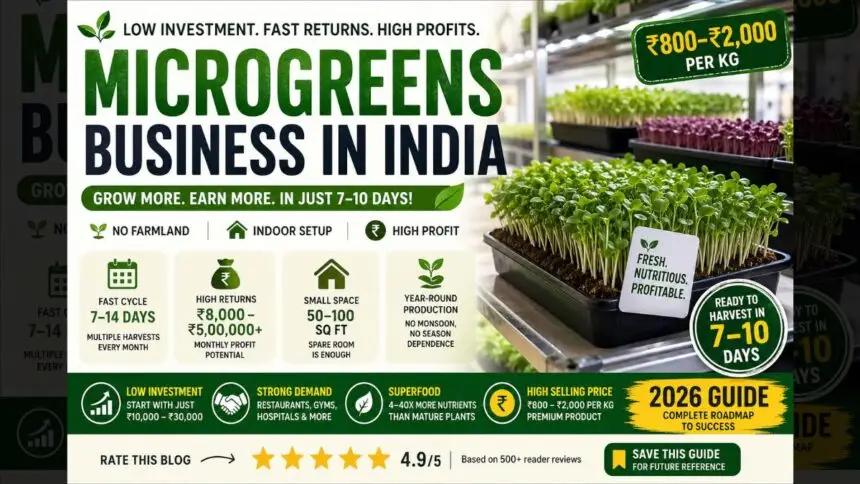
Imagine growing a crop that’s ready to harvest in just 7–10 days, needs no farmland, and sells at ₹1,000–₹2,000 per kg. Sound too good to be true? It’s not. The microgreens business is doing exactly that for hundreds of Indian farmers and agri-entrepreneurs right now — in spare rooms, on terrace gardens, and in small urban setups across the country.
- What Are Microgreens?
- Why the Microgreens Business Makes Sense in India (2026)
- Microgreens Business Investment Breakdown (India-Specific Costs)
- Profit Potential: How Much Can You Really Earn?
- Real Success Story: From a Spare Room to ₹5 Lakh/Month
- Step-by-Step Guide to Starting Your Microgreens Business
- Expert Tips to Grow Your Microgreens Business Faster
- Common Mistakes to Avoid in the Microgreens Business
- Microgreens vs Traditional Farming: A Quick Comparison
- Is the Microgreens Business Worth Starting in 2026?
- Frequently Asked Questions (FAQs)
If you’ve been looking for a low-investment agriculture business that gives fast returns, microgreens farming could be your answer. This guide breaks down everything you need to know — from what they are, to how much you can realistically earn in 2026.
What Are Microgreens?
Microgreens are the young seedlings of vegetables and herbs, harvested just 7 to 21 days after germination. Think of them as baby versions of plants like radish, sunflower, basil, mustard, peas, and broccoli — but packed with far more nutrition than the fully grown version.
Research from the University of Maryland found that microgreens contain 4 to 40 times more nutrients than their mature counterparts, including high levels of Vitamin C, Vitamin E, Vitamin K, and beta-carotene.
They’re widely used by restaurants as garnishes, by gyms and nutritionists as health supplements, and by home cooks who want to add nutrition to salads and smoothies. The best part? You don’t need soil, sunlight, or even a farm. A spare room with good ventilation and LED grow lights is enough to get started.
Popular varieties to grow in India include: radish, sunflower, mustard, peas, broccoli, fenugreek (methi), and basil.
Why the Microgreens Business Makes Sense in India (2026)
The India microgreens market is growing fast. According to industry research, the market was valued at over USD 73 million in 2024 and is projected to nearly double by 2033, growing at a CAGR of close to 14% annually. This isn’t a trend — it’s a structural shift in how urban India eats.
Here’s why starting a microgreens business right now is a smart move:
- Fast turnaround: Crops are ready in 7–14 days, allowing multiple harvests every month
- Small space needed: You can run a setup in just 50–100 sq ft
- Year-round production: No dependence on monsoons or seasons — grow indoors 365 days a year
- High selling price: Microgreens sell at ₹800–₹2,000 per kg depending on variety and buyer
- Growing B2B demand: Hotels, hospitals, gyms, fine-dining restaurants, and health food stores are actively sourcing locally
- Low risk: If one batch fails, your loss is minimal — seeds and growing medium are inexpensive
Microgreens Business Investment Breakdown (India-Specific Costs)
One of the biggest reasons people avoid farming is the fear of large investment. With microgreens, that barrier doesn’t exist. Here’s a realistic cost breakdown for a beginner setup in India in 2026:
One-Time Setup Costs
| Item | Estimated Cost (₹) |
|---|---|
| Metal / wooden shelving racks (2–3 racks) | ₹3,000 – ₹6,000 |
| LED grow lights (2–4 panels) | ₹4,000 – ₹8,000 |
| Growing trays (10×20 inch, food-grade, 20–30 trays) | ₹1,500 – ₹3,000 |
| Humidity / temperature monitoring gadget | ₹500 – ₹1,000 |
| Small fan for ventilation | ₹600 – ₹1,200 |
| Total One-Time Investment | ₹10,000 – ₹20,000 |
Monthly Recurring Costs (for ~30 trays)
| Item | Monthly Cost (₹) |
|---|---|
| Seeds (non-GMO, open-pollinated varieties) | ₹2,000 – ₹4,000 |
| Cocopeat / growing medium | ₹800 – ₹1,500 |
| Packaging (zip-lock or eco boxes) | ₹500 – ₹1,000 |
| Electricity (LED lights, fan) | ₹500 – ₹800 |
| Water | ₹100 – ₹200 |
| Total Monthly Cost | ₹4,000 – ₹7,500 |
You can realistically start a microgreens business with ₹10,000 to ₹30,000 and scale from there. There is no need to invest lakhs from day one.
Profit Potential: How Much Can You Really Earn?
Let’s talk numbers honestly. Here’s what a beginner setup of 30 trays per cycle can generate:
200–300g – yield per 10×20 tray
30 trays – starter batch size
~6–9 kg – yield per batch
₹1,200/kg – average selling price
With 2 batches per month (on a 14-day cycle), you’re looking at 12–18 kg of produce. At ₹1,000–₹1,500 per kg:
- Monthly revenue: ₹12,000 – ₹25,000 (beginner, 30 trays)
- After monthly costs: Net profit of ₹8,000 – ₹18,000
- With 100 trays (medium scale): ₹40,000 – ₹80,000/month net profit
- Large scale (300+ trays): ₹1 lakh to ₹5 lakh/month (proven by real farmers)
Selling direct to restaurants, gyms, and hospitals (B2B) gives you the best margins. Retail and subscription boxes are excellent for B2C. Both models work well together.
Agropotli Profit Calculator
Real Success Story: From a Spare Room to ₹5 Lakh/Month
Ajay Gopinath, Kochi, Kerala
Former Citigroup Banker → Microgreens Entrepreneur
Ajay Gopinath quit his banking job at Citigroup in 2020 after spotting microgreens as a garnish at a Bengaluru restaurant. Curious about what they were, he researched extensively, connected with an expert in the UK, and spent two years learning the correct methods.
He started in just an 80 sq ft room in his home in Chittoor, maintaining temperatures below 25°C and humidity at 40–60%. Today, he grows over 15 varieties of microgreens — radish, mustard, sunflower, and beet being his bestsellers — and earns ₹5 lakh per month from sales to over 20 channels including hotels, gyms, hospitals, and retail buyers. He has also helped over 30 other farmers across India set up their own units.
His advice: “Use only non-GMO, non-hybrid, non-treated, open-pollinated seeds. The medium matters as much as the seed — cocopeat gives the most consistent results.”
Ajay’s story isn’t unique. Mohit Nijhawan from Chandigarh, a former pharma executive, now runs Greenu — a microgreens startup that generates ₹12 lakh/month in turnover and has trained over 300 farmers across India. He started with just 3 racks in a 9 sq ft area. Another farmer, Vidydharan Narayanan from Chennai, invested under ₹1 lakh for a 300 sq ft greenhouse and now clears over ₹60,000/month in profit.
Step-by-Step Guide to Starting Your Microgreens Business
- Do your market research first. Find out who will buy your microgreens before growing. Visit local restaurants, cafes, gyms, and organic stores. Talk to chefs. Know your buyer before you grow your first tray.
- Set up your growing space. You need a clean, well-ventilated room with controlled humidity (40–60%) and temperature (18–25°C). Install metal shelves and LED grow lights. Keep the area dust-free and easy to clean.
- Buy the right seeds. Always source non-GMO, non-hybrid, non-treated, open-pollinated seeds. Start with fast-growing, high-demand varieties: radish, sunflower, peas, and mustard. Buy seeds from trusted suppliers in Bengaluru, Pune, or certified online stores.
- Prepare your trays and growing medium. Use food-grade trays (10×20 inch is the standard). Fill with low-EC cocopeat — it retains moisture without waterlogging. Soak seeds in clean water for 8–12 hours before sowing.
- Sow and germinate. Spread pre-soaked seeds evenly on moist cocopeat. Cover with another tray (blackout period) for 2–3 days to encourage germination. Mist lightly twice a day. Maintain airflow.
- Expose to light after germination. Once seedlings are 1–2 cm tall, remove the cover and place trays under LED grow lights for 12–16 hours per day. Keep watering with a mister — never flood the tray.
- Harvest at the right time. Most microgreens are ready in 7–12 days after the light phase begins. Harvest just above the growing medium using clean scissors. Harvest in the morning for best freshness and shelf life.
- Package and sell. Store in eco-friendly zip-lock bags or biodegradable boxes. Refrigerate at 4–7°C. Sell fresh within 5–7 days. Deliver to buyers within 24 hours of harvest for best quality.
- Register your business legally. Get FSSAI registration — it’s mandatory for any food business in India. If your turnover crosses ₹20 lakh annually, register for GST. Optional but valuable: pursue organic certification for premium pricing.
Expert Tips to Grow Your Microgreens Business Faster
- Start with 3–5 varieties, not 20. Master a few before expanding your range.
- Lock in B2B contracts early. Even 2–3 restaurants with weekly orders can give you a stable base income.
- Use Instagram to grow your brand. Photos of fresh microgreens do extremely well. Many growers get direct customers from social media alone.
- Offer live tray sales. Selling growing trays instead of cut greens gives buyers a longer shelf life and commands a higher price.
- Stagger your sowing schedule. Don’t sow all trays the same day. Sow batches every 3–4 days so you always have fresh supply available for buyers.
- Keep records. Track which varieties sell fastest, which buyers order most, and your cost per tray. Data helps you scale smarter.
Common Mistakes to Avoid in the Microgreens Business
✕ Using treated or hybrid seeds. These won’t germinate uniformly and could carry fungicide coatings that make the crop unsafe. Always confirm seeds are untreated and non-GMO.
✕ Overwatering. The number one cause of mold and crop failure in microgreens. Use a mister, not a watering can. The medium should be moist, not wet.
✕ Poor ventilation. Stagnant air causes fungal growth and damping-off disease. Always keep a small fan circulating air in your grow room.
✕ No marketing before growing. Growing first, selling later is the biggest mistake beginners make. Always have confirmed buyers before scaling up production.
✕ Skipping FSSAI registration. If you’re selling food commercially, FSSAI registration is legally required. Don’t risk penalties — register early, it’s a simple process.
✕ Harvesting too late. Once microgreens bolt (start growing tall with a secondary leaf), quality and taste drops sharply. Harvest at the cotyledon or first true leaf stage.
Microgreens vs Traditional Farming: A Quick Comparison
| Factor | Microgreens Business | Traditional Farming |
|---|---|---|
| Land required | 50–300 sq ft (indoor) | 1+ acres typically |
| Startup cost | ₹10,000 – ₹1 lakh | ₹2 lakh – ₹20 lakh+ |
| Crop cycle | 7–21 days | 60–180 days |
| Monsoon dependence | None (indoor) | High |
| Selling price | ₹800 – ₹2,000/kg | ₹20 – ₹200/kg (most crops) |
| Risk level | Low (small batches) | High (weather, pest risk) |
| Who can do it | Anyone, anywhere | Needs farming knowledge + land |
Is the Microgreens Business Worth Starting in 2026?
Yes — if you’re willing to do the groundwork. The microgreens business offers one of the shortest paths from investment to income in Indian agriculture. You don’t need acres of land, lakhs of capital, or years of farming experience. What you need is discipline, hygiene, and a solid plan to sell before you grow. Start small with ₹15,000–₹30,000, master 3–4 varieties, build your buyer network, and scale from there. The market is real, the demand is growing, and the profit margins are among the best in food production today.
Frequently Asked Questions (FAQs)
How much does it cost to start a microgreens business in India?
You can start a basic microgreens business in India with ₹10,000 to ₹30,000. This covers racks, LED grow lights, food-grade trays, cocopeat, and seeds. A medium-scale setup of 100 trays costs ₹50,000 to ₹1 lakh including all equipment.
How much profit can you make from a microgreens business in India?
Beginners with 30 trays can earn a net profit of ₹8,000 to ₹18,000 per month. At medium scale (100 trays), profits range from ₹40,000 to ₹80,000 monthly. Large-scale commercial growers in India have documented earnings of ₹1 lakh to ₹5 lakh per month.
Do I need a license to sell microgreens in India?
Yes. FSSAI (Food Safety and Standards Authority of India) registration is mandatory for selling food products commercially. If your annual turnover crosses ₹20 lakh, GST registration is also required. Organic certification is optional but helps you command premium prices.
Which microgreens sell best in India?
Radish, sunflower, mustard, peas, and basil are the top-selling varieties in India. Radish and sunflower are particularly popular with restaurants and hotels due to their strong flavor and visual appeal. For health-conscious buyers, broccoli and fenugreek microgreens also command premium pricing.
Can I grow microgreens without sunlight?
Yes. Microgreens grow very well under LED grow lights indoors with no natural sunlight needed. This makes them ideal for urban setups, apartments, spare rooms, and rooftop setups with cover. LED lights use minimal electricity and can be run for 12–16 hours per day at low cost.