



Every year, hundreds of Maharashtra farmers set up a polyhouse — and dozens of them lose their entire subsidy eligibility before the first brick is laid.
- What Is a Polyhouse? (And Why Maharashtra Is Perfect for It)
- Why the Polyhouse Subsidy in Maharashtra Is Worth Pursuing in 2026
- Polyhouse Subsidy Schemes Available in Maharashtra — Two Routes
- Route 1: NHM (National Horticulture Mission) — State Scheme via MahaDBT
- Route 2: NHB (National Horticulture Board) — Central Government Scheme
- Complete Cost Breakdown: What Does a Polyhouse Cost in Maharashtra in 2026?
- Agro Potli Daily Farm Expense Tracker
- Profit Potential: Realistic Income Numbers for Maharashtra
- Real Farmer Success Story: Subhash Gadge, Ahilyanagar District, Maharashtra
- Step-by-Step: How to Apply for Polyhouse Subsidy in Maharashtra in 2026
- Expert Tips Specific to Maharashtra Polyhouse Farmers
- Common Mistakes Maharashtra Farmers Make
- Polyhouse Farming vs. Traditional Open-Field Farming in Maharashtra
- Conclusion: Is the Polyhouse Subsidy in Maharashtra Worth Pursuing in 2026?
- Frequently Asked Questions (FAQs)
Not because they did anything dishonest. Because they built first and applied later.
If you are researching the polyhouse subsidy in Maharashtra in 2026, this guide will save you from that single, irreversible mistake — and walk you through everything else you need to know: how much subsidy you will actually get, what it costs to build, what you can realistically earn, and how to apply step by step through MahaDBT.
Maharashtra has one of the most active polyhouse farming ecosystems in the country. The Nashik-Pune belt in particular is practically a global-standard protected cultivation hub. The government knows this, and the subsidy support reflects it.
Let’s get into the details.
What Is a Polyhouse? (And Why Maharashtra Is Perfect for It)
A polyhouse is a farming structure built with a galvanized iron (GI) frame and covered with UV-stabilized polyethylene film. Inside, you control temperature, humidity, and ventilation — so your crops grow in a stable environment regardless of what is happening outside.
Think of it as giving your capsicum, roses, or cucumber a climate-controlled home that no hailstorm, drought, or unseasonal rain can damage.
The Nashik-Pune-Satara-Kolhapur belt is considered the “Goldilocks Zone” for polyhouse farming — mild winters, moderate summers, and excellent diurnal temperature variation. A standard Naturally Ventilated Polyhouse with 200-micron UV film works brilliantly here, and because the climate is naturally favorable, your capital expenditure on extreme cooling equipment is much lower than in other states.
Maharashtra also has a massive geographic advantage: proximity to Mumbai and Pune airports, and APEDA packhouses, makes the Nashik-Pune belt an export hub for Dutch Roses, exotic vegetables, and cut flowers destined for the UAE and Europe.
If you are in Vidarbha or Marathwada, the conditions are more challenging — but still workable with the right structure and crop selection.
Why the Polyhouse Subsidy in Maharashtra Is Worth Pursuing in 2026
Setting up a polyhouse from scratch is expensive. A 1-acre unit can cost anywhere from ₹25 to ₹50 lakh depending on structure type, crop requirements, and location.
Without a subsidy, very few farmers can afford this upfront. That is exactly why the government scheme exists.
Here is what Maharashtra offers in 2026:
The Maharashtra State Government, under the Horticulture Department, provides a subsidy of 50% to 75% on the total cost of setting up a polyhouse — depending on the farmer’s category and the size of the project. The maximum subsidy is around ₹70,000 to ₹90,000 per 100 sq meters, with larger polyhouses of up to 4,000 sq meters also supported.
Beyond the state scheme, there is also the central government’s NHB route.
Why this matters in hard numbers:
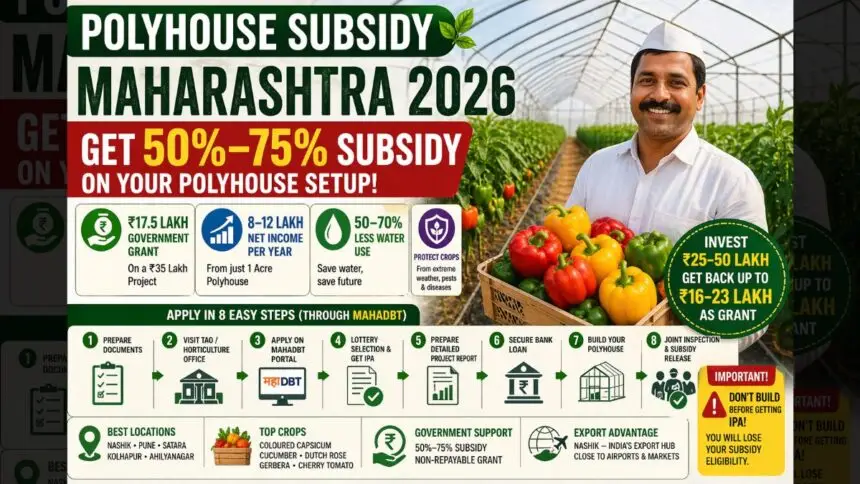
On a ₹35 lakh project, a 50% subsidy means the government hands you back ₹17.5 lakh — permanently. Not a loan. Not a repayable amount. A grant.
Add Maharashtra’s state top-up and the combined support can reach 65%, meaning your actual out-of-pocket cost drops even further.
Polyhouse Subsidy Schemes Available in Maharashtra — Two Routes
Route 1: NHM (National Horticulture Mission) — State Scheme via MahaDBT
This is the most accessible route for small and medium farmers in Maharashtra.
- Apply at: mahadbt.maharashtra.gov.in under the Horticulture Department section
- Subsidy: 50% of project cost (with state top-up possibilities)
- Minimum area: 500 sq meters (accessible for beginners)
- Maximum area covered: up to 4,000 sq meters
- Because demand in Maharashtra is massive, applications on MahaDBT are often selected via a computerized lottery system. If selected, your file moves to the Taluka Agriculture Officer (TAO).
This means you apply, wait for the lottery result, and if selected, proceed with your DPR and bank loan. The process is competitive — apply early in the financial year.
Route 2: NHB (National Horticulture Board) — Central Government Scheme
Best suited for large commercial projects targeting exports or high-tech structures.
- Apply at: nhb.gov.in
- Subsidy: 50% of total project cost
- Maximum NHB subsidy: ₹56 lakh per project; applicable for project areas above 2,500 sq meters.
- Requires a detailed, bank-approved DPR and In-Principle Approval (IPA) before any construction starts
For most first-time farmers in Maharashtra, the NHM/MahaDBT route is the better starting point. Once you have one successful unit running, scale up with NHB.
Complete Cost Breakdown: What Does a Polyhouse Cost in Maharashtra in 2026?
Here is a realistic cost estimate for a 1-acre (4,000 sq meter) Naturally Ventilated Polyhouse (NVPH) in Maharashtra:
One-Time Setup Cost
| Component | Estimated Cost |
|---|---|
| GI frame + UV polyfilm structure | ₹20–28 lakh |
| Drip irrigation + fertigation system | ₹2–3 lakh |
| Seedlings (capsicum @ ₹12/plant × 12,000 plants) | ₹1.44 lakh |
| Land leveling, plumbing, electricity connection | ₹1–2 lakh |
| Soil and water testing + DPR preparation | ₹20,000–₹30,000 |
| Total Project Cost (approx.) | ₹26–36 lakh |
After 50% Subsidy (NHM/NHB)
- Government grant: ₹13–18 lakh
- Your effective investment: ₹13–18 lakh (through bank loan + margin)
Because Pune and Nashik are manufacturing hubs for high-grade GI pipes, UV-stabilized polyfilms, and drip irrigation systems, freight costs for Maharashtra farmers are lower than most other states — which means your total project cost is often at the lower end of the national range.
Annual Operating Cost (Year 2 onwards)
- Fertilizers, pesticides, labour: ₹3–5 lakh/year
- Electricity and water: ₹60,000–₹1.2 lakh/year
- Miscellaneous maintenance: ₹30,000–₹50,000/year
Agro Potli Daily Farm Expense Tracker
Profit Potential: Realistic Income Numbers for Maharashtra
Maharashtra’s proximity to Mumbai, Pune, and export markets gives polyhouse farmers a genuine pricing advantage.
Coloured Capsicum (most popular crop in Maharashtra polyhouses)
- Yield: 25–40 tons per acre per crop cycle
- Average wholesale price: ₹60–100 per kg (Mumbai/Pune markets)
- Gross revenue: ₹18–30 lakh per crop cycle
- Annual operating cost: ₹4–6 lakh
- A well-managed 1-acre polyhouse growing coloured capsicum can generate a net profit of ₹8 lakh to ₹12 lakh per year, provided strict climate control and direct marketing are maintained.
Cucumber
- Lower investment, faster return (3-month crop cycle)
- Net profit: ₹5–8 lakh per acre per year
Dutch Roses / Gerbera (Nashik-Pune export belt)
- Dutch Roses offer the highest revenues — ₹12–18 lakh per acre — but also have the highest production cost and require a guaranteed market.
- Best suited for farmers with export market access or tie-ups with florists
Return on Investment Timeline: Most Maharashtra polyhouse farmers recover their net investment (post-subsidy) within 2.5 to 3.5 years.
Real Farmer Success Story: Subhash Gadge, Ahilyanagar District, Maharashtra
Subhash Vitthal Gadge, a 47-year-old progressive farmer from Pimpri Lokai village in Rahata block, Ahilyanagar district, exemplifies how protective cultivation can transform farm livelihoods in drought-prone regions. With over 25 years of farming experience, he earlier faced serious challenges due to erratic rainfall and recurring droughts, which limited productivity from traditional crops like soybean, pearl millet, and Bengal gram. Indian Council of Agricultural Research
After receiving specialized training from the Krishi Vigyan Kendra (KVK), he adopted protected cultivation and established a 3,000 sq meter polyhouse.
During the 2025 season, Gadge planted red and yellow capsicum on 1 June. He harvested 20 tonnes of high-quality produce, with market prices ranging from ₹60 to ₹300 per kg and an average realization of ₹100 per kg. Indian Council of Agricultural Research
Instead of depending on local mandis, he proactively developed strong marketing linkages in major urban markets such as Mumbai and Nashik. He also took the lead in forming a polyhouse cultivators’ group in the region — facilitating bulk input procurement and ensuring consistent supply to markets. Buyers from Mumbai, Ahmedabad, and Indore now directly approach him at the village level for contractual purchases. Indian Council of Agricultural Research
His approach proved that even a drought-prone district with limited irrigation can become a profitable polyhouse zone — with the right training, the right crop, and pre-arranged market connections.
Step-by-Step: How to Apply for Polyhouse Subsidy in Maharashtra in 2026
Follow this sequence exactly. Skipping any step — or doing Step 6 before Step 4 — can permanently void your application.
Step 1: Get Your Documents in Order
Before you even open MahaDBT, gather these:
- Aadhaar card and PAN card
- 7/12 Utara (Saat Bara) and 8A land holding certificate — you cannot apply for any loan or subsidy in Maharashtra without these two documents.
- Bank passbook (nationalized bank — SBI, Bank of Maharashtra, Bank of Baroda)
- Passport-size photographs
- Soil and water test report (from a government-approved lab or agricultural university)
- Caste certificate (if applicable for SC/ST category for enhanced subsidy)
Step 2: Visit Your Taluka Agriculture Officer (TAO)
Before applying online, visit your local TAO or District Horticulture Officer. Understand the current year’s approved targets for your district and whether applications are open. This saves time and prevents applying in a closed window.
Step 3: Apply on MahaDBT Portal
Go to mahadbt.maharashtra.gov.in, navigate to the Horticulture Department section, select the polyhouse/protected cultivation scheme, and fill your application with all required documents.
Step 4: Wait for Lottery Selection and IPA
Because demand is massive, applications are often selected via a computerized lottery system. If selected, you receive an In-Principle Approval (IPA) from the department. This is your green light — do not begin any construction before this document arrives.
Step 5: Prepare Your Detailed Project Report (DPR)
Your DPR must include: project area and structure specifications, crop plan, cost estimates, bank loan requirement, and expected income projections. Get help from an agricultural consultant or your district horticulture office for this document. Banks will not approve loans without a credible DPR.
Step 6: Secure Your Bank Loan
With your IPA and DPR, approach a nationalized bank for an Agriculture Term Loan. Ask specifically about the Agriculture Infrastructure Fund (AIF) scheme — it provides an additional 3% interest subvention on your loan, reducing your repayment burden significantly.
Step 7: Build the Polyhouse
Once you have the loan sanction letter, hire a registered contractor and build the structure exactly as specified in your DPR. Use B-class GI pipes and approved UV polyfilm. Do not deviate from the DPR — the Joint Inspection Team will verify every detail.
Step 8: Joint Inspection and Subsidy Release
After construction is complete, the Joint Inspection Team (JIT) visits your farm — comprising bank officials and horticulture department officers. If the structure matches the DPR, the subsidy is credited directly to your loan account, reducing your outstanding balance.
Expert Tips Specific to Maharashtra Polyhouse Farmers
Choose your district’s natural strength. Nashik-Pune-Satara-Kolhapur farmers should focus on Dutch Roses, gerbera, and coloured capsicum for maximum ROI. Vidarbha and Marathwada farmers should prioritize cucumber and cherry tomato, which handle temperature stress better.
Target the right markets. The Vashi APMC in Navi Mumbai is the largest wholesale market in India — ideal for high-volume capsicum and cucumber. Gultekdi Market in Pune feeds the entire IT and hospitality sector. For flowers, the Dadar and Kalyan flower markets are the primary hubs. If you are in the Nashik belt, explore direct APEDA export tie-ups and bypass local markets entirely.
Never rely on a vendor’s “free” project report. The person selling you the steel is not the person paying your bank loan. Contractors are incentivized to recommend the most expensive structure — even when your district’s climate doesn’t require it. To protect your ROI, involve an independent agronomist in planning.
Book your seedlings early. Most commercial nurseries supplying tissue culture capsicum or hybrid seedlings need 3 to 4 months of advance notice. Book as soon as your bank loan is sanctioned — not after the polyhouse is built.
Apply early in the financial year. MahaDBT subsidy budgets are finite. Districts exhaust their annual allocation by mid-year in many cases. The earlier you apply, the higher your chances of being included in the current year’s selection.
Common Mistakes Maharashtra Farmers Make
Building before getting IPA. This disqualifies your application permanently. There is no exception and no appeal. Wait for the document.
Applying with incomplete land documents. If your 7/12 Utara is disputed, has a joint name issue, or your 8A is not updated, your MahaDBT application will be rejected instantly. Resolve all land document issues before applying.
Growing low-value crops inside a polyhouse. Regular green capsicum, standard tomatoes, or leafy vegetables rarely give you the ROI to recover polyhouse investment. Always grow crops that command a premium price — coloured capsicum, cherry tomato, cucumber, gerbera, or roses.
Underestimating operating costs. Labour, fertigation inputs, electricity, and maintenance add up. Plan for ₹4–6 lakh per acre per year in operating costs. Farmers who budget only for setup cost often face cash flow problems in Year 1.
Ignoring water quality. Maharashtra’s water in many districts has high EC (electrical conductivity) due to dissolved salts. High EC water damages roots and reduces yield dramatically. Get your water tested before choosing your crop — and if EC is above 1.0, invest in an RO system before anything else.
Polyhouse Farming vs. Traditional Open-Field Farming in Maharashtra
| Factor | Open-Field Farming | Polyhouse Farming |
|---|---|---|
| Yield (capsicum/acre) | 8–15 tons | 25–40 tons |
| Weather dependency | Very high | Very low |
| Price realization | Mandi rates | Premium (30–80% higher) |
| Water usage | High | 50–70% lower |
| Crop cycles per year | 1–2 | 2–3 |
| Government subsidy | Minimal | Up to 65% of setup cost |
| Net annual income/acre | ₹1–3 lakh | ₹8–12 lakh |
| Export potential | Low | High (Nashik-Pune belt) |
Conclusion: Is the Polyhouse Subsidy in Maharashtra Worth Pursuing in 2026?
Without question — yes.
Maharashtra is arguably the best state in India to start a polyhouse farming business. You have a favorable climate in the western belt, a massive domestic market on your doorstep in Mumbai and Pune, export infrastructure through Nashik, and manufacturing hubs that keep construction costs competitive.
The polyhouse subsidy in Maharashtra reduces your financial barrier by 50% to 65%, depending on your project and category. That is a genuine, non-repayable grant that changes the economics of the entire investment.
The process is structured, sometimes competitive through the MahaDBT lottery, but absolutely navigable if you follow the correct sequence — get your documents ready, apply on MahaDBT, wait for IPA, then build.
Do not build first. That one mistake has cost hundreds of farmers their entire subsidy. Every other part of this process is manageable.
If you are sitting on land in Maharashtra and thinking about this — start by visiting your District Horticulture Office or Taluka Agriculture Officer this week. The application window does not stay open all year.
Frequently Asked Questions (FAQs)
Q1. How much polyhouse subsidy can I get in Maharashtra in 2026?
Under the National Horticulture Mission (NHM) via MahaDBT, Maharashtra farmers can get a 50% subsidy on total polyhouse setup cost. The maximum subsidy is around ₹70,000 to ₹90,000 per 100 sq meters of polyhouse area. When state top-ups are included, the combined support can reach 65% of the total project cost for eligible categories.
Q2. Where do I apply for polyhouse subsidy in Maharashtra?
Apply online at mahadbt.maharashtra.gov.in under the Horticulture Department scheme section. For the central government NHB scheme (for large projects above 4,000 sq meters), apply at nhb.gov.in. Always visit your Taluka Agriculture Officer before applying to confirm the current year’s open targets.
Q3. What documents are needed to apply for the polyhouse subsidy in Maharashtra?
You will need: Aadhaar card, PAN card, 7/12 Utara (Saat Bara), 8A land holding certificate, bank passbook from a nationalized bank, soil and water test report, passport-size photographs, and caste certificate if applicable.
Q4. Can I apply for a polyhouse subsidy on leased land in Maharashtra?
Yes, leased land is eligible. You must have a registered lease deed for a minimum of 10 to 15 years. Your 7/12 and all land records must be in order before the application is submitted.
Q5. Which crops give the best profit from a polyhouse in Maharashtra?
Coloured capsicum (red and yellow), Dutch Roses, gerbera, cucumber, and cherry tomatoes are the most profitable crops for Maharashtra polyhouses. Farmers in the Nashik-Pune belt particularly benefit from growing Dutch Roses and exotic vegetables for export markets, given proximity to APEDA packhouses and international airports. For first-time farmers, coloured capsicum is the recommended starting crop.