




You are growing tomatoes, mangoes, or flowers on your land. You have heard that the government gives money for horticulture farming. But every time you go to the block office, they give you a form, a few unclear instructions, and you come back empty-handed.
- What Is the MIDH Scheme?
- Why MIDH Matters: The Real Problem It Solves
- What Does MIDH Cover? (List of Activities Supported)
- Funding Pattern: How Much Does the Government Pay?
- Real Cost and Profit Breakdown (India-Specific Numbers)
- Step-by-Step Guide: How to Apply for MIDH Scheme in 2026
- Sub-Schemes Under MIDH — Which One Is Right for You?
- Success Story: From ₹80,000 Per Acre to ₹18 Lakh Per Year
- Expert Tips to Maximize MIDH Benefits
- Common Mistakes Indian Farmers Make While Applying for MIDH
- MIDH vs. PM-KISAN vs. PMFBY — Which Scheme Is Best for You?
- Conclusion: Is MIDH Worth It for You in 2026?
- Frequently Asked Questions (FAQs)
Sound familiar?
The MIDH scheme — Mission for Integrated Development of Horticulture — is one of the most powerful and underutilized government programs available to Indian farmers right now. It covers everything from fruit orchards and vegetable polyhouses to cold storage and organic farming certification. And the subsidies are real — not promises, but actual money transferred to your bank account or loan account.
This guide will explain exactly what MIDH is, what it covers, how much subsidy you can get, and the step-by-step process to apply in 2026. No bureaucratic language. No fluff.
What Is the MIDH Scheme?
MIDH — Mission for Integrated Development of Horticulture — is a Centrally Sponsored Scheme for the holistic growth of the horticulture sector covering fruits, vegetables, root and tuber crops, mushrooms, spices, flowers, aromatic plants, coconut, cashew, cocoa, and bamboo.
Think of it as an umbrella scheme that merges multiple older programs into one. MIDH subsumed ongoing missions including the National Horticulture Mission (NHM), Horticulture Mission for North East and Himalayan States (HMNEH), National Horticulture Board (NHB), Coconut Development Board (CDB), and Central Institute for Horticulture (CIH), Nagaland.
MIDH has been implemented from 2014-15 for holistic development of horticulture in the country. All States and UTs are covered under MIDH.
So whether you are a farmer in Maharashtra, Madhya Pradesh, Punjab, or Assam — MIDH applies to you.
Why MIDH Matters: The Real Problem It Solves
Most Indian farmers growing fruits and vegetables face the same three problems:
1. High setup costs — Building a polyhouse, drip system, or cold storage is expensive. A small farmer cannot do it alone.
2. Post-harvest losses — The horticulture sector still faces challenges in terms of high post-harvest losses and gaps in post-harvest management and supply chain infrastructure.
3. Low productivity — Traditional open-field farming yields are far lower than what is possible with modern techniques.
MIDH addresses all three by providing financial assistance for infrastructure, better planting material, technology adoption, and marketing support.
MIDH has played a significant role in increasing the area under horticulture crops. Area and production during the years 2014-15 to 2019-20 increased by 9% and 14% respectively.
That is not just a government statistic. That is more income for real farmers across India.
What Does MIDH Cover? (List of Activities Supported)
Under MIDH, financial assistance is provided for the following major activities: setting up of nurseries and tissue culture units for production of quality seed and planting material; area expansion, establishing new orchards and gardens for fruits, vegetables, and flowers; rejuvenation of unproductive, old, and senile orchards; protected cultivation including poly-house and green-house to improve productivity and grow off-season high-value vegetables and flowers; organic farming and certification; creation of water resources structures and watershed management; bee-keeping for pollination; horticulture mechanization; and creation of post-harvest management and marketing infrastructure.
In plain language, here is what that means for you as a farmer:
- Want to set up a polyhouse to grow capsicum or tomatoes? MIDH covers it.
- Have an old mango or guava orchard that is no longer productive? MIDH helps you rejuvenate it.
- Want to build a small cold storage unit to stop your produce from rotting? MIDH covers that too.
- Thinking about organic farming? MIDH will support certification costs.
- Need a drip irrigation or micro-sprinkler system? MIDH has you covered.
Funding Pattern: How Much Does the Government Pay?
This is the most important part. Here is the actual subsidy breakdown:
Under MIDH, the Government of India contributes 60% of the total outlay for developmental programs in all states except those in North East and Himalayas, where the state governments contribute the remaining 40%. In the case of North Eastern States and Himalayan States, the Government of India contributes 90%.
But wait — this 60:40 split is between the central and state governments. As a farmer, your actual benefit depends on the specific activity. Here is a practical breakdown:
Polyhouse / Protected Cultivation:
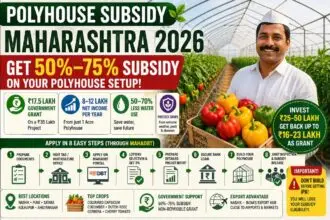
- The National Horticulture Mission provides a 50% subsidy under MIDH for polyhouse construction and irrigation systems, with rates varying by state and enhanced support for North East and hilly regions.
- The National Horticulture Board offers up to 50% subsidy on total project cost for commercial horticulture, including polyhouses, capped at ₹56 lakh per project.
- General category farmers are usually eligible for 50% subsidy, sometimes up to 75% depending on state programs, while SC/ST farmers may receive subsidies up to 95% in some states such as Telangana and Haryana.
Area Expansion (New Orchards/Gardens): The subsidy for fruit crop area expansion is typically 40–50% of the unit cost defined by the government (not your actual bill — more on this below).
Cold Storage and Post-Harvest Infrastructure: MIDH supports establishment of pre-cooling units, on-farm pack houses, mobile pre-cooling units, staging cold rooms, cold storage units with and without controlled atmosphere capability, integrated cold chain systems, refrigerated vans, refrigerated containers, primary processing units, ripening chambers, and preservation units.
Real Cost and Profit Breakdown (India-Specific Numbers)
Let us take the example of a naturally ventilated polyhouse — one of the most common MIDH applications.
Setup Cost for 4,000 sq. meters (approximately 1 acre):
| Item | Estimated Cost |
|---|---|
| Polyhouse structure (GI frame + poly film) | ₹20–28 lakh |
| Drip irrigation and fertigation | ₹3–5 lakh |
| Seedlings and initial inputs | ₹1–2 lakh |
| Miscellaneous (labour, land prep) | ₹1–2 lakh |
| Total Approximate Cost | ₹25–37 lakh |
After 50% MIDH Subsidy:
Government subsidy (50% of cost norm): approximately ₹14–18 lakh credited to your bank loan account.
Your effective net investment: approximately ₹11–19 lakh.
Income Potential (Per Year, 4,000 sq. meters):
| Crop | Approximate Annual Revenue |
|---|---|
| Capsicum (Bell Pepper) | ₹18–25 lakh |
| Cucumber | ₹12–18 lakh |
| Tomato (Hybrid) | ₹15–22 lakh |
| Gerbera Flowers | ₹20–30 lakh |
The approximate gross returns from 710 acres of protected cultivation works out to approximately ₹71 crore at ₹10 lakh gross value per 4,000 square meters.
After deducting operating costs (labour, nutrients, electricity, water), net profit for a well-managed 4,000 sq. meter polyhouse typically ranges between ₹6–14 lakh per year.
At this rate, the investment is recovered in 2–4 years. And from Year 3 onwards, with the subsidy already absorbed, you are running a highly profitable operation.
Step-by-Step Guide: How to Apply for MIDH Scheme in 2026
Here is the exact process most farmers can follow:
Step 1 — Identify Your Activity Decide what you want to do — polyhouse, drip irrigation, orchard setup, cold storage, etc. Each activity has a different unit cost and subsidy percentage under MIDH.
Step 2 — Contact Your District Horticulture Officer (DHO) Visit your nearest DHO office or State Horticulture Mission (SHM) office. Every district in India has one. Ask specifically about MIDH-funded activities for the current year’s Annual Action Plan (AAP).
Step 3 — Collect and Submit Documents Standard documents required include:
- Land ownership records (7/12, patta, or equivalent in your state)
- Aadhaar card and PAN card
- Bank account details (passbook copy)
- Passport-size photographs
- For larger projects: a Detailed Project Report (DPR)
- Bank sanction letter (for credit-linked projects)
Step 4 — Get Administrative Sanction After selection and verification of the required documents, the list of beneficiaries is placed before the District Management Committee (DMC) for approval. After approval, administrative sanction to the beneficiary is issued through the District Collector.
Step 5 — Implement the Work Start construction or planting only AFTER receiving the Letter of Intent (LOI) or administrative sanction. Starting before this is the number one reason applications get rejected.
Step 6 — Inspection and Subsidy Release Subsidy is released in two instalments to TRA/Escrow/SRF accounts based on progress after the Joint Inspection Report when found satisfactory.
For NHB applications specifically, you can apply online at nhb.gov.in.
Sub-Schemes Under MIDH — Which One Is Right for You?
MIDH is not a single scheme. It works through multiple sub-programs. Here is a quick guide:
NHM (National Horticulture Mission) — Best for small and medium farmers across 18 states and UTs. Covers polyhouses from 500 sq. meters to 4,000 sq. meters. Apply through your State Horticulture Mission.
HMNEH (Horticulture Mission for North East and Himalayan States) — For farmers in states like Assam, Meghalaya, Manipur, Nagaland, J&K, Himachal Pradesh, and Uttarakhand. HMNEH is implemented for overall development of horticulture in North East and Himalayan states. Central government contributes 90%.
NHB (National Horticulture Board) — Best for larger commercial projects above 4,000 sq. meters. Maximum subsidy cap of ₹56 lakh. Apply online at nhb.gov.in.
CDB (Coconut Development Board) — Specifically for coconut farmers. Covers new planting, replanting, and intercropping.
NBM (National Bamboo Mission) — For bamboo cultivation, value addition, and marketing.
Success Story: From ₹80,000 Per Acre to ₹18 Lakh Per Year
Ramesh Patel, a farmer from Anand district in Gujarat, was growing wheat and cotton on 2 acres of land. His annual income was barely ₹1.5 lakh. In 2023, he visited his District Horticulture Office and learned about MIDH.
He applied for a naturally ventilated polyhouse of 4,000 sq. meters to grow colored capsicum. He submitted his land records, got a bank loan of ₹28 lakh, and received a 50% subsidy of approximately ₹14 lakh credited to his loan account under NHM-MIDH.
In the first full crop cycle, he produced 32 tonnes of capsicum and sold it at ₹45–60 per kg to both the local mandi and a direct export aggregator.
Gross revenue in Year 1: ₹16.5 lakh. Operating cost: ₹5 lakh. Net profit: ₹11.5 lakh — from the same land that previously gave him ₹75,000.
By 2025, he had fully repaid his bank loan and was running debt-free. He is now training neighboring farmers to apply for MIDH subsidies.
Expert Tips to Maximize MIDH Benefits
1. Apply early in the financial year. Each state gets an Annual Action Plan (AAP) with fixed targets. Once those targets are filled, no more applications are accepted for that year. April-June is the best time to apply.
2. Prepare a proper DPR for large projects. A Detailed Project Report (DPR) is mandatory for infrastructure projects. A poorly written DPR is the most common reason for rejection. Take help from your KVK (Krishi Vigyan Kendra) or a professional consultant if needed.
3. Stack multiple subsidies where possible. In many states, you can combine a polyhouse subsidy with drip irrigation subsidy, micro-irrigation support, and soil health card schemes, significantly reducing your total cash outflow. Agro Potli
4. Use NHB-accredited nurseries. Planting material for MIDH must be mandatorily procured only from NHB-accredited nurseries. Buying from non-accredited sources can disqualify your claim.
5. Keep all bills and receipts. Subsidy verification involves physical inspection. Every expense should have a proper invoice from a registered supplier.
Common Mistakes Indian Farmers Make While Applying for MIDH
Starting work before getting approval — This is the single most common mistake and an immediate disqualification. No exceptions.
Buying land or signing a short lease — Many activities require ownership or a long-term registered lease (10+ years for perennial crops). A verbal agreement or a 2-year lease will not work.
Misunderstanding the cost norm — The government subsidy is calculated on a fixed “unit cost” defined in the MIDH guidelines, not on your actual contractor bill. If your contractor charges more than the unit cost, the extra amount comes from your own pocket.
Not following up after submission — Many applications get stuck because the farmer submits documents and waits. You need to actively track your application through the DHO office or the MIDH SURAKSHA Portal.
Skipping the DPR requirement — For project-based applications involving cold storage, pack houses, or large polyhouses, a full DPR is non-negotiable.
MIDH vs. PM-KISAN vs. PMFBY — Which Scheme Is Best for You?
| Feature | MIDH | PM-KISAN | PMFBY |
|---|---|---|---|
| Type | Subsidy for infrastructure/crops | Direct income support | Crop insurance |
| Amount | ₹50,000 to ₹56 lakh+ | ₹6,000/year | Premium-based claim |
| Who benefits most | Horticulture/vegetable farmers | All small/marginal farmers | Field crop farmers |
| One-time or recurring | One-time (per activity) | Recurring (annual) | Seasonal |
| Effort to apply | Moderate to high | Low | Low |
The answer is not one over the other — ideally, a smart farmer uses all three. PM-KISAN gives you annual cash. PMFBY protects your open field crops. MIDH gives you the capital investment to move into high-value horticulture.
Conclusion: Is MIDH Worth It for You in 2026?
Absolutely — if you are serious about horticulture.
MIDH is not a handout. It is a partnership. The government pays half the cost of infrastructure that can 5x your income. But you have to do the work — apply on time, prepare proper documents, follow the process, and manage your farm professionally.
The farmers who are benefiting from MIDH are not lucky. They are informed. And now, you are too.
Visit midh.gov.in or your nearest District Horticulture Office to start your application this season.
Frequently Asked Questions (FAQs)
Q1. What is MIDH and who can apply for it? MIDH — Mission for Integrated Development of Horticulture — is a Centrally Sponsored Scheme for the holistic growth of the horticulture sector covering fruits, vegetables, root and tuber crops, mushrooms, spices, flowers, aromatic plants, coconut, cashew, cocoa, and bamboo. Any farmer, FPO, or agri-entrepreneur with agricultural land in India can apply through the State Horticulture Mission.
Q2. How much subsidy can I get under MIDH for a polyhouse? Under MIDH, the National Horticulture Board offers up to 50% subsidy on total project cost for commercial horticulture, including polyhouses, capped at ₹56 lakh per project. For smaller projects under NHM, the subsidy is also 50% of the government-defined unit cost, accessible for structures from 500 sq. meters onward.
Q3. Where do I apply for MIDH scheme in 2026? For NHM-based activities, apply through your State Horticulture Mission or District Horticulture Officer. For NHB-based commercial projects, applications are submitted online at nhb.gov.in. Always apply at the beginning of the financial year (April–June) for best chances of selection.
Q4. Is a bank loan mandatory to get MIDH subsidy? For large infrastructure projects like polyhouses above 4,000 sq. meters under NHB, yes — it is a credit-linked back-ended subsidy, meaning the bank loan is mandatory and the subsidy is credited to your loan account post-inspection. For smaller projects up to ₹30 lakhs, credit linkage may be optional and subsidy would be released in two instalments based on progress after the Joint Inspection Report.
Q5. Which crops are covered under MIDH in 2026? MIDH covers fruits, vegetables, root and tuber crops, mushrooms, spices, flowers, aromatic plants, coconut, cashew, cocoa, and bamboo. National Portal of India This covers the vast majority of horticulture crops grown across India, including mango, banana, tomato, capsicum, onion, ginger, turmeric, rose, gerbera, and many more.