



Are you still growing the same wheat and paddy season after season and wondering why your income is not growing?
- What Is the National Horticulture Mission (NHM)?
- Why Does the National Horticulture Mission Matter for You?
- Key Objectives of NHM — What the Government Is Trying to Achieve
- What Does NHM Actually Fund? (Complete Component Breakdown)
- Cost and Investment Breakdown (India-Specific 2026 Numbers)
- Profit Potential — How Much Can You Actually Earn?
- Agropotli Profit Calculator
- Real-Life Success Story: Ramesh Kumar from Haryana
- Step-by-Step Guide to Applying for NHM / NHB Subsidy in 2026
- Step 1: Identify the Right Scheme for You
- Step 2: Contact Your District Horticulture Officer (DHO)
- Step 3: Prepare a Detailed Project Report (DPR)
- Step 4: Get a Bank Loan Sanction
- Step 5: Apply Online
- Step 6: Wait for Letter of Intent (LOI)
- Step 7: Complete the Project and Get Inspected
- Step 8: Subsidy is Released to Your Loan Account
- Expert Tips to Maximize Your NHM Benefits
- Common Mistakes Farmers Make — and How to Avoid Them
- NHM vs. NHB vs. MIDH — What Is the Difference?
- Conclusion: Should You Apply for NHM in 2026?
- Frequently Asked Questions (FAQs)
You are not alone. Millions of Indian farmers are stuck in this cycle — low prices, high input costs, and zero support. But here is something most farmers either do not know about or have not fully explored yet: the National Horticulture Mission (NHM).
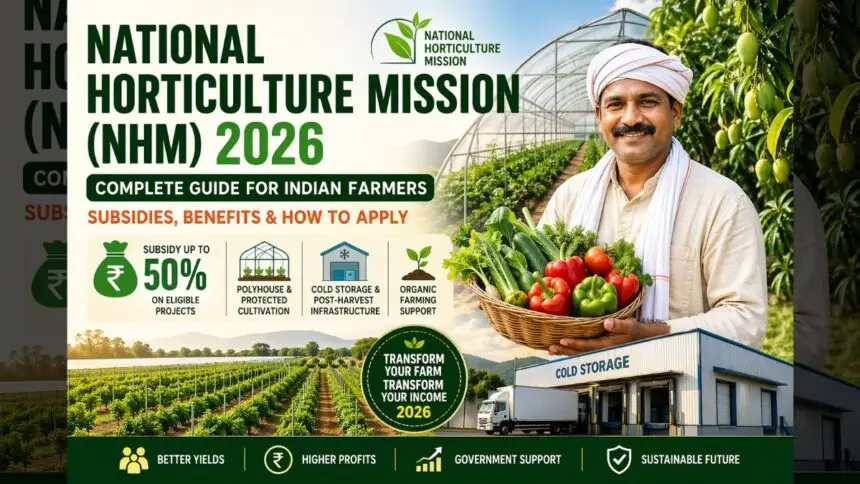
This government scheme has the potential to literally transform your farm income. We are talking about subsidies up to 50%, cold storage support, polyhouse funding, and organic farming assistance — all under one roof.
In this guide, we are going to break down everything you need to know about the National Horticulture Mission in 2026 — what it is, who is eligible, how much money you can get, and how to actually apply without getting lost in paperwork.
Let us get into it.
What Is the National Horticulture Mission (NHM)?
The National Horticulture Mission (NHM) was launched in 2005-06 under the National Horticulture Board as a government initiative focused on the all-round development of India’s horticulture sector.
Think of it as the government’s dedicated push to get Indian farmers away from traditional crops and into high-value horticulture — fruits, vegetables, flowers, spices, medicinal plants, and more.
NHM is a sub-scheme of the Mission for Integrated Development of Horticulture (MIDH), implemented by the National Horticulture Board (NHB). The mission was developed to promote growth in the horticulture sector covering vegetables, fruits, root and tuber crops, spices, mushrooms, flowers, aromatic plants, cashew, and cocoa.
Under MIDH, the Government of India contributes 60% of the total outlay for developmental programmes in all states except those in North East and Himalayan regions, where the remaining 40% is contributed by State Governments. For North Eastern States and Himalayan States, GOI contributes 90%.
In simple terms: the central government puts in most of the money. You, as a farmer, just need to know how to access it.
Why Does the National Horticulture Mission Matter for You?
Here is the honest reality — traditional cereal crops give you marginal returns. Horticulture crops can give you 3x to 5x more income per acre when done right.
But setting up a polyhouse, orchard, or cold storage chain involves heavy upfront costs. That is exactly where NHM steps in.
NHM has led to significant income enhancement for small and marginal farmers by boosting productivity and providing better market linkages. By reducing post-harvest losses through infrastructure development like cold storage and processing units, farmers have achieved better price realization.
The success of NHM is evident in the significant increase in production from 43.5 to 107.7 million tonnes in fruits alone, demonstrating the mission’s effectiveness in achieving its objectives of enhancing farmer prosperity through sustainable horticulture.
The horticulture sector, under NHM initiatives, has created numerous job opportunities in rural areas — not only in cultivation but also in allied industries such as processing, packaging, and transportation.
So beyond just farming, NHM is also about building a complete value chain around horticulture.
Key Objectives of NHM — What the Government Is Trying to Achieve
The main objectives of the National Horticulture Mission are: to increase the growth of the horticulture sector by conducting research, technology promotion, post-harvest management, processing, and marketing; to improve horticulture production, enhance nutritional security, and double the income of farmers; to establish convergence among multiple on-going and planned programmes for horticulture development; to promote and develop technologies through a seamless blend of traditional and modern scientific knowledge; and to create employment opportunities, especially for unemployed skilled or unskilled youth.
What Does NHM Actually Fund? (Complete Component Breakdown)
This is where it gets really practical. NHM does not just support one type of farming — it covers the entire supply chain. Here is what you can get help with:
1. Planting Material and Nurseries The financial assistance for vegetable seed production is at the rate of 50%, subject to a limit of ₹25,000 per hectare, for the private sector, limited to 5 hectares per beneficiary as a credit-linked back-ended subsidy.
2. Expansion of Horticulture Area The Mission envisages coverage of large areas under improved varieties of horticultural crops. The assistance for cultivation is for a maximum area of 4 hectares per beneficiary, spread over a period of three years in a ratio of 60:20:20 in the first, second, and third year depending on the nature of the crop.
3. Organic Farming Support For adopting organic farming, additional assistance is provided at the rate of ₹10,000 per hectare. For cultivation of vegetables, the maximum assistance of up to ₹5 lakhs is given for a group of farmers holding an area of 50 hectares.
4. Cold Storage and Post-Harvest Infrastructure The Mission supports establishment of pack houses, pre-cooling units, mobile pre-cooling units, cold storage units, Controlled Atmosphere (CA) storage, refrigerated vans/containers, primary/mobile processing units, ripening chambers, and zero energy cool chambers. All these projects will be entrepreneur-driven through commercial ventures with Governmental assistance as credit-linked back-ended subsidy.
5. Cold Storage Subsidy Rates The subsidy rate for cold storage is 35% of the capital cost for projects in general areas, and 50% of the capital cost in designated special areas such as North-Eastern States and hilly states.
6. Tissue Culture Units New Tissue Culture units are set up at an estimated cost of ₹100 lakh per unit. For TC units in the private sector, assistance is 50% of cost as credit-linked back-ended subsidy, with a ceiling of ₹7.50 lakh. Each TC unit must produce a minimum of 15 lakh plants of the mandated crop.
7. Polyhouse and Protected Cultivation Under the NHB scheme, eligible farmers can receive a flat 50% subsidy on their total polyhouse project cost. The maximum subsidy limit is ₹56 lakhs for general areas and up to ₹1 crore depending on the structure type and location.
Cost and Investment Breakdown (India-Specific 2026 Numbers)
Let us get to the numbers you actually want.
Polyhouse Setup (1 Acre / ~4,000 sq. meters)
| Item | Estimated Cost (₹) |
|---|---|
| Polyhouse structure (GI pipes + poly film) | ₹25–35 lakhs |
| Drip irrigation system | ₹2–3 lakhs |
| Planting material (e.g., capsicum, tomato) | ₹1–2 lakhs |
| Fertigation system | ₹1–1.5 lakhs |
| Total Project Cost | ₹30–42 lakhs |
| NHB Subsidy (50% of admissible cost) | ₹14–17 lakhs |
| Your effective investment (after subsidy) | ₹15–25 lakhs |
Important Note: Because the government’s admissible cost norms are often lower than 2026 market rates, the effective subsidy typically works out to about 35–40% of your total actual expense. Always carry 15–20% extra cash over and above your 25% margin money to cover the gap, or your project may stall mid-construction.
Fruit Orchard Setup (Mango / Guava / Banana — 1 Hectare)
| Item | Estimated Cost (₹) |
|---|---|
| Land preparation | ₹15,000–20,000 |
| Quality planting material (certified) | ₹20,000–40,000 |
| Fencing | ₹30,000–50,000 |
| Irrigation (drip) | ₹60,000–80,000 |
| Year 1 cultivation cost | ₹50,000–70,000 |
| Total (Year 1) | ₹1.75–2.6 lakhs |
| NHM Subsidy (approx. 40–50%) | ₹70,000–1.2 lakhs |
Cold Storage Unit (500 MT capacity)
- Total project cost: approximately ₹60–80 lakhs
- Subsidy available: 35% in general areas = ₹21–28 lakhs
- Your investment after subsidy: ₹40–55 lakhs (bank-financed largely)
Profit Potential — How Much Can You Actually Earn?
Let us talk realistic numbers, not textbook figures.
Polyhouse Capsicum (Bell Pepper) — 4,000 sq. meters
- Average yield: 20–25 kg per sq. meter
- Total produce: 80,000–1,00,000 kg
- Market price (wholesale): ₹40–80 per kg (seasonal)
- Gross revenue: ₹32 lakhs – ₹80 lakhs per crop cycle
- Net profit after all costs (labour, electricity, inputs): ₹12–30 lakhs per year
Banana Farming — 1 Hectare
- Yield: 35–40 tonnes per hectare
- Price: ₹15–25 per kg
- Annual revenue: ₹5.25–10 lakhs
- Net profit after costs: ₹2.5–5 lakhs
Flower Farming (Marigold/Rose) — 1 Hectare
- Revenue: ₹3–8 lakhs per year
- Net profit: ₹1.5–4 lakhs per year
These figures vary by state, season, and marketing channel. Selling directly to APMCs, exporters, or through FPOs typically yields 20–30% better returns than going through middlemen.
Agropotli Profit Calculator
Real-Life Success Story: Ramesh Kumar from Haryana
Ramesh Kumar, a 42-year-old farmer from Karnal, Haryana, used to grow wheat and paddy on 2 acres of land. His annual income barely crossed ₹1.5 lakhs.
In 2022, he attended a District Horticulture Department awareness camp and learned about NHM-linked polyhouse subsidies. He applied through the NHB portal for a 4,000 sq. meter polyhouse to grow cherry tomatoes and capsicum.
His total project cost was ₹38 lakhs. He secured a term loan from Punjab National Bank and received a back-ended subsidy of approximately ₹16 lakhs credited to his loan account after inspection.
By 2024, Ramesh was earning ₹18–22 lakhs in gross revenue per year from the same 2 acres. After all costs, his net income crossed ₹8 lakhs — over 5 times what he made before.
His story mirrors that of many farmers across India who have transformed their livelihoods using NHB-linked subsidy routes, proving that modern farming becomes accessible to smaller farmers through these new subsidy rules.
Today, Ramesh has also installed a drip irrigation system and is exploring organic certification — both of which have additional NHM support available.
Step-by-Step Guide to Applying for NHM / NHB Subsidy in 2026
Step 1: Identify the Right Scheme for You
If your polyhouse area is below 4,000 square meters, apply under the NHM scheme through your District Horticulture Office. If your polyhouse area is above 4,000 square meters, apply under the NHB scheme at nhb.gov.in.
For orchards, cold storage, and organic farming, NHM through your State Horticulture Mission (SHM) is the route.
Step 2: Contact Your District Horticulture Officer (DHO)
Visit your nearest District Horticulture Office. Explain what you want to do — whether it is a polyhouse, orchard, nursery, or cold storage. They will guide you on which specific component of NHM applies to your project.
Step 3: Prepare a Detailed Project Report (DPR)
The DPR must include land details, technology used, a complete cost breakup, and a bank loan sanction letter.
If you are unsure how to make a DPR, your block-level agriculture extension officer can help. Some private agri-consultants also assist with DPR preparation for a fee of ₹5,000–15,000.
Step 4: Get a Bank Loan Sanction
Visit a nationalized bank such as SBI, Bank of Baroda, or Punjab National Bank with your completed DPR and apply for an Agriculture Term Loan. Ask your bank specifically about the Agriculture Infrastructure Fund (AIF) scheme, which provides an additional 3% interest subvention on your agriculture loan, significantly reducing your total borrowing cost.
Step 5: Apply Online
For NHB polyhouse subsidy, apply online at nhb.gov.in and pay the processing fee of approximately ₹5,000 to ₹10,000. For NHM polyhouse subsidy, visit your District Horticulture Officer in person or apply through your state-specific online portal. Upload all required documents digitally and keep original physical copies safely stored for the verification and inspection process.
Step 6: Wait for Letter of Intent (LOI)
After your application is reviewed, the sanctioning authority issues a Letter of Intent or Administrative Approval. Do not start construction before getting this document — it may make you ineligible for subsidy.
Step 7: Complete the Project and Get Inspected
Build your project as per approved specifications. Once done, notify your DHO for a Joint Inspection Team (JIT) visit.
Step 8: Subsidy is Released to Your Loan Account
The subsidy is back-ended — you must first spend the money via bank loan and your margin to build the structure. Once the project is completed and inspected by the Joint Inspection Team, the subsidy is released to your bank account to adjust against the loan.
Expert Tips to Maximize Your NHM Benefits
- Always check your state government’s top-up subsidy before applying. Combining central and state subsidies can significantly increase your total grant amount. States like Haryana, Maharashtra, and Rajasthan regularly offer additional 10–25% support on top of central schemes.
- Join or form an FPO (Farmer Producer Organization). Farmer Producer Organizations (FPOs), partnership/proprietary firms, Self Help Groups (SHGs), NGOs, companies, corporations, and cooperatives are eligible to get assistance under all NHB schemes. National Horticulture Board An FPO also gives you better bargaining power in the market.
- Do not skip the DPR quality. A weak DPR is the number one reason applications get rejected or delayed. Hire a professional if needed — it pays off.
- Apply early in the financial year (April–June). Budget allocations are released state-by-state and get exhausted. Late applications often get deferred to the next year.
- Keep all original land documents ready. Leased land is eligible, but you must have a registered lease deed for a minimum period of 10 to 15 years, depending on the scheme.
Common Mistakes Farmers Make — and How to Avoid Them
Mistake 1: Starting construction before getting LOI Many farmers start building and then apply for subsidy. This is a guaranteed rejection. Always apply first and wait for official approval.
Mistake 2: Underestimating the actual cost Because the admissible cost norms are lower than 2026 market rates, the effective subsidy typically works out to around 35–40% of total expense. Not planning for this gap means your project stalls mid-way.
Mistake 3: Applying for two central schemes simultaneously The schemes of NHB and other schemes of MIDH including NHM will be mutually exclusive — benefit can be claimed only from one scheme for one project. National Horticulture Board Trying to double-dip leads to disqualification.
Mistake 4: Ignoring post-harvest planning Getting a subsidy to grow is great. But if you have no plan for storage or marketing, your income will suffer. Plan your cold chain and market linkages before you even plant.
Mistake 5: Not following up with the DHO regularly Government offices get busy. A polite follow-up visit every 3–4 weeks keeps your file on top of the pile. Passive applicants often wait 6–12 months unnecessarily.
NHM vs. NHB vs. MIDH — What Is the Difference?
| Scheme | Full Form | Best For | Administering Body |
|---|---|---|---|
| NHM | National Horticulture Mission | Small farmers, orchards, vegetables, organic farming | State Horticulture Mission (SHM) |
| NHB | National Horticulture Board | Large commercial polyhouses, cold storage, hi-tech units | National Horticulture Board |
| MIDH | Mission for Integrated Development of Horticulture | Umbrella scheme covering NHM + NHB + others | Ministry of Agriculture & Farmers’ Welfare |
MIDH is the parent Centrally Sponsored Scheme for holistic growth of the horticulture sector covering fruits, vegetables, root and tuber crops, mushrooms, spices, flowers, aromatic plants, coconut, cashew, cocoa, and bamboo.
In practical terms — NHM is your entry point if you are a small or medium farmer. NHB is for those planning large commercial ventures.
Conclusion: Should You Apply for NHM in 2026?
Absolutely — if you are serious about growing your farm income.
The National Horticulture Mission is not just a subsidy scheme. It is a complete ecosystem designed to help Indian farmers shift to higher-value crops, reduce post-harvest losses, and access better markets.
The subsidy money is real, the infrastructure support is real, and the income potential is real. But it requires effort on your part — preparing a proper DPR, coordinating with your bank, applying on time, and executing the project correctly.
The farmers who are earning ₹8–20 lakhs per year from 2 acres today are not doing anything magical. They just took the time to understand and use these schemes.
Do not leave government money on the table. Contact your District Horticulture Officer this week and ask about NHM components applicable to your land and crop plan.
Start small, apply correctly, execute well — and let the subsidy do its job.
Frequently Asked Questions (FAQs)
Q1. What is the National Horticulture Mission (NHM) and who runs it?
National Horticulture Mission (NHM) is the sub-scheme of Mission for Integrated Development of Horticulture (MIDH), implemented by the National Horticulture Board (NHB). It was developed to promote growth in the horticulture sector covering vegetables, fruits, root and tuber crops, spices, mushrooms, flowers, aromatic plants, cashew, and cocoa. It is administered at the state level through State Horticulture Missions (SHMs).
Q2. How much subsidy can I get under the National Horticulture Mission?
Subsidy amounts vary by component. For polyhouses under NHB, you can receive up to 50% of the project cost, with a maximum of ₹56 lakhs for general areas. For cold storage, the subsidy is 35% in general areas and 50% in special areas. For organic farming, additional assistance is provided at ₹10,000 per hectare. For vegetable seed production, the private sector gets 50% subsidy up to ₹25,000 per hectare.
Q3. Can I apply for NHM subsidy on leased land?
Yes, you can. You must have a Registered Lease Deed for a minimum period of 10 to 15 years, depending on the scheme. Ownership is preferred, but valid long-term leases are accepted across most NHM components.
Q4. Is the NHM subsidy given upfront or after project completion?
The subsidy is back-ended — you must first spend the money via bank loan and your own margin to build the structure. Once the project is completed and inspected by the Joint Inspection Team, the subsidy is released to your bank account to adjust against the loan. You cannot receive the subsidy before completing the project.
Q5. Where do I apply for NHM subsidy — online or offline?
For NHB polyhouse subsidy, apply online at nhb.gov.in and pay the processing fee of approximately ₹5,000 to ₹10,000. For NHM-linked components, visit your District Horticulture Officer in person or apply through your state-specific online portal. It is advisable to visit your DHO first regardless of route, as they will guide you on the correct sub-scheme for your project.