



Every year, thousands of Indian farmers are quietly making money — not by growing crops, but by selling what feeds them. The organic fertilizer business in India is one of the most underrated, low-risk, and high-return agri-businesses available right now in 2026. And the timing could not be better.
- What Is the Organic Fertilizer Business?
- Why the Organic Fertilizer Business Makes Sense in 2026
- Investment Breakdown: How Much Does It Cost to Start?
- Profit Potential: How Much Can You Actually Earn?
- Real-Life Success Story: From ₹20,000 to ₹2 Crore Annual Turnover
- Step-by-Step Guide to Starting Your Organic Fertilizer Business
- Step 1 — Choose Your Product Line
- Step 2 — Arrange Your Raw Materials
- Step 3 — Set Up Your Production Unit
- Step 4 — Source Your Earthworms
- Step 5 — Register Your Business
- Step 6 — Apply for Government Subsidies
- Step 7 — Start Marketing and Selling
- Agro Potli Daily Plant Audit Tool
- Best Tips From Experienced Producers
- Common Mistakes to Avoid
- Organic Fertilizer Business vs Other Agri-Businesses
- Is the Organic Fertilizer Business Worth It in 2026?
- Frequently Asked Questions (FAQs)
- How much does it cost to start an organic fertilizer business in India?
- What is the profit margin in the organic fertilizer business?
- What licenses are needed to start an organic fertilizer business in India?
- Which government schemes support organic fertilizer businesses in 2026?
- Can I export organic fertilizer from India?
Chemical fertilizer prices have surged. Soil health is deteriorating across major farming belts. And the government is actively pushing organic farming through real subsidies and accessible schemes. Meanwhile, demand for organic inputs is outpacing supply in most districts across India.
So if you have been thinking about starting an agriculture-based business — whether you are a farmer, a rural entrepreneur, or a complete beginner with limited capital — this guide walks you through everything. Real numbers, real steps, no fluff.
What Is the Organic Fertilizer Business?
Simply put, an organic fertilizer business means producing and selling plant nutrients made entirely from natural sources — cow dung, agricultural waste, kitchen scraps, crop residue, or specific microbes — instead of synthetic chemicals.
The most common products in this space are vermicompost (made using earthworms and the most popular entry point for beginners), regular compost or Farm Yard Manure (FYM) made through aerobic decomposition, biofertilizers which are microbial cultures like Rhizobium, PSB, and Azotobacter, PROM (Phosphate-Rich Organic Manure), and liquid organic fertilizers like vermi wash, jeevamrit, and panchagavya.
You can start with just vermicompost and a small shed. Or you can build a full-scale unit producing multiple products over time. Either way, you are entering a market that is growing at 8.5% annually and is projected to cross USD 1 billion in India by 2032.
Why the Organic Fertilizer Business Makes Sense in 2026
Let us look at the ground reality before we talk numbers.
India has over 1.76 million hectares under certified organic farming and 3.62 million hectares under conversion, making it the 4th largest certified organic area globally. Every new organic farm needs inputs — and local supply is not keeping up with that demand.
Chemical fertilizer prices are hitting record highs. Farmers who once paid ₹700–₹900 for a bag of urea are now looking hard for alternatives. And urban gardening is booming — terrace gardens, nurseries, and kitchen gardens in Tier 1 and Tier 2 cities are a rapidly growing retail market for packaged organic fertilizer.
India is currently the world’s largest exporter of vermicompost, with major importing countries including the US, Japan, South Korea, and Australia. This means even if your local market is small, the export opportunity is real for quality producers.
The supply gap is the biggest opportunity for new entrepreneurs. Most districts in Madhya Pradesh, Uttar Pradesh, Rajasthan, Maharashtra, and Karnataka have demand that far outpaces what local producers can currently supply.
Investment Breakdown: How Much Does It Cost to Start?
This is what most people want to know first — and rightly so. Here is a realistic, India-specific breakdown at three scales.
Beginner or Home-Scale Unit — ₹15,000 to ₹50,000
At this level, you need earthworms (around 50 kg at ₹200–₹500 per kg, costing ₹10,000–₹25,000), a basic shed or tarpaulin cover (₹2,000–₹5,000), bed construction using cement or bamboo (₹3,000–₹10,000), and basic packaging bags and tools (₹2,000–₹5,000). Total investment lands between ₹15,000 and ₹50,000. Raw materials like cow dung and agricultural waste are either free or available at ₹1–₹2 per kg from nearby dairies.
Small Commercial Unit — ₹1 lakh to ₹3 lakh
Here you would need a semi-permanent shed of around 50×30 feet (₹40,000–₹80,000), 300–500 kg of earthworms (₹60,000–₹1,50,000), 30 to 50 vermi-beds (₹20,000–₹40,000), a basic sieving machine and equipment (₹15,000–₹30,000), and packaging with basic branding (₹10,000–₹20,000). Total comes to roughly ₹1.45 lakh to ₹3.20 lakh.
Medium-Scale Commercial Unit — ₹5 lakh to ₹20 lakh
This covers a proper manufacturing setup with mechanised sieving, larger storage, lab testing infrastructure, and full FCO registration for selling across states or to distributors. At this scale, annual production can comfortably exceed 300 to 500 tonnes.
One critical point most guides miss — under the Capital Investment Subsidy Scheme linked to Soil Health Management, private entrepreneurs can receive assistance of up to 33% of setup cost, capped at ₹63 lakh per unit. This means a significant portion of your investment can come back to you through government channels. Apply before you spend.
Profit Potential: How Much Can You Actually Earn?
Here is where it gets genuinely exciting. Organic fertilizer — particularly vermicompost — carries strong margins because your raw material is nearly free, while the finished product commands a solid price in the market.
Current vermicompost pricing in India for 2026 sits at ₹6–₹10 per kg for bulk sales to farmers, ₹12–₹20 per kg for retail bags of 5–10 kg, ₹40–₹70 per kg for online and urban markets, and ₹25–₹60 per kg for export depending on quality and certification level.
At home scale with 5 beds, you can produce 500–800 kg per month, earning ₹5,000–₹8,000 in revenue with take-home profit of around ₹3,500–₹6,000. At small commercial scale with 30 beds, monthly production of 3,000–5,000 kg generates ₹30,000–₹50,000 in revenue and ₹20,000–₹35,000 in profit. At medium commercial scale with 100 or more beds, monthly production of 15,000–25,000 kg generates ₹1.5 lakh to ₹2.5 lakh in revenue with profit between ₹80,000 and ₹1.5 lakh.
People already running vermicompost fertilizer businesses in India earn between 30% and 70% profit depending on whether they sell bulk or retail, and whether raw materials are self-sourced or purchased from outside.
Beyond vermicompost itself, you can earn additional income from selling earthworm culture at ₹150–₹300 per kg, selling vermi wash liquid fertilizer at ₹20–₹50 per litre, and conducting paid training sessions for aspiring producers. Multiple income streams from a single unit is what makes this business model so resilient.
Real-Life Success Story: From ₹20,000 to ₹2 Crore Annual Turnover
Dharminder Laddi from Mohali, Punjab, started his organic fertilizer business with just ₹20,000 after attending a training programme at his local Krishi Vigyan Kendra. He had no farming background — just a diploma in IT and a genuine willingness to learn something new.
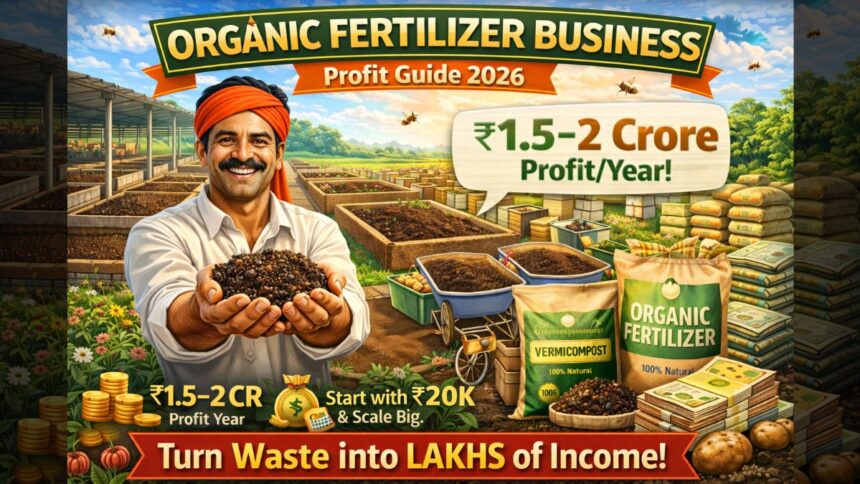
He set up a small vermicompost unit, started cautiously, and expanded production cycle by cycle. Today, his enterprise produces over 900 tonnes of organic fertilizer annually and records a turnover of approximately ₹2 crore per year — with a 50% profit margin. 30 Stades
He sells vermicompost in bulk at ₹6 per kg to local farmers, at retail for ₹10–₹20 per kg, and earns additional revenue from selling earthworm cultures at ₹150–₹300 per kg. His wife Karamjit Kaur co-manages operations and conducts training sessions. He has also trained 12–14 satellite farmers who now supply raw compost back to him, creating a buy-back network that keeps his supply chain strong.
His advice is simple and worth remembering: vermicomposting is one of the most accessible businesses for beginners because the investment is genuinely low, the process is completely learnable, and the demand from farmers is real and growing every season.
Step-by-Step Guide to Starting Your Organic Fertilizer Business
Step 1 — Choose Your Product Line
For most beginners, vermicompost is the smartest entry point. Low investment, a fast production cycle of 45–60 days per batch, and strong local demand in virtually every district. As your confidence and capital grow, you can add biofertilizers, PROM, or liquid organics to your product range.
Step 2 — Arrange Your Raw Materials
Approach nearby dairy farms for cow dung — most will provide it free or at ₹1–₹2 per kg since disposal is their problem. For kitchen and agri-waste, partner with your local panchayat, a vegetable market, or a food processing unit. Your raw material cost should ideally stay close to zero. This is what makes the margins so attractive.
Step 3 — Set Up Your Production Unit
Build raised beds or cemented trenches, typically in a 10×3 feet size, under a shade net or a simple roof structure. Each bed produces approximately 100–150 kg of finished vermicompost per cycle. You do not need fancy equipment to start — a tarpaulin and bamboo poles work perfectly fine for a pilot unit of 5–10 beds.
Step 4 — Source Your Earthworms
The Eisenia fetida variety, commonly called the red wiggler, is best suited for Indian climate conditions and composting. Source from your nearest KVK, a NABARD-supported unit, or a verified local supplier. Start with 1–2 kg of worms per bed — they multiply every 45–60 days naturally, so you will not need to repurchase them.
Step 5 — Register Your Business
For selling commercially, a few registrations are essential. FCO registration under the Fertilizer Control Order, 1985 is mandatory for any entity manufacturing or selling fertilizer in India — apply through your State Controller of Fertilizers. The FCO specifies what substances are eligible for use as fertilizers, product-wise specifications, methods for sampling, and the procedure for obtaining registration as a manufacturer or dealer. You also need Udyam (MSME) registration which is free online and makes you eligible for subsidies, GST registration if annual turnover crosses ₹20 lakh, and NPOP certification if you plan to sell to certified organic farms or export.
Step 6 — Apply for Government Subsidies
Do not skip this step — it can dramatically reduce your effective investment. Key schemes running in 2026 include PKVY (Paramparagat Krishi Vikas Yojana) which provides financial assistance of ₹31,000 per hectare over three years for organic inputs including bio-fertilizers, bio-pesticides, organic manure, and vermicompost. The CISS under Soil Health Management offers 33% capital subsidy for private compost units. NABARD provides loans at subsidised interest rates for agri-processing enterprises. Additional schemes available in 2025–2026 include PM-KISAN, Soil Health Card, and Kisan Credit Card loans which can support your working capital needs.
Contact your district agriculture office or visit the nearest KVK to initiate applications. Most state portals now accept online submissions.
Step 7 — Start Marketing and Selling
Your first ten customers will almost certainly come from your own village or block. Give free samples to two or three trusted local farmers, let them observe the results on their crops, and word-of-mouth takes over from there. After building that initial trust base, approach local organic vegetable farmers for bulk supply contracts, tie up with nurseries and garden centres, list your products on IndiaMart or WhatsApp Business for urban buyers, and sell directly at mandis or organic haats in your district.
Agro Potli Daily Plant Audit Tool
Best Tips From Experienced Producers
Never use fresh cow dung directly in your beds. It generates internal heat that kills earthworms. Pre-compost it for 15–20 days before adding.
Maintain bed moisture consistently between 40–60%. A simple thumb test works — squeeze a handful and only one or two drops of water should emerge. In summer months, check moisture daily and water as needed.
Harvest on schedule. Delay in harvesting beyond 55 days reduces earthworm reproduction rates and overall output. Stick to your cycle timing.
Brand your product from day one. A printed bag with your farm name and a basic nutrient analysis builds trust and allows you to charge retail prices instead of competing only on bulk price. This single step can double your per-kg realization.
Sell vermi wash alongside your solid product. The liquid that drains from beds is a powerful liquid fertilizer. Collect it, dilute at a 1:10 ratio with water, and sell at ₹20–₹50 per litre to home gardeners and organic farmers.
Build a training revenue stream once your unit is established. Charge ₹500–₹1,500 per person for hands-on training days. Many experienced producers earn ₹10,000–₹30,000 per month from training alone — completely separate from their fertilizer sales.
Common Mistakes to Avoid
Starting too big too soon is the most common error. A 5-bed pilot run for two or three production cycles will teach you more than any video or course. Scale only after you have confirmed local demand and understood your production rhythm.
Ignoring quality consistency will destroy your repeat business fast. Farmers will not buy from you a second time if quality varies between batches. Get your batches lab tested — KVKs often provide this service free for registered units.
Skipping FCO registration is a legal risk many small producers ignore. Selling fertilizer commercially without registration can result in penalties. Get it done before your first commercial sale.
Selling without branding means you compete purely on price and lose to anyone who undercuts you. A recognisable name and consistent packaging let you command 2–3x more per kg in retail channels.
Not tracking government scheme application windows is an expensive oversight. PKVY and CISS subsidy applications have annual deadlines. Missing them means waiting another full year.
Organic Fertilizer Business vs Other Agri-Businesses
When compared to other popular agricultural businesses, vermicompost-based organic fertilizer production consistently offers the best combination of low entry cost, short breakeven period, and scalable growth potential. Mushroom farming requires a minimum of ₹30,000 and higher technical skill. Goat farming needs ₹2–₹5 lakh upfront with an 18-month breakeven. Poultry requires ₹3–₹8 lakh with medium-to-high management skill. Biofertilizer manufacturing demands ₹5–₹15 lakh and significant technical expertise.
Vermicompost, by contrast, starts at ₹15,000, breaks even within 3–6 months, and requires a low level of technical skill that any motivated beginner can develop within weeks of hands-on practice.
Is the Organic Fertilizer Business Worth It in 2026?
The answer is yes — without hesitation. The organic fertilizer business checks every box for a sustainable rural enterprise: genuinely low investment, near-zero raw material cost, fast-growing demand, active government support, and multiple income streams operating from a single unit.
You do not need agricultural land, expensive machinery, or a large team to begin. What you need is a shed, a supply of earthworms, access to organic waste, and the consistency to manage your production week after week.
Start with ₹15,000 to ₹50,000. Learn the process. Sell your first 500 kg. Reinvest your earnings. That is the exact formula that turned Dharminder Laddi’s ₹20,000 into a ₹2 crore enterprise — and it can absolutely work for you too.
The soil needs organic inputs. The market is paying for them. And in 2026, the government is literally subsidising you to produce them. There is no better time to start than right now.
Frequently Asked Questions (FAQs)
How much does it cost to start an organic fertilizer business in India?
You can start a home-scale vermicompost unit with as little as ₹15,000 to ₹50,000. A small commercial unit with 30 production beds costs around ₹1.5 lakh to ₹3 lakh. Larger units with FCO registration and mechanised production range from ₹5 lakh to ₹20 lakh. Government subsidies under CISS can cover up to 33% of setup costs for private units, which significantly reduces your effective investment.
What is the profit margin in the organic fertilizer business?
Profit margins typically range from 30% to 70% depending on your product type, sales channel, and raw material sourcing. Vermicompost sold in retail packs at ₹12–₹20 per kg or through online channels at ₹40–₹70 per kg yields far higher margins than bulk sales. Adding vermi wash, earthworm culture sales, and training income significantly boosts overall profitability from a single unit.
What licenses are needed to start an organic fertilizer business in India?
You need FCO registration from your State Controller of Fertilizers, which is mandatory for all commercial fertilizer manufacturing and sales in India. Additionally, Udyam (MSME) registration is needed to access subsidies, GST registration if turnover exceeds ₹20 lakh, and NPOP certification if you plan to sell to certified organic farms or export your product.
Which government schemes support organic fertilizer businesses in 2026?
Key schemes include PKVY which provides ₹31,000 per hectare support over three years for organic inputs, CISS under Soil Health Management offering 33% capital subsidy for compost production units, and NABARD financing for agri-processing enterprises. Several states including Maharashtra, Madhya Pradesh, Tamil Nadu, and Uttar Pradesh also offer additional top-up subsidies through their own agriculture departments.
Can I export organic fertilizer from India?
Yes, and the opportunity is substantial. India is currently the world’s largest exporter of vermicompost, with major buyers in the US, Japan, South Korea, and Australia. For export, you need NPOP certification and compliance with the destination country’s organic standards. Export prices range from ₹25 to ₹60 per kg — significantly higher than domestic bulk rates. Registering with APEDA is strongly recommended for any export-oriented organic fertilizer unit.