



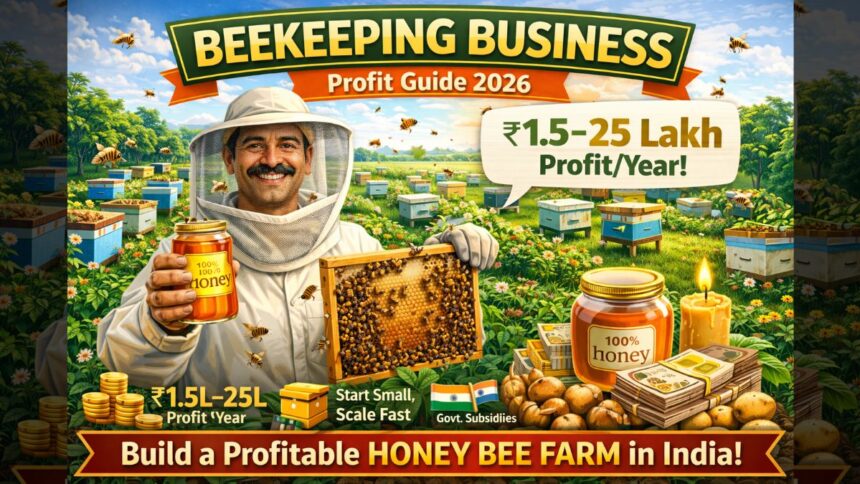
Most people see a beehive and walk the other way. Smart farmers see it and think — that’s a business opportunity.
- What Exactly Is a Beekeeping Business?
- Why Beekeeping in India Makes Strong Business Sense in 2026
- Beekeeping Business Cost Breakdown: What Does It Actually Cost to Start?
- How Much Profit Can You Actually Make? (Realistic Numbers)
- Real Success Story: From 5 Boxes to ₹2 Lakh Per Month
- Government Schemes for Beekeeping in 2026: Free Help You Shouldn’t Miss
- 1. National Beekeeping and Honey Mission (NBHM)
- 2. KVIC Honey Mission (Sweet Kranti)
- 3. NABARD and NBB Subsidy (Up to 85%)
- 4. PMEGP Scheme
- Step-by-Step Guide to Starting Your Beekeeping Business
- Step 1: Get Trained First
- Step 2: Choose the Right Bee Species
- Step 3: Set Up Your Location
- Step 4: Buy Equipment and Colonies
- Step 5: Hive Management Through the Seasons
- Step 6: Harvest and Process Honey
- Step 7: Sell Your Product
- Expert Tips for a Profitable Beekeeping Business
- Common Mistakes New Beekeepers Make (Avoid These)
- Beekeeping vs Other Agri-Businesses: A Quick Comparison
- Is the Beekeeping Business Worth Starting in 2026?
- Frequently Asked Questions (FAQs)
Beekeeping, or apiculture, is one of the most underrated agri-businesses in India right now. You don’t need a large plot of land. You don’t need heavy machinery. And you can start with as little as ₹20,000–₹50,000. Yet the returns can grow to several lakhs per year as your operation scales.
If you’ve ever wondered whether a beekeeping business is worth starting in 2026, this guide gives you everything — the real numbers, the government schemes available, and a practical step-by-step roadmap from zero to profit.
What Exactly Is a Beekeeping Business?
Beekeeping (also called apiculture) means maintaining honeybee colonies in man-made hive boxes to collect honey and other hive products commercially.
Honey bee farming, commonly known as beekeeping, is the care and breeding of honey bee colonies for producing honey and other bee-related goods such as propolis, beeswax, and royal jelly.
But here’s the thing — it’s not just about honey. A well-run beekeeping operation generates income from:
- Honey (primary product)
- Beeswax (cosmetics, candles, pharma)
- Royal Jelly (health supplements, skincare)
- Propolis (medicinal use)
- Bee Pollen (superfood supplements)
- Pollination services (renting colonies to farms)
- Live bee colonies (selling nucleus colonies to new beekeepers)
These by-products are used in various industries including food, cosmetics, and pharmaceuticals, which ensures a steady market demand.
Why Beekeeping in India Makes Strong Business Sense in 2026
India is in the middle of what the government officially calls a “Sweet Revolution.” The numbers speak for themselves.
In 2024, India produced approximately 1.4 lakh metric tonnes of natural honey, and exported around 1.07 lakh metric tonnes worth USD 177.55 million in FY 2023-24. India is now the second-largest exporter of honey globally, up from the 9th rank in 2020.
That’s a massive jump in just a few years. Demand for natural, chemical-free honey is growing fast — both domestically and internationally. Urban consumers are moving away from refined sugar. Pharmaceutical and cosmetic companies are buying bee products in bulk. And the government is actively subsidising new beekeepers.
One of beekeeping’s greatest strengths is its flexibility. Unlike most agricultural ventures, it requires no land ownership. A landless laborer, a small and marginal farmer, a rural woman, or even an urban entrepreneur can take it up with relatively modest capital investment.
Economic studies from Punjab and Haryana have demonstrated that beekeeping within integrated farming models delivers a strong cost-benefit ratio — 2.46 in Punjab and 2.06 in Haryana — confirming that it is a highly profitable venture even in its early stages.
Beekeeping Business Cost Breakdown: What Does It Actually Cost to Start?
This is the question every beginner asks first — and rightfully so.
Here’s a realistic, India-specific breakdown for starting with 50 bee boxes (a solid beginner scale):
| Item | Estimated Cost (₹) |
|---|---|
| 50 Bee boxes (Langstroth hives) | ₹75,000 – ₹1,00,000 |
| Live bee colonies (50 colonies) | ₹50,000 – ₹75,000 |
| Protective gear (suit, gloves, veil) | ₹3,000 – ₹5,000 |
| Smoker | ₹1,500 – ₹2,500 |
| Honey extractor (manual) | ₹8,000 – ₹15,000 |
| Foundation sheets (wax) | ₹5,000 – ₹8,000 |
| Feeding equipment | ₹2,000 – ₹3,000 |
| Miscellaneous (medicine, transport) | ₹5,000 – ₹10,000 |
| Total Estimated Investment | ₹1.5 lakh – ₹2.2 lakh |
NABARD estimates that establishing an economically viable unit of about 50 bee colonies — complete with hives, supers, and equipment — costs roughly ₹2.2 to ₹2.5 lakh.
If you’re starting very small — say 10 boxes — you can get going for as little as ₹20,000–₹40,000. The investment is truly scalable.
How Much Profit Can You Actually Make? (Realistic Numbers)
Let’s talk money. No fluff — just real numbers.
On average, one healthy bee colony kept in a bee box can produce around 20–40 kg of honey per year, depending on environmental conditions and the type of honey bees.
Conservative profit calculation for 50 boxes:
- Average yield per box: 25 kg/year
- Total honey: 1,250 kg/year
- Selling price (retail/wholesale): ₹200–₹500/kg
- Revenue from honey alone: ₹2.5 lakh – ₹6.25 lakh
- Add beeswax, pollen, and colony sales: ₹30,000–₹80,000 extra
Net profit (after costs): ₹1.5 lakh – ₹4 lakh per year for 50 boxes — and this can scale significantly.
A farmer managing thirty honey bee boxes can earn an impressive annual income of around ₹1.5 lakh per year. With an average yield of 15 kg of honey per box, total production reaches 450 kg. Even at a conservative selling price of ₹300 per kilogram, this translates to an income of ₹1,35,000.
At commercial scale (200–500 boxes), annual earnings of ₹10–₹25 lakh are achievable, as proven by real success stories below.
Agropotli Profit Calculator
Real Success Story: From 5 Boxes to ₹2 Lakh Per Month
Ms. Spoorthi, a woman farmer who started with just 5 boxes, expanded to 300 boxes within a single year through disciplined migration of her hives across Telangana, following flowering seasons. She chose Apis mellifera bees for their high yield and ease of management. She is now a proud owner of her bee farm earning lakhs per month.
Her key insight: Migrating boxes to follow seasonal blooms dramatically improves both quantity and quality of honey. She moved her colonies to areas rich in flowers — mustard, sunflower, litchi — and saw yields multiply.
Another story worth knowing: R. Vishwan from Kerala, who once struggled with poverty, now manages 6,000 beehive boxes, harvesting 90 to 110 tonnes of honey annually and earning over ₹25 lakh per year. He started small. He scaled consistently. That’s all it took.
Government Schemes for Beekeeping in 2026: Free Help You Shouldn’t Miss
This is where Indian beekeepers have a massive advantage. The central government has invested heavily in making this business accessible.
1. National Beekeeping and Honey Mission (NBHM)
The National Beekeeping and Honey Mission (NBHM) is a Central Sector Scheme launched by the Government of India for the overall promotion and development of scientific beekeeping. It has a total budget outlay of ₹500 crore and has been extended through FY 2025-26, implemented through the National Bee Board (NBB).
2. KVIC Honey Mission (Sweet Kranti)
The Sweet Kranti scheme, launched by KVIC in 2017, aims to promote beekeeping across the country. It offers financial assistance to beekeepers in the form of subsidised bee boxes, equipment, and training programmes. KVIC also provides mobile honey processing vans that visit beekeepers directly, reducing transportation costs
3. NABARD and NBB Subsidy (Up to 85%)
The government is providing a subsidy of up to 85% to help aspiring beekeepers start their operations. This is a game-changer for anyone who lacks startup capital.
4. PMEGP Scheme
Under PMEGP, an aspiring beekeeper can set up a micro enterprise with a maximum project cost of up to ₹50 lakh. For general category applicants, the government provides a 15–25% subsidy on the project cost, while SC/ST/women/minority applicants can receive up to 25–35%.
Where to apply: Visit your nearest Krishi Vigyan Kendra (KVK), National Bee Board office, or the official Madhukranti portal (madhukranti.india.gov.in) for registration and subsidy application.
Step-by-Step Guide to Starting Your Beekeeping Business
Step 1: Get Trained First
Don’t buy a single box before getting trained. Contact your nearest KVK, agricultural university, or the National Bee Board. KVIC offers 5-day training courses. Some are free for SC/ST candidates; general category training is around ₹1,500.
The training fee is ₹1,500 per candidate for general applicants, while SC/ST candidates are exempted.
Step 2: Choose the Right Bee Species
For commercial beekeeping in India, two species dominate:
- Apis mellifera (Italian bee): High honey yield, easy to manage, best for beginners. Costs around ₹1,500–₹2,000 per colony.
- Apis cerana indica (Indian bee): Indigenous species, hardy, lower yield but suited to traditional methods.
Most commercial operations use Apis mellifera. Start with this unless you’re in a region where Apis cerana performs better.
Step 3: Set Up Your Location
You do not need farmland. But you do need:
- Proximity to flowering crops (mustard, sunflower, litchi, eucalyptus, fruit orchards)
- Access to a clean water source
- Away from pesticide-heavy farms (very important — chemicals kill bee colonies)
- Shade during peak summer months
Beekeeping can thrive almost anywhere — from farms to balconies. Ensure your site is clear of fire hazards and industrial disturbances but rich in nectar sources like sunflowers, hibiscus, and flowering trees.
Step 4: Buy Equipment and Colonies
Start with 10–20 hive boxes if you’re a beginner. Purchase from a reputed local beekeeper or certified supplier. Confirm the colony has an active, laying queen and healthy brood frames.
Step 5: Hive Management Through the Seasons
- October–January: Colony growth phase. Inspect weekly. Feed sugar syrup if nectar is scarce.
- February–April: Peak honey season. Harvest every 2–3 weeks.
- May–September (monsoon): Lean period. Protect hives from rain. Feed supplementally.
During the monsoon season, beekeepers need to give a sugar solution to bees because if they don’t get food during the rains, they abandon the comb. Special attention must be given to keeping them dry by wrapping them with plastic covers. The Better India
Step 6: Harvest and Process Honey
Use a manual or motorised extractor. Never overheat honey. Strain it through a fine mesh filter. Store in food-grade containers. For retail, reduce moisture content — honey should be below 20% moisture for shelf stability.
Step 7: Sell Your Product
- Local markets and weekly haats
- Direct to consumers via WhatsApp groups
- Organic stores and medical stores (250ml/500ml bottles sell fast)
- Online platforms (Amazon, Flipkart, local e-commerce)
- Pharmaceutical and cosmetic companies (bulk buyers, better prices)
- Contract with honey aggregators who buy at fixed rates
Expert Tips for a Profitable Beekeeping Business
- Migrate your boxes to follow seasonal flowering. Stationary hives produce significantly less honey than migratory ones.
- Diversify your products. Don’t just sell raw honey. Process beeswax into lip balms, candles, or creams for 3–5x higher margins.
- Brand your honey. Consumers pay ₹400–₹800/kg for branded, organic honey. The same honey fetches ₹150–₹200/kg unbranded.
- Register on the Madhukranti Portal to access government schemes and improve traceability, which boosts market credibility.
- Join a Farmer Producer Organisation (FPO) for better collective bargaining power on pricing.
- When bees are kept alongside farming activities, crop production increases between 20 and 200 percent — use this as a selling point to organic farms willing to pay for pollination services.
Common Mistakes New Beekeepers Make (Avoid These)
1. Placing hives near pesticide farms Bees can die immediately by inhaling chemicals even from a distance of 3–4 kilometres. One couple lost nearly ₹3,60,000 when their bees inhaled chemicals from a nearby farm and died. Always scout your location thoroughly before setting up.
2. Skipping training and buying colonies first Colonies without proper management collapse. The bees leave or die. Your entire investment walks away.
3. Harvesting too early or too often Immature honey has high moisture content and will ferment. Wait until 80% of the comb is capped before harvesting.
4. Ignoring seasonal feeding During lean months, bees starve if you don’t feed. A weak colony won’t survive — and rebuilding costs more than feeding.
5. Selling only bulk unbranded honey This is the biggest profit killer. Branding and processing your honey can multiply your income 3–5 times for the same volume.
Beekeeping vs Other Agri-Businesses: A Quick Comparison
| Factor | Beekeeping | Poultry | Dairy |
|---|---|---|---|
| Starting investment | ₹20,000–₹2.5 lakh | ₹2–₹5 lakh | ₹3–₹10 lakh |
| Land required | Minimal/nil | Moderate | Moderate |
| Break-even period | 6–12 months | 6–10 months | 12–18 months |
| Govt subsidy | Up to 85% | 25–50% | 33–50% |
| Scalability | Very high | High | Moderate |
| Skill required | Moderate | Low–Moderate | Low–Moderate |
Beekeeping wins on land flexibility, subsidy percentage, and scalability — which is why it’s becoming the preferred secondary income stream for Indian farmers.
Is the Beekeeping Business Worth Starting in 2026?
The answer is clear: yes, if you’re willing to learn and stay patient in the first season.
With ₹1.5–₹2.5 lakh of initial investment (much of which can be subsidised by the government), a beekeeper with 50 boxes can realistically earn ₹1.5–₹4 lakh per year within the first two years. As the operation scales to 200–500 boxes with proper migration and branding, annual income can reach ₹15–₹25 lakh.
India is the second-largest honey exporter in the world. Domestic demand for natural honey is rising every year. And the government is actively putting money, training, and infrastructure behind this sector.
The hardest part of starting a beekeeping business isn’t the bees — it’s taking the first step. Get trained. Start small. Migrate your boxes. Brand your honey. The rest follows.
Frequently Asked Questions (FAQs)
Q1. How much does it cost to start a beekeeping business in India?
You can start with as little as ₹20,000–₹40,000 for 10 boxes. A professional setup with 50 boxes costs ₹1.5–₹2.5 lakh. Government subsidies of up to 85% are available through NABARD and KVIC schemes, significantly reducing your actual out-of-pocket cost.
Q2. How much profit can I make from beekeeping in India?
With 50 bee boxes, a well-managed operation can produce 1,000–1,500 kg of honey per year. At ₹250–₹500/kg, annual revenue ranges from ₹2.5 lakh to ₹7 lakh, with net profit of ₹1.5–₹4 lakh after expenses. At 200–500 boxes, earnings of ₹10–₹25 lakh per year are achievable.
Q3. Which is the best bee species for beginners in India?
Apis mellifera (Italian bee) is the most recommended species for commercial beekeeping beginners. It produces high honey yields, is relatively easy to manage, and adapts well to different climatic zones across India.
Q4. What government schemes are available for beekeeping in India in 2026?
Key schemes include the National Beekeeping and Honey Mission (NBHM) with a ₹500 crore budget, KVIC’s Sweet Kranti/Honey Mission, NABARD-NBB financing with up to 85% subsidy, and PMEGP (for micro enterprises up to ₹50 lakh). Apply through your nearest KVK, National Bee Board office, or the Madhukranti portal.
Q5. Do I need land to start a beekeeping business?
No. One of the biggest advantages of beekeeping is that it requires no land ownership. You can place hive boxes on a rented farm, your existing agricultural land, or even a large terrace. The key requirement is proximity to flowering plants and freedom from pesticide exposure.