




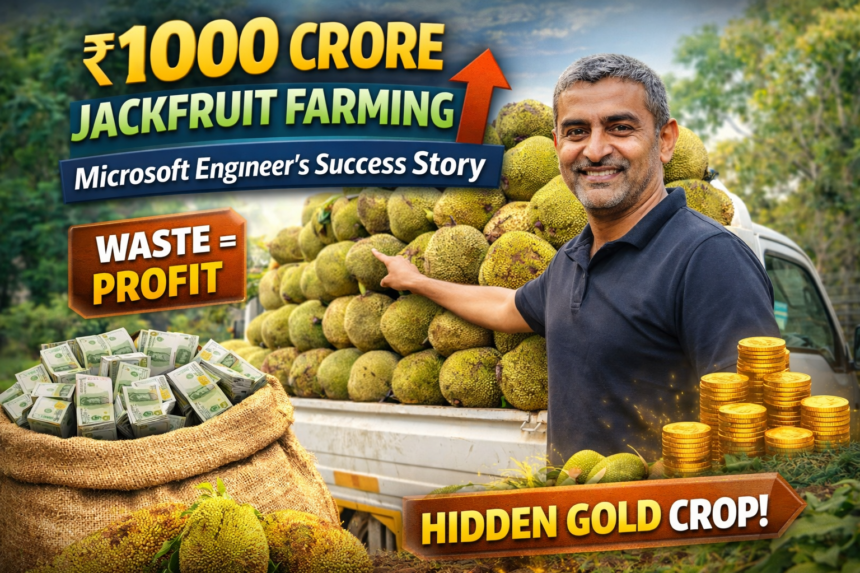
Every year, roughly 14 lakh metric tonnes of jackfruit falls off trees in Kerala alone — and nobody picks it up.
- What Is Jackfruit and Why Is It India’s Most Misunderstood Crop?
- Three Stages of Jackfruit You Must Know (As a Farmer or Consumer)
- The Real Problem: 14 Lakh Tonnes Wasted Every Year in Kerala
- How One Man Turned Jackfruit Into a Medically Validated Product
- The Science Behind Jackfruit Flour and Diabetes Management
- Income Potential for Jackfruit Farmers: Real Numbers
- Step-by-Step: How Jackfruit Flour Is Made (Factory Process Overview)
- Tips for Farmers Interested in Jackfruit
- Common Mistakes to Avoid in Jackfruit Business
- Why India Needs a “Greener Revolution”
- The Verdict on Jackfruit Farming
- Frequently Asked Questions (FAQs)
Not because farmers don’t want money. Because nobody told them this “shade tree fruit” was worth anything.
That’s changing fast. And if you’re a farmer, agri-entrepreneur, or someone curious about India’s most underestimated crop — this article is for you.
We’ll cover everything: jackfruit farming basics, its proven health benefits (including diabetes management), how food processing creates 10x more income, and what one man’s journey from Microsoft to a Kerala village taught us about turning agricultural waste into a national opportunity.
What Is Jackfruit and Why Is It India’s Most Misunderstood Crop?
Jackfruit (Artocarpus heterophyllus) is the world’s largest tree fruit. In India, it grows almost everywhere — Kerala, Karnataka, Tamil Nadu, Assam, West Bengal, Andhra Pradesh, and the North-East. Most homes in Kerala have at least one jackfruit tree in the backyard.
But here’s the strange part: India is among the world’s top producers of fruits and vegetables, yet ranks at the bottom globally for fruit and vegetable consumption — below even several African nations according to WHO data.
Jackfruit sits right at the center of this paradox. There’s enormous supply. Almost no organized demand.
The result? An estimated 250 lakh metric tonnes of jackfruit is produced annually across India — and most of it rots.
Three Stages of Jackfruit You Must Know (As a Farmer or Consumer)
Most people don’t realize that jackfruit is essentially three different foods depending on when you harvest it. Understanding this is critical before you plan farming or processing.
Stage 1 — Immature Jackfruit (3 kg, “tender”) This small jackfruit is harvested from October onwards. Its seed is very soft, almost invisible. This is the one North India uses for sabzi, biryani, and cutlets. Weight: around 3 kg. High demand in northern markets.
Stage 2 — Mature Green Jackfruit (15 kg, “raw but grown”) If you leave that 3 kg fruit on the tree for two more months, it becomes a 15 kg fruit. The seed is now fully developed. This stage is the most nutritionally powerful — low sugar, high soluble fiber (pectin), and extremely versatile. It can substitute rice or wheat as a staple food. This is what JackFruit365 processes into flour.
Stage 3 — Ripe Jackfruit (15 kg, fully sweet) Just two days after the mature green stage, the pectin converts to sugar. The fruit becomes sweet, yellow inside, and its sugar value jumps five times. Great as a fruit, but not suitable for diabetes benefits. Shorter shelf life, lower demand in North India.
Key takeaway for farmers: The same fruit gives you three different market opportunities. Most farmers are currently only tapping Stage 1 (tender jackfruit for North India) — which earns them ₹10 per kg at best.
The Real Problem: 14 Lakh Tonnes Wasted Every Year in Kerala
Kerala produces 15 lakh metric tonnes of jackfruit annually. Of that:
- 1 lakh tonnes goes to North India as tender jackfruit — earning farmers roughly ₹100 crore
- 14 lakh tonnes falls from the tree and goes to waste — earning farmers exactly ₹0
No cultivation cost. No irrigation. No labour for growing. These fruits literally grow by themselves — and then rot.
If even half of that wasted 14 lakh tonnes were converted to processed products, farmers could earn an additional ₹1000 crore per year — without planting a single new tree.
This is not a farming problem. It’s a supply chain and awareness problem.
How One Man Turned Jackfruit Into a Medically Validated Product
James Joseph was a top-rated employee at Microsoft, working across the US and UK before returning to his Kerala village. In 2012, he took a year off from his job while his wife — a doctor — settled back into Indian medical practice.
Sitting at home writing a book, he noticed a jackfruit growing outside his window. From 3 kg in October, it became 15 kg by December — untouched, unplanted, unstoppable.
That moment sparked a question: Why is all of this going to waste?
He learned from his village’s tradition that raw jackfruit — called chakka in Malayalam — was historically eaten as a rice and roti substitute. Low acidity, high fiber, filling as a full plate. The tradition existed. The knowledge had just faded.
Then Dr. APJ Abdul Kalam read James’s book, connected with his idea, and challenged him: “You’re an engineer. Don’t change people’s food habits. Instead, figure out how to blend jackfruit into the food they already eat — roti, idli, dosa — and reduce their rice and wheat intake without them even noticing.”
That became the foundation of JackFruit365.
The Science Behind Jackfruit Flour and Diabetes Management
This is where jackfruit farming moves from agriculture into health — and where the real market opportunity lies.
The pectin problem and solution
Raw mature jackfruit contains exceptionally high levels of soluble fiber, especially pectin. But here’s the challenge: within just 48 hours of harvesting, that pectin converts to sugar naturally. If you don’t process it fast enough, the sugar content spikes dramatically.
James found a competitor product in Hyderabad with 27% sugar content. His product has 4%.
His flour has 5.6% soluble fiber. Oats — long marketed as the gold standard of fiber — contain less fiber per calorie than this jackfruit flour.
The clinical trial
After 18 months of engineering work to standardize the product, James conducted a double-blind, placebo-controlled randomized trial at a government medical college in Andhra Pradesh — the same gold-standard methodology used for pharmaceutical drugs.
Two groups of patients: one ate wheat flour and rice powder as usual. The other substituted jackfruit flour in their idli, dosa, and roti — same taste, same texture, no difference in appearance.
Result after three months: The wheat group’s average blood sugar (HbA1c) went up. The jackfruit flour group’s HbA1c went down — significantly.
The study was accepted by the American Diabetes Association and published in Nutrition & Diabetes journal (Nature Group). It was the first-ever drug-like food study of this kind.
Beyond diabetes
A doctor in Ahmedabad started prescribing jackfruit flour to all his patients and reported results across multiple conditions:
- Fatty liver reversal (200 patients)
- Weight loss
- Reduced triglycerides
- Lower cholesterol
- Reduced inflammation markers
The mechanism: the soluble fiber (pectin) ferments in the large intestine, acting as a powerful prebiotic fertilizer for gut microbiome. This triggers a gut-liver axis response that metabolizes liver fat. Better gut health → better everything else.
According to ICMR data, over 80% of Indians have some form of metabolic disorder. Jackfruit flour addresses the root cause — excess refined carbohydrates — without forcing anyone to change their food habits.
Income Potential for Jackfruit Farmers: Real Numbers
Let’s talk money, because that’s what matters.
| Stage | Weight | Price Without Processing |
|---|---|---|
| Tender (Stage 1) | 3 kg | ₹10/kg = ₹30 per fruit |
| Mature green (Stage 2) | 15 kg | ₹10/kg = ₹150 per fruit |
| Currently wasted | 15 kg | ₹0 |
When James sources mature green jackfruit for processing, he pays the same ₹10/kg rate — but farmers now earn ₹150 per fruit instead of ₹0, because this fruit was previously going to waste.
Real case study — A single panchayat in Kerala:
In one year, James sourced 530 tonnes of jackfruit from a single panchayat.
That same panchayat’s total cultivated fruit production (pineapple, banana, mango combined) was only 200 tonnes.
The 530 tonnes was all uncultivated jackfruit — trees no one had planted, fruits no one had harvested before. That is pure extra income that didn’t exist previously.
After value addition (processing into flour): JackFruit365 achieves roughly 10x value addition. ₹10/kg raw jackfruit becomes approximately ₹100/kg as flour. The flour sold on Amazon became a bestseller overnight after a 2-minute interaction with PM Modi was shared on WhatsApp — temporarily overtaking India’s largest atta brands.
The product now has over 14,000 reviews on Amazon with 50% repeat customers.
Agropotli Profit Calculator
Step-by-Step: How Jackfruit Flour Is Made (Factory Process Overview)
This is a simplified overview of the process JackFruit365 uses. The exact ratios and machine specifications are patented — but the logic is useful for any farmer or entrepreneur exploring food processing.
Step 1 — Harvest timing Collect mature green jackfruit 2 days before it fully ripens. This window is critical. Miss it and the pectin converts to sugar.
Step 2 — Transport and cleaning Jackfruit is collected from farms across Kerala and brought to a centralized processing unit. Cleaned and sorted on arrival.
Step 3 — Separation Three parts are separated: the fruit flesh (low sugar, high starch), the seeds (high quality protein), and the outer skin/rind (used to extract additional soluble fiber and as biomass for biogas research).
Step 4 — Dehydration The fruit flesh is dehydrated rapidly to remove moisture. Speed matters here — delay causes sugar to build up in the product.
Step 5 — Blending in specific ratios Protein from seeds, starch from fruit flesh, and soluble fiber from the rind are blended in a specific patented ratio to achieve the target nutritional values: ~4% sugar, ~5.6% soluble fiber, 16% total fiber.
Step 6 — Batch testing Every single batch is tested for nutritional values before packing. If soluble fiber is below target — the batch is rejected. This pharmaceutical-grade consistency is what makes the clinical results replicable.
Step 7 — Packaging Packed in moisture-proof packaging. Combined with the natural antifungal properties from jackfruit seed powder, the shelf life reaches 365 days — one full season to the next.
Tips for Farmers Interested in Jackfruit
If you have jackfruit trees on your property:
- Don’t let mature green fruits fall and waste. Contact local FPOs or processors who buy mature green jackfruit.
- The 15 kg mature green fruit is far more valuable than the 3 kg tender fruit — it just doesn’t have a ready buyer yet. That market is building.
If you want to start organized jackfruit farming:
- Jackfruit starts yielding from year 3. One mature tree can produce a tonne of fruit.
- Do mixed cropping — alternate jackfruit and mango trees. Jackfruit is prone to fungal spread between trees; interplanting with mango breaks the chain.
- Jackfruit is a summer crop — it produces during drought season when farmer income is lowest. This makes it a natural income shock absorber.
If you’re thinking about food processing:
- Don’t build infrastructure before you have buyers. The most common mistake James saw in FPO meetings: companies registered, buildings rented, staff hired — with no confirmed market.
- Find demand first. Build supply chain second. Processing third.
- The money in agriculture is always in value addition — but value addition without demand is just expensive waste.
Common Mistakes to Avoid in Jackfruit Business
Mistake 1: Processing ripe jackfruit thinking it’s the same as raw A Gujarat customer gave ripe jackfruit product to his diabetic father — blood sugar went up. Ripe and raw jackfruit are nutritionally opposite. Never mix the two in marketing or packaging.
Mistake 2: Making jackfruit powder without controlling sugar levels Many copycat products have appeared with 27% sugar content. These are made from ripe or partially ripe fruit and offer zero health benefit — and may actively harm diabetics. Standardization is not optional.
Mistake 3: Scaling production before scaling demand James himself once had to dispose of 5,000 kg of frozen jackfruit because he processed before demand materialized. Scale your factory only after your market is proven.
Mistake 4: Ignoring the 15 kg variety Most small processors only chase the tender 3 kg variety because there’s existing market demand. The 15 kg mature green variety is where the real health value (and future large-scale market) exists.
Why India Needs a “Greener Revolution”
Here’s a perspective worth remembering.
The original Green Revolution of the 1960s — credited to Dr. MS Swaminathan — increased rice and wheat production dramatically. It solved hunger. But it also made grains cheap and abundant, which led people to eat more of them while eating fewer vegetables.
Today, 65% of India’s calories come from rice and wheat (ICMR data). That excess carbohydrate load is a primary driver of India’s metabolic disease epidemic.
Dr. Swaminathan himself, later in his career, wrote that we now need to reduce rice and wheat from India’s Public Distribution System by 5% — replacing them with more nutritious options.
Jackfruit flour, blended into everyday atta at just 5%, could achieve that without changing anyone’s food habits. No new crop, no behavior change, no cultural disruption.
As James puts it: we added iodine to salt and solved goitre nationwide. Blending jackfruit flour into atta could do something similar for metabolic disease.
The Verdict on Jackfruit Farming
Jackfruit is not a trendy superfood. It’s not new. Your grandmother’s grandmother probably ate it.
What’s new is the science confirming what traditional Kerala and South Indian food culture always knew — raw jackfruit is a powerhouse of soluble fiber that directly improves metabolic health.
For farmers, the immediate opportunity is clear: there’s fruit on your trees worth ₹150 per piece that you’re currently letting fall and rot. That’s not a farming problem — that’s an awareness problem with a straightforward fix.
For entrepreneurs, jackfruit flour is a clinically validated, patented, Amazon bestselling product in a country where 80% of people have a metabolic disorder. The demand side just needs more education.
The ₹1000 crore sitting uncollected in Kerala’s forests is a starting point. Across all of India, the number is multiples of that.
Frequently Asked Questions (FAQs)
Q1. When does jackfruit farming start yielding returns? Jackfruit trees start bearing fruit from the 3rd or 4th year after planting. Once mature, a single tree can yield up to 1 tonne of fruit per season. Since jackfruit requires minimal investment (no irrigation, no fertilizer in most cases), it offers high returns relative to input cost.
Q2. What is the difference between green jackfruit and ripe jackfruit for farming? Green jackfruit (raw) is low in sugar, high in soluble fiber and starch, and is used as a vegetable substitute or for flour making. Ripe jackfruit is high in sugar, used as a fruit, and has much shorter shelf life. For health-based food processing and diabetes management products, only green (raw) jackfruit is suitable.
Q3. How much can a jackfruit farmer earn per acre? Income depends on variety and market. Selling tender jackfruit (3 kg) to North India earns ₹10/kg. Selling mature green jackfruit (15 kg) to processors can earn ₹150 per fruit at the same rate — simply by waiting 2 more months. With organized farming and processing linkage, per-acre income can increase significantly compared to traditional crops.
Q4. Is jackfruit flour clinically proven to help with diabetes? Yes. A double-blind, placebo-controlled clinical trial conducted at a government medical college in Andhra Pradesh showed significant reduction in HbA1c (3-month average blood sugar) in the jackfruit flour group compared to a wheat flour control group. The study was published in Nutrition & Diabetes (Nature Group) and accepted by the American Diabetes Association.
Q5. What are the best states in India for jackfruit farming? Kerala has the highest density of jackfruit trees, but significant production exists in Karnataka, Tamil Nadu, Assam, West Bengal, Goa, and several North-Eastern states. Jackfruit grows well in tropical and subtropical climates with moderate rainfall. It is drought-tolerant once established, making it especially suitable as a summer income crop.