




Papaya has always been a farmer-friendly crop — fast-growing, low-maintenance, and market-ready within a year. But most farmers still treat it as a secondary crop, a filler between orchards or a backup plan. That thinking is costing them lakhs.
- What Is Taiwan Red Lady 786 F1 Hybrid Papaya?
- Why Taiwan Red Lady 786 Papaya Is Taking Over Indian Fields
- 1. Early and Consistent Fruiting
- 2. Strong Market Demand, Year-Round
- 3. Shorter Investment-to-Return Cycle
- Real Cost and Profit Breakdown (Per Acre)
- How to Grow Taiwan Red Lady 786 Papaya: Step-by-Step Guide
- Step 1: Land Selection and Preparation
- Step 2: Seedling Selection and Nursery
- Step 3: Planting Geometry
- Step 4: Drip Irrigation Setup
- Step 5: Fertilization Schedule
- Step 6: Disease and Pest Management
- Step 7: Harvesting
- Advanced Strategy: Multi-Crop Integration Like Lalit
- Farm-to-Table: The Next Evolution of Indian Farming
- Real Case Study: A Farmer from Nashik District
- Common Mistakes to Avoid in Papaya Farming
- Expert Tips for Higher Yield and Quality
- Is Taiwan Red Lady 786 Worth It?
- Frequently Asked Questions (FAQs)
Meet Lalit Lodha from Pahur village, Jalgaon district, Maharashtra. He’s been farming 8 acres of mixed fruit orchards for over a decade. In 10 years, he hasn’t faced a single year of loss. His secret? Taiwan Red Lady 786 F1 Hybrid papaya, combined with smart planning, drip irrigation, and a market-first mindset.
If you’re a farmer wondering whether papaya is worth the investment, this guide — built around real numbers and ground-level experience — will answer that question clearly.
What Is Taiwan Red Lady 786 F1 Hybrid Papaya?
Taiwan Red Lady 786 (also written as Taiwan 786 or Red Lady 786) is a high-yielding hybrid papaya variety developed in Taiwan and now widely cultivated across India, especially in Maharashtra, Gujarat, Andhra Pradesh, and Madhya Pradesh.
The “F1 hybrid” means it’s a first-generation cross between two parent lines — giving you the best traits of both: disease resistance, uniform fruit size, high sugar content, and early fruiting.
Key characteristics:
- Fruit weight: 1.5–2.5 kg per fruit
- Flesh color: Deep red-orange (high lycopene, market-preferred)
- First harvest: 8–10 months after transplanting
- Productive life: 12–18 months of continuous harvesting
- Disease resistance: Better tolerance to papaya ringspot virus (PRSV) compared to desi varieties
This variety is sold by Prochan Seeds (Pro Chand) and has become a go-to choice for progressive farmers looking for commercial returns.
Why Taiwan Red Lady 786 Papaya Is Taking Over Indian Fields
1. Early and Consistent Fruiting
Most fruit crops make you wait. Mango takes 3–5 years. Mosambi (sweet lime) takes 3 years to give commercial yield. But Taiwan Red Lady 786 starts fruiting in 8–9 months and gives continuous harvests for over a year.
Lalit planted his crop on 15th March. Harvesting began just 8–9 months later. The yield progression was remarkable:
| Harvest Round | Yield |
|---|---|
| 1st Harvest | 3.5 tonnes |
| 2nd Harvest | 5.5 tonnes |
| 3rd Harvest | 7.5 tonnes |
| 4th Harvest | 3–4 tonnes |
That’s 18–20+ tonnes from a single crop cycle on roughly 1.5–2 acres. And each cycle builds on the last as the plant matures.
2. Strong Market Demand, Year-Round
Unlike seasonal vegetables that crash the market all at once, papaya sells consistently throughout the year. Red Lady 786’s deep red flesh and sweet taste make it preferred by both wholesale mandis and retail consumers.
In Lalit’s case, per-kg rates rarely drop below ₹20–25 in his local market — often climbing to ₹35–40 during off-season months.
3. Shorter Investment-to-Return Cycle
For a farmer with limited capital, a crop that pays back within 12 months is gold. Taiwan Red Lady 786 delivers exactly that, making it ideal for small and medium landholders (1–5 acres).
Real Cost and Profit Breakdown (Per Acre)
This is what most agriculture content skips or gets wrong. Here’s a realistic breakdown based on Lalit’s farm and general Maharashtra market rates:
Investment (Per Acre)
| Expense Item | Approximate Cost (₹) |
|---|---|
| Taiwan 786 seedlings (approx. 1,100–1,200 plants/acre) | ₹15,000–20,000 |
| Land preparation + bed formation | ₹5,000–8,000 |
| Drip irrigation setup (if not already installed) | ₹25,000–35,000 (one-time, subsidized under Jain Irrigation/NHM) |
| Fertilizers (NPK, micro-nutrients, organic) | ₹15,000–18,000 |
| Plant protection (fungicide, insecticide) | ₹8,000–10,000 |
| Labour (transplanting, deweeding, harvesting) | ₹12,000–15,000 |
| Miscellaneous | ₹5,000 |
| Total Investment | ₹85,000–1,10,000 |
Note: Drip irrigation is often subsidized under the National Horticulture Mission (NHM) and state schemes. Jain Irrigation’s subsidy program can cover 45–50% of drip costs.
Revenue (Per Acre, Good Crop)
| Item | Estimate |
|---|---|
| Total yield over full cycle | 18–22 tonnes |
| Average rate at mandi | ₹20–30/kg |
| Gross Revenue | ₹3.6–6.6 lakh |
| Less: Total Investment | ₹1–1.1 lakh |
| Net Profit | ₹2.5–5.5 lakh/acre |
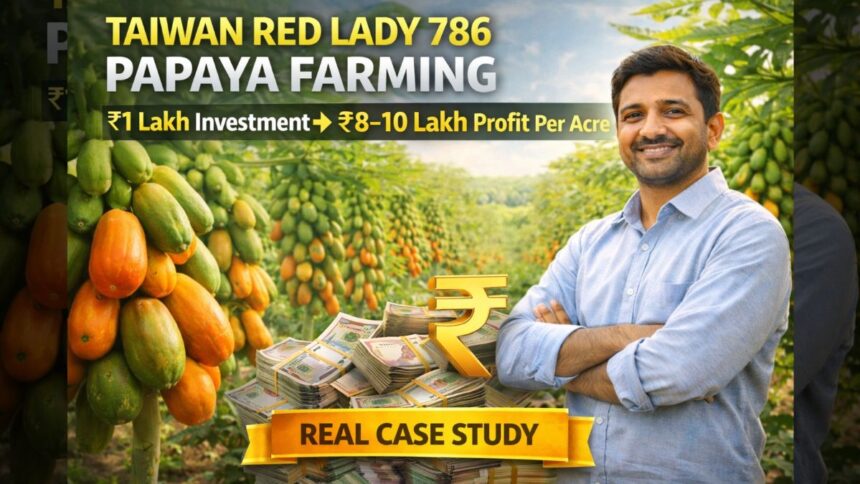
Lalit summarizes it simply: “₹1 lakh ka kharcha, ₹8–10 lakh ka maal” — particularly when combining papaya with other mixed crops on the same land. His overall 8-acre farm with mosambi, papaya, and coconut generates ₹10–12 lakh revenue against ₹4 lakh expenses annually.
Agropotli Profit Calculator
How to Grow Taiwan Red Lady 786 Papaya: Step-by-Step Guide
Step 1: Land Selection and Preparation
Papaya hates waterlogging. Choose well-drained, slightly sandy-loam soil with pH between 6.0–7.0. If your field has even slightly poor drainage, make raised beds (15–20 cm high) before transplanting.
Deep plough the field 2–3 times. Add well-decomposed FYM (farmyard manure) at 20–25 tonnes per hectare before the last ploughing.
Step 2: Seedling Selection and Nursery
You can buy ready nursery seedlings (25–30 days old) from certified nurseries or prepare your own. For Taiwan Red Lady 786 specifically, buy seeds from authorized Prochan dealers to avoid counterfeit hybrids.
Raise seedlings in pro-trays with coco-peat medium. Transplant when seedlings are 20–25 cm tall (roughly 4–5 weeks after germination).
Step 3: Planting Geometry
The standard spacing for Taiwan Red Lady 786 is 6 × 6 feet or 5 × 5 feet depending on your soil fertility. At 6×6 feet, you accommodate around 1,100–1,200 plants per acre.
Lalit uses 15 × 15 feet spacing for his mosambi orchard, but for papaya as a primary crop, 5×6 feet spacing works best for maximum yield.
Step 4: Drip Irrigation Setup
This is non-negotiable. Papaya is extremely sensitive to both drought and over-irrigation. Drip irrigation keeps moisture consistent, reduces disease pressure (wet leaves = fungal issues), and saves 40–50% water compared to flood irrigation.
Install a single lateral drip line per row with 2 drippers per plant. Maintain soil moisture at 70–80% field capacity throughout the growing period.
Jain Irrigation’s drip kits with government subsidy are what Lalit uses — and he strongly recommends it for any new papaya farmer.
Step 5: Fertilization Schedule
Papaya is a heavy feeder. Use a split fertilization approach:
Basal dose (at planting): DAP 100 kg/acre + FYM 5 tonnes/acre
Vegetative stage (months 1–4): High nitrogen — urea through drip (fertigation), plus potash for root development.
Flowering and fruiting stage (months 5–9): Reduce nitrogen, increase phosphorus and potassium. Add micronutrients like boron, zinc, and calcium — these directly affect fruit size and shelf life.
Important: Always do a soil test before deciding fertilizer doses. Over-fertilization, especially nitrogen during fruiting, causes hollow fruits and poor taste.
Step 6: Disease and Pest Management
The two biggest threats to Taiwan 786 papaya:
Papaya Ringspot Virus (PRSV): Spread by aphids. Control aphids aggressively using neem oil spray (5 ml/litre) + imidacloprid as needed. Remove and destroy infected plants immediately — there’s no cure once infected.
Phytophthora Root Rot: Caused by excessive soil moisture. Prevention is the only solution — good drainage + drip irrigation. If seen early, apply metalaxyl + mancozeb near the root zone.
Powdery Mildew and Anthracnose: Common in humid conditions. Use copper oxychloride or mancozeb sprays at 10-day intervals during monsoon.
Step 7: Harvesting
Taiwan Red Lady 786 papaya is ready for first harvest when fruits show yellow color breaking from the tip (about 10–20% yellow). At this stage, the fruit transports well and ripens perfectly at the market or home.
For local market sale, you can harvest at 30–40% ripeness. For long-distance transport, harvest at first color break (10% yellow).
Use a sharp knife or secateurs, leave a 2 cm stub of stalk, and handle carefully — papaya bruises easily and bruised fruit fetches 30–40% lower price.
Advanced Strategy: Multi-Crop Integration Like Lalit
One of the biggest lessons from Lalit’s farm is that papaya works best as part of a mixed farming system, not as a standalone monoculture.
His 8 acres are organized like this:
- 2 acres: Mosambi (sweet lime) — 550 grafted plants, 5–7 years old, 10–15 tonnes/year
- 1.5–2 acres: Taiwan Red Lady 786 papaya
- 0.5 acres: Apple Ber (100 plants)
- Remaining 2.5–3 acres: Banana + additional papaya expansion (planned)
- Coconut and date palm planted as border/intercrop
This diversification means no single crop failure can affect his overall income. Mosambi gives stable income for 15–17 years. Papaya gives quick cash every season. Banana fills the gap in between.
Farm-to-Table: The Next Evolution of Indian Farming
Lalit is building something that goes beyond farming — a farm café on the Jalgaon-Nagpur Highway where travelers can buy fresh fruit directly from the farm.
This farm-to-table model has several advantages:
- You bypass the mandi entirely for a portion of production
- Fresh fruit commands 2–3x the mandi price at retail
- Café adds a separate revenue stream (juices, fruit platters, seasonal specials)
- Highway location ensures consistent footfall
His children — both IIT engineers with government jobs — are aligned with this vision. They plan to add agro-tourism experiences where urban visitors can engage with the farm, understand where their food comes from, and reconnect with rural life.
This isn’t just a business idea. It’s a model for the next generation of Indian farming: technologically equipped, market-integrated, and rooted in natural farming principles.
Real Case Study: A Farmer from Nashik District
To add further perspective: Rajendra Patil, a farmer from Niphad taluka, Nashik, began growing Taiwan Red Lady 786 on 1.2 acres in 2022. He had previously grown onion and grapes, but water shortage forced him to switch.
With drip irrigation from a bore well and solar pump (installed with state subsidy), his first papaya crop yielded 19.5 tonnes over three harvests. At an average of ₹22/kg, gross revenue was ₹4.29 lakh. His net profit after all expenses was approximately ₹3.1 lakh from 1.2 acres in just 14 months.
He now farms 3 acres of papaya and has reduced his dependence on the unpredictable onion market entirely.
Common Mistakes to Avoid in Papaya Farming
1. Buying cheap or unverified seeds Counterfeit Taiwan 786 seeds are a real problem in India. Always buy from registered dealers or directly from companies like Prochan. A ₹2,000 saving on seed can cost ₹2 lakh in lost yield.
2. Ignoring drainage Even one episode of waterlogging can wipe out 30–50% of your crop through root rot. Raised beds and proper field slope are not optional.
3. Skipping soil testing Most fertilizer over-application problems (hollow fruit, tip burn, premature drop) happen because farmers apply urea blindly. A ₹200 soil test can save ₹20,000 in wasted fertilizer.
4. Late harvesting Papaya over-ripens fast. Delaying harvest even 2–3 days in summer causes significant fruit damage and weight loss. Set a harvesting schedule and stick to it.
5. No market linkage before planting Know your market before you sow. Are you selling at local mandi? Direct to retailer? Processing unit? Each requires a different harvest maturity and packaging standard. Plan this before planting, not after harvesting.
Expert Tips for Higher Yield and Quality
- Use solar-powered pumps wherever possible — consistent irrigation timing improves crop uniformity and reduces input cost long-term.
- Intercrop with short-duration vegetables (like coriander or fenugreek) between papaya rows in the first 2–3 months to earn while the papaya establishes.
- Train one fruit per node — remove extra fruits on weak branches to allow the plant to channel energy into fewer, larger fruits that fetch better market price.
- Apply micronutrient foliar spray (boron 0.5% + zinc sulphate 0.5%) at flowering stage to prevent fruit drop and improve fruit set.
- Mulch the base of plants with dry grass or sugarcane trash — conserves moisture, suppresses weeds, and keeps soil temperature stable.
Is Taiwan Red Lady 786 Worth It?
Absolutely yes — if done right.
Taiwan Red Lady 786 F1 Hybrid papaya is not a gamble. It’s a well-proven, commercially viable crop that gives results within 12 months, requires modest investment, and responds very well to good agronomic management.
Lalit Lodha’s story isn’t extraordinary luck. It’s the result of consistent decision-making: right variety, right technology, right market thinking. He didn’t wait for the government to solve his problems. He adopted drip irrigation, solar pumps, and hybrid varieties years before they became mainstream.
If you have even 1 acre of well-drained land, access to drip irrigation, and willingness to follow a schedule — Taiwan Red Lady 786 papaya can be your most profitable crop this year.
Start small. Learn well. Scale smart.
Frequently Asked Questions (FAQs)
Q1. What is the yield of Taiwan Red Lady 786 papaya per acre? Under good management with drip irrigation and proper fertilization, Taiwan Red Lady 786 can yield 18–22 tonnes per acre over a full crop cycle of 12–14 months. Individual harvests range from 3 to 7+ tonnes depending on plant maturity.
Q2. How long does Taiwan Red Lady 786 papaya take to bear fruit? The first harvest typically begins 8–10 months after transplanting. Yields increase with each subsequent harvest as the plant matures.
Q3. What is the cost of growing Taiwan Red Lady 786 papaya per acre in India? Total cost per acre ranges from ₹85,000 to ₹1,10,000, including seedlings, drip irrigation, fertilizers, plant protection, and labour. Drip irrigation costs can be offset by government subsidies under NHM or state horticulture schemes.
Q4. Where can I buy Taiwan Red Lady 786 papaya seeds in India? Prochan Seeds (Pro Chand) is the primary supplier of Taiwan Red Lady 786 in India. Seeds and seedlings are also available through state horticulture department nurseries and registered agri-dealers in Maharashtra, Gujarat, and Andhra Pradesh.
Q5. Is papaya farming profitable in India? Yes. With the right hybrid variety like Taiwan Red Lady 786, drip irrigation, and proper marketing, net profit can range from ₹2.5 to ₹5 lakh per acre in a single crop cycle. Multi-year comparisons show papaya outperforming many traditional crops in terms of return on investment and time to payback.