



Why Most Dairy Farms in India Never Really Take Off
Here’s something most people won’t tell you about the dairy business in India — having cows is not the same as running a dairy farm.
- Why Most Dairy Farms in India Never Really Take Off
- What Is a Dairy Business? (And What It Actually Involves)
- The Biggest Reason Dairy Farms Fail (And Nobody Talks About It)
- Key Lessons from a Successful Dairy Farm (Binsar Dairy, Haryana)
- 1. Start Small, Learn Everything
- 2. People Are the Real Asset
- 3. Feed Management is 70% of Your Profitability
- Agropotli Profit Calculator
- 4. The Reproduction Cycle Is Your Business Cycle
- 5. Calf Care = Future Milk Production
- The Dairy Business Model That Actually Works in India
- Realistic Profit Potential in Dairy Business (India)
- Step-by-Step Guide to Starting a Dairy Business in India
- Step 1: Learn Before You Invest
- Step 2: Start with 5–10 Animals
- Step 3: Choose the Right Breed
- Step 4: Build Proper Infrastructure
- Step 5: Set Up Feed Planning
- Step 6: Create a Vaccination & Health Calendar
- Step 7: Focus on Direct Marketing from Day One
- Step 8: Add Value Over Time
- Contract Farming Integration: A Smart Twist
- Case Study: From Bamboo Shed to Branded Dairy Brand
- 5 Common Mistakes to Avoid in Dairy Farming
- The Role of Government Policy (And Why It Needs to Improve)
- Is a Dairy Business Worth It in India?
- FAQs: Dairy Business in India
Walk into any government-funded dairy scheme across North India. You’ll find sheds built with good intentions, cattle purchased with subsidy money, and within two to three years? The whole thing is shut down. Animals sold. Infrastructure rusting.
Why does this keep happening?
Because most people start a dairy business without understanding three things: the right breed, the right feed management, and the economics behind milk production. They focus on getting the cows — and forget everything else.
This post is for farmers, beginners, and agri-entrepreneurs who want to start or scale a dairy business the right way. We’ll cover real costs (in ₹), practical steps, common mistakes, and proven strategies — all India-focused.
What Is a Dairy Business? (And What It Actually Involves)
A dairy business is not just keeping cows or buffaloes and selling milk to a nearby cooperative. At a commercial scale, it involves:
- Livestock management — breed selection, health, vaccination, reproduction cycles
- Feed management — balancing fodder, concentrate feed, and supplements
- Milk production & quality control — fat, SNF levels, hygiene
- Processing & value addition — butter, ghee, lassi, paneer, packaged milk
- Marketing & distribution — finding direct customers, building a brand
When all these parts work together, dairy becomes one of the most stable and profitable agribusiness models in India. When even one part breaks down, the whole farm suffers.
The Biggest Reason Dairy Farms Fail (And Nobody Talks About It)
Schemes like Kamdhenu have been launched across many states with good intentions. But here’s the ground reality: most of these farms don’t survive beyond 2–3 years.
The missing ingredients are always the same:
- No knowledge of breeds — farmers pick cattle based on price, not productivity
- No disease prevention plan — one outbreak can wipe out months of income
- No feed science — most farmers don’t know the difference between fodder and concentrate feed
- No commercial sense — the economics of the farm are never studied before starting
Starting a dairy farm without these is like building a house without a foundation. It looks okay for a year, then slowly collapses.
Key Lessons from a Successful Dairy Farm (Binsar Dairy, Haryana)
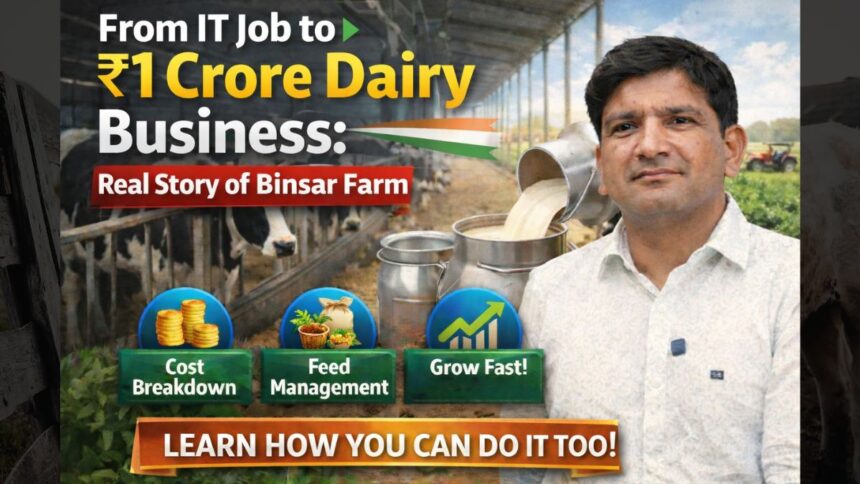
Binsar Dairy is a real example of what’s possible when you combine traditional values with modern dairy science. The founder — a former IT company manager from North India — left a well-paying corporate job, came back to his village near the Delhi-Haryana belt, and built a dairy operation from scratch.
Here’s what made it work:
1. Start Small, Learn Everything
The farm started with just 50 heifers, a bamboo shed, and zero dairy expertise. The first few years were brutal — wrong breeds purchased, diseases they didn’t know how to prevent, and heavy financial losses.
But instead of quitting, the team studied. They partnered with dairy experts from New Zealand (home to one of the world’s most cost-efficient milk production systems), learned about breed development, nutrition science, and farm management.
The lesson: Don’t start big. Start with 5–10 animals, understand the system, then scale.
2. People Are the Real Asset
The farm now employs 40–42 people: farm workers, a veterinarian, a gatekeeper, processing staff, packaging teams, and delivery personnel. That’s meaningful local employment created in one village.
But more importantly — the quality of your farm workers directly determines the quality of your output. A poorly managed cow will underperform no matter how expensive her breed is.
Hire slowly. Train consistently. Pay fairly.
3. Feed Management is 70% of Your Profitability
This is the single most overlooked aspect in Indian dairy farming.
Most farmers mix up fodder (roughage like green grass, silage, hay) and concentrate feed (grain-based, protein-rich). They’re not the same thing. Overfeeding concentrates wastes money. Underfeeding reduces milk output and delays reproduction.
The average dairy cow producing 20 litres per day needs a minimum ₹400/day in total feeding and maintenance costs. This includes:
Agropotli Profit Calculator
| Cost Component | Approx. Monthly Cost (per cow) |
|---|---|
| Green fodder | ₹2,000–₹3,000 |
| Dry fodder | ₹1,000–₹1,500 |
| Concentrate feed | ₹3,000–₹4,500 |
| Vitamins & minerals | ₹300–₹500 |
| Veterinary & vaccination | ₹500–₹800 |
| Labour (per cow share) | ₹800–₹1,200 |
| Total | ₹7,600–₹11,500/month |
Getting this balance right is where 3–5% savings become your actual profit margin in dairy.
4. The Reproduction Cycle Is Your Business Cycle
Here’s a critical fact that many new dairy farmers miss completely:
A cow only gives milk after she delivers a calf. If the gap between two calvings exceeds 14 months, you’re losing money every extra day.
The target inter-calving period should be 12–14 months maximum. To achieve this, the cow needs to be re-impregnated within 60–90 days after calving. That requires:
- Balanced nutrition (energy + protein + vitamins)
- Proper heat detection
- Timely artificial insemination (AI)
Farms that ignore this lose an entire lactation cycle — which can mean a loss of ₹40,000–₹80,000 per cow per year.
5. Calf Care = Future Milk Production
At Binsar Dairy, there’s a clear focus on raising healthy calves from day one. This isn’t sentiment — it’s economics.
A real example from their farm: Two twin calves were born from the same cow. One got diarrhea as a newborn and didn’t receive proper care. When both grew up and entered milking, the difference was 5–7 litres per day. The unhealthy calf also took 3 extra months to reach first calving — that’s 3 months of feed costs with zero milk income.
Invest in your calves. They are your future herd.
The Dairy Business Model That Actually Works in India
Phase 1: Production Side
- Maintain cost-efficient milk production
- Maintain proper breed development
- Keep inter-calving interval under 14 months
- Use seasonal feeding adjustments (cows need extra energy in summer)
Phase 2: Market Side
- Don’t just sell raw milk to a private company — they will underpay you
- Build your own customer base, even if you start with 50–100 litres/day
- Focus on quality: good fat levels, good SNF, no adulteration
- Package properly — glass bottles work exceptionally well for premium positioning
Binsar Dairy started selling directly to customers in a nearby township using glass bottle packaging — and demand grew rapidly. Today they supply hundreds of households with packaged milk and multiple dairy products.
Realistic Profit Potential in Dairy Business (India)
Here’s an honest breakdown for a small-to-medium dairy farm in North India:
Scale: 30 cows producing an average of 18 litres/day
| Item | Numbers |
|---|---|
| Daily milk production | ~540 litres |
| Selling price (direct/branded) | ₹60–₹80/litre |
| Daily revenue | ₹32,000–₹43,000 |
| Daily operating cost (~₹400/cow) | ₹12,000 |
| Gross daily margin | ₹20,000–₹31,000 |
| Monthly gross profit | ₹6–₹9 lakh |
This does not include:
- Value-added products (ghee, paneer, butter — which add significant margin)
- Organic manure income from gobar/cow dung
- Government subsidies under NABARD dairy schemes
The margins look thin at wholesale rates (₹28–₹35/litre to cooperatives). But direct-to-consumer or branded packaged milk changes everything.
Step-by-Step Guide to Starting a Dairy Business in India
Step 1: Learn Before You Invest
Spend 3–6 months visiting working dairy farms. Understand feed, breed, reproduction, and disease management. Don’t skip this step.
Step 2: Start with 5–10 Animals
Resist the urge to start with 50+ animals. Begin small, make your mistakes at low cost, and learn the system.
Step 3: Choose the Right Breed
- HF (Holstein Friesian) or Jersey cross: High milk output, requires more care
- Sahiwal or Gir: Indigenous, disease-resistant, lower input costs
- HF x Sahiwal cross: A good balance of yield and hardiness for North India
Step 4: Build Proper Infrastructure
- Well-ventilated shed (cross-ventilation critical in Haryana summers)
- Separate calving pen
- Clean water supply (cows drink 80–100 litres/day)
- Silage pit or green fodder cultivation land
Step 5: Set Up Feed Planning
Get a proper ration chart made for your herd based on body weight, milk yield, and stage of lactation. Work with a veterinary nutritionist if possible.
Step 6: Create a Vaccination & Health Calendar
- FMD vaccine: twice a year
- Brucellosis: once
- BQ, HS: once a year
- Deworming: every 3 months
Vaccination reduces disease losses far more than it costs. A 2-day milk dip during vaccination is worth avoiding a major outbreak.
Step 7: Focus on Direct Marketing from Day One
Don’t depend entirely on cooperatives or private milk companies. Build even 10 direct customers. Use proper packaging, maintain cold chain, and be consistent.
Step 8: Add Value Over Time
Once stable at milk production, slowly introduce ghee, paneer, lassi, or butter. These products carry 3–5x the margin of raw milk.
Contract Farming Integration: A Smart Twist
One strategy that works very well in the Haryana/UP belt is integrating contract farming with your dairy operation.
Here’s how Binsar Dairy does it:
- They partner with nearby farmers to grow maize/baby corn between wheat and paddy seasons
- Farmers sell baby corn heads to Azadpur Mandi (cash income for them)
- The leftover maize stalks and fodder come to the dairy farm at low cost
- The dairy gets nutritious green fodder cheaply; the farmer gets an extra crop income
Both sides win. This model also builds community trust and gives the farm a stable, local feed supply.
Case Study: From Bamboo Shed to Branded Dairy Brand
Starting point (Year 1): Bamboo shed, 50 heifers from Punjab, zero dairy knowledge, multiple disease losses.
Year 3: Infrastructure improved, New Zealand partnership established, breed development started, direct milk sales began in glass bottles.
Year 7: 40+ local employees, 5 nearby dairies opened using their technical support, farm averaging 15–16 litres/cow/day.
Year 10: Company profitable, milk average improved to 17–18 litres/cow/day through breed development, supplying hundreds of direct customers, multiple dairy products launched.
Key takeaway: Success in dairy farming takes 8–10 years of consistent work. Anyone promising results in 1–2 years is misleading you.
5 Common Mistakes to Avoid in Dairy Farming
1. Buying cattle without knowing the breed Always check the animal’s milk history, parentage if possible, and health records.
2. Ignoring calf health A sick calf becomes an underperforming cow. Calf care is not optional.
3. Selling only to private milk companies at wholesale rates You’ll never build a sustainable business at ₹28–₹32/litre. Develop your own customer base.
4. Skipping vaccinations to save money A single FMD outbreak can put your entire herd out of production for weeks. Vaccination costs are insurance.
5. Not tracking the inter-calving interval If you’re not monitoring when each cow last delivered, you’re running the farm blind.
The Role of Government Policy (And Why It Needs to Improve)
India’s dairy sector contributes more to agricultural GDP than wheat, paddy, and sugarcane combined. That’s a fact the PM himself acknowledged at a major dairy sector summit.
But the ground reality is that policy advisors rarely visit actual farms. Schemes get designed without input from farmers who are actually working the land.
What’s needed:
- A standing committee with real farmers, not just bureaucrats
- Private extension services (not just government veterinarians)
- International collaboration — countries like New Zealand have cracked cost-efficient milk production; their knowledge should flow into India faster
Until that happens, individual farmers need to educate themselves and build informal networks of knowledge-sharing.
Is a Dairy Business Worth It in India?
Yes — but only if you treat it like a business, not just a farm activity.
Dairy has consistent daily cash flow (you sell milk every day, not once a season), minimal wastage (manure becomes organic fertilizer), and scalable margins if you build your own brand and market.
The farmers making real money in dairy aren’t the ones with the most cows. They’re the ones who understand feed science, reproductive management, quality control, and direct marketing.
Start small. Learn everything. Build a brand. That’s the formula.
FAQs: Dairy Business in India
Q1. How much investment is needed to start a small dairy business in India? For a 10-cow setup with basic infrastructure, expect ₹8–₹12 lakh as initial investment (cattle + shed + equipment). NABARD offers dairy development loans covering up to 85% of project cost under the Dairy Entrepreneurship Development Scheme (DEDS).
Q2. Which cow breed is best for a dairy business in North India? HF-Sahiwal crossbreeds work well in Haryana, Punjab, and UP — they offer reasonable milk yield (15–20 litres/day) with better disease resistance than pure HF. Gir and Sahiwal are excellent for those targeting A2 milk markets.
Q3. What is the most profitable dairy product to sell in India? Desi ghee consistently commands the highest margins (₹600–₹1,200/kg depending on quality and brand). Paneer and butter are also strong. Packaged, branded milk sold directly to consumers at ₹60–₹80/litre is more profitable than wholesale.
Q4. How long does it take to become profitable in the dairy business? Realistically, 3–4 years to break even and 7–10 years to build a stable, profitable operation. Anyone claiming faster results is either very lucky or hiding the full picture.
Q5. Is organic dairy farming viable in India? Yes, and demand is growing — especially in urban markets. Organic certification takes 2–3 years of documented chemical-free practices. The premium is real (20–40% higher price) but requires strict feed and health management without synthetic inputs.