




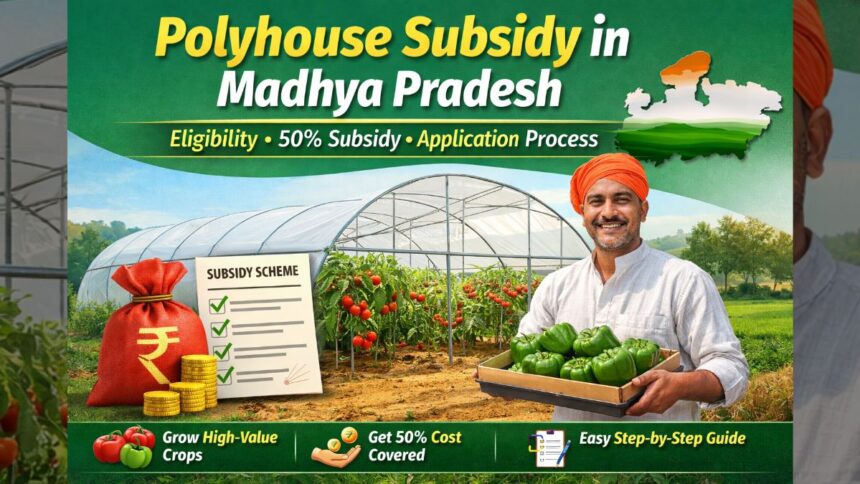
Polyhouse Subsidy in Madhya Pradesh: Imagine growing tomatoes, capsicum, or cucumbers all year round — no dependency on rain, no crop loss due to hailstorm, and double or triple the market price. Sounds like a dream, right?
- What Is a Polyhouse?
- Why Polyhouse Farming Makes Sense in Madhya Pradesh
- Polyhouse Subsidy in Madhya Pradesh (2025–26 Rates)
- Polyhouse Cost & Profit: Realistic Numbers for MP Farmers
- Actual Investment Breakdown (1000 sq. mt. Naturally Ventilated Polyhouse)
- Profit Potential (Capsicum / Shimla Mirch in 1000 sq. mt.)
- Agropotli Profit Calculator
- Eligibility Criteria for Polyhouse Subsidy in MP
- Documents Required for Polyhouse Subsidy Application in MP
- Step-by-Step Process to Apply for Polyhouse Subsidy in MP
- Step 1: Register on MP Kisan Portal
- Step 2: Get Vendor Quotation
- Step 3: Submit Online Application
- Step 4: Field Verification by Department
- Step 5: Approval & Work Order
- Step 6: Completion Certificate & First Installment
- Step 7: Second Installment
- Expert Tips to Get Your Subsidy Approved Faster
- Common Mistakes Farmers Make (And How to Avoid Them)
- Polyhouse Subsidy: Central vs State Component (Quick Comparison)
- Is the Polyhouse Subsidy Worth It?
- FAQs: Polyhouse Subsidy in Madhya Pradesh
Well, for thousands of farmers in Madhya Pradesh, this dream is becoming a reality — and the MP government is actually paying a big chunk of the cost.
The polyhouse subsidy in Madhya Pradesh under the National Horticulture Mission (NHM) and Pradhan Mantri Krishi Sinchayee Yojana can cover up to 50% of your polyhouse construction cost. That’s lakhs of rupees back in your pocket.
But most farmers miss out — not because they’re ineligible, but because they don’t know the exact process or paperwork.
In this guide, we’re breaking down everything: who qualifies, how much you’ll get, what documents you need, and exactly how to apply Polyhouse Subsidy in Madhya Pradesh — step by step.
What Is a Polyhouse?
A polyhouse (also called a protected cultivation structure) is a tunnel-like structure covered with UV-treated polyethylene film. Inside, you can control temperature, humidity, and light — creating the perfect growing environment for vegetables, flowers, and herbs.
There are mainly three types used in MP:
- Naturally Ventilated Polyhouse (NVH): Most common, uses natural airflow. Suitable for most crops.
- Fan & Pad Polyhouse: Has cooling system. Used in hot zones like Vidarbha belt.
- Shade Net House: More affordable. Good for nurseries and leafy vegetables.
For subsidy purposes under MP Udyan Vibhag (Horticulture Department), all three types qualify under different cost norms.
Why Polyhouse Farming Makes Sense in Madhya Pradesh
MP has diverse agroclimatic zones — from the Malwa plateau to Bundelkhand to Mahakoshal. Open-field farming in many of these regions is a gamble with weather. Polyhouse changes that equation completely.
Here’s why serious farmers are making the switch:
- Year-round production — grow off-season vegetables when market prices are 3–5x higher
- 80% less water usage with drip irrigation inside polyhouse
- Higher yield per acre — polyhouse tomato yields 120–150 tonnes/acre vs 20–25 tonnes in open field
- No pest/disease pressure like open farms — less pesticide cost
- Premium pricing — supermarkets and exporters pay top rupee for protected-cultivation produce
The subsidy makes the entry cost much more manageable for small and marginal farmers.
Polyhouse Subsidy in Madhya Pradesh (2025–26 Rates)
This is what everyone wants to know — toh seedha baat karte hain.
Under the National Horticulture Mission (NHM) implemented through the MP Horticulture Department:
| Structure Type | Govt. Cost Norm (per sq. mt.) | Subsidy % | Max Subsidy (per unit) |
|---|---|---|---|
| Naturally Ventilated Polyhouse | ₹935/sq. mt. | 50% | ₹56 lakhs (for 4000 sq. mt.) |
| Fan & Pad Polyhouse | ₹1,290/sq. mt. | 50% | ₹77 lakhs (for 4000 sq. mt.) |
| Shade Net House (flat) | ₹355/sq. mt. | 50% | ₹21 lakhs (for 4000 sq. mt.) |
Note: These are government benchmark norms. Actual market construction costs may be slightly higher. Subsidy is calculated on the government norm, not your actual bill.
For SC/ST and small & marginal farmers, some state components offer an additional 10–15% top-up over the central government’s 50%.
Polyhouse Cost & Profit: Realistic Numbers for MP Farmers
Actual Investment Breakdown (1000 sq. mt. Naturally Ventilated Polyhouse)
| Item | Estimated Cost |
|---|---|
| Polyhouse structure (1000 sq. mt.) | ₹9,35,000 |
| Drip irrigation system | ₹70,000 |
| Levelling & soil preparation | ₹20,000 |
| Seedlings + inputs (1st crop) | ₹35,000 |
| Miscellaneous | ₹15,000 |
| Total Investment | ~₹10,75,000 |
| Government subsidy (50%) | ~₹4,67,500 |
| Your actual cost (after subsidy) | ~₹6,07,500 |
Profit Potential (Capsicum / Shimla Mirch in 1000 sq. mt.)
- Average yield: 8,000–10,000 kg per crop cycle (3–4 months)
- Farm gate price: ₹40–80/kg (off-season can go ₹100+)
- Revenue per cycle: ₹3,20,000 – ₹8,00,000
- Input cost per cycle: ₹70,000 – ₹1,00,000
- Net profit per cycle: ₹2,50,000 – ₹6,00,000
- 2 crops per year = ₹5,00,000 – ₹12,00,000 annual profit
Your investment (post-subsidy) typically recovers within 1.5 to 2.5 years. After that, it’s mostly profit for 10–15 years.
Agropotli Profit Calculator
Eligibility Criteria for Polyhouse Subsidy in MP
Before you run to the office, check if you actually qualify. Here’s the straightforward eligibility list:
Basic Eligibility:
- Must be a resident farmer of Madhya Pradesh
- Must own or lease agricultural land (minimum 0.1 hectare / ~0.25 acre)
- Valid bank account linked with Aadhaar
- Registered on MP Kisan Portal or willing to register
Priority Given To:
- Small and marginal farmers (land holding below 2 hectares)
- SC/ST farmers
- Women farmers
- Farmer Producer Organization (FPO) members
- Farmers in designated Horticulture Zones / Clusters
Who is NOT Eligible:
- Farmers who have already taken subsidy for the same structure in the last 5 years
- Farmers with pending dues/defaulters with cooperative banks (in some cases)
- Non-agricultural land holders
Documents Required for Polyhouse Subsidy Application in MP
Keep these ready before you apply — incomplete documents are the #1 reason applications get rejected:
- Aadhaar Card (self-attested copy)
- Khasra/Khatauni (land record — from patwari or MP Bhulekh portal)
- Bank passbook (first page with account details)
- Passport-size photographs (2–3 copies)
- Caste certificate (if applying under SC/ST category)
- Quotation/estimate from an approved polyhouse vendor/supplier
- Site map / sketch of proposed polyhouse location on your land
- Mobile number linked with Aadhaar
- MP Kisan App registration or Farmer ID
Step-by-Step Process to Apply for Polyhouse Subsidy in MP
Yeh process seedha aur simple hai — agar aap sahi kram follow karo:
Step 1: Register on MP Kisan Portal
Go to mpfsts.mp.gov.in or the MP Udyan (Horticulture) Department portal. Create your farmer login using Aadhaar and mobile OTP.
Step 2: Get Vendor Quotation
Contact an NHM-approved polyhouse vendor in your district. Get a written quotation with GST details. This is mandatory — you cannot submit application without it.
Step 3: Submit Online Application
Log in to the portal → Select “Protected Cultivation” scheme → Fill in land details, bank info, structure type → Upload all documents.
Step 4: Field Verification by Department
After submission, a Horticulture Department officer visits your site. They verify land suitability, soil condition, water source, and quotation reasonableness. Be present on the day of inspection.
Step 5: Approval & Work Order
Once verified, you receive official approval via SMS/portal. Now you can begin construction with the approved vendor.
Step 6: Completion Certificate & First Installment
After construction (usually within 90 days), department officer does final inspection. If satisfactory, the first subsidy installment (typically 50–75% of total subsidy) is released directly to your bank via DBT.
Step 7: Second Installment
After 6 months of crop growing evidence (photos, bills, crop diary), the remaining subsidy installment is released.
Pro Tip: Always maintain a crop diary with photographs. Many farmers lose their second installment simply because they have no proof of cultivation.
Expert Tips to Get Your Subsidy Approved Faster
From what we’ve seen talking to farmers across Indore, Jabalpur, Rewa, and Sehore districts — these tips make a real difference:
1. Apply at the start of the financial year (April–June) Budget allocations get exhausted by November–December. Early birds get the subsidy; latecomers get waitlisted.
2. Choose an NHM-empanelled vendor only If your vendor isn’t on the approved list, your application gets rejected outright. Ask the district horticulture office for the empanelled vendor list.
3. Keep your Khasra-Khatauni updated Outdated land records are a very common rejection reason. Visit your patwari before applying.
4. Don’t start construction before approval Starting before official approval disqualifies you from subsidy. Many eager farmers make this mistake.
5. Keep track of application status Log in to the portal weekly. If there’s a document query, respond fast — unanswered queries lead to cancellation after 30 days.
Common Mistakes Farmers Make (And How to Avoid Them)
Let’s be honest — the subsidy process has some friction. Here’s where most people go wrong:
- Choosing unapproved vendors to “save money” — and then losing the subsidy entirely
- Submitting wrong khasra number — always double-check with your land record
- Not linking Aadhaar with bank account — DBT payment fails without this
- Skipping crop evidence photos — results in second installment being stuck
- Missing site inspection appointment — department officers don’t reschedule easily; always confirm the date
- Applying for size larger than your land — if you apply for 4000 sq. mt. but your land is 3000 sq. mt., your application gets flagged
Polyhouse Subsidy: Central vs State Component (Quick Comparison)
Many farmers get confused about where the money comes from. Here’s a simple breakdown:
| Component | Source | Share |
|---|---|---|
| Central subsidy (NHM/MIDH) | Government of India | 60% of total subsidy |
| State share | MP Government | 40% of total subsidy |
| Additional top-up (SC/ST/Women) | MP State Budget | Extra 10–15% |
Both components are released together as a single DBT payment to your bank account — you don’t need to chase two different departments.
Is the Polyhouse Subsidy Worth It?
Now the straight answer: Yes, it is definitely worth it — if you’re serious about farming as a business.
The polyhouse subsidy in Madhya Pradesh makes one of the most profitable farming technologies accessible to small farmers. With 50% cost covered by the government, the financial risk drops significantly. And with crops like capsicum, cucumber, cherry tomato, and gerbera giving returns of ₹5–12 lakhs per year from just 1000 sq. mt., the math works clearly in your favor.
The process takes patience — typically 4–6 months from application to first subsidy installment. But the long-term returns make that wait very worthwhile.
Start by visiting your district’s Udyan Vibhag (Horticulture Department) office, or apply online through the MP FSTS portal. If you need help with the application or vendor selection, our team at Agropotli can guide you.
FAQs: Polyhouse Subsidy in Madhya Pradesh
Q1. How much subsidy do farmers get for polyhouse in Madhya Pradesh? Farmers in MP get 50% subsidy on the government-defined cost norm. For a 1000 sq. mt. naturally ventilated polyhouse (cost norm ₹935/sq. mt.), the subsidy is approximately ₹4.67 lakhs. SC/ST and women farmers may get additional state top-up benefits.
Q2. Which government scheme provides polyhouse subsidy in Madhya Pradesh? The primary scheme is the National Horticulture Mission (NHM) under the Mission for Integrated Development of Horticulture (MIDH), implemented by the MP Horticulture & Food Processing Department. Some components also come under PMKSY.
Q3. How long does it take to get polyhouse subsidy approved in MP? From application submission to first subsidy release, the process typically takes 3 to 6 months — including field inspection, construction, and final verification. Apply early in the financial year (April–June) for faster processing.
Q4. Can a tenant farmer or leased land farmer apply for polyhouse subsidy in Madhya Pradesh? Yes, farmers with registered lease agreements (at least 7 years) can apply. The lease agreement must be notarized and registered, and the landowner’s NOC may be required in some districts.
Q5. Where do I apply for polyhouse subsidy in Madhya Pradesh online? Apply through the official portal: mpfsts.mp.gov.in (MP Farmer Subsidy Tracking System). You can also visit your district Udyan Vibhag office or contact the nearest Krishi Vigyan Kendra (KVK) for guided assistance.
- Button Mushroom Farming: High Returns, But One Mistake Can Ruin the Crop
- Pig Farming in India: Fast Profits, Huge Demand, But One Disease Can Wipe You Out
- Mango Farming Business: Does Exporting Really Pay ₹100/kg?
- Bajra Flour Shelf Life: How One Millet Startup Turned a 10-Day Problem Into a 6-Month Opportunity
- The Basmati Rice Farming Business Is Huge. Farmers Don’t Get the Whole Story