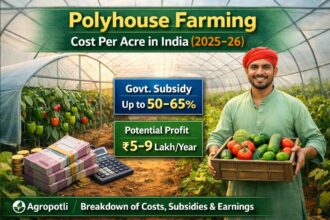





Imagine setting up a polyhouse worth ₹40 lakhs — and the government quietly offers to pay ₹20–30 lakhs of it. No catch. Just paperwork most farmers never bother to read.
- What Is a Polyhouse Subsidy?
- Why Polyhouse Farming Matters for Indian Farmers in 2026
- Central Government Polyhouse Subsidy Schemes in 2026
- 1. NHB (National Horticulture Board) Subsidy
- 2. NHM (National Horticulture Mission) Subsidy
- 3. NABARD Support
- State-wise Polyhouse Subsidy Guide 2026
- Haryana
- Maharashtra
- Rajasthan
- Gujarat
- Uttar Pradesh
- Himachal Pradesh
- Karnataka & Tamil Nadu
- Telangana & Andhra Pradesh
- North-Eastern States (Assam, Meghalaya, Nagaland, Tripura, etc.)
- Polyhouse Cost Breakdown (India-Specific, 2026)
- Profit Potential: What Can You Realistically Earn?
- Step-by-Step: How to Apply for Polyhouse Subsidy in India
- Documents Required for Polyhouse Subsidy Application
- Success Story: Khemaram from Rajasthan’s Desert
- Expert Tips: How to Maximize Your Polyhouse Subsidy
- Common Mistakes to Avoid
- NHB vs NHM: Which Scheme is Better for You?
- Conclusion: Is Polyhouse Farming with Subsidy Worth It in 2026?
- FAQs: Polyhouse Subsidy in India 2026
That is exactly what the polyhouse subsidy scheme does. Every year, thousands of farmers across India miss out on this financial support simply because they don’t know it exists, or they start construction too early and lose eligibility entirely.
If you are a farmer, an agri-entrepreneur, or even someone thinking about getting into protected cultivation — this guide is your starting point. We’ll break down every polyhouse subsidy scheme in India for 2026, state by state, with real numbers and a step-by-step process you can follow tomorrow morning.
No jargon. No fluff. Just what you need to know.
What Is a Polyhouse Subsidy?
A polyhouse is a structure covered with UV-stabilized polyethylene film where crops are grown in a controlled environment — protected from rain, extreme heat, pests, and off-season conditions. Think of it as giving your crops a “safe home” regardless of what the weather does outside.
Now, setting up a polyhouse is expensive. A basic naturally ventilated polyhouse of 1 acre (4,000 sq. meters) can cost anywhere from ₹25–50 lakhs depending on the type and location.
That’s where the polyhouse subsidy comes in.
The central government, through schemes like the National Horticulture Board (NHB) and National Horticulture Mission (NHM) under the Mission for Integrated Development of Horticulture (MIDH), provides up to 50% of the total project cost as a grant — meaning you don’t repay it. Several states add a top-up on this, pushing total support to 65–95% for eligible farmers.
Why Polyhouse Farming Matters for Indian Farmers in 2026
Before we get into schemes, let’s be clear on why this investment makes sense.
Traditional open-field farming is unpredictable. One bad monsoon, one hailstorm, one pest attack — and the season is gone. Polyhouse farming changes that equation fundamentally:
- Yield is 5–10x higher compared to open field cultivation
- Year-round production regardless of season or climate
- Water savings of 50–70% through drip and fertigation systems
- Premium crop quality that commands higher mandi and export prices
- Faster ROI — most farmers recover costs in 2–3 years with high-value crops like capsicum, Dutch roses, and cherry tomatoes
The combination of government subsidy + premium crop income makes this one of the most financially sound decisions a farmer can make right now.
Central Government Polyhouse Subsidy Schemes in 2026
1. NHB (National Horticulture Board) Subsidy
This is the flagship polyhouse subsidy scheme for large commercial projects across India.
| Parameter | Details |
|---|---|
| Subsidy Rate | 50% of project cost |
| Maximum Subsidy (General Area) | ₹56 Lakhs per project |
| Maximum Subsidy (NE/Hilly States) | Up to ₹1 Crore |
| Minimum Area (General) | 4,000 sq. meters |
| Minimum Area (NE/Hilly) | 1,000 sq. meters |
| Type | Credit-Linked, Back-Ended |
| Application Portal | nhb.gov.in |
What “Credit-Linked, Back-Ended” means: You first take a bank loan and build the polyhouse. After a government inspection confirms the structure, the subsidy amount is directly credited to your bank loan account — reducing what you owe. You cannot self-finance and claim NHB subsidy.
2. NHM (National Horticulture Mission) Subsidy
For small and medium farmers, NHM under MIDH is often a better fit.
| Parameter | Details |
|---|---|
| Subsidy Rate | 50% of project cost |
| Area Coverage | 500 sq. meters to 4,000 sq. meters |
| Who Manages It | District Horticulture Officer (DHO) |
| Application | State-specific portals |
This scheme is accessible to farmers with smaller landholdings and is managed at the district level, making it easier to apply and track.
3. NABARD Support
NABARD does not directly give polyhouse subsidies but plays a critical backend role — it refinances banks to ensure the subsidy amounts get properly credited to farmers’ loan accounts. NABARD also runs special financing support for Farmer Producer Organizations (FPOs) getting into protected cultivation.
State-wise Polyhouse Subsidy Guide 2026
Here’s the part most guides skip. Central government gives 50%, but many states add their own top-up. Here’s a quick state-by-state breakdown:
Haryana
- Total Subsidy: Up to 65–70% (50% central + 15–20% state top-up)
- SC/ST Farmers: Higher support available
- Apply at: hodahorticulture.com or local DHO office
- Best Crops: Capsicum, cucumber, tomato
Maharashtra
- Total Subsidy: 50–75% depending on farmer category and project size
- Max Subsidy per 100 sq. m: ₹70,000–₹90,000
- Apply at: mahadbt.maharashtra.gov.in under Horticulture Department
- Best Crops: Gerbera, tomato, colored capsicum
Rajasthan
- Total Subsidy: 50–70%
- Small & Marginal/SC/ST Farmers: Higher slabs available
- Max Area: 4,000 sq. meters
- Apply at: rajkisan.rajasthan.gov.in
- Note: Rajasthan has become a model state for polyhouse farming — villages like Gurha Kumawatan in Sikar district show what’s possible
Gujarat
- Total Subsidy: Up to 65%
- Apply at: ikhedut.gujarat.gov.in
- Best Crops: Exotic vegetables, flowers
Uttar Pradesh
- Total Subsidy: 50%
- Apply at: Local horticulture department or upagripardarshi.gov.in
- Note: State subsidy was ₹20 lakh on a ₹43 lakh project in recent documented cases
Himachal Pradesh
- Total Subsidy: Up to 85% for general farmers; 70% for polysheet replacement
- Strength: Highest state support in India for hilly terrain
Karnataka & Tamil Nadu
- Total Subsidy: 50% (central) + state-level top-ups under state horticulture mission
- Apply at: Respective state horticulture department portals
Telangana & Andhra Pradesh
- SC/ST Farmers: Up to 95% subsidy (one of the highest in the country)
- General Farmers: 75%
- Apply at: State horticulture department offices
North-Eastern States (Assam, Meghalaya, Nagaland, Tripura, etc.)
- Minimum area requirement reduced to 1,000 sq. meters
- Total Subsidy: Up to ₹1 Crore under NHB
- Special priority given under MIDH for hilly and tribal regions
Pro Tip: Always check your state agriculture department website before applying. Scheme budgets and percentages can change annually. The central 50% under NHB/NHM is fairly stable, but state top-ups vary.
Polyhouse Cost Breakdown (India-Specific, 2026)
Here’s what you are actually paying before subsidy:
| Polyhouse Type | Cost per Sq. Meter | 1-Acre (4000 sq.m) Total Cost |
|---|---|---|
| Basic Tunnel / Low-tech | ₹600–700 | ₹24–28 Lakhs |
| Naturally Ventilated (NVPH) | ₹800–1,100 | ₹32–44 Lakhs |
| Fan-Pad / Climate Controlled | ₹1,500–2,500 | ₹60–1 Crore |
| Full Automation / Hi-tech | ₹3,000–4,000 | ₹1.2–1.6 Crore |
Important Reality Check: The government’s “cost norm” (the price they calculate subsidy on) is often lower than current market rates due to steel price hikes and GST. For example, if the government norm is ₹1,000/sq.m but actual construction costs ₹1,100/sq.m, your subsidy is calculated only on the norm — not the actual cost. Your effective subsidy works out to roughly 35–40% of your real expense, not 50%.
Always keep 15–20% extra cash beyond your margin money to cover this gap.
Profit Potential: What Can You Realistically Earn?
Let’s talk numbers. Assuming a 1-acre (4,000 sq.m) Naturally Ventilated Polyhouse growing colored capsicum:
| Parameter | Amount |
|---|---|
| Total Project Cost | ₹38 Lakhs |
| Government Subsidy (50%) | ₹16–19 Lakhs (on cost norm) |
| Your Bank Loan | ~₹20 Lakhs |
| Your Margin Money (25%) | ~₹7–8 Lakhs |
| Annual Gross Revenue (Capsicum) | ₹25–35 Lakhs |
| Annual Operating Expenses | ₹8–12 Lakhs |
| Net Annual Profit | ₹13–22 Lakhs |
| Loan Recovery Period | 2–3 Years |
For flowers like Dutch Roses, profits can be even higher — ₹20–30+ lakhs per acre annually with good market linkage.
These are realistic, not best-case numbers. Actual profits depend on crop selection, market access, and management quality.
Agro Potli Daily Farm Expense Tracker
Step-by-Step: How to Apply for Polyhouse Subsidy in India
Follow this sequence strictly. One wrong step and you can lose your entire subsidy claim.
Step 1 — Site Selection Ensure your land is level, has road access, electricity, and water source. Get soil and water testing done. If water EC is above 1.0, plan for an RO system.
Step 2 — Get Multiple Vendor Quotes Contact at least 3–4 polyhouse vendors for structure cost estimates. This is essential for building your DPR.
Step 3 — Prepare a Detailed Project Report (DPR) Your DPR should include construction costs, crop plan, irrigation details, market linkage, and financial projections. This is the most important document in the entire process.
Step 4 — Bank Sanction Approach a nationalized bank (SBI, Bank of Baroda, Canara Bank) with your DPR. Get a Term Loan sanction letter. Without this, your NHB application cannot proceed.
Step 5 — Apply Online to NHB or State Horticulture Department For NHB: Apply at nhb.gov.in with your DPR, bank sanction, land documents, Aadhaar, and other required documents. Processing fee: ₹5,000–₹10,000. For NHM/State Schemes: Apply at your state-specific portal (ikhedut.gujarat.gov.in, rajkisan.rajasthan.gov.in, mahadbt.maharashtra.gov.in, etc.)
Step 6 — Wait for In-Principle Approval (IPA) / Letter of Intent (LOI) DO NOT start construction before receiving this letter. This is the most common and most expensive mistake farmers make. The government will reject your claim if you build before LOI.
Step 7 — Start Construction After LOI Once you have the LOI, begin civil work — foundation, structure, drip system, climate control, etc. Build exactly as described in your DPR. Do not deviate without prior written approval.
Step 8 — Request Joint Inspection After construction, inform the board. A Joint Inspection Team (JIT) — comprising bank officials, NHB/NHM officers, and state agriculture officers — will physically verify your farm against the DPR.
Step 9 — Subsidy Released to Your Loan Account If the JIT report is positive, the subsidy is transferred directly to your bank account, reducing your outstanding loan. Done.
Documents Required for Polyhouse Subsidy Application
- Land ownership documents (7/12, Khatauni, Patta)
- Aadhaar card and PAN card
- Bank passbook (account where subsidy will be credited)
- Caste certificate (for SC/ST/OBC categories)
- Bank-sanctioned loan letter / Term Loan approval
- Detailed Project Report (DPR)
- Quotations from polyhouse vendors
- Passport-size photographs
- Soil and water test reports
Success Story: Khemaram from Rajasthan’s Desert
Khemaram Saini from Gurha Kumawatan village in Sikar district, Rajasthan, took a bet on polyhouse farming when his neighbors called it a “palace of dreams” that would end in debt.
The polyhouse setup cost ₹40 lakhs. The government covered ₹30 lakhs as subsidy and arranged low-interest loans through state banks. Agricultural university experts provided technical support at no extra cost.
He planted hybrid seedless cucumbers — and harvested his first crop within a month.
“My very first cucumber crop earned me ₹13.6 lakh in just three months,” Khemaram recalls. That single harvest silenced every critic in the village.
Today, his village has dozens of polyhouses. Farmers who once struggled with erratic monsoons now supply premium-quality cucumbers to urban markets year-round. An FPC (Farmer Producer Company) has been formed to negotiate better rates and explore export markets.
Khemaram’s story is not an exception — it’s a blueprint.
Expert Tips: How to Maximize Your Polyhouse Subsidy
Choose the Right Scheme First. If your project is above 4,000 sq.m, go for NHB. If smaller, NHM through your state is the better route. Don’t apply to both for the same project — it’s not allowed.
Get Your DPR Done Professionally. A poorly written DPR is the most common reason for rejection. Hire an agriculture consultant or reach out to your Krishi Vigyan Kendra (KVK) for help.
Fix Your Market Before You Build. A polyhouse without a buyer is just an expensive shed. Before construction, tie up with a local mandi agent, supermarket chain, export house, or start a direct customer network.
Grow High-Value Crops Only. Wheat and regular tomatoes won’t give you the ROI to justify the investment. Stick to colored capsicum, Dutch roses, gerbera, seedless cucumber, or cherry tomatoes.
Combine Subsidies Where Possible. In many states, you can combine a polyhouse subsidy with drip irrigation subsidy, micro-irrigation support, and soil health card schemes — significantly reducing your total cash outflow.
Common Mistakes to Avoid
Starting construction before LOI — This is the single biggest mistake and an immediate disqualification. No exceptions.
Deviating from the DPR during construction — If your DPR says naturally ventilated polyhouse with capsicum, don’t build a net house and grow cucumbers. The JIT inspection will catch it.
Not understanding the cost norm gap — Many farmers assume they’ll get 50% of their actual bill. They won’t. The subsidy is on the government’s cost norm, which may be lower than your real cost. Plan accordingly.
Taking a short lease on land — NHB requires the land lease to be for at least 10+ years. A 5 or 7-year lease will disqualify you.
Ignoring water quality — High EC water can destroy an entire crop in a polyhouse. Test first, plan your irrigation accordingly.
NHB vs NHM: Which Scheme is Better for You?
| Feature | NHB | NHM |
|---|---|---|
| Best For | Large commercial projects | Small & medium farmers |
| Minimum Area | 4,000 sq.m (general) | 500 sq.m |
| Max Subsidy | ₹56 Lakhs – ₹1 Crore | Varies by state |
| Application | nhb.gov.in (centralized) | State portals (district level) |
| Processing Time | Longer (3–6 months) | Relatively faster |
| Complexity | Higher | Lower |
If you are a first-time farmer with 500–2,000 sq.m, go with NHM through your state. It’s more accessible and processed at the district level. If you’re planning a commercial operation above 1 acre, NHB gives you the highest subsidy ceiling.
Conclusion: Is Polyhouse Farming with Subsidy Worth It in 2026?
Yes — if you do it right.
The polyhouse subsidy scheme in India in 2026 is one of the most generous government support programs available to farmers today. With 50% central support and state top-ups ranging from 65% to 95% for eligible categories, the actual cash you need to put in is far less than most people assume.
The key is sequencing. Apply first. Get your LOI. Then build. Build exactly what your DPR says. Choose high-value crops. Secure your market before harvest.
Farmers like Khemaram in Rajasthan and Kamlesh Mishra in UP have already proven the model works. The government has made the money available. The question is whether you’re going to claim it.
Apni zameen par, sarkari madad se, protected farming ki shuruat karo — 2026 se behtar waqt nahi milega.
FAQs: Polyhouse Subsidy in India 2026
Q1. How much polyhouse subsidy can I get in India in 2026? Under the central government’s NHB scheme, you can get up to 50% of the project cost, with a maximum of ₹56 lakhs for general areas and up to ₹1 crore for hilly and North-Eastern states. With state government top-ups, total support can reach 65–95% depending on your state and category (SC/ST/General).
Q2. Can I build the polyhouse first and then apply for subsidy? No. This is one of the most important rules. You must apply first, get the In-Principle Approval (IPA) or Letter of Intent (LOI) from NHB or your state horticulture department, and only then begin construction. Building before LOI will permanently disqualify your application.
Q3. Which state gives the highest polyhouse subsidy in India? Telangana and Andhra Pradesh offer up to 95% subsidy for SC/ST farmers. Himachal Pradesh offers up to 85% for general farmers in hilly areas. Haryana, Gujarat, and Maharashtra offer 65–75% when state top-ups are combined with central schemes.
Q4. What is the minimum area required to apply for a polyhouse subsidy? For the NHB scheme, the minimum is 4,000 sq. meters for general areas and 1,000 sq. meters for hilly and North-Eastern states. For NHM through state horticulture departments, you can apply with as little as 500 sq. meters, making it accessible for smaller landholdings.
Q5. Is the polyhouse subsidy a loan or a grant? The polyhouse subsidy is a back-ended grant — meaning you do not repay it. However, since it is credit-linked, you must first take a bank loan. After the government inspects and approves your completed polyhouse, the subsidy amount is directly credited to your bank loan account, reducing your repayment burden.
If you found this guide helpful, share it with a fellow farmer. For more practical guides on government schemes, polyhouse crops, and agri-business tips, explore Agro Potli — your trusted partner in modern farming.
Tags: polyhouse subsidy, polyhouse subsidy India 2026, NHB subsidy, NHM subsidy, MIDH scheme, polyhouse farming, protected cultivation subsidy, polyhouse subsidy state-wise, how to apply polyhouse subsidy, polyhouse subsidy Maharashtra, polyhouse subsidy Rajasthan, polyhouse subsidy Haryana