




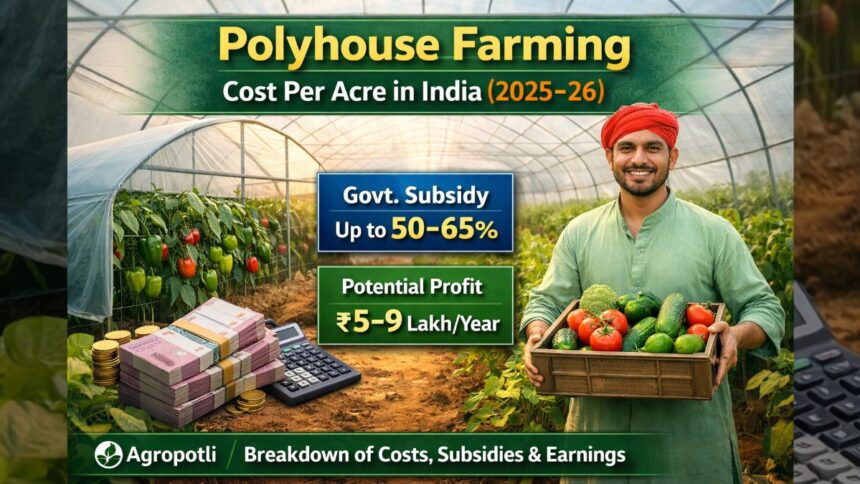
If you’ve been hearing about polyhouse farming and wondering whether it’s actually worth the lakhs you’ll spend setting it up — you’re not alone. Most farmers either dive in without a plan or stay away thinking it’s only for big investors.
- What Is Polyhouse Farming?
- Why Polyhouse Farming Is Worth Considering
- Polyhouse Farming Cost Per Acre in India – Detailed Breakdown
- 1. Polyhouse Structure Cost
- Agropotli Profit Calculator
- 2. Irrigation & Fertigation System
- 3. Land Preparation & Soil Work
- 4. Planting Material & Seeds
- Agro Potli Daily Plant Audit Tool
- 5. Annual Running Costs (Year 1)
- Total Polyhouse Farming Cost Per Acre (First Year)
- Government Subsidy on Polyhouse Farming
- Polyhouse Farming Income & Profit Potential
- Tomato (Cherry/Hybrid Variety)
- Capsicum (Coloured)
- Rose (Cut Flower)
- Cucumber
- Net Profit Estimate (From Year 2 Onwards)
- Step-by-Step Process to Start Polyhouse Farming
- Expert Tips for Polyhouse Farming Success
- Common Mistakes to Avoid
- Naturally Ventilated vs Hi-Tech Polyhouse – Which One?
- Is Polyhouse Farming Worth It?
- FAQs – Polyhouse Farming Cost in India
The truth? Polyhouse farming can give you 3–5x more income than open-field farming on the same land — but only if you understand the real costs upfront. No sugarcoating, no vague estimates.
In this guide, we’ll break down the polyhouse farming cost per acre in India — structure, equipment, crops, running expenses — with real numbers you can actually use to plan.
What Is Polyhouse Farming?
A polyhouse is a structure covered with UV-stabilized polyethylene film or plastic sheets. It creates a controlled environment — regulating temperature, humidity, and sunlight — so crops can grow year-round, even in harsh seasons.
It’s not magic. It’s engineering applied to farming.
You can grow vegetables, flowers, herbs, and exotic crops inside a polyhouse that wouldn’t survive outside in the same conditions. That’s the core advantage — control over your crop’s environment = control over your income.
Why Polyhouse Farming Is Worth Considering
Let’s be straight — polyhouse farming isn’t for everyone. But here’s why serious agri-entrepreneurs are increasingly choosing it:
- Year-round production: No dependency on monsoon or season
- 2–3x higher yield compared to open-field cultivation
- Better crop quality: Uniform color, size, and shelf life — fetching premium prices
- Less pesticide use: Protected environment means fewer pest attacks
- Export-grade produce: Tomatoes, capsicum, cucumber, roses — high demand in domestic and export markets
- Government subsidy support: National Horticulture Board (NHB) and state governments offer 50–65% subsidy in many states
Polyhouse Farming Cost Per Acre in India – Detailed Breakdown
This is the section most blogs get wrong — they give vague ranges. We’ll give you specific numbers with categories.
Note: Costs vary by state, structure type, and crop. The numbers below are 2024–25 estimates for a naturally ventilated polyhouse (NVP) — the most common type for Indian farmers.
1. Polyhouse Structure Cost
The structure is the biggest upfront investment.
| Component | Cost Estimate (Per Acre) |
|---|---|
| GI pipes / MS frame | ₹8–12 lakh |
| UV film / polyethylene cover | ₹3–4 lakh |
| Shade net (side/top) | ₹1–1.5 lakh |
| Foundation & civil work | ₹2–3 lakh |
| Total Structure Cost | ₹14–20 lakh |
Agropotli Profit Calculator
A fanpad (hi-tech) polyhouse costs significantly more — ₹35–50 lakh per acre — and is suitable for crops like exotic vegetables, orchids, or export-quality roses.
2. Irrigation & Fertigation System
Polyhouse farming almost always uses drip irrigation with fertigation (fertilizer through drip lines). This saves water and boosts efficiency.
| Item | Cost (Per Acre) |
|---|---|
| Drip irrigation system | ₹1.5–2.5 lakh |
| Fertigation unit | ₹50,000–1 lakh |
| Water pump & piping | ₹30,000–50,000 |
| Total Irrigation Cost | ₹2.5–4 lakh |
3. Land Preparation & Soil Work
| Item | Cost |
|---|---|
| Soil testing & treatment | ₹10,000–20,000 |
| Land levelling | ₹15,000–30,000 |
| Organic matter / coco peat / substrate | ₹40,000–80,000 |
| Total | ₹65,000–1.3 lakh |
4. Planting Material & Seeds
This depends heavily on the crop. Here’s what to expect:
- Tomato/Cucumber/Capsicum seedlings: ₹40,000–80,000 per acre
- Rose/Gerbera planting material: ₹1.5–4 lakh per acre (imported varieties cost more)
- Exotic herbs/leafy greens: ₹25,000–60,000 per acre
Agro Potli Daily Plant Audit Tool
5. Annual Running Costs (Year 1)
These are ongoing expenses after setup:
| Expense | Annual Cost (Per Acre) |
|---|---|
| Labour (2–3 workers) | ₹2–3 lakh |
| Fertilizers & nutrients | ₹80,000–1.2 lakh |
| Pesticides / bio-control | ₹30,000–60,000 |
| Electricity (pump, cooling) | ₹40,000–80,000 |
| Miscellaneous | ₹20,000–40,000 |
| Total Running Cost | ₹3.7–5.8 lakh/year |
Total Polyhouse Farming Cost Per Acre (First Year)
| Category | Cost Range |
|---|---|
| Structure | ₹14–20 lakh |
| Irrigation & fertigation | ₹2.5–4 lakh |
| Land & soil prep | ₹65,000–1.3 lakh |
| Planting material | ₹50,000–4 lakh |
| Running costs (Year 1) | ₹3.7–5.8 lakh |
| Grand Total (Year 1) | ₹21–35 lakh |
From Year 2 onwards, you only bear the running costs (₹4–6 lakh/year) since the structure is already in place.
Government Subsidy on Polyhouse Farming
Good news — you don’t have to pay the full amount yourself.
Under the National Horticulture Mission (NHM) and Rashtriya Krishi Vikas Yojana (RKVY), farmers get:
- 50% subsidy for general farmers
- 65% subsidy for SC/ST farmers
This subsidy applies to the structure cost only. So if your structure costs ₹18 lakh, you may get ₹9–11.7 lakh as government support.
State-wise, additional subsidies are available in: Maharashtra, Karnataka, Gujarat, Himachal Pradesh, Rajasthan, UP, and Uttarakhand.
Pro Tip: Apply through your nearest Horticulture Department office or at the National Horticulture Board (NHB) portal. Getting the paperwork right is key — many farmers lose subsidy due to documentation errors.
Polyhouse Farming Income & Profit Potential
Let’s look at real crop-wise numbers:
Tomato (Cherry/Hybrid Variety)
- Yield: 15,000–20,000 kg per acre per crop cycle (90–100 days)
- Market price: ₹25–60/kg
- Revenue: ₹3.75–12 lakh per crop, 3 cycles/year possible
- Annual Revenue: ₹10–20 lakh
Capsicum (Coloured)
- Yield: 12,000–18,000 kg/acre/year
- Price: ₹40–100/kg
- Annual Revenue: ₹6–18 lakh
Rose (Cut Flower)
- Yield: 80,000–1,20,000 stems/acre/year
- Price: ₹3–12/stem depending on season
- Annual Revenue: ₹4–14 lakh
Cucumber
- Yield: 20,000–30,000 kg/acre/year
- Price: ₹15–35/kg
- Annual Revenue: ₹4–10 lakh
Net Profit Estimate (From Year 2 Onwards)
Once your structure cost is recovered (or subsidized), here’s what Year 2+ looks like for capsicum:
- Annual Revenue: ₹10–14 lakh
- Annual Running Cost: ₹4–5.5 lakh
- Net Profit: ₹5–9 lakh per acre per year
That’s ₹40,000–75,000 per month from one acre. Not bad, right?
Step-by-Step Process to Start Polyhouse Farming
Here’s how to go from zero to growing:
Step 1 – Feasibility & Planning Decide on crop, market linkage, water source, and budget. Don’t start without a buyer or mandI connection in mind.
Step 2 – Apply for Subsidy Contact your state’s Horticulture Department before constructing. Subsidy must be applied for before the structure is built, not after.
Step 3 – Site Preparation Level the land, test soil, install drainage. Choose a location with good sunlight (8–10 hours/day) and wind protection.
Step 4 – Polyhouse Structure Construction Hire a registered polyhouse contractor. Average construction time: 30–45 days for 1 acre. Don’t cut costs on UV film quality — it affects crop for 4–5 years.
Step 5 – Install Irrigation & Fertigation Get drip lines and inline filters installed before planting. Test the system fully before adding crops.
Step 6 – Soil/Media Preparation Depending on crop, either prepare raised beds in soil or set up cocopeat/substrate-based growing.
Step 7 – Planting Source quality seedlings or grafted plants from a certified nursery. Spacing depends on crop — follow the variety-specific recommendations.
Step 8 – Crop Management Train plants on wires (for tomato, cucumber), monitor for pests weekly, apply fertigation schedule as per crop stage.
Step 9 – Harvesting & Marketing Start scouting for mandI buyers, supermarkets, or hotel supply contracts before harvest. Direct marketing = better margins.
Expert Tips for Polyhouse Farming Success
- Don’t copy your neighbour’s crop. Check what’s overflowing in your nearest mandi. Choose a crop where demand is steady.
- Water quality matters. High TDS or alkaline water can damage crops. Get it tested before investing.
- Visit a working polyhouse first. Spend 2–3 days at an existing farm before building yours. Theory and practice are very different here.
- Track every expense from Day 1. Most beginners underestimate running costs. Maintain a proper record.
- Join a Farmer Producer Organisation (FPO). Group buying of inputs and group selling of produce can increase your margin by 15–20%.
Common Mistakes to Avoid
Mistake 1 – Cheap structure to save money Using low-quality pipes or thin UV film to cut costs is the biggest beginner mistake. It compromises on life span and leads to crop losses. Don’t do it.
Mistake 2 – Starting without a market plan Many farmers grow high-quality capsicum only to sell it at ₹10/kg in the local mandi. Always have 2–3 buyer contacts before you plant.
Mistake 3 – Ignoring temperature management Opening/closing vents at the right time is critical. Improper ventilation leads to diseases, especially fungal ones like powdery mildew.
Mistake 4 – Skipping training Polyhouse farming is very different from open-field farming. Spend at least ₹5,000–10,000 on a short training program before you invest lakhs.
Mistake 5 – Not applying for subsidy Many farmers don’t apply because the process “seems complicated.” A simple visit to the horticulture office or help from an agri-consultant can save you ₹8–12 lakh.
Naturally Ventilated vs Hi-Tech Polyhouse – Which One?
| Feature | Naturally Ventilated (NVP) | Hi-Tech (Fan-Pad) |
|---|---|---|
| Cost Per Acre | ₹14–20 lakh | ₹35–50 lakh |
| Temperature Control | Moderate | Very precise |
| Best For | Vegetables, flowers | Exotic crops, export |
| Suitable States | All of India | Plains with high summer heat |
| ROI Timeline | 3–4 years | 5–7 years |
For most beginner and mid-level farmers, naturally ventilated polyhouse is the recommended starting point. Go hi-tech only when you have stable market linkages and export contracts in hand.
Is Polyhouse Farming Worth It?
Yes — but only if you go in with realistic expectations.
The polyhouse farming cost per acre in India ranges from ₹21–35 lakh in the first year. With government subsidy, your out-of-pocket cost can come down to ₹12–20 lakh. From Year 2, your net profit can easily be ₹5–9 lakh/acre — which is difficult to achieve with traditional open-field crops.
The key is: right crop, right market, right management.
It’s not a get-rich-quick scheme. It’s a serious investment in controlled agriculture — and for those who put in the work, it genuinely pays off.
FAQs – Polyhouse Farming Cost in India
Q1. What is the minimum cost to start polyhouse farming in India? For a small-scale setup of 500–1000 sq meters, you can start with ₹5–8 lakh. However, per acre cost is ₹21–35 lakh for a complete setup including structure, irrigation, and first-year running costs.
Q2. How much subsidy is available for polyhouse farming? Under the National Horticulture Mission (NHM), general farmers get 50% subsidy and SC/ST farmers get 65% subsidy on the structure cost. State governments may offer additional support. Apply through your district Horticulture Department.
Q3. Which crop is most profitable in a polyhouse? Coloured capsicum, cherry tomato, gerbera, and rose are among the most profitable crops. Coloured capsicum especially has stable demand and can give ₹6–18 lakh/acre annual revenue.
Q4. How long does it take to recover investment from polyhouse farming? With subsidy and good market linkage, most farmers recover their investment in 3–4 years. Without subsidy, it may take 5–6 years depending on crop and pricing.
Q5. Can a small farmer afford polyhouse farming? Yes. Many state governments and NABARD offer soft loans and subsidies specifically for small and marginal farmers. Starting with a smaller area (500–2000 sq m) is a practical approach before scaling to one acre.
This article was written for Agropotli — India’s practical agriculture knowledge hub. All cost estimates are based on 2025–26 market rates and government scheme guidelines. Consult your local horticulture department or agri-consultant before making investment decisions.